
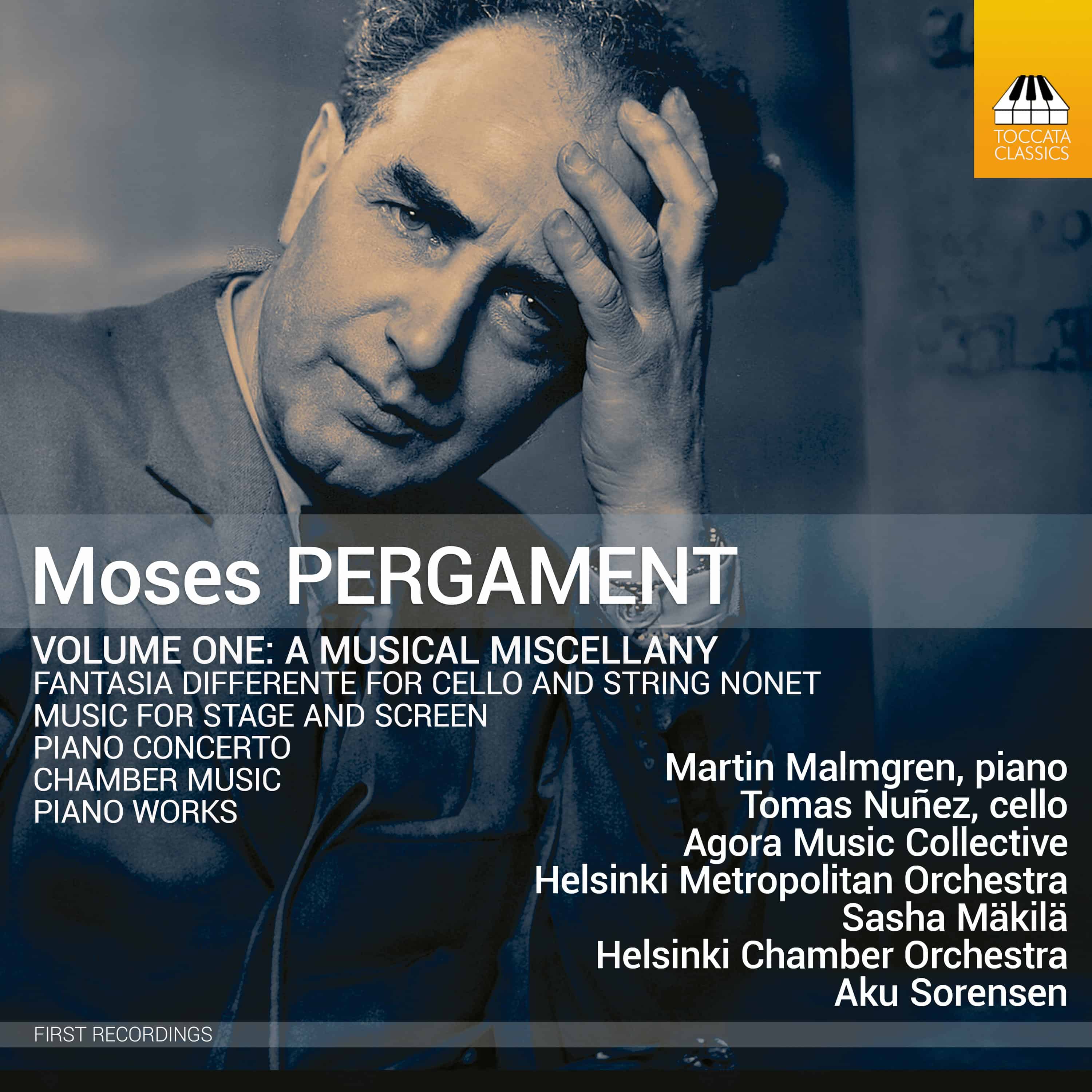
Martin Malmgren (piano) (all except Fantasia differente) with Tomas Nuñez (cello) (Meditations, Melodia romantica, Fantasia differente); musicians from Agora Music Collective [Sebastian Silén, Lea Tuuri (violins), Mathias Hortling (cello)] (Chanson triste); Helsinki Metropolitan Orchestra / Sasha Mäkilä (Piano Concerto); Helsinki Chamber Orchestra / Aku Sorensen (Fantasia differente)
Moses Pergament
Piano Concerto (1951-2)
Sorrow Op.5 (1908-09)
Lyrical Dances (1912-14)
King Solomon – Sulamith’s Dance
Chanson triste (both 1915)
The Feast of Esther (1936): Dance; Adagio
They Stakes their Lives (1939): The Mill, Minuet (both arr. Malgren), Valse lente
Festive Fanfare (1961, arr. composer)
For Nicole (1974)
Meditation (1974)
Meditation (1969)
Melodia romantica (1970)
Fantasia differente (1969)
Toccata Classics TOCC0728 [76’28”]
Producer Martin Malmgren Engineers Matti Heinonen, Sofia Riippi
Recorded 2021-2024, with full venue details here
Reviewed by Richard Whitehouse
What’s the story?
Toccata Classics issued the first in a series affording an overview of Moses Pergament (1893-1977), a Finnish-born Swedish composer, conductor and critic whose music received belated recognition in his lifetime and has received scant attention in the half-century since his death.
What’s the music like?
Not a few listeners (such as this reviewer) first encountered Pergament in Stig Westerberg’s recording of the ballet Krelantems och Eldeling, striking and eventful music which typifies his complex stylistic make-up overall. The present release ranges widely over Pergament’s output – thereby confirming his idiom to be less one of innate originality than a skilful and constantly evolving synthesis as draws on his Lithuanian ancestry, Finnish adolescence and Swedish maturity; all the while underpinned with elements drawn from his Jewish heritage.
This is nowhere better demonstrated than in his Piano Concerto. Whether or not the musical content infers any concrete programme, it provides a refreshing take on the three-movement archetype – taking in a tensile allegro prefaced by a commanding Maestoso, an eloquent and often plangent adagio, then a lively and increasingly propulsive Allegretto with the deftest of resolutions. Standing in a notable linage of such concertos by Hindemith (1945), Tcherepnin, Blacher (both 1947) and Rosenberg (1950), this is a significant work whose revival is timely.
The remainder of this anthology unfolds, chronologically, from the inwardly elegiac Sorrow and the quizzical playfulness of three Lyrical Dances, to the charged sensuality of Sulamith’s Dance then suffused lamenting (abetted in its revised scoring) of Chanson triste. Two pieces from a seemingly unused score for the play The Feast of Esther convey a calmly simmering intensity, and three pieces for the film They Staked their Lives yield an imaginative response to what appears a well-meaning but unintentionally hilarious perspective on Totalitarianism.
The proclamatory Festive Fanfare and touchingly evocative For Nicole lead into a group of cello pieces inspired by the artistry of Gaspar Cassadó. Although the latest of these, the solo Meditation sounds inwardly pensive next to the overt volatility of the eponymous duo from five years earlier or the distinctly equivocal interplay of Melodia romantica. The final piece also makes the deepest impact – Fantasia differente emerging as a processional of mounting anguish then sombre evanescence, its ‘Ciélo e térra’ subtitle hinting at an existential subtext.
Does it all work?
Pretty much throughout – owing not least to the commitment from these musicians, for whom making this album was far more than just another assignment. Above all, those contributions of Martin Malmgren who not only tackles the Piano Concerto with aplomb but also pens the detailed and what might be called ‘positively contentious’ notes on this composer’s life and music; part of a booklet which also includes a pertinent consideration of national identity by Henrik Rosengren. Those new to Pergament could hardly hope for a more inclusive context.
Is it recommended?
It is. Anyone suitably enthused should investigate releases on the Phono Suecia and Caprice labels, not least the choral symphony The Jewish Song regarded as Pergament’s masterpiece. The second volume of this Toccata Classics survey, devoted to songs, has just been released.
Listen / Buy
You can hear excerpts from the album and explore purchase options at the Toccata Classics website. Click on the names to read more about composer Moses Pergament and pianist Martin Malmgren
Published post no.2,911 – Monday 8 June 2026

