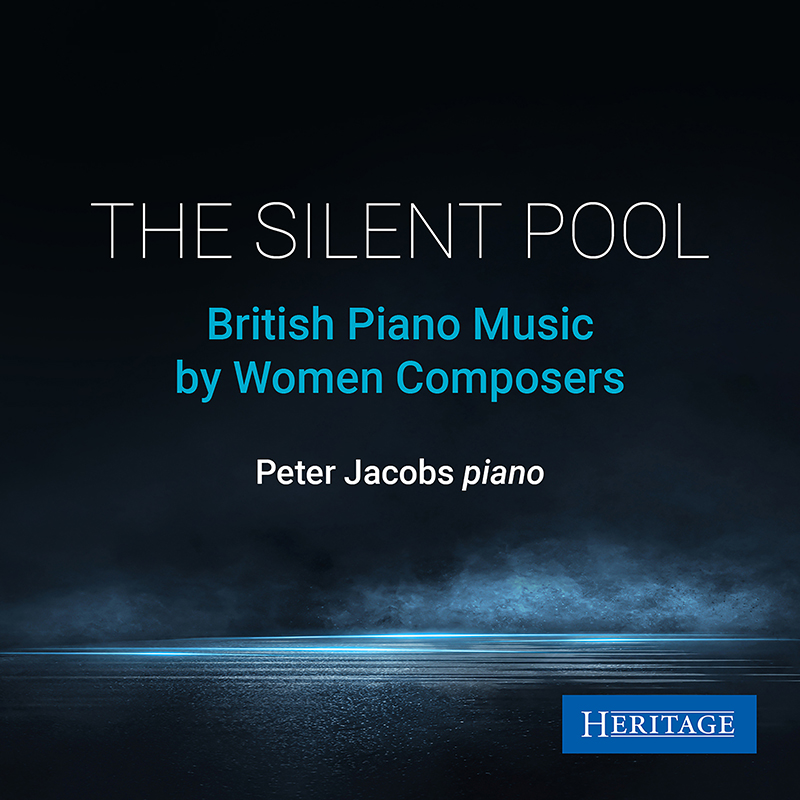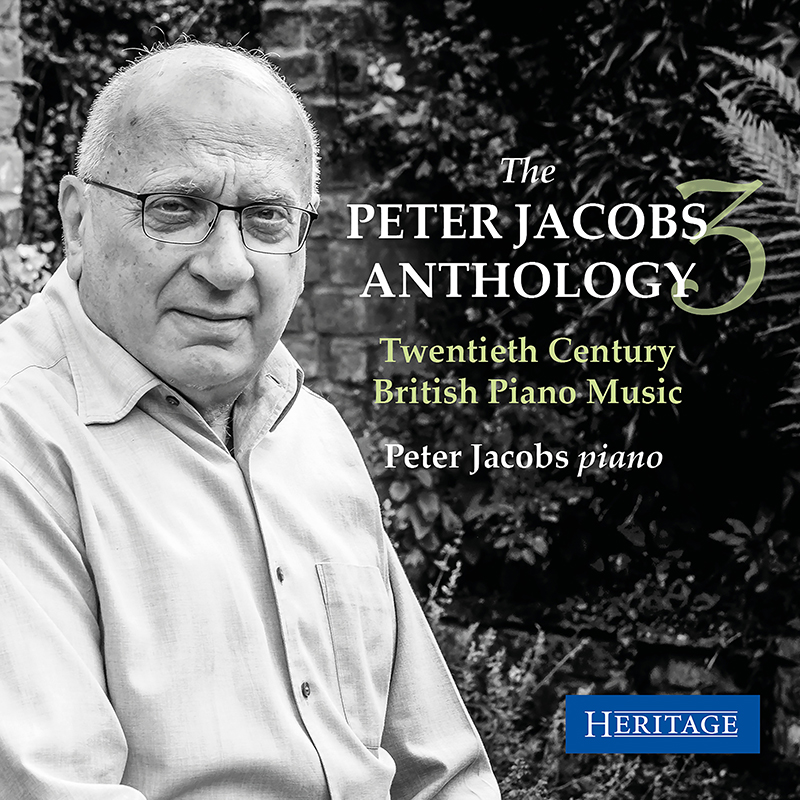
On Record – Peter Jacobs: The Silent Pool: British Piano Music by Women Composers (Heritage Records)

Peter Jacobs (piano)

Smyth Piano Sonata no.3 (1877); Piano Sonata no.2 (Andante) (1877)
Maconchy A Country Town (nos. 1, 3, 4, 5 & 7) (1945)
Williams The Silent Pool (1932)
Grime The Silver Moon (2025)
Dring Colour Suite (1963)
Bingham The Moon Over Westminster Cathedral (2003)
Woodforde-Finden Indian Love Lyrics (nos.2 & 1) (1903)
McDowall Vespers in Venice (2002)
Bingham Christmas Past, Christmas Present (1991)
Roe A Mystery of Cats (nos. 1, 4 & 5) (1994)
Beamish Lullaby for Owain (2016)
Da Costa Gigue; Moods (both 1930)
Lehmann Cobweb Castle (nos. 2 & 5) (1908)

Heritage Records HTGCD126 [75’40”]
Producer / Engineer Paul Arden-Taylor

Recorded 16 September 2024 & 26 January 2025 at Wyastone Concert Hall, Wyastone Leys, Monmouth

Reviewed by Richard Whitehouse

What’s the story?

Peter Jacobs continues his productive association with the Heritage label with this anthology that takes in a well-planned overview of piano music by female British composers, ranging across over more than 130 years of creativity in an impressive variety of idioms and genres.

What’s the music like?

Although female composers had been active in the UK from the outset of the English Musical Renaissance and before, relatively few came to prominence during their lifetime, with many others destined to be rediscovered only years and sometimes decades after their death. While hardly the first of its kind, the present collection is among the most representative in terms of its stylistic coverage which, in turn, underlines they should not be pigeon-holed any more than their male counterparts. Moreover, what was the loss to earlier generations is our gain today.

This recital opens with the redoubtable Ethel Smyth – her Third Piano Sonata contrasting the equable motion of its initial Allegro with the impetuous manner of its closing Allegro vivace. From its larger scale predecessor, the central Song Without Words affords ruminative space between the dynamism and tensions of those movements either side. Of the five (out of nine) pieces in Elizabeth Maconchy’s suite, the eloquent Lament and limpid Bells are especially appealing. Grace Williams is at her most haunting in the piece as gives this collection its title, and Helen Grime pens a miniature stark yet pellucid. Among the most versatile composers of her generation, Madeleine Dring is represented here by a five-movement themed suite which includes such delights as the quizzical Pink Mirror or the appropriately sensuous Blue Air. Judith Bingham may be best known for her choral and brass band music, but there is nothing unpianistic about so translucently textured a nocturne.

Two of Amy Woodforde-Finden’s four-piece suite include the elegant poise of Less than the Dust, while Cecilia McDowall sounds a note of spatial immensity in her Venetian evocation. The four pieces of her Christmas suite find Bingham pursuing an altogether more winsome vein of expression – duly complemented by three out of five whimsical feline homages by Betty Roe, happily still going strong in her 96th year. Sally Beamish contributes a (surprisingly?) capricious lullaby, with two pieces by the short-lived Raie da Costa typifying her witty and sassy manner. The wistful charm of Liza Lehmann, two of six pieces from her only piano suite, affords an elegant then touching envoi.

Does it all work?

As an overall sequence, absolutely. At around 75 minutes, this concert-length recital can be enjoyed as a continuous sequence or in any number of selections. It helps when Jacobs is so persuasive an exponent of this music, much of it remaining little known other than to pianists with his breadth of sympathies but which ought to find an audience given exposure in a live context. As he himself notes, this “random selection [is] united by being rewarding to play, beautifully written for the instrument, varied in style and intellectual depth”. Enough said.

Is it recommended?

It is. Piano sound is as full and spacious as expected given its Wyastone source, while Jacobs contributes laconically insightful notes on the recital overall. Most enjoyable, with hopefully enough material in this pianist’s “library of over 60 years collecting” to warrant a follow-up.

Listen / Buy

You can read more about this release and explore purchase options at the Heritage Records website

Published post no.2,682 – Thursday 9 October 2025

On Record – Sarah Leonard, Xue Wei, BBCSO & BBCSSO / Martyn Brabbins – Naresh Sohal: Lila & Violin Concerto (Heritage Records)

Naresh Sohal
Lila (1996)
Violin Concerto (1986)

Sarah Leonard (soprano), BBC Symphony Orchestra / Martyn Brabbins (Lila)
Xue Wei (violin), BBC Scottish Symphony Orchestra / Martyn Brabbins (Violin Concerto)

Heritage HTGCD133 78’40”
Remastering Paul Arden-Taylor

Live performances at BBC Broadcasting House, Glasgow on 24th October 1992 (Violin Concerto); Royal Festival Hall, London on 13th October 1996 (Lila)

Reviewed by Richard Whitehouse

What’s the story?

Heritage follows up its earlier release of Naresh Sohal with this coupling of major orchestral works, both of them heard in their premiere performances.

What’s the music like?

By the 1990s, Sohal was a well-respected if not regularly played figure. Both these works demonstrate his compositional versatility while being wholly characteristic of his maturity. They were also written before and after his move from Edinburgh to London; having spent more than a decade in the Scottish capital, during which period he embarked on numerous multi-media pieces, he subsequently found himself drawn anew to the Punjabi and Bengali writers whose work frequently informed his compositions over the ensuing quarter-century.

Written a decade apart, these works could hardly be more different in their nominal concerns. At just under half an hour, the Violin Concerto may appear to be firmly within the lineage of such pieces from the Classical and early Romantic eras yet its three movements are hardly, if at all, beholden to precedent. That each is faster as to its underlying pulse than the one before, what one might loosely call an ‘Andante-Allegretto-Allegro’ progression, is less notable than the transformation of ideas and texture from one to the other; resulting in an overall sequence as convinces in its formal discipline and beguiles in its expressive immediacy. Its inhabiting a neo-Romantic world (with significant precursors by David Blake and H. K. Gruber) does not detract from the individuality and sheer attractiveness of Sohal’s contribution to this medium.

By contrast Lila, it title a Sanskrit term for the play of Nature, is the representation in music of the seven stages of development, in yogic philosophy, from the earthbound to the cosmic. That each of these can be linked to a specific colour, sound and elemental force might imply a multi-media presentation, and one as integrated music with dance and lighting was initially planned, but the work succeeds admirably on its own terms as it traverses seven continuous while increasingly shorter sections with its transformation of salient motifs never less than audible. There is no ultimate climax, yet the passing from ‘Consciousness’ to ‘Yoga’ could   be heard as a culmination; after which – this final section is graced with a soaring vocalise, here the late Sarah Leonard in what was a no doubt unintentional but appropriate memorial.

Does it all work?

Yes, once one has grasped the basis of Sohal’s compositional thinking via the essence of what   he was seeking to convey. It helps that both these performances are fully attuned to his idiom – Xue Wei evincing no indecision or uncertainty in the Violin Concerto, and Martyn Brabbins (who replaced an indisposed Andrew Davis for the first rendition of Lila) securing committed playing from the BBC Symphony and the BBC Scottish Symphony orchestras. Any future performances could hardly hope for more persuasive guides when approaching these pieces.

Is it recommended?

Very much so. Paul Arden-Taylor has once again done a fine job in remastering the original broadcasts while Suddhaseel Sen’s annotations, with a biographical note by Janet Swinney, provide all the relevant background. Further releases from this source will hopefully follow.

Listen / Buy

You can explore purchase options at the Heritage Records website

For more on the artists featured, click on the names to read more about Sarah Leonard, Xue Wei, the BBC Symphony Orchestra, BBC Scottish Symphony Orchestra and conductor Martyn Brabbins, and composer Naresh Sohal

Published post no.2,630 – Monday 18 August 2025

On Record – Havergal Brian: Symphonies nos. 29 – 32 (Heritage Records)

Havergal Brian
Symphony no.29 in E flat major (1967)
Symphony no.30 in B flat minor (1967)
Symphony no.31 (1968)
Symphony no.32 in A flat major (1968)

Philharmonia Orchestra / Myer Fredman (nos.29 & 32), Sir Charles Mackerras (no.31), BBC Symphony Orchestra / Lionel Friend (no.30)

Heritage HTGCD130 73’20”
Recorded 12 March 1979 (nos.29 & 32) and 16 March 1989 at Maida Vale Studio One, London (no.30), 9 January 1979 at Henry Wood Hall, London (no.31)

Reviewed by Richard Whitehouse

What’s the story?

The enterprising Heritage label continues its coverage of Havergal Brian with this volume featuring the last four of his 32 symphonies, three of them in pioneering studio broadcasts that were organized by Robert Simpson during his last years as music producer at the BBC.

What’s the music like?

The 29th Symphony is the culmination of a classicizing tendency Brian pursued throughout the 1960s, falling into four continuous if clearly demarcated sections whose formal poise is matched by their lucidity of expression. Thus, a ruminative Lento then genial Allegretto are balanced by the rumbustious though not unduly truculent Allegros either side but it is those framing Adagio sections, launching the piece before bringing it full circle in a mood of rapt contemplation, which leave the deepest impression and so set the seal on an eloquent work.

Barely four months later, the 30th Symphony inhabits a wholly different and fractious world. Likely drawing on material for an abandoned opera on Sophocles’ Oedipus Coloneus, its two continuous parts unfold from a restive, increasingly ominous Lento into the most disjunctive of Brian’s numerous Passacaglia movements; its inherent logic countered at every stage with a visceral and even assaultive impetus prior to the suitably implacable apotheosis. Definitely a work for all times, and among a select handful of orchestral masterpieces from this period.

Five months later and the 31st Symphony emerges as among its composer’s most enigmatic statements, abetted by its single movement being the most seamless of Brian’s symphonies and the one whose key-centre is most difficult to discern. Evolving almost intuitively from casual gestures, it builds with unsparing focus towards a climax whose dynamism is thrown into relief by the inevitability of those final bars. Easy to underestimate in context, it might be considered a rule-book for Brian’s late maturity did it not break those rules at every turn.

Completed six months later, the 32nd Symphony is the longest work here – pursuing a sustained evolution across its four movements divided into two parts. Its thoughtful while not untroubled Allegretto is followed by an Adagio of keen inner strength, its seriousness of purpose subtly offset by a leisurely, often capricious scherzo then finale whose contrapuntal ingenuity underpins the determined onward course to a coda defiant in its resignation. Brian was to finish no further works, so leaving this symphony to stand as an inimitable testament.

Does it all work?

Yes, once the essence, recalcitrant but never intractable, of Brian’s symphonism in this final creative decade is grasped. It helps when performances of the 29th and 32nd were entrusted to Myer Fredman, his appreciation of Brian’s music evident elsewhere in this Heritage series, and the 31st to Sir Charles Mackerras who made a fine studio recording eight years on. The 30th is heard in a reading by Lionel Friend far more assured than its premiere by Harry Newstone, but it was not until Martyn Brabbins’s 2010 studio account that this work came into its own.

Is it recommended?

It is. The sound of the older performances has been cleaned up and opened out, much to their advantage, and that of the 30th offsets the dryness of the Maida Vale acoustic. John Pickard’s insightful booklet notes are further incentive to acquiring this welcome and necessary release.

Listen / Buy

Published post no.2,627 – Friday 15 August 2025

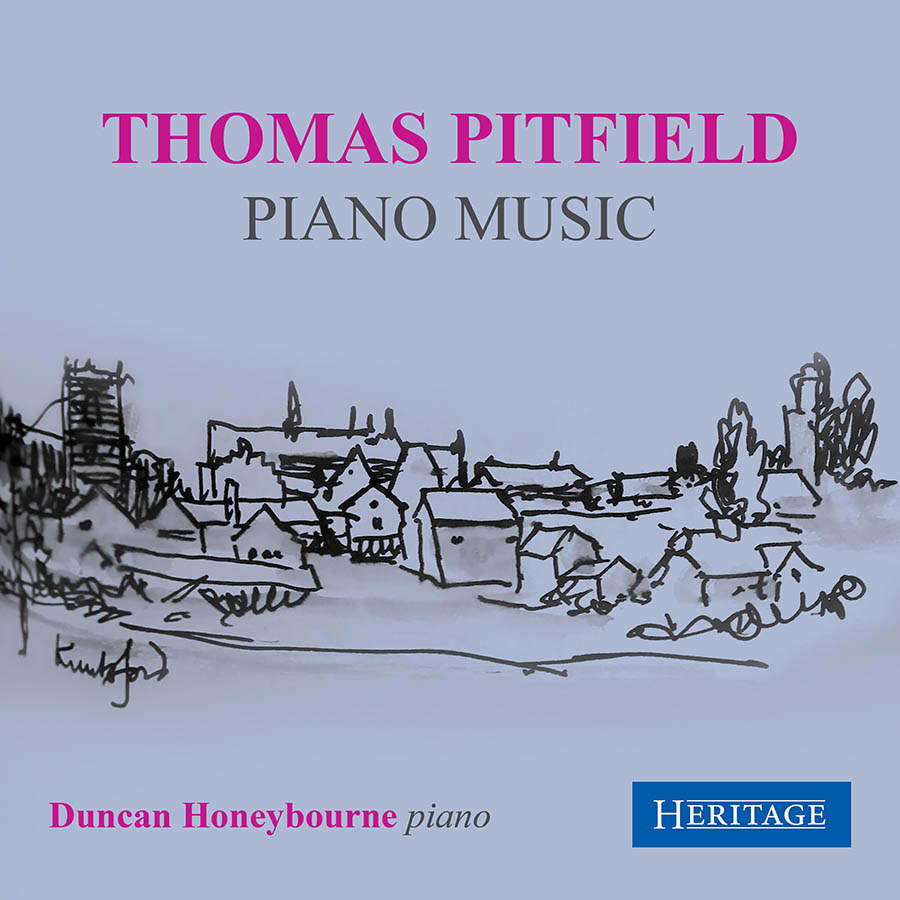
On Record – Duncan Honeybourne: Thomas Pitfield Piano Music (Heritage Records)

Thomas Pitfield
Toccata (1953)
Solemn Pavane in F minor (1940)
Circle Suite (1938)
Capriccio (1932)
Diversions on a Russian Air (1959)
Novelette no.1 in F major (1953)
Bagatelles – no.1 in E flat major (1950); no.2 in C major (1952); no.3 in F major (c1995)
Impromptu on a Tyrolean Tune (1957)
Two Russian Tunes (1948)
Sonatina no.2 (c1990)
Five Short Pieces (1932)
Prelude, Minuet and Reel (1932)
Little Nocturne (c1985)
Humoresque (1957)
Homage to Percy Grainger (1978)
Cameo and Variant (1993)

Duncan Honeybourne

Heritage Records HTGCD132 [68’40”]
Producer / Engineer Paul Arden-Taylor

Recorded 7-8 September 2024 at Wyastone Concert Hall, Wyastone Leys, Monmouth

Reviewed by Richard Whitehouse

What’s the story?

Heritage continues its coverage of Thomas Pitfield (1903-99), following a reissued volume of chamber music (HTGCD210)) with this well-rounded and representative overview of his piano output, performed with his customary flair and conviction by Duncan Honeybourne.

What’s the music like?

The programme launches in fine style with a Toccata whose sheer rhythmic incisiveness and unforced joie de vivre makes it an ideal encore, and to which the pensive understatement of Solemn Pavan affords pertinent contrast. Written as homages to (and likely evocations of) a close-knit group of musical colleagues, The Circle Suite draws on Baroque dance forms in characterful and always personable terms; while the Capriccio underlines that, throughout his composing, Pitfield allied a deft pianistic technique to a highly appealing musical voice.

Centred on a Russian folksong ‘The Blacksmith’, no doubt conveyed to the composer by his Russian wife, Diversions on a Russian Air packs a diverse range of variants into its modest duration, while the Novelette (at 4’36’’ the longest single item here) unfolds as a rumination audibly in the English ‘pastoral’ tradition. Although they were not written concurrently, the Three Bagatelles amount to an effective sequence – their respectively nonchalant, capering then genial demeanours evoking more than a touch of early 20th century French influence.

The Central European-ness of Impromptu on a Tyrolean Tune makes it surprising this lively tune was encountered in a collection housed at a stately home in Chesire, while Two Russian Tunes comprise a playful ‘Nursery Song’ and plaintive ‘Cossack Cradle Song’. Actually, the third of three such works, the Second Sonatina separates its lively Allegro and rumbustious Finale with a ‘Threnody’ as finds the composer at his most confiding, whereas the engaging Five Short Pieces are pithy miniatures whose pedagogical function is anything but didactic.

Prelude, Minuet and Reel was Pitfield’s earliest success and has (rightly) retained a degree of popularity through its melodic insouciance and rhythmic verve. From among the remaining four pieces, Little Nocturne is most likely an intimate reflection from its composer’s old age, while Humoresque contrasts its expected levity with a surprisingly plangent middle section. Homage to Percy Grainger is a ‘take off’ idiomatic and engaging, while the alternate poise then suavity of Cameo and Variant rounds off this collection in the most disarming fashion.

Does it all work?

It does, accepting those formal and expressive limits within which Pitfield operated. For all that his performers comprised a significant roster of pianists (among them John Ogdon and John McCabe), this is music written for the composer’s pleasure and it eschews profundity without thereby lacking in depth. That he was invited to record this selection by the Pitfield Trust and researched the manuscripts at Manchester’s RNCM says much for Honeybourne’s dedication to the Pitfield cause, reinforced with playing of unfailing perception and finesse.

Is it recommended?

It is and not least as these pieces, few of them previously recorded, offer much of interest to performers and listeners alike. John Turner contributes extensive notes while Honeybourne adds his own observations, enhancing a release that warrants the warmest recommendation.

Listen / Buy

You can read more about this release and explore purchase options at the Heritage Records website

Published post no.2,577 – Friday 27 June 2025

On Record – BBC SSO & BBC SO / Sir Andrew Davis – Naresh Sohal: The Wanderer & Asht Prahar (Heritage)

Naresh Sohal
Asht Pradar (1965)
The Wanderer (1982)

Jane Manning (soprano), BBC Scottish Symphony Orchestra (Asht Pradar), David Wilson-Johnson (baritone), BBC Symphony Chorus and Orchestra (The Wanderer) / Sir Andrew Davis

Heritage HTGCD135 [77’36”] English text included
Remastering Engineer Paul Arden-Taylor

Broadcast performance from BBC Studios, Glasgow on 6 January 1973 (Asht Pradar); live performance from Royal Albert Hall, London on 23 August 1982 (The Wanderer)

Reviewed by Richard Whitehouse

What’s the story?

Heritage issues what will evidently be an ongoing series of archival releases devoted to the music of Naresh Sohal, taken from BBC sources and featuring performers who championed his work over a career whose achievement is not reflected in the availability of recordings.

What’s the music like?

Although he came belatedly to the UK, Sohal (1939-2018) rapidly made up for any lost time when arriving in London in 1962 (further biographical detail can be found in the booklet note for this release and on the composer’s website). Within three years, he had produced his first major (and latterly his first acknowledged) work. Asht Prahar then had to wait until 1970 for its premiere (at the Royal Festival Hall conducted by Norman Del Mar), but it attracted much favourable attention and led to another hearing three years on – the performance featured here.

Taking its cue from the Indian sub-division of the day into eight temporal units (four each for day and night), Asht Prahar unfolds its eight sections as an unbroken continuity. The sizable forces are, for the most part, used sparingly yet resourcefully; as too the deployment of such devices as quarter-tones, along with influences of Ravel and Stravinsky, in music that makes a virtue of its pivoting between East and West. Cyclical if not necessarily cumulative, its final and longest ‘prahar’ brings wordless soprano and orchestra into tangible and haunting accord.

By the time that The Wanderer received its premiere, Sohal had a number of major works to his credit and rationalized his musical idiom accordingly. Setting an anonymous Anglo-Saxon poem in which the male protagonist speaks movingly and often despairingly of his isolation – both physical and spiritual – after the death of his lord, the work divides into two large parts that expand on the narrative’s emotional import. Such ‘‘existential bleakness’’ is intensified by omission of the poem’s last lines with their invoking a specifically Christian consolation. Despite its more than 50-minute duration, there is nothing discursive or unfocussed about The Wanderer’s content. Much of its text is understandably allotted to the baritone, whose austere character is complemented by darkly rhetorical choral passages while offset by an orchestral component with much soloistic writing (notably for flute) in a texture the more involving for its restraint and its strategic use of colour to define specific incidents or emotional responses. Nor is this an opera-manqué, the work succeeding admirably on its inherently abstract terms.

Does it all work?

It does, allowing for the fact that Sohal is not seeking any overt fusion between Occident and Orient, but rather attempting to forge a personal idiom influenced by both while beholden to neither. Both these performances bear out his convictions, Jane Manning adding her ethereal presence to Asht Prahar and David Wilson-Johnson bringing evident compassion to his more substantial role in The Wanderer. Both works benefit from the insightful presence of the late Sir Andrew Davis, whom one regrets never had an opportunity to record them commercially.

Is it recommended?

It is. The sound of these broadcasts has come up decently in remastering, lacking only the last degree of clarity or definition, and Suddhaseel Sen contributes informative annotations. Those looking for a way into Sohal’s distinctive and alluring sound-world need no further incentive.

Listen & Buy

For purchase options, you can visit the Heritage Records website

Published post no.2,451 – Thursday 20 February 2025