
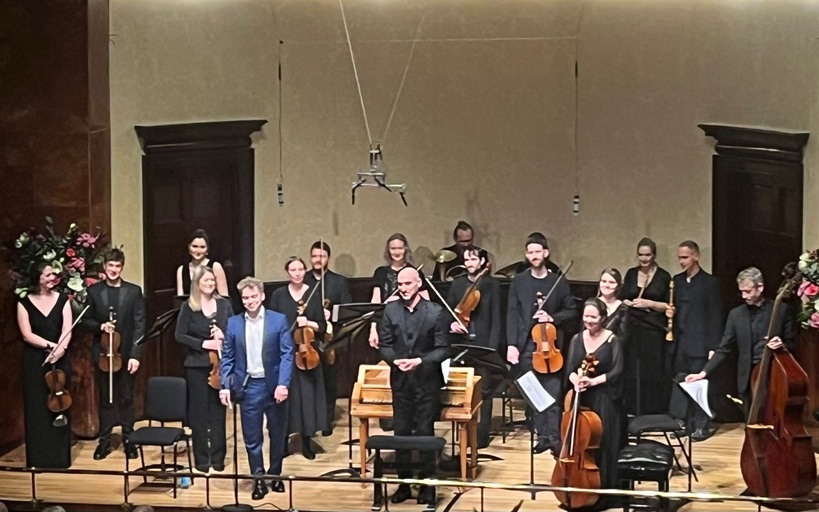
In concert – Hugh Cutting, Irish Baroque Orchestra / Peter Whelan @ Wigmore Hall

Hugh Cutting (countertenor), Irish Baroque Orchestra (Peter Whelan, director)

Programme including pieces by Mozart, Gluck, Johann Christian Bach, Johann Christian Fischer, Tommaso Giordani and Thomas Arne. Full repertoire list at the bottom of this review

Wigmore Hall, London, 9 March 2026

by John Earls. Photo credits John Earls

Giusto Ferdinando Tenducci (c. 1735-90) may not be a name on many people’s lips but he was something of a superstar in his day (his portrait was painted by Gainsborough twice). The Siena-born soprano castrato (who were the pop stars of their time) was not just a successful singer but his celebrity also featured a colourful life that included spells in a debtors’ prison and a scandal involving him marrying his teenage singing pupil Dorothea (Dora) Maunsell – the couple met in Dublin in Ireland but eloped to Cork, where he was also jailed for a time (the marriage was later annulled).

This concert explored the world and music of Tenducci and his time in Ireland (he spent the early part of his career touring Italian and German cities and came to prominence in London and Ireland in the late 1750s and early 1760s). The Irish Baroque Orchestra released the album The Trials of Tenducci: A Castrato in Ireland (Linn Records) in 2021 and a number of its pieces featured tonight, although there were some compositions too. On the album the singer is Irish mezzo-soprano Tara Erraught. Tonight’s singer was British countertenor Hugh Cutting, a BBC New Generation Artist (2022–24) and the first countertenor to win the Kathleen Ferrier Award. Cutting impressed me as Arsace in English National Opera’s recent surrealist production of Handel’s Partenope, and he made a very strong impact in this performance.

In a nice scene setter, the concert began with Mozart’s Symphony no. 1 which the composer wrote when he was just eight years old, about the time when Tenducci met him in England in 1764. The first set also included two arias from Mozart’s third opera Mitridate: re di Ponto: Già dagli occhi and Venga pur Minacci (which closed the first half) seeing Cutting give rein to his strong stage presence and in the latter, an, at times, literally pointed delivery.

The rest of the first set featured Thomas Arne’s Vengeance, O come inspire me! from Alfred (a forceful opener from Cutting with lively, bright accompaniment from the orchestra) and Water parted from the sea from Artaxerxes (which ran for some 33 performances in Dublin in 1765-66), delivered with clarity by Cutting (not so much the audience member who coughed loudly at the end).

Another first set highlight was the orchestra’s performance of Johann Christian Fischer’s Gramachree Molly with variations from the Oboe Concerto No. 7 which spotlighted some gorgeously expressive and fluent oboe playing by Emma Black.

The young Mozart’s Symphony no. 4 opened the second half followed by three pieces from Gluck’s opera Orfeo ed Euridice. Here the orchestra was in full command for Dance of the Furies with the two horn players holding their instrument’s bells upright for maximum impact. Cutting’s singing on Ahimè! dove trascorsi! and Che farò senza Euridice? was clear and passionate.

There then followed a piece where the orchestra absolutely shined. Tommaso Giordani’s The Celebrated Overture and Irish Medley to The Island of Saints saw Emma Black working oboe magic again, beautifully accompanied by plucked strings, for Shepherds I Have Lost My Love. The Irish Medley was given a joyous performance of its selection of Irish folk melodies featuring some fantastic fiddle playing. It was rewarded with rapturous applause – a perfect early Saint Patrick’s Day celebration. There was more Giordani of a different sort next with Caro mio ben, with Cutting’s vocals hanging confidently and elegantly.

Johann Christian Bach’s Vo solcando un mar crudele from Artaserse W.G 1 was a crisp, rousing finale giving full expression to Cutting’s virtuosity. A repeat of Caro mio ben served as an encore and was even more glorious than the first time round.

This was a mesmerising evening with a wonderful programme that highlighted that baroque music in Ireland goes further than the celebrated premiere of Handel’s Messiah in Dublin in 1742. Hugh Cutting and the Irish Baroque Orchestra are an outstanding combination. I hope there is more to come.

Hugh Cutting and the Irish Baroque Orchestra performed the following repertoire:

Mozart Symphony No. 1 in E flat major K16
Arne Vengeance, O come inspire me! from Alfred
Mozart Già dagli occhi from Mitridate, re di Ponto
Johann Christian Fischer Gramachree Molly with variations from Oboe Concerto No. 7
Arne Water parted from the sea from Artaxerxes
Mozart Venga pur Minacci from Mitridate, re di Ponto; Symphony No. 4 in D major K19
Gluck Dance of the Furies; Ahimè! dove trascorsi!; Che farò senza Euridice? from Orfeo ed Euridice
Giordani The Celebrated Overture and Irish Medley to The Island of Saints; Caro mio ben;
Johann Christian Bach Vo solcando un mar crudele from Artaserse W.G 1

John Earls is Director of Research at Unite the Union and posts at @johnearls.bsky.social on Bluesky and @john_earls on X. You can subscribe (free) to his Hanging Out a Window Substack column here: https://johnearls.substack.com/

Published post no.2,825 – Tuesday 10 March 2026

In concert – City of London Sinfonia @ Southwark Cathedral: Origin: This is CLS

cls

Monteverdi arr. Wick Toccata from ‘L’Orfeo’ (1607)
Vaughan Williams
Fantasia on a theme by Thomas Tallis (1910)
Tabakova
Frozen River Flows (2005)
Finnis
The Centre is Everywhere (2019)
Vasks
Music for the fleeting birds (1977)
Tabakova
Origin (2022) (world premiere)
Carter
A Fantasy about Purcell’s ‘Fantasia on one note’ (1975)
Tavener
The Hidden Face (1996)

Hugh Cutting (countertenor), Dan Bates (oboe), City of London Sinfonia / Alexandra Wood (violin)

Southwark Cathedral, London
Thursday 3 March 2022

Written by Ben Hogwood

When the young Richard Hickox assembled a performing group in 1971, his vision was an extended family of talented musicians coming together to project the enjoyment of their art onto their audience.

Just over 50 years on, Hickox may sadly no longer be with us but his vision, realised by the City of London Sinfonia, burns with an ever brighter flame. This celebration in Southwark Cathedral may have been a year late, due to the consequences of the pandemic, but it brought everything together in a programme blending the old with the new.

Great credit should go to the orchestra’s creative director and leader, Alexandra Wood, for choosing music that looked simultaneously forwards and backwards, while utilising the vast spaces offered by the cathedral in inspiring and imaginative ways.

The audience were free to roam around during the concert, which was a considerable plus, for acoustic hotspots could be found and exploited, while it was also possible to stand to one side in contemplation. The mood was relaxed but focused, with audience members chosing a mixture of both options. The only danger of this was unexpectedly finding yourself in front of a group of instrumentalists when they were about to play, meaning the focus would suddenly shift in your direction! This was a risk well worth taking, for the rewards were many.

Before the concert, the Dean of Southwark Cathedral, Andrew Nunn, spoke warmly of the power of music to soothe the fevered mind, giving the pertinent Biblical example of David’s harp curing Saul’s war-torn temper, illustrated vividly by a stained-glass window depiction at the back of the church. The parallels with Russia and Ukraine were unmistakeable, and before the programme started everyone stood for the Ukraine national anthem.

The programme itself began under that very window, with Stephen Wick’s excellent arrangement of the Toccata from Monteverdi’s L’Orfeo, the brass filling the cathedral from back to front with sonorous colours.

The baton then passed to the strings for an unforgettable account of Vaughan WilliamsFantasia on a Theme of Thomas Tallis. This work was written for performance in Gloucester Cathedral in 1910, utilising the space in imaginative ways – and the City of London Sinfonia responded in kind, with the work’s solo group in the round in the nave, and the main body of the strings in the centre of the church. This was a deeply emotive performance, finding the intersection between the old of Tallis and Vaughan Williams’ own sweeping melodies and added-note harmonies. In doing so a composition that is often overplayed gained fresh insight, and, for your reviewer standing at the back of the church, a magical experience.

British-Bulgarian composer Dobrinka Tabakova has a close association with the Sinfonia. Frozen River Flows, an earlier work from 2005, appeared here in an arrangement for clarinet and percussion which was played in the south transept. This brightly coloured piece found Katherine Spencer’s clarinet evoking graceful lines not dissimilar to Poulenc, complemented by the richness of the vibraphone and crotales (antique cymbals), expertly managed by Chris Blundell.

We also heard Tabakova’s music in the world premiere of Origin, written for this concert. It was a brief but meaningful celebration placing violin soloist Alexandra Wood in the nave, with the accompanying musicians under the tower. Wood’s role was that of virtuoso, but she managed it carefully so that slower contributions from the strings and vibraphone were ideally balanced. Tabakova has a talent for the immediate creation of an atmosphere, and this may have been a relatively minimal piece but it left a lasting impression.

Complementing this was another work in the round of the nave, as 12 string players assembled for Edmund Finnis’s The Centre is Everywhere. This was a wholly appropriate choice, the soloists creating unusual and original sounds. On occasion the music swelled like the bellows of an accordion, then subsided to a barely audible whisper, then appeared to be reaching beyond the cathedral for the skies above. Finnis has an unusual and remarkable habit of writing music that becomes an out of body experience, and The Centre is Everywhere shows there is still so much more to achieve when writing for stringed instruments.

The programme turned to wind instruments for a timely reference to the troubles in Ukraine. Latvian composer Pēteris Vasks wrote Fleeting Birds in 1977 as an expression of his need for freedom. Restricted from travelling by the Soviet authorities, he made his feelings known through music. The City of London Sinfonia winds walked the length of the cathedral as they played, turning from joyous expressions of freedom and release to statements soured by compression, reflecting the composer’s earthbound plight.

Freedom lay in Elliott Carter’s Purcell Fantasy, richly expressed by the brass around a persistent middle C, before cutting without a break to John Tavener’s Hidden Face for a final contemplation. The stillness of this work is deceptive, achieved through great virtuosity from solo oboe and a countertenor, singing text written by Mother Maria. Oboist Dan Bates and singer Hugh Cutting were superb throughout, the latter floating his words effortlessly above the prayerful strings, whose sonorous tones were the ideal match for Bates’s keening oboe, which also scaled unfathomable heights with impressive ease.

It was a fitting way to finish a deeply felt concert and celebration, that of a performing group who continue to do their founder proud. Like their musical choices, the City of London Sinfonia look to the future, embracing new advances as well as nurturing past achievements while they do so. They deserve to continue as a treasured feature of the capital’s music making.

To read more about the City of London Sinfonia, visit their website – and for more on composers Dobrinka Tabakova and Edmund Finnis, click on their names