Gwilym Bowen (tenor), Gareth Brynmor John (baritone), William Vann (piano), Navarra Quartet [Benjamin Marquise Gilmore, Eva Aronian (violins), Sascha Bota (viola), Brian O’Kane (cello)]
Venables Out of the Shadows Op.55 (2023) Vaughan Williamsarr. Vann Fantasia on Greensleeves (1934) Vaughan Williams On Wenlock Edge (1909) Vaughan Williams Love Bade Me Welcome (1911) Venables Portraits of a Mind Op.54 (2022) Howells An Old Man’s Lullaby (1947)
The Temple Church, London Tuesday 4 November 2025
Reviewed by Richard Whitehouse
The emergence of Ian Venables as the leading British art-song composer was suitably marked with a 70th-birthday concert, sponsored by the Morris-Venables Charitable Foundation under the auspices of Temple Music Foundation and held in the evocative setting of Temple Church.
Song cycles being at the forefront of Venables’s output, it made sense to start with one of his most recent – Out of the Shadows a wide-ranging overview of male love. From the coyness of Constantine Cavafy’s At the Cafè Door and the barbed humour of Horatio Brown’s Bored, this takes in the fleeting ecstasy of Cavafy’s The Mirror in the Hall and stark soulfulness of Alfred Tennyson’s Dark House, prior to the overt playfulness of John Addington Symonds’s Love’s Olympian Laughter and calm affirmation of Edward Perry Warren’s Body and Soul.
Affectingly sung by Gareth Brynmor John (above), it preceded likely the most influential such cycle in English. A. E. Housman may have disliked his settings, but Vaughan Williams always gets to the heart of the matter in On Wenlock Edge. Hence the volatile imaginings of its title-number or hymnic poise of ‘From Far, from Eve and Morning’, the brooding dialogue of ‘Is My Team Ploughing’ or nonchalant wit of ‘Oh, When I Was in Love with You’; reaching a climax in the innocence to experience of ‘Bredon Hill’, with ‘Clun’ ending the sequence in fatalistic repose.
Gwilym Bowen gave a searching account of this cycle (doubly so having replaced Alessandro Fisher at such short notice), with Brynmor John comparably attuned to the understatement of George Butterworth’s Love Blows as the Wind Blows. These settings of W. E. Henley amount to a cohesive yet subtly contrasted entity – the existential musing of In the Year that’s Come and Gone followed by the deadpan charm of Life in Her Creaking Shoes and effervescence of Fill a Glass with Golden Wine, then On the Way to Kew brings a close of deftest poise.
Bowen duly tackled a further Venables cycle. Written to commemorate the 150th anniversary of Vaughan Williams’s birth, Portraits of a Mind is a notably inclusive one of the composer. Hence the gentle pantheism of George Meredith’s The Lark Ascending and the meditation on creativity of Ursula VW’s Man Makes Delight His Own; the engaging impetus of R. L. Stevenson’s From a Railway Carriage a perfect foil to the resignation of Christina Rosetti’s Echo, before lines from Walt Whitman’s A Clear Midnight conjure a warm transcendence.
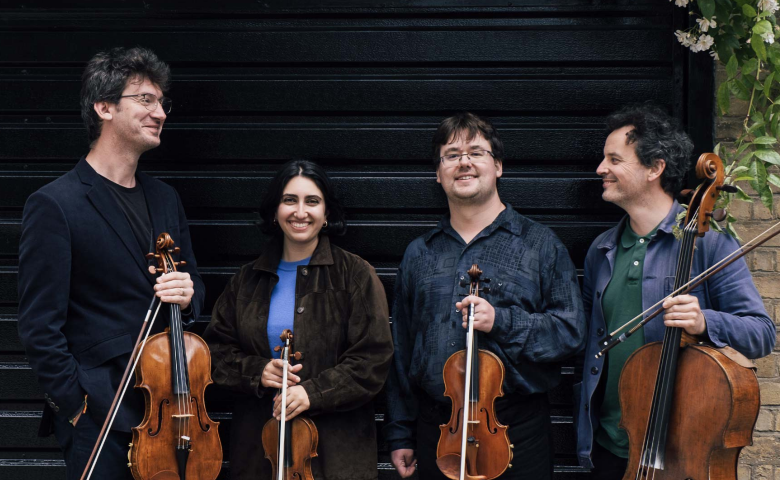
Throughout these performances, the playing of the Navarra Quartet (above) evinced an incisiveness and eloquence always at the service of this music; William Vann’s attentive pianism astutely deployed in his appealing arrangement of VW’s Fantasia on ‘Greensleeves’. Brynmor John opened the second half with that composer’s disarming take on George Herbert’s Love Bade Me Welcome (first of Five Mystical Songs), with both vocalists heard to advantage in An Old Man’s Lullaby – Herbert Howells’s setting of Thomas Dekker that made for a winsome envoi.
Taken overall, this was a wholly pleasurable evening and welcome confirmation of Venables’ creative prowess – his corpus of songs or song-cycles surely second to none among those for whom the English language is a source of never-ending and always unexpected possibilities.
In this guest article, pianist Graham J. Lloyd pays tribute on the occasion of a landmark for his husband, the much-loved English composer – and offers both valuable and candid insights into his work. Photo (c) Graham Wallhead
In his 2015 article, written especially for Musical Opinion, Michael Bywater, in celebration of the 60th birthday of the English composer Ian Venables, suggested that he was writing “from the potentially compromised position of not just an admirer of his elegant, sinuous melodic lines, but also as a friend. Were this a court-case, I would have to recuse myself on the grounds of conflict of interest. But, as it is, it’s not and anyway, I knew his music before I knew the man”. The present writer agrees, except for the final part, as I knew the man before his music, Why? Because Ian Venables has been my partner and husband for over four decades.
In spite of this, I write this article in the knowledge that propinquity, by its very nature can both obscure or heighten observation, but suggest that who, if anyone, is better equipped to discuss the life and works of a composer than that person’s life partner, particularly if they themselves are a musician? Far from expressing unfettered praise, an inamorata can be, and often is, their harshest critic.
Venables is fortunate in that his music has been well received by audiences, musicians and critics and this allows me the freedom to express how remarkable I think he is as a composer – and by the way I think he is! – but use the words of others. I am, in the most positive way, his harshest critic!
Living with a composer for over 40 years has, perhaps surprisingly, given me little insight into the fundamental elements or alchemic nature of composition. I am unable to illuminate the workings of Ian’s creativity; but then so is he. It is, after all why composers compose; if there is an answer, why bother to keep asking the question?
In the recent film documentary, Ian Venables: Hidden Music directed by Anthony Cheng, the soprano Patricia Rozario (below, with Venables and fellow-composer John Joubert) remarked that “when you listen to Ian’s music – time stands still”. His music certainly has the capacity to transport the listener to another realm, as articulated by the critic Christopher Morley writing in the Birmingham Post – Venables’ work is “honest, direct, from the heart” and “never fails to engage the spirit”.
He has written upwards of 55 opuses and in that corpus of works, over 90 individual songs lie at its heart. He is considered the most important song composer to have emerged on the musical landscape in the last 50 years. Ned Rorem, late doyen of American music and himself a prolific writer of art songs, wrote to Venables saying: “your songs are real, beautiful and true”; the baritone Roderick Williams has described him as “one of this country’s most famous song composers” and Professor Stephen Banfield wrote in a letter to Venables, “You should be proud of your gifts, which are extraordinary. You have a genius for melancholy, for understanding melodic, harmonic and poetic tradition, for speaking to the heart”. Roderic Dunnett’s assessment of Venables’ contribution to English music stands out as summative: “Every now and then a composer emerges who has a remarkable gift of being able to sum up perfectly the spirit of music of a previous era, and yet draw fresh strength from it to create something invigorating, original and new”.
When I first met Ian in 1983 he had before him: his Piano Sonata Op.1 (1975); Elegy for ‘Cello and Piano Op.2 (1982); the song Midnight Lamentation Op.6(1974); a Melodrama for two pianos; a string sextet; a prelude for piano; a Meditation for solo guitar (the last four works all subsequently withdrawn); numerous pieces for solo piano and sketches for S.A.T.B. choir and organ. I was immediately struck by the emotional power of Midnight Lamentation and the Elegy. Both exhibit a perfect musical structure, allied to profoundly beautiful melodies and a rich and inventive harmonic language – characteristics Venables has never lost. The Elegy itself is ‘vintage’ Venables (if such an epithet can be used for a work designated as Op.2), as it stands as a totem to a well-formed musical language, with all the fingerprints of his later style firmly in place.
Elegy hovers between the key of B minor and the Aeolian mode [on B], and it is as if the composer is ‘fighting’ a musical battle with himself: diatonicism versus modality – Elgar versus Vaughan Williams? In terms of influence, Vaughan Williams certainly features, as Venables’ trajectory is borne of the latter’s harmonic and melodic language and its concomitant spiritual resonances. He acknowledges that he is indebted to RVW (and Herbert Howells too), but that he has not modelled himself on either of these magnificent composers, however he adds, “…I would say that my music is as English in sound as theirs and that is why many critics have placed me in that lineage.” In spite of its modality, Venables’ music can be dissonant, energetic and visceral and although it is a natural follow-on from the romantic aesthetic, there is nothing trite, simplistic, gratuitous or sentimental about it. Many reviewers have commented on the sincerity of Venables’ music (as well as its craftsmanship) and it is this quality that gives his works their emotional and spiritual connection to the listener.
Here, I thought at the tender age of 19, was an impressive man and an equally impressive musician and I wasted no time learning his Piano Sonata. Written as a homage to Dmitri Shostakovich in 1975, it is a strikingly original work which takes the ubiquitous D.S.C.H. motif, (oft-used by Shostakovich, most notably in his 8th String Quartet) and weaves it throughout each of its three movements. The work is a passionate outpouring for a 20-year-old composer, but could Venables play it? He certainly gave it a ‘good go’, as he is actually a fine pianist; the strains of Schubert, Chopin, Medtner, Debussy, Beethoven, Brahms, Shostakovich et al. have issued forth from our music room over the years. Have these composers’ styles or pianistic techniques influenced his own piano writing? I would say, having been privileged to record Ian’s ‘Complete Works for Solo Piano’ on the Naxos label, that only a few early works, such as Debussy in the Stourhead Follies Op.4 (1984), or inevitably Shostakovich in the Piano Sonata, show these influences. However when it comes to his songs, the piano writing is very much his own, for instance: At Malvern (the rippling arpeggio-laden left hand and bell-like right hand); Break, break, break (the cascading right hand over a chordal accompaniment) or uniquely etched, aquatic semiquavers in J. A. Symonds’s Invitation to the Gondola. These, and many other ‘accompaniments’, are without precedent.
Venables has, like one of his musical ‘heroes’ Samuel Barber, been fortunate in that he has only accepted commissions he wished to take on. He has also (with the exception of Robert Graves’ Flying Crooked’) chosen every single poem that he has set, and this lack of constraint has given him the creative freedom to write what he wants. All twelve of his remarkable song-cycles were commissioned by friends or institutions and although he may not wish to be strait-jacketed, he responds well to a deadline, having never missed one.
He has perhaps single-handedly, put the song cycle and chamber song-cycle firmly on the map of English vocal music, as he sees the genre in symphonic terms: ripe for cyclical development; textual homogeneity; timbral nuancing and structural extension. For example, in Songs Of Eternity And Sorrow Op.36 (2004), four settings of poems by A E Housman, it is possible to perceive it in the same way as Tchaikovsky’s Sixth Symphony: a dramatic first movement, followed by a lilting intermezzo, an energetic scherzo and elegiac finale. It is for this reason that he is beginning to orchestrate some of them; having perceived them symphonically, they need to be symphonic.
Like many composers who choose to write multiple works in a specific genre, it is possible to gain a glimpse of Venables’ development through these song-cycles. Of the twelve: three use piano alone; four – string quartet and piano; one – clarinet and piano; two – string quartet; one – viola, cello and piano and one – viola and piano. Perhaps more important are the poets Venables chooses: Housman; Symonds; Clare; Gurney and Whitman all have a cycle to themselves, whilst other poets set, include: Edward Thomas; Longfellow; Emerson; Melville; Yeats; Lorca; Stevenson; Masefield; de la Mare; Sassoon and Tennyson, with modern poets being represented by Andrew Motion (who also has his own cycle), Jonathan Davidson, Charles Bennett, Jennifer Andrews, Rennie Parker and Jim Dening. It is though, the themes Venables has chosen that gives us an indication of who he is. One would think that as a gay man, he would ‘use’ this as a significant ‘leitmotif’ throughout his works: he has not, (although he has set many gay poets) and it was only recently that he wrote what he considers to be his first ‘gay’ cycle, Out of the Shadows Op.56 (2024). However even this is misleading, as he refers to it as a cycle about ‘male love’ in its many forms (one of the texts is part of Tennyson’s In Memoriam; the poet’s reflection on the loss of his dear friend Arthur Henry Hallam). So what are the themes he uses or has responded to: the First World War; America and its chequered history; the natural world (particularly landscape); the ‘underdog’ in society, together with the more universal themes of love, loss, desire and death.
It is now possible to look back with more objectivity on Venables’ music: how it has changed or developed; the influences that have shaped that change and his own growing need to express himself through music. There were two seminal moments in his life which I believe altered both his musical and personal outlook. The first was the death of his mother Audrey in 1990, at the age of 56. Apart from the obvious and palpable sense of loss and grief that he experienced, the external manifestation of this grief through his music became an aural representation of what was going on in his inner world. The work he was writing at that point was his Piano Quintet Op.27 [1989-95] and he had already finished the first of its three movements; an essay brimming with joyful optimism. Its slow, second movement begins with a threnody for solo viola; a musical idea that Ian himself described as “my mother in music”. Further to this was a Meditation for solo piano (a specific work, written in memory of his mother) which houses a more optimistic melody that Venables considered was another aspect of his mother’s personality. What is important is that these two melodies have inspired him in a number of subsequent works: the song Break, break, break, on Tennyson’s words “Oh, for the touch of a vanished hand”; the Offertorium from his Requiem andthe final song from his Whitman Cycle The Last Invocation Op.50 (2019). Meditation itself was later reworked as the basis for the extremely powerful Canzonetta for clarinet and string quartet Op.44 (2013). “My mother keeps appearing,” says Venables, “such is the power of that love”.
The second significant moment was when Ian suffered a stroke in 2005. Nursing him back to health was my priority, with all things ‘musical’ very much on the back-burner. However, after many months, and as a thank you, Ian was moved to write something for me and, as part of a commission from our friends Nigel and Gilly Lowson for a song cycle with clarinet and piano, On the Wings of Love Op. 38[2006], he set Jean de Sponde’s poem Sonnet XI, which is a paean to love. Its central section houses one of the most sensual and intoxicating passages in his whole output. That the most important words in the poem are “that loving you, I love without regret” speaks for itself in this context; that the music is, in some ways, a departure from his previous works, is telling.
What does Venables himself feel about his songwriting? “I had no idea when I started to compose that I would respond to the written word in such a profound way. My love of poetry has journeyed hand-in-hand with my love of music and it makes sense that they should have coalesced in such a way. Like most composers, I began writing music for my own instrument, in this case the piano and it seemed that abstract music would be the direction in which I would go. Words however, fire up my imagination: they provides me with the canvas on which to ‘paint’ my music”.
In some of that abstract music – which interestingly, accounts for a third of his output – a few critics have picked up on a Hungarian sound-world; in particular in his gritty and at times uncompromising String Quartet Op.32(1999). Described by Simon Heffer as“a masterpiece”,Venables is unsurprised by this seeming incongruity, “I have on many occasions written works in the Lydian mode [with its sharpened 4th], which is a strong characteristic of that country’s folk music as used by Bartok and Kodaly”. It certainly has occasional bouts of the Hongroise about it, however the ardent Englishman is never far away! This Englishness is nowhere more apparent than in his first song Midnight Lamentation which was written when he was 19. Venables has been composing since the age of 12, but describes his early attempts as “juvenilia that will never see the light of day” and although Midnight Lamentation has been described by Michael Hurd as “a perfect song” and Professor Stephen Banfield as a song that haunted him unbearably – “very little in music has affected me as much as its simplicity”, Venables berates himself for bowdlerising Harold Monro’s poem. “It is a beautiful song, but it is not”, he opines “the way to write a proper art song”. However all that changed in 1992 when (after having written the song Pain Op.10 [1991] to words by Ivor Gurney) he heard Gerald Finzi’s songs and, as a result, read all of Thomas Hardy’s poetry. In A Kiss, he did, in his own words “get it right”. The text was unaltered and he was able to marry words and music to create what he describes as the sister discipline of art song. It has become one of his most popular songs (along with the witty and irreverent Flying Crooked) and after that, there was no stopping him! He had found the way into discovering the ‘hidden music’ in every poem he chose to set.
What is meant by this phrase ‘hidden music’; it is used in the title of the recent documentary referenced earlier? This difficult topic is best explained by the composer, through his setting of Wilfred Owen’s poem “The Send Off”; the first song from his ‘War Cycle’ Through These Pale Cold Days Op.46 (2016). It is also informative as to how Venables begins a composition: “I am looking for a poem that will take me on an emotional journey. Ideally, the poet will provide images that illuminate the narrative, allowing me to expand and comment upon these musically; words after all, can only give a partial glimpse of this deeper world to which music has full access. It combines energy with pathos and the underlying rhythmic pattern was naturally march-like. So ruminating beneath the words, I begin to feel rhythms and accents and emotions welling up, then a musical idea begins to take form. Two bars are written and without hesitation I hear a melodic line that begins to follow the contours of the words. It is almost complete in my mind, right up to the end of the second line, including most of the harmonic movement. If my ideas take flight, I move ahead very quickly to the other sections, trying to jot down half-finished ideas; perhaps a rhythmic pattern or some harmonic progressions. The prevailing mood or atmosphere of each section (or stanza) becomes clearer and I then fix that atmosphere or mood. However it is the poem which provides this mood, which must then be recognised by me and transmuted into sound.”
Venables has often been asked whether he has a favourite work from his own oeuvre. Although he often says, “the one I’m working on at the moment”, he does in fact have two. The first is the song Invitation to the Gondola from his song-cycle Love’s Voice Op.22 (1995). This setting, by another Venables ‘hero’ John Addington Symonds, is a perfectly formed work where structure, harmony and melody coalesce to create a sumptuous representation of the canals in Venice and, in an achingly beautiful middle section, the penumbrous city itself.
The other work is his Requiem Op.48 (2017/19) and this remarkable piece is worthy of special attention. It started life as a single-movement anthem, based on the words of the Introit and was written in celebration of the life of Doreen Somerville. It was commissioned by her son and daughter, Bryce and Cynthia and although Venables was adamant that he did not wish to write a full scale requiem, the fact that the Introit found itself suspended – on the dominant major – suggested it had a further journey ahead of it. It did, and the Kyries were borne out of this moment. It was quickly followed by the Offertorium and over the next two years, movement after movement was added, culminating in an iridescent Lux aeterna and including a truly radiant Sanctus, a suitably malevolent Dies irae, a profoundly moving Pie Jesu and ravishing beautiful Agnus Dei. Originally scored for S.A.T.B. choir and organ, a commission from Patrick and Kate Aydon to orchestrate it, meant that it could move from the church, into the concert hall.
Two recordings (on the SOMM and Signum Labels – the latter in its orchestral form); a performance at the Worcester Three Choirs Festival in 2024; two in San Francisco and one in Canada, have sealed the fate of a work that, according to Adrian Partington (who conducted the first full performance of the work in Gloucester Cathedral and for whom the work was effectively written), “will become a major part of the choral repertoire and take its place alongside those requiems written by Fauré, Duruflé and Howells”. His longest work to date, it has spawned a whole raft of choral works that have taken him into a new and interesting direction. Is Venables surprised by this bout of religiosity? “I am a spiritual person, not a religious one, but I do recognise the influence Christianity has had on all aspects of life and whilst I do not ascribe to its doctrines, the more human aspects resonate with my own deeply felt humanity”. A Magnificat and Nunc dimittis, written for Samuel Hudson and the Choir of Worcester Cathedral was premiered at the 2024 Three Choir Festival and broadcast on Radio 3. It is the latest addition to what is now being described as Venables’ ‘Worcester Service’; a set of versicles and responses has also been added.
Having already written a Christmas Carol, a setting of While Shepherd’s Watched their Flocks by Night (2003) – published by his principal publisher, Novello and co [Wise Music Classical] – he has recently been inspired to set Symonds’s Christmas Lullaby. Written on Christmas Day 2024, it is dedicated to Madisson Renshaw-Perez, the then, 15 month-old granddaughter of one of our friends, Anne Renshaw. Both Ian and I have, within the last year, lost our respective remaining parent and the newness and beauty of this life moved Ian in a way that I had previously not witnessed. A Christmas carol seemed the most fitting response to the ‘miracle’ of this new life.
Since Michael Bywater’s article, Venables has written: a Requiem; five major song-cycles (comprising 27 individual songs); two Dramatic Scenas for voice, viola and piano; two choral anthems – one with string orchestra and organ; a Magnificat and Nunc dimittis; a set of Versicles and Responses; a Choral Wedding Blessing; a Christmas Carol as well as works for voice or solo piano. He has also orchestrated his Requiem, two of his song-cycles and arranged two existing works for full string orchestra.
So what are his plans for the next decade? “This appears to be the time of life when putting one’s house in order becomes important. Also, my interest in Symonds has increased rapidly over the last 30 years and I am presently writing a new biography about him, as I feel it is time to set down a more definitive and up-to-date account of his path-finding work as one of this country’s first gay pioneers.”
What about new music? “When the right commission comes along” he says, “I will know it.”
Does he have a bucket list of works he has not yet written? “I do not have a burning desire to compose a wind nonet, or write a symphony, even though Simon Heffer has been trying to convince me for years that I should write in the latter form! However, never say never: I did not think I would compose a requiem; I never thought I would orchestrate my song-cycles and I certainly did not think that I would write a complete liturgical setting for the church!”
In his book Albion’s Glory A Celebration of 20th century English Composers (2020), Stephen H Smith wrote, “At a little over fifty opus numbered works to date, it cannot be said that Venables is a particularly prolific composer, and he has never yet been tempted by the larger canvas; but neither of these observations make him any less of a composer. Indeed, the opposite may well be true, for it is all too easy to write too much and in so doing compromise on quality. Venables pays meticulous attention to detail in every work, and his sensitivity to the words he sets is perhaps more finally tuned than that of any other art-song composer since Finzi.”
Having now just had his 70th birthday, there will be many who hope, as Smith says “…that the fires of his creative imagination will remain alight for many years to come.”
c. Graham J. Lloyd
Published post no.2,671 – Sunday 28 September 2025
Recorded 13-14 April 2024 at St Mary’s Church, St Marylebone, London
Reviewed by Richard Whitehouse
What’s the story?
Although the Taiwanese violinist Chu-Yu Yang and the American pianist Eric McElroy have found success independently, their appearances as a duo have firmly established them before the public across a wide repertoire, not least the music which is featured on this new release.
What’s the music like?
The title of this album might be thought to speak for itself, yet An English Pastoral amounts to more than an exercise in wanton nostalgia. Alongside early if not wholly uncharacteristic music by Ivor Gurney and Arthur Bliss – contemporaries whose outlooks were transformed through war service – it takes in one of Gerald Finzi’s most affectingly realized instrumental pieces and works by Ian Venables whose 70th birthday is just weeks away at time of writing. A programme, moreover, as cohesive in recorded terms as it would be heard as a live recital.
The centrepiece here is a sequence of pieces by the teenage Gurney such as demonstrates no mean assurance in this testing medium. Hence the Elgarian wistfulness of Chanson Triste or respectively poetic and bittersweet evocations as are In September and In August. A winsome Romance is the most elegantly proportioned of these eight pieces, with the elaborate Legende more discursive in its (over-) ambition. The poignant A Folk Tale and an engaging Humoreske have a succinctness to confirm that, with Gurney as with most composers, less is often more.
The players seem as emotionally attuned to this music as they are when mining the expressive subtleties of Finzi’s Elegy which, composed barely a year into the Second World War, offsets its yielding nostalgia with passages of simmering anxiety. Nor do they disappoint in the single movement that was all Bliss completed – if, indeed, he ever envisaged any successors – of his wartime Violin Sonata; its cautious if never inhibited handling of ‘phantasy’ form implying a transition from his earlier Pastoralism to the innovation of those pieces which came afterward.
Venables proves no less adept combining violin and piano, not least when adapting what was previously his Flute Sonata as to emphasize the pensive raptness of the first movement or its alternately playful and plaintive successor. Witness, moreover, the astutely judged trajectory of his Three Pieces as it moves from the blithe lyricism of its initial Pastorale, through the unforced eloquence of its central Romance, to the incisive energy of its final Dance – thus making for a sequence that could have been a ‘sonatina’ had the composer designated it thus.
Does it all work?
Pretty much always. Nothing here sounds less than idiomatic in terms of being conceived for this medium, a tribute to the skill of these players in realizing the intentions of the composers in question. For those listeners who still (rightly) attach importance to such things, the layout is viable but it might have been improved by interpolating the Gurney pieces – most of which are what might be termed ‘medium slow’ – across the release as a whole rather than grouping them all together at its centre, but this is relatively less of a consideration in streaming terms.
Is it recommended?
Indeed it is. The recorded ambience could hardly be bettered in terms of this medium, while Yang contributes detailed and informative annotations. Hopefully he and McElroy will have a chance to record further such collections, whether or not in the ‘English Pastoral’ tradition.
Listen / Buy
You can read more about this release and explore purchase options at the Somm Recordings website
Alessandro Fischer (tenor, above), Roger Vignoles (piano, below)
Wigmore Hall, Monday 16 March 2020 (lunchtime)
You can listen to this concert on the BBC Sounds app here (opens in a new window)
Review and guide by Ben Hogwood
With the Coronavirus pandemic now sadly in full swing, this was the last concert at the Wigmore Hall for some time, the venue now on an enforced break until mid-April at the earliest. It served as a reminder of just how lucky we are to be able to experience live music, and how good it is to have concerts such as this preserved on the radio.
This particular concert was a fascinating program of Nordic tales through the eyes of four composers of different nationality. BBC New Generation Artist Alessandro Fisher and the superb, ever-attentive Roger Vignoles cleverly constructed a program focusing on Scandinavia. Yet we saw it not just through the eyes of one of its favourite musical sons (Grieg) but through three others with strong connections – Robert Schumann (Germany), Frederick Delius (England) and Gunnar de Frumerie (Sweden).
Schumann’s 5 Lieder date from 1840, his famed year of song, and came about from his admiration of Hans Christian Andersen’s ability to blend the childlike and the grotesque in his stories. Each of the five songs behaves in a similar way musically. Märzveilchen (The March Violets) (2:32), are aptly timed here, with an appropriately breezy and outdoor air, Fisher’s clear voice adding to the sunny countenance. In Muttertraum (A mother’s dream) (4:10) a shadow falls over the music, drawing longer as the tenor describes the ominous appearance of a raven, all to the accompaniment of a beautifully shaped single line from Vignoles (below).
For Der Soldat (The soldier) (6:56) the muffled drum is vividly described by Schumann – and Vignoles – and Fisher’s voice takes on a declamatory form but reaches stunned silence at the end, when he realises he has killed his man. In Der Spielmann (The fiddler) (9:55), Fisher’s ringing voice tells of celebration but also an untimely death, before the final Verratene Liebe (Betrayed Love) (13:14) This brief song stays in genial mood despite its subject matter.
You can learn a lot about a composer’s output from their songs, and in the case of Grieg his songs reveal the work of a skilled tunesmith and an effortless ability to set a scene in next to no time. The songs here tell of those skills, and Fisher clearly loved performing them. He begins with two early works, the affectionate To brune Øjne (Two brown eyes) (15:50) and yearning Jeg elsker dig (I love you) (16:55).
Grieg’s depiction of En svane (The swan) is held in magical suspension by both Fisher and Vignoles (19:51), its serene progress leading to the flowing song Med en vandlilje (With a waterlily) (22:26). Prinsessen (24:55) has particularly special pleading from Fisher here, the prince’s entreaties to his beloved falling on deaf ears, while Fra Monte Pincio (28:02) has an urgent delivery, thinking of good times ahead.
To Delius, who visited Norway for a number of epic walks across the country, and whose relationship with the country remained close. He was good friends with Grieg, too, so it is perhaps inevitable they should both share common ground as excellent songwriters. The selection here begins with Twilight Fancies (34:40), Roger Vignoles shading the picture with distant horn fanfares and Fisher judging his vibrato ideally. The song sets a translation of the text used by Grieg in Prinsessen, and the different responses of the composers are fascinating in comparison.
Young Venevil (38:32) strains at the leash, impetuous but ultimately unlucky in love. The Nightingale (40:35) is airy and atmospheric, its chromatic movement nicely managed, while Longing (43:24) brings with it a surge of feeling through the flowing piano and Fisher’s ringing tone.
The music of Gunnar de Frumerie is seldom heard, but he is highly regarded among 20th century Swedish composers. The Songs of the Heart cycle features deeply intimate music, its subject matter woven into natural allegory. The six songs begin with the contemplative, almost rapturous When You Close My Eyes (47:58), then the pure You Make Everything Beautiful (50:10), which feels whiter than white. Blessed It Is To Wait (52:36) carries a feeling of impatience despite its title, before the profound From The Depths Of My Soul (54:16). You Are My Aphrodite (57:05) surges forward with great passion and intensity, Fisher’s effectively surfing the turbulent waves of the accompaniment. Finally Like A Wave (58:24) carries a Debussy-like humidity, sultry and ardent.
Repertoire
This concert contained the following music (with timings on the BBC Sounds broadcast in brackets):
Schumann 5 Lieder Op.40 (1840) Grieg To brune Øjne Op.5/1, Jeg elsker dig Op.5/3 (1864), En svane Op.25/2, Med en vandlilje Op.25/4 (1876), Prinsessen (1871), Fra Monte Pincio Op.39/1 (1869-84) Delius From Seven Songs from the Norwegian (1889-90): Twilight Fancies (34:40); Young Venevil (38:32); From Five Songs from the Norwegian (1888): The Nightingale (40:35); Longing (43:24) de Frumerie Hjärtats sånger (Songs of the Heart) Op.27 (1942, rev. 1976) (47:58)
As an encore, once the Radio 3 microphones had departed, Fisher and Vignoles gave a brilliantly rendered account of Ian Venables’ Flying Crooked, a comical but rather accurate portrayal of the flight of a butterfly, in this case a Cabbage White.
Further listening & viewing
Alessandro Fisher has not yet recorded the music given in this concert, but each song is included on the playlist below, in leading versions that include Anne Sofie von Otter’s account of Songs of the Heart:
Grieg’s songs are particularly worthy of further exploration, and these recordings from soprano Claire Booth and pianist Christopher Glynn are a great introduction to his craft:
von Otter meanwhile has recorded a disc of Swedish songs which include the works by Gunnar de Frumerie:
Finally Delius and his Norwegian connection, brilliantly explored in this vocal and orchestral collection from Danacord:
Romanian Cultural Institute, London, Thursday 9th March, 2017
Delius Romance (1896); Ireland Cello Sonata in G minor (1923); Elgar Salut d’amour, Op.12 (1888); Venables Elegy, Op.2 (1980); Matthew Walker Fast Music, Op.158 (2016); Enescu Allegro in F minor (1897); Lloyd Webber Nocturne (1948); Bridge Scherzetto, H19 (1902)
Written by Richard Whitehouse
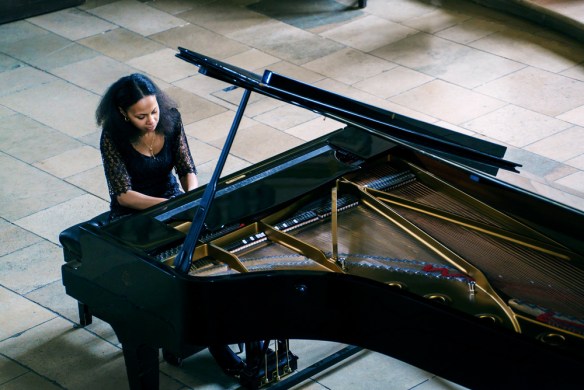
It is not often musicians get the chance to tour unusual repertoire, though Răzvan Suma and Rebeca Omordia have been doing just so with a recital of mainly British music which tonight arrived at the Romanian Cultural Institute as part of its enterprising Enescu Concert Season.
Playing continuously for just over an hour, their choice of music made for a varied as well as cohesive programme. Opening with the discreet charm of Delius’s early Romance, its echoes of Grieg and Massenet not precluding a more personal expression, the duo continued with an account of Ireland’s Cello Sonata that was a world away from the sombre introspection most often associated with this composer’s chamber output. After a taut and impulsive take on the initial Moderato, the slow movement exuded an anxiety that motivated the expected fatalism, then a finale whose tensile progress resulted in a peroration of unusual eloquence and resolve. Certainly, Ireland’s music only stands to benefit from such a forthright approach, and it is to be hoped that Suma’s and Omordia’s advocacy will continue long beyond their present tour.
After an elegant if not too indulgent reading of Elgar’s Salut d’amour, the duo played pieces by two contemporary figures. If Ian Venables is best known for a substantial contribution to English art-song, his chamber music is not insignificant and this early Elegy gave notice of an immersion in the ‘British tradition’ never insular or derivative. Keen to offset the inward tendencies of this repertoire, Robert Matthew Walker penned Fast Music as a toccata which veers engagingly between the incisive and ironic on its way to a decidedly nonchalant close.
The performers’ Romanian lineage was acknowledged with a propulsive account of Enescu’s Allegro in F minor that seems to have been a ‘dry run’ for the opening movement of his First Cello Sonata. The suave second theme is almost identical and while the stormy main theme of this piece is a little short-winded, and its development lacks focus compared to that of the sonata, the impetus sustained here is demonstrably greater than is found in its more rhapsodic and discursive successor. Such, at least, was the impression left by this persuasive rendering.
The recital concluded with two further miniatures by English composers. Rediscovered only after his death, the Nocturne by William Lloyd Webber evinces an appealing soulfulness the greater for its brevity: to which the early Scherzetto (also relocated posthumously) by Bridge provided a telling foil in its capricious humour and flights of fancy. It certainly made for an appropriate ending to this well-conceived and superbly executed programme; one, moreover, that is eminently worth catching at one of the subsequent appearances by this impressive duo.
Further information about these artists and their current UK tour can be found at website and website






 After an elegant if not too indulgent reading of Elgar’s Salut d’amour, the duo played pieces by two contemporary figures. If Ian Venables is best known for a substantial contribution to English art-song, his chamber music is not insignificant and this early Elegy gave notice of an immersion in the ‘British tradition’ never insular or derivative. Keen to offset the inward tendencies of this repertoire, Robert Matthew Walker penned Fast Music as a toccata which veers engagingly between the incisive and ironic on its way to a decidedly nonchalant close.
 Arcana.fm