On Record – Imogen Holst: Discovering Imogen (NMC)

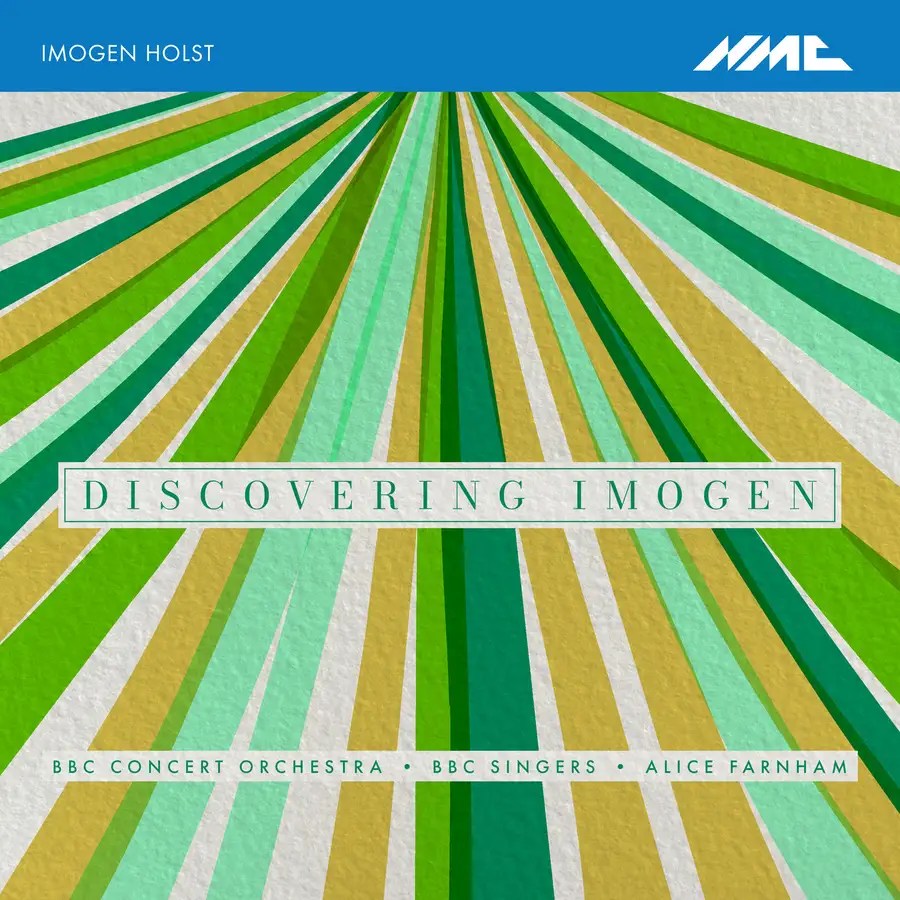
BBC Singers (What Man Is He?, Festival Anthem), BBC Concert Orchestra / Alice Farnham

Imogen Holst
Persephone (1929)
Variations on ‘Lorth to Depart’ (1962)
What Man is He? (c1940)
Allegro Assai (1927)
On Westhall Hill (1935)
Suite for String Orchestra (1943)
Festival Anthem (1946)

NMC Recordings NMCD280 [75’01”] English texts included
Producer Colin Matthews Engineers Marvin Ware, Robert Winter, Callum Lawrence
Recorded 27-29 January 2024 at Maida Vale Studio One, London

Reviewed by Richard Whitehouse

What’s the story?

As its executive producer Colin Matthews notes in his introduction, NMC would likely not exist had it not been for Imogen Holst (1907-84) setting up the Holst Foundation prior to her death – so making this release of her larger-scale works the more appropriate, and welcome.

What’s the music like?

The present anthology affords what seems a plausible overview of its composer’s output. The earliest piece here is Allegro Assai, evidently planned as the opening movement of a suite for strings that progressed no further, but which proves characterful and assured on its own terms. Such potential feels well on the way to being realized in Persephone, an overture (albeit more akin to a tone poem) given in rehearsal by Malcolm Sargent, with the influence of Ravel (and indirectly of Vaughan Williams) balanced by the dextrous handling of motifs across a formal evolution such as relates the myth in immediate and individual terms. That this went unheard until the present recording was likely as much a loss to the musical public as to Holst herself.

Underlining its composer’s skill in writing for amateurs, On Westhall Hill is an atmospheric piece the more appealing through its brevity and modesty of scoring. Deriving its text from the Book of Wisdom, What Man Is He? traverses a range of emotions from the sombre, via the introspective, to the affirmative in a setting as searching as it is fervent. Most impressive, however, is the Suite for String Orchestra composed for a ‘portrait’ concert at Wigmore Hall. The four movements unfold from a diaphanous Prelude, via a fluid and astringent Fugue then an Intermezzo whose ruminative warmth hints at qualities rather more fatalistic, to a Jig which convincingly rounds off the whole work with its mounting energy and resolve.

Written in the wake of the Second World War, Festival Anthem went unheard at this time but could be thought a ‘song of thanksgiving’. Adapted from Psalm 104 (‘Praise the Lord, O my soul’), it seamlessly integrates soloistic with choral passages prior to a calmly fulfilled close. The latest work here, Variations on ‘Loth to Depart’ takes a 17th-century tune as harmonized by Giles Farnaby as basis for five variations – the initial four respectively trenchant, eloquent, wistful and incisive; prior to a relatively extended chaconne as distils a pathos the more acute for its understatement. A string quartet is combined resourcefully with double string orchestra in music which can at least hold its own in the context of a distinctive genre in British music.

Does it all work?

It does indeed. It is all too easy to think of Imogen Holst as one who never fully realized her potential in the face of life-long teaching and administrative commitments, but the range of what is heard amply indicates her creative legacy to be one worth exploring in depth. The recordings, moreover, could hardly be bettered in terms of their overall conviction – Alice Farnham securing a laudable response form the BBC Concert Orchestra and, in the choral pieces, BBC Singers. Hopefully other ensembles, professional or amateur, will follow suit.

Is it recommended?

It is indeed. Sound is unexceptionally fine, with informative notes from Christopher Tinker. Alongside the NMC release of her chamber music for strings (D236), and that on Harmonia Mundi of choral music (HMU907576), this is a fine demonstration of Imogen Holst’s legacy.

Listen & Buy

You can listen to samples and explore purchase options on the NMC Recordings website. For more information on the artists, click on the names to visit the websites of the BBC Singers, BBC Concert Orchestra and conductor Alice Farnham, while a dedicated resource can be found for Imogen Holst herself

Published post no.2,374 – Tuesday 26 November 2024
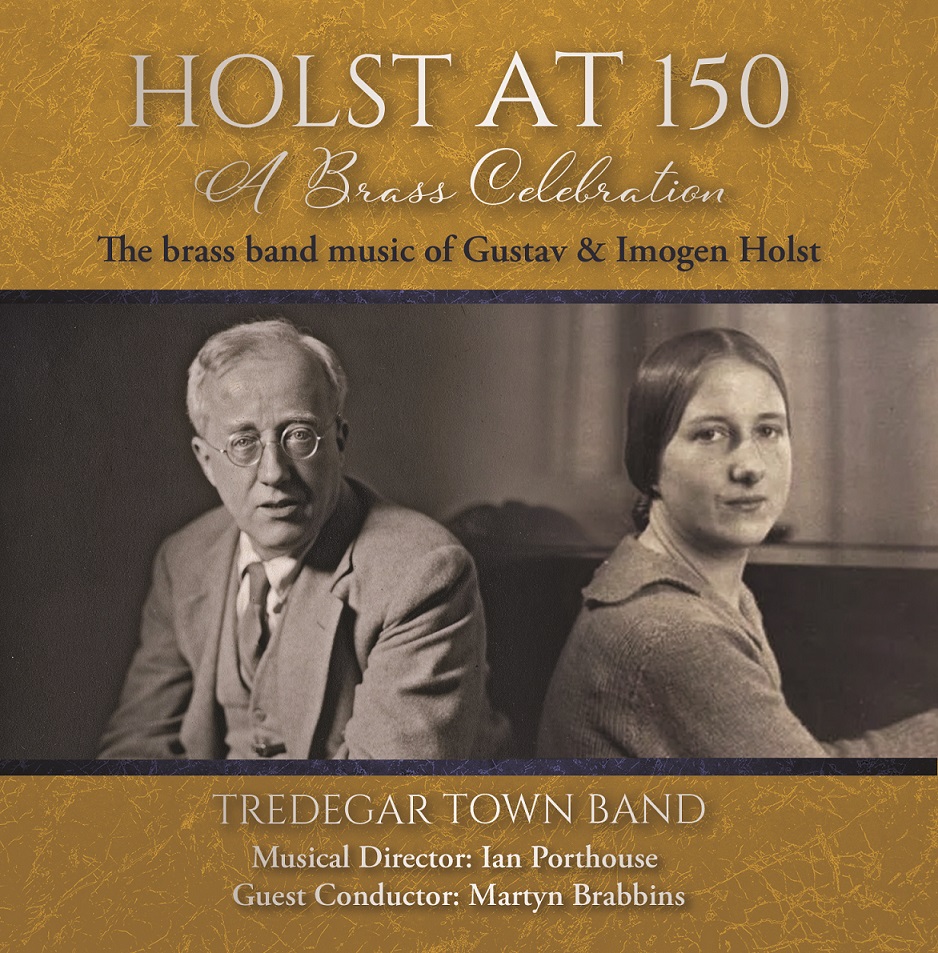
On Record – Tredegar Town Band / Ian Porterhouse, Martyn Brabbins – Holst at 150: A Brass Celebration (Doyen)

Gustav Holst
Suites for Military Band Op.28:
no.1 in E flat major (1909)
no.2 in F major (1911)
The Perfect Fool Op.39 (1918-22) – Ballet Music (all arr. Littlemore).
A Fugal Overture Op.40 no.1 (1922; arr. Wheeler)
Mr Shilkret’s Maggot (1932; arr. Hindmarsh)
A Moorside Suite (1928)
Imogen Holst
The Unfortunate Traveller (1929; ed. Hindmarsh)
Glory of the West (1969)

Tredegar Town Band / Ian Porthouse and Martyn Brabbins (A Moorside Suite)

Doyen DOYCD435 [74’37’’]
Producer Adam Goldsmith Engineer Daniel Lock
Recorded 18-19 May 2024 at Jack Williams VC Hall, The Works, Ebbw Vale

Reviewed by Richard Whitehouse

What’s the story?

The 150th anniversary of his birth, and 50th anniversary of his death, is an ideal opportunity to reassess the legacy of Holst in all its variety; not least with this anthology of his music for brass band that also finds space for her contribution to the medium by his daughter Imogen.

What’s the music like?

Typical and inimitable Holst – but, as he only wrote one work for the medium, much of this release consists of arrangements. The two Suites for Military Band were obvious candidates: the First Suite’s Chaconne emerges with renewed pathos, as too its whimsical Intermezzo or rumbustious March; no less idiomatic is the Second Suite with its recourse to traditional tunes in such as the effervescent initial March, then the final Fantasia with its memorable rendering of the Dargason. Philip Littlemore is an expert arranger here as of the Ballet Music from the opera The Perfect Fool – the sections that evoke ‘earth’ and fire’ lacking a degree of panache, but that of ‘water’ hardly less magical in this guise. Alastair Wheeler proves no less adept in capturing the impetus of A Fugal Overture, while Paul Hindmarsh gives what ought to be a new lease of life to the ‘jazz-band piece’ designated Mr Shilkret’s Maggot praised but never played by its commissioner. Imogen Holst’s 1967 orchestral arrangement as Capriccio rescued it from oblivion, but this new incarnation makes even more of its recalcitrant humour.

Mention of Imogen leads one to her pieces for brass band, both included here. Compact and characterful, her suite The Unfortunate Traveller was initially more successful as transcribed for strings, though Hindmarsh’s edition adds percussion and clarifies the brass texture as was doubtless intended. Its sure highlight is the winsome Interlude, conjuring a discreet though tangible profundity subsequently glimpsed with The Glory of the West – seven variations on said Morris Dance which confirms music written for amateurs need not involve compromise.

This just leaves A Moorside Suite, a work such as transformed the standing of test-pieces for brass band with that understated acuity surely unique to this composer. Whether in its gently satirical Scherzo, wistful Nocturne whose gradual building to a soulful culmination makes for the highlight of this collection, then a March which fuses energy and eloquence to round off the sequence with irresistible elan – this is Holst at his most engaging and communicative. Music, moreover, Martyn Brabbins clearly relished the chance to conduct for this recording.

Does it all work?

Absolutely, both in this piece and elsewhere, as long-standing music director Ian Porthouse puts the Tredegar Town Band exactingly and admirably through its collective paces. At the forefront of the modern brass-band movement, the latter is ideally placed to find this music an audience outside of its customary domain. That it succeeds is clear from the fact that one listens to this programme without thought of the medium or its context; rather, the emphasis is on those qualities of inspiration and substance as are hallmarks of any worthwhile music.

Is it recommended?

Indeed. Recorded with requisite clarity and definition, and featuring informative annotations by Hindmarsh and Littlemore, this is a significant release in Holst’s anniversary year and an evident first choice for acquiring a representative cross-section of his music in this medium.

Listen & Buy

You can listen to samples and explore purchase options on the World of Brass website Click on the names for more on conductors Ian Porthouse and Martyn Brabbins, the Tredegar Town Band, and for more on the composers Gustav Holst and daughter Imogen Holst

Published post no.2,307 – Friday 20 September 2024

In concert – Elizabeth Watts & Julius Drake perform the music of Imogen & Gustav Holst @ Wigmore Hall

Elizabeth Watts (soprano, above), Julius Drake (piano, below)

Gustav Holst Calm is the morn Op. 16 No. 1 (1903-4), Persephone Op. 48 No. 1, Betelgeuse Op. 48 No. 12 (1929), The heart worships (1907), The Floral Bandit Op. 48 No. 6 (1929)
Imogen Holst Weathers (1926), 4 Songs from Tottel’s Miscellany: Shall I thus ever long, As lawrell leaves (1944), 10 Appalachian Folk Songs: My dearest dear, The brisk young lover, I must and I will get married (1938, world première performances)
Gustav Holst Hymns from the Rig Veda Op. 24 (1907-08)

Wigmore Hall, London, 3 January 2022

reviewed by Ben Hogwood from the online broadcast. Artist photos (c) Marco Borggreve

The songs of Gustav Holst have largely eluded British performers and concert audiences over the years, and a quick scan over retail sites reveals just the one recording in the last decade. The songs of Imogen Holst, meanwhile, are even more scarce, so it was doubly welcome that this imaginative recital from soprano Elizabeth Watts and pianist Julius Drake chose to pair works by father and daughter.

Holst senior was a composer capable of finding unusual stillness in music, as the Venus and Neptune movements from his orchestral suite The Planets testify. That talent extended to his songs, and we heard several examples where the composer took his time to set the scene, helped in extremely sympathetic performances from Watts and Drake.

Calm is the morn, a Tennyson setting, found a deep peace tinged with sorrow, though the high notes floated effortlessly by Watts were rather special. These contrasted vividly with the stately Betelgeuse, low in the range while contemplating the end of life – just as Neptune explored the boundaries of the living and the dead at the edge of the solar system. In theory Betelgeuse, with text by Holst’s good friend, the poet Humbert Wolfe, should be more effective with a male voice but Watts found the mysterious depths too. Drake’s tolling chords were the ideal foil, and indeed the pianist proved sensitive to every slight nuance in his scene setting, particularly the slow chorale figure of The heart worships. This was another setting that took its time but was all the more moving for it, with the soprano’s low range well controlled. The Floral Bandit, another Wolfe setting, flitted between quick piano figurations and a restless, high contour from the voice, deliberately uncertain in its direction. Meanwhile Watts’ fretful tones caught the urgency given to Persephone.

Holst was always a keen melodist, a quality that runs through Imogen’s music too. As her father did, she had a keen interest in folk melodies both from this country and further afield, and it was fascinating to compare Watts and Drake’s Anglo-American selection, sourced with help from the Benjamin Britten archive at the Red House, with the songs digitised for performance here.

Imogen’s writing celebrated the open air, its melodies often reaching for the sky. The first song Weathers revelled in its freedom, with a lovely pointed piano part to offset the folksy tune. Drake then enjoyed the trippy syncopations from the piano, combining with a bright soprano line for Shall I thus ever long, Watts keeping clarity in the quick moving words. The slightly elusive As lawrell leaves was next, before the three Appalachian folk settings, collected by Cecil Sharp, exhibited a powerful yearning quality. My Dearest dear kept the folk melody true but turned the melody beautifully. The brisk young lover could almost have been Gustav Holst himself, though Imogen’s piano parts felt more directly connected to the melody. There was an unexpectedly devastating beauty to the simple, sad, final verse, before I must and will get married took a lighter approach.

A rare performance of the complete set of Gustav Holst’s Hymns from the Rig Veda followed. It is remarkable to think these works were published in 1908, for they still sound forward looking today, written as they were after the composer made his own translations of the sacred texts.

Holst’s advanced harmonic thinking was distilled by Drake, while Watts took the longer and more complex melodic phrasing in her stride. The accumulating brightness of Ushas (Dawn) gave way to a stern Varuna I (Sky), where confession of sin was made and ultimately quashed. The sudden movements of Maruts (Stormclouds) came as something of a shock, with the flashing of sword blades, before Indra (God Of Storm and Battle) assumed a regal air with grand chords and a bold melody, strong as an ox under Watts’ delivery. Really impressive power from both in this song. Varuna II explored mysterious and ultimately deathly waters, the listener almost losing a harmonic centre, before Song of the Frogs charmed with its burbling activity. Vac (Speech) gave us another slow and concentrated song, while Creation was even more compelling with its haunting, mostly unaccompanied writing. Finally the wandering piano line for Faith found the soprano ‘rising in silent worship’.

This remarkable set of songs are not only harmonically adventurous but have words that are prescient for today’s climate and particularly the management of the Earth on which we live. Little did Holst know the way in which his work would be thought provoking nearly 115 years on. Watts recognised this, lending a lighter touch to her encore which was Imogen’s arrangement of Henry Carey‘s The Beau’s Lament, brightly sung.

This was a special concert, one of a kind – and a mention should be made for the quality of Wigmore Hall’s camera work, sensitive to both text and performers. Copyright restrictions may prevent them from doing so, but it would be wonderful to see Watts and Drake present this programme in recorded form, for they illuminated aspects of the Holst dynasty rarely glimpsed in the concert hall. Do watch it if you can.

Watch and listen

Sadly the Imogen Holst songs are not yet available in recorded form, but you can the selection from her father Gustav on the Spotify playlist below:

Steven Isserlis – revisiting Elgar and discovering Walton

steven-isserlisCellist Steven Isserlis is one of Britain’s best-loved classical artists – loved for his highly respected interpretations of the cello repertoire, but also for his open, honest and enthusiastic approach to classical music.

Isserlis, an author of books introducing children to the likes of Beethoven, Handel and Schumann, generously donated time to talk to Arcana about the roots of his love of the cello, his new disc of Cello Concertos by Elgar and Walton and his new work as an author.

Can you remember your first encounters with classical music?

I can’t remember a time without music! From the time I remember anything, my sisters were already learning instruments, and I used to go to sleep at night to the sound of my father practising the violin and my mother the piano.

How did you develop a love of the cello?

My sister Rachel played the violin, and my elder sister Annette was always going to play the viola. So a cellist was needed – that would be me. So my parents took me to a local teacher, and – after a false start at the age of four or five – I began lessons from the age of six. I think my love for the cello developed as I came to realise that if I played OK I could be the centre of attention!

What was it like returning to record Elgar’s Cello Concerto? Was it invigorating in the company of someone (the conductor Paavo Järvi) who may not have encountered the composer’s music so much?

Well, I’ve played the Elgar so many times over the 25+ years since I first recorded it that it seemed a good idea to record it again. It’s true that Paavo needed a bit more persuading than he did for our Prokofiev / Shostakovich disc, but not much more; he’s always up for a challenge.

Was it your aim to bring out a little more of the humour in the last movement of the Elgar, given the relative darkness around it? It also feels a little quicker than your first recording of the concerto.

It was not a conscious aim – I really didn’t think about (or listen to) the earlier recording. But yes, there is humour in parts of the last movement – which for me throw the tragedy into even sharper relief.

This is the first time you have recorded the Walton (I think!) I’m assuming you knew it very well before, but what effect did it have on you in the recording process?

I’m not sure it had any particular effect on me ‘in the recording process’, but I’d been wanting to record it for some years, since I feel passionately about it. I always name the Schumann, Dvorak, Elgar and Walton concertos as the four very greatest cello concertos (though I’d be bereft without those of Haydn, C.P.E. Bach, Boccherini, Saint-Saëns, Prokofiev, Shostakovich, Dutilleux etc).

It feels like a very romantic piece, with sighing melodies and deeply felt thoughts. Given your booklet note for the release, is that how you would view it?

Definitely – romantic, poetic, impassioned, magical.

The Gustav and Imogen Holst pieces make fascinating complements. Do you think people are in neglect of just how adventurous Gustav’s music could be?

Perhaps. To my shame, I know very little of it. But I love Invocation, maybe especially so since I had something of a part in its rediscovery.

What do you remember of Imogen Holst as a person, and of the piece here? Her ‘Presto’ seems to me (a bit of wishful thinking I’m sure!) to depict birds chasing each other in the reeds at Aldeburgh.

I remember Imogen as a wonderfully quaint personality who was also sharp as a stainless steel razor! Wonderful. I’ve always thought of the Presto as depicting leaves flying around in a storm. Recently I was sent a note by the work’s dedicatee, Pamela Hind O’Malley, apparently written with Imogen’s approval, which describes it as ‘the scuttering of leaves in a high wind’. I like that word ‘scuttering’!

I understand you have just completed a book – are you able to tell us more about it at this stage?

It’s advice for young musicians – incorporating and updating Schumann’s book of the same name. I suppose that means that I’m now an old musician – groan…

Is it important for you to communicate to people, young and old, in a language that brings classical music to everybody?

Absolutely! And I enjoy playing for children, as well as writing for them – it can be tremendous fun.

Do you think classical music should do more to get the music beyond its ‘inner circle’, so to speak?

Well, yes – but not if that means distorting it, or promoting sugary crossover stuff. Classical music doesn’t need that!

You can hear extracts from the new Steven Isserlis disc of cello concertos by Elgar and Walton, released by Hyperion Records, here – including shorter pieces by Gustav Holst – his Invocation – and his daughter Imogen, a short suite for solo cello The Fall of the Leaf.

Meanwhile forthcoming concerts from the cellist are listed on his website