
In concert – Isabelle Faust, CBSO / Kazuki Yamada: Akio Yashiro: Symphony, Shostakovich: Violin Concerto no.2 & Bartók Dance Suite

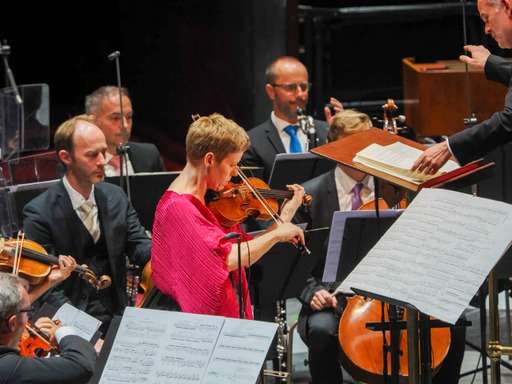
Isabelle Faust (violin, above), City of Birmingham Symphony Orchestra / Kazuki Yamada (below)

Bartók Dance Suite BB86a (1923)
Shostakovich Violin Concerto no.2 in C sharp minor Op.129 (1967)
Yashiro Symphony for Large Orchestra (1958) [UK Premiere]

Symphony Hall, Birmingham
Wednesday 5 February 2025

Reviewed by Richard Whitehouse Picture of Isabelle Faust (c) Felix Broede

It may not have been a popular programme, but tonight’s concert by the City of Birmingham Symphony Orchestra drew a pretty decent attendance in music clearly to the liking of music director Kazuki Yamada, who duly gave of his best for what proved a memorable evening.

Often seen as a breakthrough work in terms of its fusing indigenous musical expression with Western formal conceits, Bartók’s Dance Suite makes an ideal concert-opener. At its best in the rhythmic propulsion or harmonic astringency of the second and third dances, the present account felt a touch inhibited elsewhere; Yamada making overmuch of rhetorical pauses that should motivate rather than impede ongoing momentum. Not that this precluded a forthright response from the CBSO, pianist James Keefe making the most of his time in the spotlight.

Although not now the rarity it once was, Shostakovich’s Second Violin Concerto will always lag behind its predecessor as to performance. Coming near the outset of its composer’s final decade, its inwardness and austerity belie its technical difficulties – though these latter were rarely an issue for Isabelle Faust, who kept the initial Moderato on a tight if never inflexible rein so its demonstrative outbursts and speculative asides were more than usually integrated. Even finer was the central Lento, muted anguish finding potent contrast with plangent solo passages, and a closing contribution from horn player Elspeth Dutch of subdued pathos. Nor was the final Allegro an anti-climax, Faust drawn into engaging confrontation with timpani and tom-tom then heading to a denouement with more than a touch of desperation in its hilarity.

Inquiring listeners may have encountered a recording in Naxos’s Japanese Classics series of a Symphony by Akio Yashiro (1929-76). One of the first group of Japanese composers to study in Europe after the Second World War, his limited yet vital output witnesses a determined and distinctive attempt to fuse certain native elements with the more radical aspects of timbre and texture stemming from the West. Messiaen (with whom he studied) is audible in the fastidious harmonies of this work’s Lento that, building from pensive melodies on flute and cor anglais into a threnody of real emotional power, is its undoubted highlight. Otherwise, the music feels more akin to that of André Jolivet (whose three symphonies deserve revival) in its abundant orchestral colour and predilection for rhythmic ostinatos that galvanize the musical argument.

Such is evident in the implacable unfolding of a Prelude whose motivic ideas secure a more purposeful accord in the ensuing Scherzo, while the finale draws upon the slow movement’s intensity as it expands over successive waves of activity to an impetuous Allegro of no mean velocity prior to a seismic, even brutal peroration. Whatever its intermittent lack of subtlety and cohesion, Yashiro’s Symphony remains an imposing musical edifice such as makes one regret that the composer never managed to pen its successor during his subsequent 18 years.

It certainly found the CBSO at its collective best, so making one hope that Yamada (above) might yet schedule pieces by such as Toshiro Mayuzumi or Sadao Bekku. His next concert has a rather more familiar symphony by Tchaikovsky in the orchestra’s annual Benevolent Fund Concert.

For details on the 2024-25 season A Season of Joy, head to the City of Birmingham Symphony Orchestra website. Click on the names to read more about violinist Isabelle Faust and the CBSO chief conductor Kazuki Yamada, and also the composer Akio Yashiro’s symphony

Published post no.2,438 – Friday 7 February 2025
BBC Proms 2023 – Isabelle Faust, Alexander Melnikov, Les Siècles / François-Xavier Roth – Ligeti & Mozart

Prom 47 – Isabelle Faust (violin), Alexander Melnikov (fortepiano), Les Siècles / François-Xavier Roth

Ligeti Concert Românesc (1951)
Ligeti Violin Concerto (1989-93)
Mozart Piano Concerto No. 23 in A, K488 (1786)
Mozart Symphony No. 41 in C, K551, ‘Jupiter (1788)

Royal Albert Hall, London
Sunday 20 August 2023

by Richard Whitehouse photos by Sisi Burn / BBC

A major step in the evolution of musical ‘authenticity’ or vanity project of its artistic director? Celebrating its 20th anniversary, the Paris-based Les Siècles and François-Xavier Roth tonight made their third appearance at the Proms in a programme divided between Ligeti and Mozart.

Long in limbo as with most works of Ligeti’s early years, Concert Românesc now ranks as its composer’s primary crowd-pleaser – a ‘concerto for orchestra’ compact yet entertaining. Roth drew winsome charm from its initial Andantino and no mean impetus from its scherzo, before an Adagio whose dialogue of two horns (one high in the gallery) prefigures those intonational experiments three decades on. The finale did not lack verve, but anyone having heard Jonathan Nott give this piece for a Proms encore will recall just how much more scintillating it can be.

It may have had a long gestation, but Ligeti’s Violin Concerto is now established as the most recent such piece to have entered the repertoire. Technically assured but never merely showy, Isabelle Faust is a fine exponent, and it was not her fault if a lengthy platform reset made for a restive audience response in the teasingly understated Praeludium or plangent fervency of Aria, Hoquetus, Chorale which is one of the composer’s most potent inspirations. Diversely yet modestly scored, this work needs to be projected for its emotional impact to be felt and a certain bemusement met its coruscating Intermezzo and anguished Passacaglia, but not its engaging Appassionato in which Faust’s methodical cadenza fitted seamlessly into context. As, also, did the sparse Andante of Erwin Schulhoff’s Solo Violin Sonata given as an encore.

There was a similar sense of ends not always equating with means in Mozart’s Twenty-Third Piano Concerto after the interval. Playing a (Graf?) fortepiano from deep within the orchestra, Alexander Melnikov summoned playing of admirable dynamic subtlety and emotional poise – notably an Adagio whose bittersweet fatalism was consummately rendered. Just how much detail and articulation could be heard in the farther reaches of this acoustic was uncertain, but the rapport between soloist and orchestra in a sparkling final Allegro could hardly be gainsaid.

Playing to period-pitch in the second half (just occasionally offset by vagaries of intonation), Les Siècles came into its collective own with an engrossing account of Mozart’s Forty-First Symphony, its Jupiterian connotations evident from the outset of an opening Allegro whose distinction between (relative) dynamism and stasis was thrown into relief with Roth’s use of pause for expressive punctuation. Best here were an Andante whose muted while often dense textures were precisely articulated, then a Menuetto whose sweeping gait found contrast in a quizzical trio whose closing phrase was pointedly curtailed. Not that Roth had other than the measure of the finale, fully integrating its thematic unity into a powerfully controlled overall structure, but its underlying progress felt just a shade dogged in the light of what preceded it. That said, there was no lack of impetus when, after the longest of those pauses, Roth led his forces through the magisterial coda; duly setting the seal on a programme that played to this orchestra’s strengths if not always having been designed with the Royal Albert Hall in mind.

For more on the 2023 BBC Proms, visit the festival’s website at the BBC. Meanwhile click on the names for more information on artists Les Siècles, conductor François-Xavier Roth, violinist Isabelle Faust and pianist Alexander Melnikov. You can discover more about Ligeti at this dedicated website