
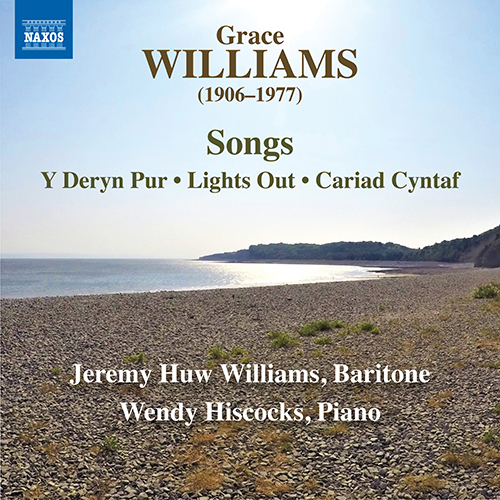
On Record – Jeremy Huw Williams & Wendy Hiscocks: Grace Williams: Songs (Naxos)

Grace Williams
Slow, slow, fresh fount (c1925); I had a little nut tree (c1930); Green Rain (1933); Stand forth, Seithenin (1935, rev; 1951); Ffarwel i langyfelach (?1920s); Llangynwyd (?1920s); The Song of Mary (1939, rev; 1945); Shepherds watched their flocks by night (1948); Fairground (1949); Flight (1949, rev; 1954); À Lauterbach (c1950); Le Chevalier du guet (1949); Four Folk Songs (1950-51); When thou dost dance (1951); Three Yugoslav Folk Songs (1952); Y Deryn Pur (1958); Y Fwyalchen (1958); Cariad Cyntaf (c1960); Ow, Ow, Tlysau (1964); Dwfn yw’r Môr (c1940); Lights Out (1965); Fear no more the heat o’ the sun (1967)

Jeremy Huw Williams (baritone), Wendy Hiscocks (piano)

Naxos 8.571384 [77’47”]
Producer Wendy Hiscocks Engineer Alastair Goolden

Recorded 28-30 September 2022 at Cooper Hall, Selwood Manner, Frome

Reviewed by Richard Whitehouse

What’s the story?

Naxos continues its long-running series of releases sponsored by the British Music Society with an album of songs by Grace Williams (1906-77), all of which are recorded here for the first time and, between them, extend chronologically over the greater part of her composing.

What’s the music like?

Even more than others of her generation, Williams has benefitted from the upsurge of interest in women composers this past decade with recordings of major works on Lyrita and Resonus. Songs may not have the primary place in her output, but they afford a viable overview of her stylistic evolution with individual instances among her most characteristic statements. Most are in English or Welsh though there also settings of French texts, while her own translations of several from the former Yugoslavia further underline the breadth of her literary concerns.

Early settings of Ben Johnson along with traditional English and Welsh poems find Williams, barely out of her teens, tackling verse with audible appreciation of this genre’s lineage within the Victorian and Edwardian eras. That of Mary Webb’s Green Rain is audibly more personal for its wistful ambivalence, while The Song of Mary brings due sensitivity to bear upon some familiar lines from St Luke. The most extended item, Fairground is a setting of Sam Harrison that captures the sights and sounds of said environment with an immediacy never descending into kitsch, while that of Flight matches the sentiments in Laurence Whistler’s poem and has a piano part testing in its intricacy. Her setting of the Jacobean-era When thou dost dance is, by comparison, slighter though no less attuned to the limpid elegance of its anonymous text.

Arrangements of traditional verse had early featured in this composer’s output, and this is not the customary text for her attractive treatment of a traditional Czech carol Shepherds watched their flocks by night. The period around 1950 saw a number of such arrangements and mainly of French texts, but with her take on the Northumbrian Bonny at Morn appreciably different from the more familiar one by Tippett. The end of that decade brought forth a trio of eloquent Welsh settings, while that of the Medieval text Oh, Oh, Treasures may be pastiche yet it has a fervency which feels not a little unsettling. The final two songs see a return to more familiar verse: that of Edward Thomas’s Lights Out evinces a subdued and even fatalistic acceptance, while that of Shakespeare’s Fear no more the heat o’ the sun captures its aura of resignation.

Does it all work?

Yes, allowing for inevitable unevenness in what is a conspectus over four decades. At least a half-dozen of these songs ranks with the best of those by British composers from this period and well warrant investigation by more inquiring singers. Jeremy Huw Williams clearly has no doubts as to their quality and, though his tone as recorded here is not always flattering, it captures his intensity of response. Nor could he have had a more committed or a perceptive accompanist than Wendy Hiscocks, who teases out myriad subtleties from the piano writing.

Is it recommended?

Indeed, and there ought to be enough remaining vocal items for a follow-up release at some stage. Graeme Cotterill pens informative notes, and while it is a pity that several texts could not be printed for copyright reasons, the clarity of Williams’s diction seems fair recompense.

Listen & Buy

Click on the artist names to read more on Jeremy Huw Williams, Wendy Hiscocks, composer Grace Williams and the British Music Society

Published post no.2,506 – Wednesday 16 April 2025
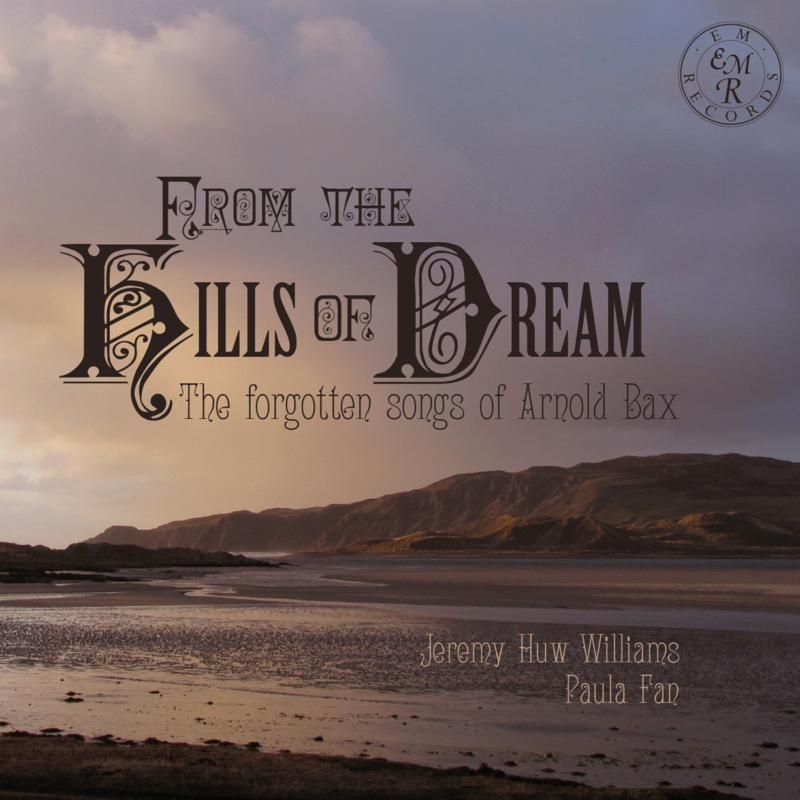
On record – Jeremy Huw Williams & Paula Fan – From The Hills of Dream: The Forgotten Songs of Arnold Bax (EM Records)

bax-songs

Jeremy Huw Williams (baritone), Paula Fan (piano)

Bax
The Grand Match (1903). To my Homeland (1904). Leaves, Shadows and Dreams. Viking-Battle-Song (1905). I fear thy kisses, gentle maiden. The Twa Corbies (both 1906). Longing. From the Hills of Dream (both 1907). Landskab (1908). Marguerite (1909). Das tote Kind (1911). Welcome, Somer. Of her Mercy (both 1914). A Leader (1916). The Splendour Falls (1917). Le Chant d’Isabeau. A Rabelaisian Catechism (both 1920). Carrey Clavel (1925) – all world premiere recordings

EM Records EMRCD073 [77’56”]

Producer Jeremy Huw Williams Engineer Wiley Ross

Recorded 13, 14, 16, 22 & 23 October 2020 at Jeff Haskell Recording Studio; 13 November 2020 at Jim Brady Recording Studios, University of Arizona, Tucson, USA

Written by Richard Whitehouse

What’s the story?

EM Records continues its coverage of lesser-known (or the lesser-known music of) English composers in an extensive survey of ‘forgotten’ songs by Arnold Bax, of which only a few were publicly performed in his lifetime with several of them first heard as recently as 2018.

What’s the music like?

Although he is best known for his symphonies and tone poems, songs with piano occupy a not unimportant place in Bax’s output – particularly over his formative years. This selection unfolds chronologically – opening with a lively setting of Moira O’ Neil’s The Grand Match, then continuing pensively with Stephen Gwynn’s To My Homeland in which Bax’s love of Irish culture was first manifest. Two settings of ‘Fiona Macleod’ (aka William Sharp) – the evocative Leaves, Shadows and Dreams, then the (would-be) heroics of Viking-Battle-Song – precede a ravishing take on Percy Shelley’s I fear thy kisses, gentle maiden, before The Twa Corbies finds Bax experimenting (not always successfully) with recitation in this traditional text. Two further settings of Macleod – the poised elegance of Longing, then the searching inwardness of From the Hills of Dream – lead on to this composer’s only treatment of a text in Danish, that of Landskab (Landscape) by Jens Peter Jacobsen, whose three manuscripts imply syntactical problems never adequately resolved despite the music’s gentle eloquence.

Bax set four texts by William Morris, among which the warmly expressive Marguerite went (surprisingly) unheard until now. The sombre symbolism of Conrad Ferdinand Meyer’s Das tote Kind is underplayed despite being in the original German, and two rondels by Geoffrey Chaucer – the wistful charm of Welcome, Somer then deft humour of Of her Mercy – exude sentiments to which he is more attuned. This is even more evident in A Leader, a setting of George Russell’s poem that underlines Bax’s emotional involvement with those issues and persons of Ireland’s ill-fated Easter Uprising that ranks among the composer’s finest songs. Few are likely to prefer his dogged setting of Alfred, Lord Tennyson’s The Splendour Falls to that by Britten (or the Delius part-song), whereas the traditional Le Chant d’Isabeau has appealing winsomeness. A Rabelaisian Catechism is a salacious take on another traditional text, with a little help from Vaughan Williams and Wagner, while Carrey Clavel matches Thomas Hardy’s wry observation of scorned love to a tee and makes for a delightful close.

Does it all work?

Most of the time. Almost from the outset, Bax was an inventive but also interventionist setter of texts, such that the poet’s sentiments are not necessarily those conveyed in his songs. This might explain why he increasingly eschewed the genre once he had found his true metier in orchestral and chamber media, so that there are very few songs from the mid-1920s onwards. That said, the literary range of what Bax did set as well as the expressive range of his settings ensures his contribution is a notable one and is enhanced by those songs featured on this disc.

Is it recommended?

Yes, not least through the advocacy of Jeremy Huw Williams whose unstinting advocacy is underpinned by Paula Fan’s perceptive accompaniment. The extensive booklet notes are by the Bax authority Graham Parlett, to whose memory this release is appropriately dedicated.

Listen and Buy

To listen to excerpts from this disc and view purchase options, visit the EM Records website. To read more about Arnold Bax, visit his dedicated composer website, and for more on the performers, click on the names of Jeremy Huw Williams and Paula Fan. Finally for more information on the English Music Festival, click here