In concert – Sol & Pat (Sol Gabetta & Patricia Kopatchinskaja) @ Queen Elizabeth Hall

pat-sol

Leclair Violin Sonata in C major Op.5/10: Tambourin (c1734)
Widmann 24 Duos: Valse bavaroise; Toccatina all’inglese (2008)
J.S. Bach Prelude in G major (from BWV860) (c1722)
Francisco Coll Rizoma (2017)
Domenico Scarlatti Sonata in G, Kk.305
Ravel Sonata for violin & cello (1922)
J.S. Bach 15 Two-part Inventions BWV772-86 (selection) (c1723)
Ligeti Hommage à Hilding Rosenberg (1982)
Xenakis Dipli zyia (1951)
C.P.E. Bach Presto in C minor Wq114/3 (c1768)
Kodály Duo Op.7 (1914)

Patricia Kopatchinskaja (violin), Sol Gabetta (cello)

Queen Elizabeth Hall, London
Tuesday 26 October 2021

Written by Richard Whitehouse

Combining two of the most charismatic and creative string players of their generation was such a good idea to make one surprised it had not happened earlier, but tonight the Patricia Kopatchinskaja and Sol Gabetta double-act hit the Southbank Centre in no uncertain terms.

A stomping entrée to Leclair’s Tambourin in C (a rare instance when Kopatchinskaja donned footwear) launched proceedings in arresting fashion, while Jörg Widmann’s Valse bavaroise and Toccatina all’inglese – both from his resourceful playbook of 24 Duos – allured and engaged. Bach’s Prelude in G (from BWV860) afforded a limpid breathing-space, then Francisco Coll’s Rizoma fairly intrigued with its incrementally shifting textures and ethereal harmonics – just the sort of piece, indeed, necessary for energizing the violin-and-cello medium. Kopatchinskaja admitted to disliking the arrangement of Scarlatti’s Sonata in G (Kk305) and canvassed the audience for its opinion, the response encouraging an incisive take on music whose enthusiastic response left her shaking her head in mock consternation.

The first half concluded with Ravel’s Sonata for violin and cello – much less often revived than it should be, ostensibly on account of the duo-medium, but an undoubted masterpiece when rendered with such commitment as here. Kopatchinskaja and Gabetta teased out those exquisite tonal obliquities of the Allegro, countered by the alternate brusqueness and suavity of the scherzo or distanced rapture of the slow movement; before the finale brought matters to a head with its headlong syncopation and no lack of that ‘spirit’ as indicated in the score.

A brief inclusion from Bach’s 15 Two-Part Inventions (BWV772-86) opened the second half with pointed understatement (presumably more so than the Scarlatti sonata that was originally scheduled), with the expressive poise of Ligeti’s Hommage á Hilding Rosenberg duly making way for the acerbic interplay of Xenakis’s Dipli zyia which is among the most Bartókian of the formative pieces to have found posthumous revival by this composer (who is hopefully being suitably commemorated throughout his centenary in 2022).

Kopatchinskaja and Gabetta then sat side by side for a speculative reading of C.P.E. Bach’s Presto in C minor (Wq.114 No. 3) made the more so through its being played pizzicato throughout. Interesting, too, how such an arrangement can dissolve any perceived boundary between musical epochs.

The programme reached a culmination in every sense with Kodály’s Duo, one of several large-scale chamber-works for strings on which his reputation as a composer of ‘abstract’ music rests. After a tensile account of the preludial Allegro, Kopatchinskaja and Gabetta rendered the central Adagio with sustained pathos and a timbral acuity made more so by their faultless intonation. Nor was there any lack of eloquence in the finale, its deliberate progress building a momentum that was released in the coda to heady and exhilarating effect.

Quite a concert, then, with a performance to match by two musicians who complement each other’s playing to a mutually beneficial degree. Hopefully they will be returning with another wide-ranging programme before too long. The enthusiastic audience evidently felt likewise.

For more information on the new Sol & Pat release, head to the Linn Records website

In concert – Hockley Social Club & the CBSO present: Symphonic Sessions

CBSO_2021.10_Symphonic Sessions_cr-Hannah Fathers-33

Symphonic Sessions

Hockley Social Club, Birmingham
Thursday 21 October 2021

Written by Richard Whitehouse Photos courtesy of Hannah Fathers

The City of Birmingham Symphony Orchestra’s ‘Out & About’ schedule has seen musicians playing at venues from railway stations to suburban pubs, but tonight’s Symphonic Sessions, billed as ‘‘the perfect evening for the musically curious’’, was a more ambitious undertaking.

The venue was Hockley Social Club – located closer to Newtown and an area which, with its rundown warehouses next to remnants of faded civic planning, is ripe for redevelopment of a kind encountered on the other side of Great Hampton Street. Such urban realism aside, it was an ideal setting for an event designed to appeal to the young professionals living or working in this area, and the capacity (300 or so) attendance was gratifying to club and orchestra alike. Assorted street food and designer cocktails were some of the attractions available on the night.

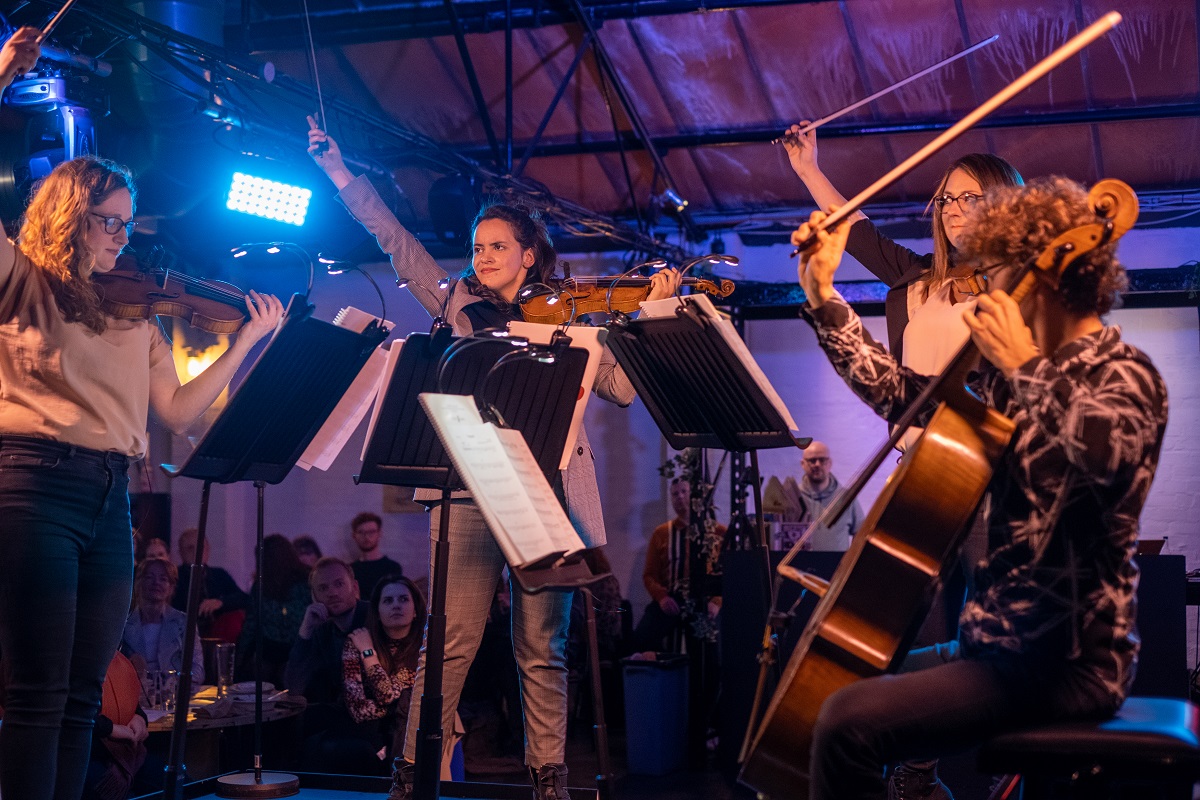
The live element consisted of two half-hour sets played by a quartet drawn from the CBSO, situated on a raised central platform, and amplified so neither visibility nor audibility was an issue. The first set enjoyed a lively start with Year of the Boar from Sufjan Stevens’s zodiacal electronica Enjoy Your Rabbit, popularized in Michael Atkinson’s arrangement for the Osso Quartet. One of the most arresting younger American composers, Caroline Shaw has written widely for quartet but, while Entr’acte provided a showcase for the musicians’ dexterity – not least cellist Arthur Boutillier – its fractured continuity tried the patience of numerous punters. Not so those teasingly ironic excerpts from Anna Meredith’s Songs for the M8 – with Sigur Rós’s evergreen Hoppípolla, as reimagined by the Vitamin Quartet, a delightful signing-off.

The inward fervency of Stevens’s Year of our Lord began a second set that touched on more Classical fare with a visceral take on the second movement of Shostakovich’s Eighth Quartet, then a lucid First Contrapunctus from Bach’s The Art of Fugue that only gained in eloquence on restarting after violinist Colette Overdijk had lost her battle with a dislodged microphone. The undoubted highlight was Bryce Dessner’s Aheym (Homeward) – a commission from the Kronos Quartet for the guitarist of The National, this is music whose propulsive energy and tensile interplay were to the fore in a performance which brooked no compromise. Violinist Kirstie Lovie and violist Amy Thomas then came into their own in excerpts from the Danish String Quartet’s folk-song anthology Wood Works, which made for a scintillating conclusion.

Either side of and in between the live music, low-key DJ sets (at least until the half-hour prior to closing) from ‘local tastemaker’ Pritt Kalsi did much to enhance the atmosphere for what throughout was a lively and appreciative audience. What proportion can be persuaded to make CBSO concerts at Symphony Hall a regular part of its fixture-list remains to be seen, though feedback on the ground was encouraging. Whatever else, the future of live events looks to be one in which listening across the spectrum of musical styles and genres has become the norm.

Good news, therefore, that Symphonic Sessions is destined not to be a one-off experiment, with the follow-up having been set for Thursday 2nd December. Whatever the line-up of musicians and music, it would seem certain that ‘‘A splendid time is guaranteed for all’’.

Further information on Symphonic Sesions can be found here. Further listening on the featured music can be enjoyed through the Spotify albums below:

Stevens:

Shaw:

Meredith:

Sigur Rós:

Shostakovich:

Bach:

Dessner:

Danish SQ:

cbso-symphonic-sessions

On record – Villa-Lobos: Choral Transcriptions (São Paulo Symphony Choir / Valentina Peleggi) (Naxos)

villa-lobos

Villa-Lobos transcriptions of:

Bach Prelude and Fugue no.8 in E flat minor / D sharp minor BWV853, Prelude no.14 in F sharp minor BWV883; Fugues – no.1 in C major, BWV846; no.5 in D major, BWV874; no.21 in B flat major, BWV866; no. 22 in B flat minor BWV867
Beethoven Adagio cantabile Op.13/2
Chopin Waltz no.7 in C sharp minor Op.64/2
Massenet Élégie Op.10/5
Mendelssohn Lieder ohne Worte in E major Op.30/3
Rachmaninov Prelude in C sharp minor Op.3/2
Schubert Ständchen D957/3
Schumann Träumerei Op.15/7
Villa-Lobos Bachianas Brasileiras no.9 W449

São Paulo Symphony Choir / Valentina Peleggi

Naxos 8.574286 [58’32”] English and Portuguese translations included

Producer Ulrich Schneider
Engineers Marcio Jesus Torres, Camilla Braga Marciano, Fabio Myiahara

Recorded: 5-10 August 2019 at Sala São Paulo, Brazil

Written by Richard Whitehouse

What’s the story?

Naxos’s coverage of the music of Heitor Villa-Lobos (part of this label’s series The Music of Brazil) continues with a selection of mainly transcriptions from the piano repertoire that the composer undertook during the mid-1930s as part of his extensive educational commitments.

What’s the music like?

Almost all these arrangements emerged in the period 1932-5, when Villa-Lobos took on the challenge of overhauling music education in the public school system of Rio de Janeiro. This involved the creation, virtually from scratch, of a choral pedagogy that he drew from across the spectrum of Baroque, Classical and Romantic music. It is a measure of his prowess that such transformation from mostly piano sources was accomplished with unfailing rigour and an idiomatic quality, so the fame of the originals is almost the only clue to their provenance.

From the soulful strains of among the most mellifluous from Mendelssohn’s Songs without Words, the programme then continues with the Eighth Prelude and Fugue from the first book of Bach’s The Well-Tempered Clavier – the former piece summoning a plangently rhetorical response which finds pertinent contrast with the latter piece’s methodical and intricate build-up to a culmination of sombre eloquence. The arrangement of Dreaming from Schumann’s Scenes from Childhood fully conveys its wistful pathos, as does that of the First Fugue from Bach’s WTC the original’s cool elegance. Similarly, the last of Schubert’s Serenade settings loses little of this song’s plaintiveness, and the Twenty-First Fugue from Bach’s WTC takes on unexpected jauntiness in what proves one of Villa-Lobos’s most inspiriting re-creations.

Chopin’s Waltzes might be considered unsuited to the vocal medium, yet the C sharp minor responds ably to such elaboration, as too the ruminative calm of the Twenty-Second Prelude from Bach’s WTC. Rachmaninov might have thought better of his Prelude in C sharp minor had he encountered this uninhibitedly dramatic realization, with basses providing the baleful anchorage, in contrast to the yearning aura drawn from the Fourteenth Prelude of the second book from Bach’s WTC. Massenet’s Elegy exceeds the original song for bittersweet poise, a foil to the serenity of the Fifth Fugue from Bach’s WTC. The indelible main melody from the Adagio of Beethoven’s Pathétique segues ideally into the Ninth Bachianas Brasileiras, with Villa-Lobos’s choral incarnation rather more atmospheric and evocative than that for strings.

Does it all work?

Almost entirely and due in no small part to the excellence of the São Paulo Symphonic Choir with its Italian conductor Valentina Peleggi. Lasting just under 60 minutes, the selection feels varied yet also cohesive enough to be enjoyed as a continuous programme, while enterprising choirs from both sides of the Atlantic ought to find much here to enrich their existing rosters. Inclusion of Villa-Lobos’s own music at the close is a reminder its technical demands should never be taken for granted, but here too the SPSC rises to the challenge with unstinting verve.

Is it recommended?

It is. The acoustic is just a little reverberant at times yet without detriment to the clarity of the choral writing, with informative annotations from Manoel Corrêa do Lago. Listeners should also investigate a recent Naxos release of Villa-Lobos’s first three violin sonatas (8.574310).

Listen

Buy

You can discover more about this release at the Naxos website, and you can also purchase the recording here. You can read more about conductor Valentina Peleggi here

BBC Proms – Víkingur Ólafsson, Philharmonia / Paavo Järvi: Bach, Mozart, Prokofiev & Shostakovich

olafsson-jarvi

Víkingur Ólafsson (piano), Philharmonia Orchestra / Paavo Järvi

Prokofiev Symphony no.1 in D major Op.25 ‘Classical’ (1916-17)
J.S. Bach Keyboard Concerto in F minor BWV1056 (c1738-9)
Mozart Piano Concerto no.24 in C minor K491 (1786)
Shostakovich Symphony no. 9 in E flat major Op.70 (1945)

Royal Albert Hall, London
Saturday 14 August 2021

Written by Richard Whitehouse

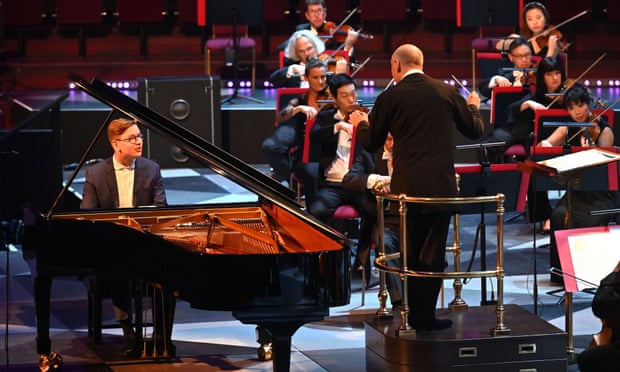
Tonight’s Prom brought change of conductor, the always reliable Paavo Järvi stepping in for Santtu-Matias Rouvali in what would have been the latter’s Proms debut, but not of soloist – Icelandic pianist Víkingur Ólafsson duly making his first appearance at these concerts with concertos which, for the most part, played to his strengths.

The number of times that Bach’s keyboard concertos have been heard here on piano in recent decades can be counted on the fingers on one hand (Tatiana Nikolayeva’s D minor resonates in the memory), but that in F minor was a good choice in terms of its succinctness – the outer movements pitting soloist and (sizable body of) strings against each other with a trenchancy as was vividly conveyed here, with the central Andante an oasis of serenity that was not without its plangent asides.

Placing this piece before the interval, however, made for a distinctly short first half – given the relative length of Mozart’s C minor Concerto after the interval. There were many good things in this latter, Ólafsson keeping the first movement on a tight yet never inflexible rein so that its inclination to pathos – if not always its portentous undertones – came through in ample measure; not least in a coda that had been cannily prepared by the soloist’s cadenza. The central Larghetto was none the less the highlight – Ólafsson varying his tone such that piano melded into the woodwind for an early and defining instance of timbral colouration, with its limpid elegance never undersold. Maybe the finale was a little staid in the overall unfolding of its variations, but the coda’s strangely ambiguous poise was tangibly realized.

An auspicious debut, then, for Ólafsson, who underlined his prowess with affecting readings of the slow movement of Bach’s Fourth Organ Sonata (BWV526) in August Stradal’s chaste transcription and Liszt’s not unduly mawkish version of Mozart’s Ave Verum Corpus (K617). These further extended the disparity between each half – the first of which had commenced with Prokofiev’s ‘Classical’ Symphony, not in the least small of scale or mimsyish as Järvi heard it; witness his acerbic and impetuous take on the initial Allegro, trumpets and timpani to the fore, then a Larghetto whose swift underlying tempo left little room for any harmonic piquancy to emerge. The Gavotte was slightly marred by several mannered agogics which tended to impede its rhythmic profile, but the Finale lacked little in sparkle or insouciance.

Among the most travelled and recorded conductors of today, Järvi can seem detached or even aloof in manner – but there was no such reticence evident in Shostakovich’s Ninth Symphony as ended this programme. After a tensile and assertive Allegro, which audibly benefitted from the sizable forces onstage, the Moderato recalled Efrem Kurtz’s classic recording as to overall restraint and a dark-hued introspection rising to anguish in its twin climaxes. Playing without pause, the other movements were of a piece with the foregoing – a driving and almost manic Presto subsiding into a Largo, whose ruminative bassoon soliloquys were eloquently taken by Emily Hultmark, then an Allegretto whose capriciousness was acutely gauged through to its bitingly sardonic climax and breathless final payoff. Undoubtedly a performance to savour.

You can find more information on the BBC Proms at the festival’s homepage

BBC Proms – Steven Isserlis, LPO / Jurowski: Stravinsky, Bach, Walton & Hindemith

jurowski-proms

Steven Isserlis (cello, below), London Philharmonic Orchestra / Vladimir Jurowski (above)

Stravinsky Jeu de cartes (1935-6)
Walton
Cello Concerto (1955-6)
Bach (arr. Goldmann)
14 ‘Goldberg’ Canons BWV1087 (1742-4 arr. 1977)
Hindemith
Symphony ‘Mathis der Maler’ (1933-4)

Royal Albert Hall, London
Thursday 12 August 2021

Written by Richard Whitehouse; pictures (c) Chris Christodoulou

Vladimir Jurowski this evening concluded his highly impressive 14-year tenure as Principal Conductor of the London Philharmonic Orchestra with a thoughtfully conceived and well-proportioned programme; one which typically played to this orchestra’s strengths as much as to his own.

Although it can seem something of an ‘also-ran’ in the context of his compositions from the period, Stravinsky’s Jeu de cartes lacks for little in terms of that rhythmic effervescence as was engagingly evident in this performance – Jurowski pointing up the humour and even occasional glimmers of pathos that inform what can easily seem music written on autopilot. The LPO responded with a trenchancy and alacrity as held good throughout this ‘ballet in three deals’, the tonal punning of whose culmination at least ensures a humorous outcome.

Walton’s Cello Concerto used to be regarded with even less favour than Stravinsky’s ballet, but this piece (written by its composer at much the same age) is now seen as more than the enervated recycling of past success. Steven Isserlis (above) has long advocated its cause, and there was little doubting his commitment in a reading of perceptiveness and finesse. At times his spare and even fragile tone tended to recede into even so restrained and transparent as this, Jurowski mindful to rein in those brief climactic moments of the outer movements, but the artful interplay of the central scherzo did not lack for incisiveness or irony. Nor, after the second of the solo variations in the finale, was there any absence of rapture as soloist and orchestra are reconciled in drawing the music through to its close of fatalistic acceptance.

After the interval, a novelty in an arrangement by composer-conductor Friedrich Goldmann (1941-2009) of the 14 canons latterly identified from Bach’s printed copy of his Goldberg Variations. Arranged for a Stravinskian post-classical orchestra, these intricate and arcane studies in canonic dexterity emerge from gentle aridity to luminous elaboration with spare, methodical elegance such as intrigues and disengages in equal measure. Hardly something one expected to hear at such an occasion or this venue, though worth hearing all the same.

In its reiterating the values of Enlightenment humanism, moreover, this prepared admirably for Hindemith’s Symphony ‘Mathis der Maler’; premiered on the cusp of Germany’s descent into barbarous self-destruction, and a plea from the committed – however reluctantly – artist for a rational response as might be worth emulating today. The alternately radiant and tensile unfolding of Concert of Angels was perfectly judged, as too the plaintive resignation of the brief if affecting Entombment. The Temptation of St Anthony then made for an elaborate finale, but Jurowski paced it superbly – the plangent central interlude thrown into relief by the impassioned episodes on either side, then its anguished introduction by an apotheosis whose ultimate wresting of triumph from adversity remains thrilling as a statement of artistic intent.

A performance to savour, then, not least as John Gilhooly presented Jurowski with the Gold Medal of the Royal Philharmonic Society in recognition of services to music – an accolade with an illustrious history, which can rarely have been more deserved than on this occasion.

You can find more information on the BBC Proms at the festival’s homepage