Christophe Rousset is a long-admired exponent of music from the Baroque period – but as this playlist shows, he should not be pinned down to that one era!
This year marks 30 years of his pioneering group Les Talens Lyriques, and the playlist below draws on recordings made in that period for the famous Universal imprint L’Oiseau Lyre, Decca and more recently the Bru Zane and Aparté labels. For the former Rousset conducted a landmark recording of Gounod’s Faust, released in 2019, while the latter are releasing three new albums this autumn.
Excerpts from the trio can be heard below, along with a celebration of Rousset’s contribution both as conductor and harpsichordist. There is much to enjoy here!
Trad. arr. Oskar Lindberg Old Swedish Folk Song (unknown) Kristina Arakelyan Modal Reeds (2021, world premiere) Albinoni arr. Balsom / Lapwood Concerto in D Minor (1722) Debussy arr. Lapwood Clair de Lune (1905); Syrinx (1913); The Girl with the Flaxen Hair (1910) Britten arr. Lapwood Sunday Morning from Peter Grimes (1945) Eben Okna (Windows): Green Window ‘Issachar’; Gold Window ‘Levi’ (1976) J.S. Bach arr. Balsom / Lapwood Chorale Erbarm dich BWV 721 (unknown) Owain Park Images (2018) Alain arr. Balsom Litanies (1937)
Alison Balsom (trumpet), Anna Lapwood (organ), Sam Mendes (lighting director)
Chapel of St. Augustine, Tonbridge School, Tonbridge
15 October 2022
by Ben Hogwood
This was an inspirational evening of music, cleverly conceived and executed as the first in an impressive set of concerts to celebrate the 60th anniversary of the Tonbridge Music Society. In its existence the society has attracted a stellar cast of classical and jazz artists to the Kent town, where they have a number of fine performing venues at their disposal. Even by their standards, however, this was an auspicious event.
Powered by a series of common musical denominators (and a shared love of Chelsea buns!), trumpeter Alison Balsom and organist Anna Lapwood created an immersive sequence of music for the striking Chapel of St Augustine in Tonbridge School. One of the many inspirations behind this was Alison’s teacher from the Guildhall School of Music, and her thank you gift took the form of an inspiring and memorable evening for many young performers, who in a ceremony afterwards were presented with a series of Diamond Music Awards given by TMS to support local musicians between the age of 5 and 18.
Both performers have a strong belief in giving back to their communities and passing on to the next generation of performers. The week leading up to the concert featured a master class given by Balsom for students of the school, and Lapwood’s continued personal and virtual encouragement for her many followers under the #playlikeagirl hashtag is bearing fruit if the young audience was anything to go by. Both showed why they can be lasting inspirations, their craft borne of a shared passion for the music they play.
Complementing the music was a lightshow, under the direction of Sam Mendes – Balsom’s husband, clearly relishing a more vocational night away from his film director profession. Running smoothly and logically, the music began with solo organ – and few would have been prepared for the immediate and bare emotion of the Old Swedish Folk Song arranged by Oskar Lindberg. We heard a counterpoint from Kristina Arakelyan, who was present for the world premiere of her similarly moving Modal Reeds. A cinematic piece led by Balsom, this had striking parallels to the film music of Thomas Newman in its rich harmonic palette and distinctive, bright textures. It made a strong impression.
The chapel was bathed in blue at this point, a subtle counterpoint to the music. Balsom then fell under the spotlight, moving to the organ loft for a spirited account of Albinoni’s Oboe Concerto in D minor, its natural arrangement for trumpet making much of the heartfelt second movement, proving there is more than one Adagio bearing the composer’s name! Lapwood’s choice of registrations on the organ throughout the evening was ideal, but here especially she found a rewarding balance and sensitive phrasing.
A Debussy triptych followed – a mellow-voiced Clair de Lune, in the organist’s own arrangement, segueing neatly into Balsom’s account of Syrinx, the solo flute piece taking flight in its arrangement for trumpet. Both instruments combined in a plaintive account of The Girl With The Flaxen Hair.
The evening’s centrepiece was to follow, prefaced by a fiendishly difficult arrangement of Sunday Morning, second of Britten’s Four Sea Interludes from Peter Grimes. The longest stop on the organ came into play, rumbling beneath a vividly pictorial account where Balsom added a treble line. From here we moved to two substantial segments from Petr Eben’s Okna (Windows), a 1976 piece inspired by four of Marc Chagall’s stained glass windows. Coincidentally, only three miles down the road stands Tudeley parish church, the only site in England to feature original windows by the artist.
This piece is clearly special to Balsom, and the two gave a penetrating insight into Eben’s writing, taking two substantial excerpts. Lapwood exploited the organ’s colour, the mottled Green Window gathering intensity with some raucous interventions against Balsom’s fluid line. The steady build in the Gold Window was something special indeed, reaching an apex in what Balsom termed ‘the loudest B flat chord ever for non-amplified instruments’. It certainly left its mark here!
Great control was required for the floated melody of Bach’s chorale Erbarm dich before the evocative Images from Owain Park, to which the trumpet added a playful yet poignant treble line. Jehan Alain’s Litanies also benefited from this, the organ piece given an extra-ceremonial air to close proceedings. We were not fully done, however, as a softly played encore arrangement of Shenandoah held the audience rapt a little while longer.
Both artists should be applauded for their creativity and collaboration here, two words that sit towards the forefront of their thinking. The balance was ideal, a notable achievement given the familiar problems of tricky sightlines and the distance between the two performers. Mendes, too, should be credited for a sensitive response that cast a spell on those in the chapel, moving from cool blue hues to dramatic outlines in gold. A special evening indeed – how about reproducing it as a late-night Prom?
For more information on Anna Lapwood’s new Images album, featuring the piece from Owain Park, click here. Meanwhile for more on Alison Balsom’s recent release Quiet City, click here– and for more information on her debut album for EMI Classics (latterly Warner), containing a complete account of Petr Eben’s Okna, click here
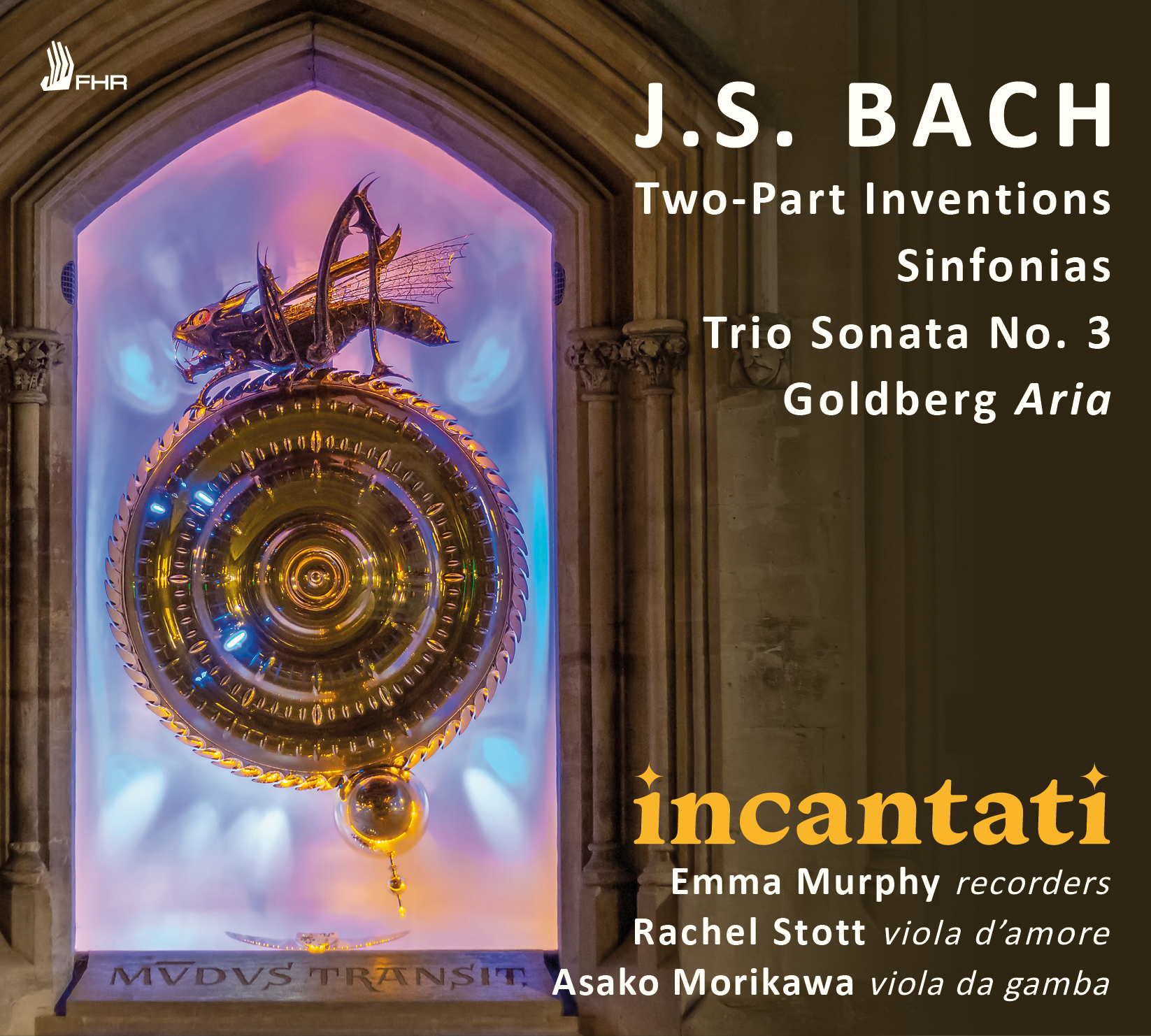
incantati [Emma Murphy (soprano/alto/tenor recorders, voice flute); Rachel Scott (viola d’amore); Asako Morikawa (viola da gamba)]
J. S. Bach Inventions, BWV772-86 (selection): no.1 in C; no.2 in C minor; No.4 in D minor; No.7 in E minor; no.8 in F; no.10 in G; No.11 in G minor; No.13 in A minor; No.15 in B minor. Sinfonias, BWV787-801 (selection): no.1 in C; no.4 in D minor; no.8 in F; no.9 in F minor; no.11 in G minor; no.13 in A minor Chorale-Preludes: Herr Jesu Christ, dich zu uns wend BWV655; Wer nur den lieben Gott lässt walten BWV691; Allein Gott in der Höh sei Her BWV716 Trio Sonata no.3 in D minor BWV527 Trio Sonata no.6 in G major BWV530/2 Aria in G major (from Goldberg Variations BWV988)
First Hand Records FHR122 [59’48”]
Producer Tom Hammond Engineer John Croft
Recorded 19-21 May 2021 at Church of the Ascension, Plumstead, London
Reviewed by Richard Whitehouse
What’s the story?
The trio incantati performs a miscellany of pieces by Bach, including selections from the two-part Inventions and the three-part Sinfonias, excerpts from the trio sonatas and several chorale preludes in what is a diverting hour-long recital by three complementary Baroque instruments.
What’s the music like?
Both the Inventions and Sinfonias stem from Bach’s period in service to Prince Leopold of Anhalt-Cöthen during 1717-23. Both sets comprise 15 pieces that ascend in chromatic order (from C major to B minor) and they explore a range of formal and contrapuntal possibilities. While the Inventions are often canonic and the Sinfonias are mainly fugal, there are various instances where Bach allows his melodic inspiration full rein. Conceived as teaching pieces they may have been – most notably for his eldest son, the talented though quixotic Wilhelm Freidemann – but there is never any feeling that these cannot be appreciated as music for its own sake. Perhaps the ideal way to enjoy them is to play them, but few of those who do will find themselves able to match the discipline and insight conveyed by the present musicians.
Also included here are three chorale-preludes which can be found in either of the Notebooks for Anna Magdalena Bach that the composer assembled from a variety of sources (including music by other composers) while at Cöthen and later at Leipzig. Although these may be less intricately textured than the two- and three-part pieces, their focus on elaborating the melodic line against a spare if pertinent harmonic accompaniment brings its own rewards. Otherwise, the trio sonatas are drawn from the set of six Bach likewise assembled in Leipzig and which also derive from pedagogic material written with Wilhelm Friedmann in mind. The third of these pieces is included here complete – its three movements being ruminative, eloquent and vivacious. The Aria on which Bach based his Goldberg Variations makes for a limpid envoi.
Does it all work?
It does. For all its economy and restraint, this music is never easy to perform and record such that the delicate interplay can be savoured in real-time – but incantati and Chiaro Audio have done just that. It helps when the pieces played have been judiciously chosen to underline the variety that Bach draws from his textures and in relatively diverse contexts. Put another way -none of this music is unfamiliar even to non-specialists, but hearing it played thus ensures it is not predictable. Ivan Moody’s succinctly informative notes are an additional enhancement.
Is it recommended?
Indeed. As recommendable as this release is in musical terms, it also and regrettably serves a commemorative function. Emma Murphy, who died in August from the effects of an auto-immune disorder just before her 50th birthday, was among the leading recorder players of her generation and respected advocate for her instrument whether as performer or teacher. Tom Hammond, who died last December from heart failure at 47, was a musician of many talents – trombonist, conductor (notably those premieres of Matthew Taylor’s Third Symphony and his Flute Concerto) of Sound Collective and Sinfonia Tamesa, teacher (masterclasses on the occupied West Bank in Israel), co-organizer of Hertfordshire Music Festival and producer for Chiaro Audio. This proved to be their final recorded project, and both will be greatly missed.
Yesterday we learned of the incredibly sad news that the pianist Lars Vogt had died, at the age of 51.
The warmth and appreciation of tributes paid to him from fellow artists yesterday evening testify to his warm personality, strength of character and great musicianship. Lars was diagnosed with cancer early in 2021, but even in his chemotherapy found that playing the piano channelled the most positive energy and feeling. Here, for instance, is a wonderful performance of Mozart’s Piano Concerto no.24 given as part of the Parnu Festival with the Estonian Festival Orchestra and Paavo Järvi.
Lars was an extremely versatile artist, either as a soloist, chamber musician or conductor. Regular partners included violinist Christian Tetzlaff and cellist Truls Mørk, while he took part in a formidable piano trio with Christian and cellist Tanja Tetzlaff. He also proved himself a conductor of some note from the keyboard, directing the Royal Northern Sinfonia from the piano in recordings of the concertos of Beethoven and Brahms, and the Orchestre de Chambre de Paris in the concertos of Mendelssohn.
His orchestral partners spoke of him with great warmth, and certainly his time in Newcastle with the Royal Northern Sinfonia was characterised by energetic, creative music making and seasonal planning. My own memories of solo performance run back to a spellbinding account of the Goldberg Variations at Wigmore Hall:
As a concerto soloist I also recall a memorable account of Brahms’ Piano Concerto no.2 with the BBC Symphony Orchestra and Jiří Bělohlávek at the Proms:
As a recording artist, Vogt enjoyed many peaks, mostly in the company of the Ondine label. The playlist below brings together just a section of these recordings, in the knowledge that a couple more are yet to be released.
He will be greatly missed, and we send condolences to all his family and friends. His lasting gift to us is in the form of recordings we will treasure greatly:
This joyful piece of music was written by Bach in Leipzig, in April 1725. It has four vocal soloists, who take on the parts of Mary Magdalene (alto), the ‘other’ Mary (soprano) and the apostles Simon Peter (tenor) and John (bass).
It is a relatively short work, with a bright orchestra consisting of trumpets, timpani, wind and strings, and its celebratory air is perfect for the festival as it tells of the events of the first Easter day.