
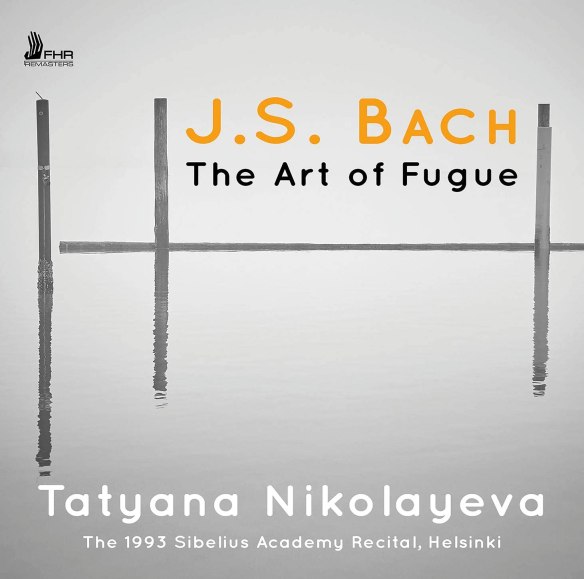
On record – Tatyana Nikolayeva plays Bach: Die Kunst der Fuge (First Hand)

Johann Sebastian Bach
Die Kunst der Fuge (The Art of Fugue) BWV1080 (c1740-50)

Tatyana Nikolayeva (piano)

First Hand Records FHR95 [87’58”]

Producer/Engineer Pekka Purhonen

Live recording, 26 April 1993 at Sibelius Academy, Helsinki

Written by Richard Whitehouse

What’s the story?

First Hand Records follows its earlier release of Tatyana Nikolayeva (Athens 1989, FHR46) with this performance of The Art of Fugue, recorded in Helsinki just seven months before her death and capturing her singular perspective on Bach’s unfinished swansong to potent effect.

What’s the music like?

Fanciful notions of Bach labouring over this compendious sequence literally on his deathbed may have long been put to rest, but The Art of Fugue remains the last in a succession of ‘late’ works – following on from the Goldberg Variations and The Musical Offering – in which the ageing composer sought to distil a lifetime’s accrued knowledge into music of rigorous, some would say arcane abstraction. Certainly, what Bach himself seems initially to have envisaged as a technical manual for the perfecting of fugal technique duly became a treatise as has been likened to Cicero’s codifying of Latin – beyond which, no further evolution seemed possible. Even the means of realization has remained conjectural, but a keyboard instrument arguably ‘translates’ the content of these increasingly intricate constructions with the greatest clarity.

Uncertainty also surrounds the exact order of the individual components: specifically whether the four canons should be placed immediately prior to the final fugue, favoured by C.P.E. Bach in the first published edition, or interspersed between those fugues at regular intervals so as to demarcate actual groupings – as indicated by surviving autograph sources and followed with increasing frequency in recital. Nikolayeva rightly opts for this latter premise, and while one might have preferred for the Canon alla decima to have been situated after Contrapunctus 13 (itself rendered prior to Contrapunctus 12), the formal focus and cumulative expressive intensity of her performance cannot be gainsaid. Bach clearly intended a methodical increase of complexity to be perceptible ‘in real time’, and this is exactly what Nikolayeva conveys.

As to Contrapunctus 14, that likely quadruple fugue left unfinished by Bach at his death and which has been completed by numerous composers and musicologists (notably Donald Tovey from among the latter), Nikolayeva plays this as it appears in Bach’s manuscript – breaking off at bar 239 as though any continuation might be sensed though not realized. It is a credit to her sustained conviction that the audience, which has stayed with her for almost one-and-a-half hours, is momentarily caught unawares by the sudden silence which ensues – thereafter responding enthusiastically. Credit, moreover, to FHR in utilizing the extended duration that has long been feasible on CD and so presenting this account as the uninterrupted span it was experienced as at the time. Few musical works need to be heard thus, but this is one of them.

Does it all work?

Yes, despite a smattering of memory lapses (as detailed by Jonathan Summers in his booklet note) and rather dry sound whose perspective nonetheless renders Nikolayeva’s pianism with commendable naturalness. Those wanting her interpretation of the work need look no further.

Is it recommended?

Indeed. David Murphy has done an excellent job in opening out the original recording without detriment to the rapport between pianist and audience during what was a memorable occasion. Hopefully, there may be other such Nikolayeva performances still to be found in the archive.

Listen

Buy

You can discover more about this release at the First Hand Records website, where you can also purchase the recording.

Playlist – Bing & Ruth

It gives us great pleasure to welcome Bing & Ruth frontman David Moore to Arcana’s playlist section.
We have been talking with David about the new Bing & Ruth album Species, due for release on Friday 17 July – and his experience of lockdown and recent world turbulence, onto which he effectively has a front window from his New York home.

David’s playlist reflects his deep love of Bach, with the Chaconne from the Solo Violin Partita no.2 in D minor acting as the centrepiece. Leading up to this we have the vibrant Toccata from Sergei Prokofiev, which contrasts with the winsome Sales Tax On The Women from The New Lost City Ramblers. Sons of Kemet‘s incendiary cut All Will Surely Burn is next, before Smoke Dawson‘s Pretty Polly, from the Fiddle album, transports us to the great wide open.

The Bach follows the rich colours and harmonies of Miles Davis‘ Gershwin elaboration Fisherman, Strawberry and Devil Crab – after which we hear the sonorous Farfisa tones of Bing & Ruth‘s Live Forever, an extended highlight from the new album.

Rudy Van Gelder‘s remix of Gene Ammons‘ sultry Hittin’ The Jug is next, then The Carter Family‘s The Storms Are On The Ocean, a poignant song thought to date from the early 1930s. Just a few years separate this from The Ink Spots’ I Don’t Want To Set The World On Fire, a rather beautiful song with which to close.

Our thanks to David for this inspiring collection of music. Stay tuned for the full interview and a review of the new album.

Bing & Ruth’s album Species is out on Friday 17 July from 4AD. You can pre-order it from the Bandcamp embed below

In concert – Steven Isserlis & Mishka Rushdie Momen @ Wigmore Hall

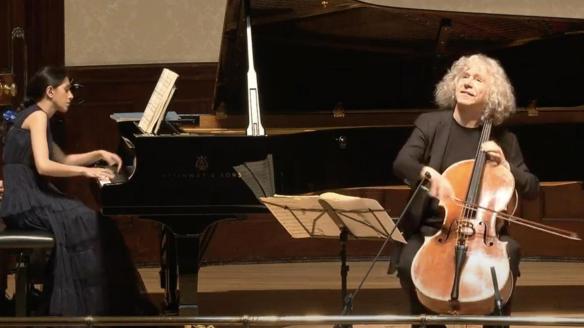
It must have been extremely special for Steven Isserlis to be playing the music of three of his favourite composers at the Wigmore Hall on this day – even more so as the date fell on the birthday of one of them, Robert Schumann.

He is one of the cellist’s greatest musical loves, and the sense persists that Isserlis is still discovering more things that make it so. One of Schumann’s many strengths is the versatility of his music, meaning pieces such as the 3 Romances Op.94, originally written for oboe and piano and given to his wife Clara as a Christmas present in 1849, can easily be performed with violin or, indeed, the cello.

Schumann’s birthday was marked by a performance of unaffected romantic beauty from Isserlis and pianist Mishka Rushdie Momen, very much on an equal footing playing the composer’s first instrument. The pair caught the doleful and slightly inquiring nature of the first romance beautifully, while the surge of feeling in the central music of the second was a strong cumulative wave. The third, its theme given in a darker shade, was briefly introspective in its unison phrases but then more overtly passionate.

Before Schumann came another ‘birthday’ composer. Beethoven’s 250th is not likely to receive quite so much live coverage as it would have done in a year without a pandemic, but what it lacks in quantity it will surely make up for in quality. The Sonata for piano and cello no.1 in F major, the first of a pair published as the composer’s Op.5, is the ideal concert opener. It begins in slight trepidation of what it is about to discover, but then, on establishing what is effectively a new form of writing for the cello and piano together, throws itself headlong into the rapids.

The Allegro that comes after that first sense of discovery was joyous indeed, with lovely dialogue in play between the two protagonists. Isserlis smiled frequently, as though revelling in the combination of favourite music and venue once again, while Momen’s clear phrasing dovetailed neatly with the cello’s, owning some of the really tricky right hand runs with fearless accuracy.

The second movement had a terrific burst of energy, the sun breaking through at every possible opportunity when its catchy theme made several reappearances. The pair also gave a nice air of mystery when Beethoven suddenly departed from ‘home’ and ended up in a number of seemingly unrelated tonal centres, before reassuring us with the warmth of the home key once again.

As he introduced his favourite 20th century cello sonata, there was a sense of Isserlis’ heart almost bursting with the chance to play music live again. He described his discovery of Fauré’s late music as ‘being outside a door but then passing through and wondering why on earth I had been outside’, before the pair played the Cello Sonata no.1 in D minor Op.108, the first of two such works from the Frenchman.

This was a very fine performance indeed, Isserlis and Momen watchful and urgent at the start, its music wracked with uncertainty but nonetheless pushing forward with great conviction. The Andante slow movement began lost in thought, the bell-like toll of the piano matched by Isserlis’ rich legato tone, before reaching heights of passion that the final movement also delivered, the performers now glorying in the major key and Fauré’s bursts of sunshine, the strong resolve of the first movement bringing its ultimate reward.

The pair finished with a profound account of Isserlis’ own transcription of a Bach chorale prelude, Ich ruf’ zu dir, Herr Jesu Christ, in which – as the cellist noted – Bach says it all.

In concert – A week locked into Wigmore Hall

At 1pm on Monday June 1st, live music-making returned to the Wigmore Hall and BBC Radio 3.

While we have been incredibly fortunate to enjoy live streams of music from around the world since lockdown began, this felt like something extra special. A whole month of lunchtime concerts, served up by our finest chamber music venue in conjunction with BBC Radio 3, and streamed on the Wigmore Hall website. With a selection of top class artists, all of whom live close enough to journey in and play, all that was missing was the audience – but this added extra poignancy, offering us private moments with the musicians in our own home, a deluxe version of what BBC Radio 3 has been giving us for decades. A note should be made for presenter Andrew McGregor‘s broadcasting manner, expertly paced and perfectly weighted.

The musical riches in the first week have been many and varied. The first concert was ideally placed, Steven Hough giving us Busoni’s epic realisation of Bach’s Chaconne in D minor and Schumann’s lovelorn Fantasie in C major. In some performances of the Bach-Busoni the virtuoso elements of the piece take over at the expense of feeling, but not here. Hough shaped the phrases with great care, bringing out the gusto when it was needed but giving an incredibly well-balanced account of a familiar showpiece.

With Schumann’s Fantasie he gave a flowing performance of a notoriously difficult work, made all the more poignant because of its circumstances, written in isolation by a composer pining for his wife Clara. There was joy, too – the march theme of the second movement ringing out with bell-like clarity, while the resolution at the end, softly voiced, left a lasting smile.

Tuesday’s song recital from soprano Lucy Crowe and pianist Anna Tilbrook had the themes of Hope and Longing – appropriately in the awful context of world events, which saw the concert begin with a two-minute period of reflection on racial inequality and violence.

Crowe began on high, judging her vibrato beautifully for Thomas Arne’s aria O ravishing delight, before three Schumann songs found her vocal control matched by her communication with the audience, in spite of the empty hall. The sound world of Berg’s 7 frühe Lieder is very different, with challenges of tricky melodic intervals and words by seven different poets, but the soprano handled them effortlessly, helped by Tilbrook’s painterly application of light and shade for the corners of Berg’s nocturnal settings.

The pair moved on to a selection of poignant folk songs, none more so than the unaccompanied She moved through the fair, before English lyrics old and new from Thomas Dunhill, Ivor Gurney, Vaughan Williams and Madeline Dring. It was a touching recital with both soprano and pianist clearly on the same page.

Few guitarists would expect to receive compliments on the quality of their quiet playing…but that was what stood out immediately from Sean Shibe’s solo recital on the Wednesday. With a collection of attractive Scottish dances the listener was drawn in from the start and borne to the beauty of the Highlands, the tunes carrying on the air in performances of extraordinary intimacy.

The same could be said for Shibe’s performance of Bach’s Lute Suite in E minor, carefully studied but delighting in the expressive interplay between the parts, bringing Bach’s notes clean off the page. Steve Reich’s Electric Counterpoint was even better, Shibe moving to a Fender to play the 12th part of this multilayered composition. The waves of sound echoing around the Wigmore as the guitarist, now barefoot, completely lost himself in the music.

Oboist Nicholas Daniel and pianist Julius Drake, both Wigmore regulars and musical partners for 40+ years, crammed their Thursday lunchtime with music old and new, all of personal significance.

They included two short premieres, the wide open textures of Huw Watkins’ haunting Arietta and the uncertainties of Michael Berkeley’s A Dark Waltz, written in lockdown. There was a rarity,too, in the first broadcast performance of Liszt’s darkly coloured Élegie, originally written for cello and piano but here in a recently unearthed version with for cor anglais.

Howard Ferguson’s arrangement for oboe and piano of Finzi’s substantial Interlude was beautifully paced and deeply felt in that slightly elusive way in which the composer writes, Drake absorbing the extra parts with ease. Meanwhile Ferguson’s arrangements of three pieces for pedal piano by Schumann studies were also nicely done. Later we heard three attractive shorter pieces from Madeline Dring, and finally Nicholas Daniel showed off the oboe’s versatility in three rewarding arrangements of popular songs, including The Girl From Ipanema and capped by All The Things You Are. A note, too, for the pair’s deeply felt and beautifully observed Bach encore, Jesu, Joy of Man’s Desiring, prefaced by a sensitive introduction.

Last but not least, Pavel Kolesnikov and Samson Tsoy reminded us what an intimate form of communication the piano duet can be. As the pair live together they have experienced isolation in each other’s company, and that in itself brought an extra poignancy to their lovingly played selection of BrahmsLiebeslieder Waltzes, a profound Schubert Impromptu in A flat from Tsoy and a bittersweet clutch of six Waltzes, Ländler & German Dances from Kolesnikov.

Together the pair enjoyed the humour and lightness of touch in Beethoven’s 8 Variations on a theme of Count Waldstein, but the best was saved for last and a wonderful performance of Schubert’s Fantasia in F minor. Recognised as one of the finest works in the piano duet repertoire, it received a performance led by Tsoy that moved from almost painful introspection to passionate outbursts five minutes later. The scherzo section had plenty of cut and thrust, while the whole piece, ideally paced, built to an almost overwhelming strength of feeling, capped by an intensely dramatic pause before the softly voiced opening theme returned.

What a musical week it has been – and looking at the roll call it looks like we are in for another three weeks of equally fine and moving insights. You can catch up with all the concerts on the links above and are strongly advised to do so, for there are some incredibly fine performances waiting to be heard. Live concerts may not be with us for a while yet, but in the meantime these intimate hours with some of our best classical music artists are an ideal substitute.

You can see the schedule for forthcoming Wigmore Hall livestreams here, the series resuming courtesy of cellist Steven Isserlis and pianist Mishka Rushdie Momen on Monday 8 June.

Online music recommendations – Chamber Music Scotland, City of London Sinfonia & Sandy Burnett’s Listening Club

The online options for music lovers continue to grow – but here at Arcana we wanted to highlight three in particular.

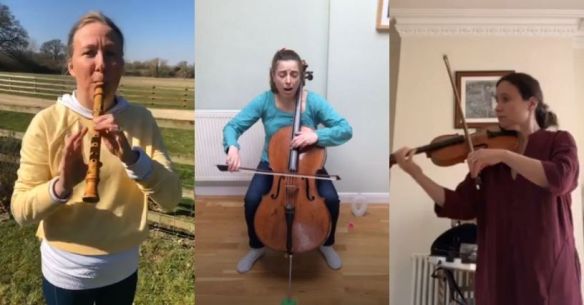
First is a rolling recommendation, for the City of London Sinfonia and their Comfortable Classical at Home series (pictured above). This has been a really excellent series of discovery, catering for all levels of knowledge including beginners, the musically curious and those looking for fresh insight into familiar pieces.

Members of the orchestra are clearly at home in front of the camera, and the next instalments – from principal clarinet Katherine ‘Waffy’ Spencer (Thursday 21 May) and cellist Becky Knight (Tuesday 2 June) are set to be every bit as enjoyable as the series so far – which can be seen on the orchestra’s Facebook channel. It is well worth considering a donation to the orchestra through that page too, recognising the problems musicians are having finding work in lockdown.

Also well worth exploring is Chamber Music Scotland, who are offering a weekly series of streamed concerts and lectures. Future appearances are scheduled from guitarist Sasha Savaloni and a trio of flautist Georgia Browne, violinist Tuomo Suni and harpsichordist Tom Foster.

The next online event from Chamber Music of Scotland is tonight, Wednesday 20 May. It will be presented by cellist David Watkin, who will be looking for meaning from the solo cello works of J.S. Bach in quarantine. Bach’s music is proving particularly popular in lockdown, presumably due to its suitability for one performer, who can take on the rich part writing to sound like several people at once. You can watch this on the organisation’s YouTube channel, where you can also catch up on previous episodes:

Finally a nod in the direction of Sandy Burnett, who is running a summer-long online Listening Club. Every Tuesday at 11am Sandy, a highly respected broadcaster and musician, will offer his own insights into a chosen classical work in his typically engaging and informative style. The next, on Tuesday 26 May, will focus on Bach and his Sonata for Solo Violin in G minor – while future instalments will include works by Weill, Mozart, Monteverdi, Messiaen and Beethoven. You can join the Listening Club here