
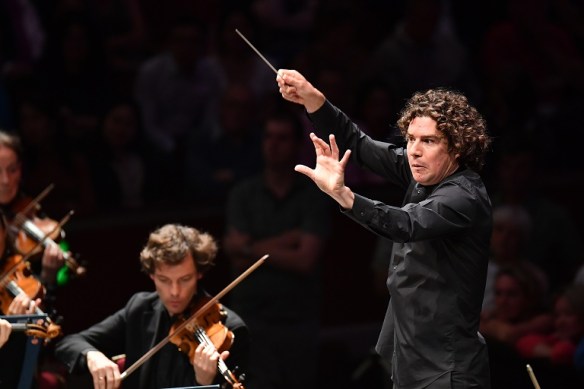
BBC Proms 2017 – Christian Tetzlaff, Scottish Chamber Orchestra & Robin Ticciati: Brahms, Berg, Thomas Larcher & Schumann’s ‘Rhenish’ Symphony

Prom 40: Christian Tetzlaff (violin), Scottish Chamber Orchestra / Robin Ticciati

Brahms Tragic Overture Op.81 (1880)

Berg Violin Concerto (1935)

Thomas Larcher Nocturne – Insomnia (first UK performance) (2008)

Schumann Symphony no.3 in E flat major Op.97, ‘Rhenish’ (1850)

Royal Albert Hall, Tuesday 15 August 2017

You can listen to this Prom here for 28 days from the date of the performance

The Scottish Chamber Orchestra are one of the UK’s finest ensembles, and they proved their worth once again with outgoing chief conductor Robin Ticciati leading a fine Prom tracing a course from darkness to light.

Brahms’s Tragic Overture is one of the composer’s deepest orchestral statements, and Ticciati was determined to present its steely side. Often the strings were without vibrato, the lean sound complemented by raucous horns and open textures in the woodwind. Lower strings growled ominously, and only the softer woodwind passages offered occasional respite in their beautifully choreographed choir.
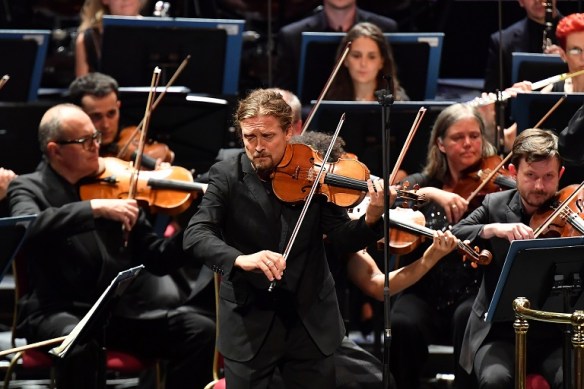
Berg’s Violin Concerto contains music of similarly ominous qualities, in this case uncannily heralding the composer’s final year despite its dedication elsewhere. Though the violin begins with elegiac tones it has a broad emotional range, and Christian Tetzlaff (above) rose magnificently to the occasion, finding Berg’s many and varied colours but crucially balancing them with the excellent orchestral contributions.

The coded messages Berg inserts into the music were on occasion stripped bare, and the anger at the heart of the second movement was almost completely unconcealed. Its crowning moment lies in quiet simplicity, however, and when the quotation of Bach’s chorale Es Is Genug arrived on clarinets the mellow tones were deeply moving. Capping the concerto with his rise to a high ‘G’ at the end, Tetzlaff held the note at a barely audible volume so that it sounded like one last breath in his ascent to another world.

As the evening progressed the darkness drew in ever more closely for Thomas Larcher’s Insomnia Nocturne, an orchestral piece receiving its first UK performance. Written for a relatively small orchestra of eighteen, it was an uncomfortably accurate portrayal of sleep’s refusal to take hold, with a high pitched glockenspiel tone becoming particularly tiresome. Sitting in the background, its tone made an uncomfortable backdrop for the increasingly fractious instrumental activity in front, which finally subsided into a fitful slumber, the sort where it is already too late in the night to be rescued. The piece began with promising tonal material, but in a manner akin to insomnia this was rendered much less appealing by the end.

Thankfully Schumann’s Rhenish Symphony was on hand to pierce the darkness with music of unrestrained joy. The opening surge is one of the happiest in all classical music, and like the river on which it is based it takes everything with it downstream. The Scottish Chamber Orchestra were superb, the lofty horns enhancing the open-air sound while the woodwind worked together in beautifully shaded colours, as did the strings with more vibrato this time.

If anything the second movement Ländler was even better, flowing forward with purpose and charm, while the Intermezzo following also had a softer heart. The mood became solemn for Schumann’s powerful evocation of Cologne Cathedral in the fourth movement, the symphony turning inwards with self-doubt and contemplation, but from this the finale emerged with resolve and conviction.

A strong Prom, then, the Scottish Chamber Orchestra giving us something old (Brahms and Schumann), something new (Larcher), something borrowed in the Berg and something blue in the mood that ran throughout. Thankfully the shade of this particular blue changed from deep and dark at the outset to a bright and breezy azure by the end.

Ben Hogwood

Stay tuned for the next in Arcana’s Ask The Audience series, where Sam Hogwood will give her verdict on the Scottish Chamber Orchestra Prom. Coming shortly!

Wigmore Mondays – Annelien Van Wauwe & Nino Gvetadze play Debussy, Poulenc & Brahms

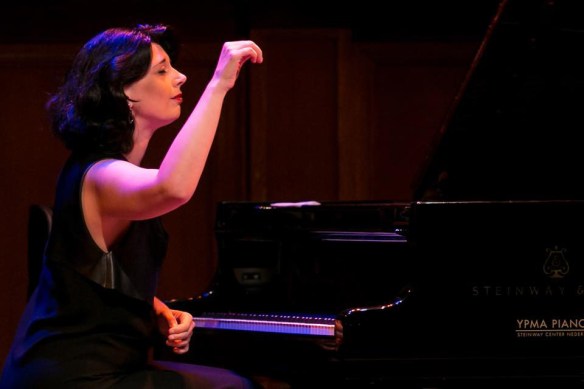
Annelien Van Wauwe (clarinet, above) and Nino Gvetadze (piano, below)
Debussy Première rapsodie (1909-10)

Poulenc Clarinet Sonata (1962)

Schumann Arabeske in C major, Op 18 (1838-9)

Brahms Clarinet Sonata in E flat, Op 120 No 2 (1894)

Wigmore Hall, London; Monday 20 March, 2017

Listen to the BBC broadcast here

Written by Ben Hogwood

The soft, languid tones of Annelien Van Wauwe’s clarinet were perfectly judged at the hushed start of Debussy’s Première rapsodie, the first piece in a nicely chosen set of music for clarinet and piano.

This piece is an elusive ten-minute train of thought, with two distinct ideas – the slow, sleepy opening paragraph (from 1:40 on the broadcast link) and another, spiky idea (around 3:42), begging for a jazz accompaniment. Gradually the two get closer together and the cumulative energy builds. Nino Gvetadze’s colourful piano accompaniment showed just how suitable the piece is for orchestra – which Debussy realised with a subsequent arrangement.

Poulenc’s Clarinet Sonata is one of his last published works, written in homage to fellow composer Arthur Honegger. Central to its success is the yearning theme of the central Romanza (16:36), where Van Wauwe’s tone and phrasing was beautifully observed. The first movement (beginning at 11:24) could have been a bit more mischievous, perhaps, but the brisk and largely upbeat finale (21:22) certainly hit the spot.

Following this was a chance for Gvetadze to take centre stage in Schumann’s lilting Arabeske (25:40), where wife Clara explicitly asked him to avoid making musical references to her. I’m not convinced he kept that bargain, because the music is very affectionate, and Gvetadze portrayed that too.
We then heard Brahms’ last published chamber work, the last part of an Indian summer instigated by the clarinettist Richard Mühlfeld, whose quality of tone directly inspired four pieces from the composer. This included a pair of sonatas published in 1894 as Brahms’s Op.120. These are lovely autumnal works, and both performers shaded the E flat work, the more positive of the two, with appropriate care. More authority could perhaps have been given to the second movement (marked Allegro appassionato, from 43:26 on the broadcast) but the outer movements had plenty to admire. The first movement (from 35:09) was largely contented, while the last, a theme and variations (48:50), was more changeable in mood and brilliantly played here, Brahms’ inspiration as keen as ever.

A final thought – what will Brexit mean for the non-English contingent the BBC choose for their excellent New Generations scheme? One of many questions classical music and the arts will face in the coming months and years.

Further listening

Brahms’s last works for clarinet are collected in the playlist below. They are autumnal in nature but have some wonderful lyrical writing for the instrument.

Live: Jörg Widmann & Mitsuko Uchida at the Wigmore Hall

jorg_widmann_clarinet_040_c_marco_borggreve_crop

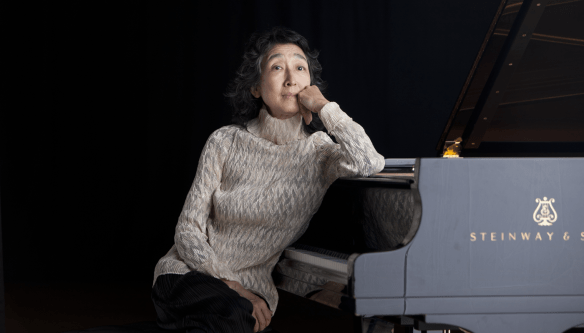
Jörg Widmann (clarinet, above – photo by Marco Borggreve) & Mitsuko Uchida (piano, below)

Wigmore Hall, Thursday 9th February, 2017

Brahms Clarinet Sonata in F minor Op.120/1 (1894)

Berg 4 Pieces for Clarinet and Piano Op. 5 (1913)

Widmann Fantasie for solo clarinet (1993)

Schubert Impromptu in C minor D899/1 (1827)

Widmann Sonatina facile (2016, UK première)

Schumann 3 Fantasiestücke Op.73 (1849)

Written by Ben Hogwood

The sound made by the clarinet is surely one of the most beautiful in classical music.

Yet, as Jörg Widmann reminded a packed Wigmore Hall when playing his Fantasie for solo clarinet, the instrument’s qualities extend far and wide. Widmann explored multiphonics – playing more than one note at once – and also used the clarinet to evoke a lilting Alpine dance, some outrageous Gershwin-style slides and baleful, shy asides as though he was the only performer in the room.

Widmann has been chosen as the Wigmore Hall’s Composer in Residence for 2017-18. It is a chance to appreciate his versatility, for clarinet pieces are one side of a substantial catalogue. He has written for solo piano, but although Mitsuko Uchida’s UK premiere performance of the Sonata facile was superbly characterised, it was not as successful musically. Widmann takes Mozart’s Piano Sonata in C major, K545, as a starting point, but he effectively screws up the pages of the work, distorting and fragmenting so that they did not quite add up to a meaningful whole.

mitsuko-uchida-240815Far more purposeful was Uchida’s performance of Schubert’s first published Impromptu, where we explored the composer’s very heart through an interpretation that had the hall on the edge of their seats. The repetitive march theme was darkly coloured, but the transition from minor key to major brought brilliant shafts of light under Uchida’s quick fingers.
When the two musicians played together the results were electric. In spite of a mobile phone that rang for more than a minute, and a hearing aid that shrilled in close proximity to the pitch of Widmann’s clarinet, their Brahms was beautifully poised. The Clarinet Sonata in F minor Op.120/1 is a late, nocturnal treasure, its tension giving way to an autumnal glow in exchanges between the instruments that behave as though they are old friends. This performance caught that intimacy, especially in the slow movement, and enjoyed the dance of the finale with a spring in its step.

Schumann’s 3 Fantasiestücke faired similarly, closing the program wreathed in smiles, despite the occasional furrowed brow in the first piece. Here the interaction was again on the most intimate of scales, Widmann’s control exquisite in the slower music and matched by Uchida’s voicing of the individual parts.

Even better was the duo’s performance of Berg’s 4 Pieces for Clarinet and Piano, a relatively early publication from 1913 that explores the outer limits of tonality. The mysterious second piece had an extraordinary inner tension, fully released in a flurry of notes, while the last piece, also slow, hung on the air for an age.

Widmann’s control here was almost superhuman, and although he admitted to being out of breath after the Schumann, he and Uchida gave a substantial encore by the 14-year old Mendelssohn. The graceful second movement from his Clarinet Sonata sounded like the work of a much older man, and was lovingly played.

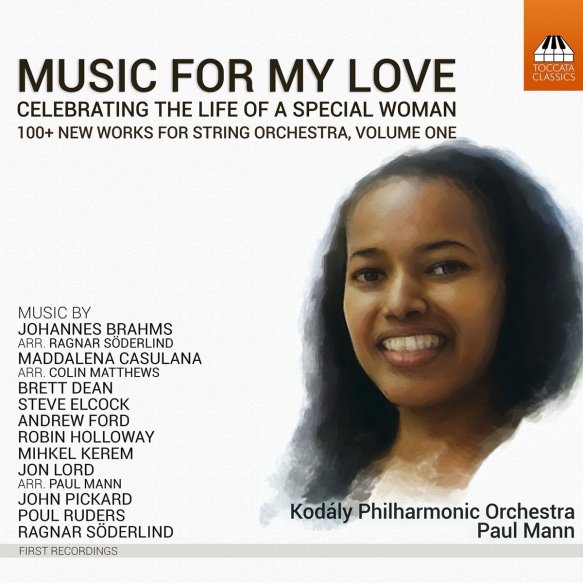
On record: Music For My Love (Toccata)

music-for-my-love

Brahms (arr. Söderlind) Von ewiger Liebe
Casulana (arr. C. Matthews) Il vostro dipartir
Dean Angels’ Wings (Music for Yodit)
Elcock Song for Yodit, Op. 23
Ford Sleep
Holloway Music for Yodit
Kerem A Farewell for Yodit
Lord (arr. Mann) Zarabanda Solitaria
Pickard …forbidding mourning…
Ruders Lullaby for Yodit
Söderlind 15 Variations on a Norwegian Folktune

Kodály Philharmonic Orchestra / Paul Mann

Summary

The Music For My Love project has its basis in the life, cut short by cancer, of Yodit Tekle – the Eritrean-born partner of Martin Anderson, whose desire to commemorate her in music led to his contacting those composers he knew personally, resulting in over 100 pieces for string orchestra which he intends to record for his Toccata Classics label. This first volume takes in eight pieces and three arrangements, ranging from around two minutes to a full quarter-hour.

What’s the music like?

Appreciably more varied in expression than might be expected given the context.

Among the original pieces, Robin Holloway has written a pensive elegy whose dance-like central section offers but minimal contrast, whereas Poul Ruders contributes a wistful and affecting lullaby. Mikhel Kerem’s miniature amply sustains its rapt atmosphere, while Andrew Ford takes an earlier vocal setting for his gentle round-lay. Steve Elcock conveys a consolatory mood via the subtlest of means, then Brett Dean draws on an earlier piano piece in music of ethereally diffused harmony. John Pickard draws more obliquely upon an earlier cello piece for what is the most animated of these works in its textural contrasts, while Ragnar Söderlind takes the Norwegian folksong Oh, the cooling wind as the basis for 15 variations whose cumulative impact feels a little diffused in context – for all that its emotional consistency is undeniable.

Among the arrangements, the late Jon Lord’s evocative sarabande for string quartet responds effortlessly to Paul Mann’s skilful adaptation. Framing the sequence overall, Söderlind makes of Brahms’s song a threnody of Grieg-like plaintiveness, whereas Colin Matthews draws out the assertive eloquence inherent in a madrigal by the still little-known Maddalena Casulana.

Does it all work?

Indeed, given that it would have been all too easy to assemble a programme unrelieved in its emotional range. Thanks to judicious sequencing of the pieces at hand, this disc amply fulfils its commemorative function while also making for an hour’s absorbing listen in its own right.

Is it recommended?

Absolutely, not least as the Debrecen-based Kodály Philharmonic Orchestra responds with commitment to Paul Mann’s direction. The sound endows the string textures with plenty of space and definition, while booklet annotations are as comprehensive as ever from Toccata.

Richard Whitehouse

Further instalments in this worthwhile project are much anticipated: in the meantime, read more about its continuation via the Toccata Classics website

Wigmore Mondays – Marie-Elisabeth Hecker & Martin Helmchen

hecker-helmchen

Marie-Elisabeth Hecker (cello) & Martin Helmchen (piano)

J.S. Bach Viola da gamba Sonata no.3 in G minor, BWV1029 (late 1730s-early 1740s) (14 minutes)

Stravinsky Suite Italienne (arr. Piatigorsky) (1932/33) (20 minutes)

Brahms Cello Sonata no.1 in E minor Op.38 (1862-5) (23 minutes)

Listen to the BBC Radio 3 broadcast here, until 23 November

Arcana’s commentary

Pairing Bach with Brahms was a smart move for this concert.

When Bach was writing for the viola da gamba – essentially an early form of cello with no spike and sometimes five strings! – he was one of the first to recognise its potential as a treble instrument as well as a bass.

To that end the three sonatas he published for viola da gamba and ‘continuo’ – which in this case would normally mean a harpsichord. The pieces transcribe well for modern cello and piano though, as can be heard from 1:35 on the broadcast. It took a little while for Marie-Elisabeth Hecker to settle her tone and intonation in this performance, but once evened out the performance is notable for its clarity and expression at the higher end of the cello. This becomes especially obvious in the Adagio slow movement (from 7:00), which takes the form of an aria. The last movement (12:22) is like a fugue, with its question and answer phrases.

Stravinsky’s Suite Italienne comes from a period in his compositional life where he was looking back to the music of classical and baroque times, taking that music as inspiration, and remoulding it into something that sounded much more modern. For his ballet Pulcinella he took the music of Pergolesi (1710-1736) – or a contemporary, as was recently suggested – and gave it new musical clothes, with spiced-up harmonies and colourful orchestration. Several movements from Pulcinella were reworked for violin and piano to become the Suite Italienne, after which point the cellist Gregor Piatigorsky realised with a few more tweaks he could expand the repertoire of his own instrument.

This was done with Stravinsky’s approval, and the results – as you can hear from this concert – are invigorating and humourous. The nip and tuck between cello and piano is brilliantly caught in the Tarantella (29:49) but in truth all the movements carry the same levels of excitement – running through a sprightly Introduzione (17:33), Hecker’s graceful Serenata (20:00), a surprisingly vigorous Aria (23:45), a sombre and slow Minuetto that grows in stature (32:30) before leading into the vivacious Finale (34:48)

The Brahms (beginning at 39:25) is a piece that also looks back for its inspiration – to Bach, who inspires the finale (55:29) and perhaps to classical composers for the second movement minuet (50:00)

Marie-Elisabeth Hecker and Martin Helmchen give a superb and very fluent performance of this work, getting the balance between cello and the active piano part just right. The similarities between Brahms and Bach are clearest in the two composers’ use of counterpoint – that is a number of different melodies being played simultaneously or in complement to each other.

The flow of melodies in the first movement is unbroken and rather beautiful, especially when the piano briefly switches to a major key (42:13) Elsewhere the mood is darkly passionate and powerfully played.

The Minuet has an attractive poise, enjoying the relative mystery of its central section (from 51:43) while the finale has a steely sound to its theme from the piano (55:29) and the cello’s response (55:37) – all set out as a fugue, developing considerable momentum through to the end, which is straight faced but roundly optimistic at the same time.

This was a brilliantly played account of the Brahms, ideally balanced and communicating the composer’s rich abundance of melodies.

Further listening

The Spotify playlist below – Looking back to move forward – examines more of Brahms and Stravinsky’s use of techniques of the past to shape their own music of the future. You can also hear Marie-Elisabeth Hecker and Martin Helmchen in their new disc of the Brahms Cello Sonatas.

by Ben Hogwood