In concert – Boris Giltburg plays Ravel, Schumann & Prokofiev @ Wigmore Hall

boris-giltburg

Prokofiev Piano Sonata no.6 in A major Op.82 (1939-40)
Ravel Valses nobles et sentimentales (1911)
Schumann Carnaval Op.9 (1834-5)
Ravel La valse (1920)

Boris Giltburg (piano, above)

Wigmore Hall, London
Monday 4 October 2021

Written by Ben Hogwood

This review marks your correspondent’s first visit to the Wigmore Hall for 18 months – after weekly coverage of the hall’s wonderful Monday lunchtime series. It was so good to be back! In that time it seems the core audience has changed, dropping by a couple of decades at least. This could be due to understandable caution on the part of the older members of the audience to get back to the post-Coronavirus version of concert life, but it is more likely to be the regular streaming of concerts that has lured in a much younger generation. This concert was streamed (you can watch below) and, for the record, the audience were enthusiastic and immaculately behaved – in fact there was a celebratory atmosphere.

Boris Giltburg fully inhabited the positivity. The pianist was beginning a new, two-year look at the piano music of Ravel, and if this first instalment was anything to go by, we are in for a treat. Giltburg’s first selection concentrated on the waltz in its many forms – with two very different approaches to triple time from Ravel, complemented by Schumann and Prokofiev.

It was with the coruscating tones of the latter’s Piano Sonata no.6 in A major that Giltburg began, something of a shock to unaccustomed ears with its discordant language. This underrated work is first in a trilogy of sonatas written during World War Two. The impact was immediate and confrontational, delivered with impressive force but also control. The serrated edges of the first movement were complemented by a poetic second theme, and the tension relaxed a little further for the second movement’s witty march. The right hand of the piano drew parallels with the Ballet of the Unhatched Chicks from Mussorgsky’s Pictures At An Exhibition, as the left hand ascended with a probing melody. The slow movement had a softer, yearning heart, though the dissonant harmonies lingered around the edges, before the runaway theme of the finale took hold. This could easily be a silent film soundtrack, but its cat and mouse nature was challenged and ultimately caught by the reappearance of the first movement’s angular melody. Giltburg staged a profound drama between these elements before bringing the sonata to a shattering conclusion.

Ravel’s Valses nobles et sentimentales was next, providing a relatively controlled contrast to the Prokofiev’s unwieldly ways. Giltburg enjoyed the music greatly, swaying to the rhythms as he played. His control was immaculate but the rhythmic profile of the waltzes was instinctive, holding back or pressing forward as appropriate. A tender, intimate second waltz (marked Assez lent – avec une expression intense) brought the audience in closer, while the fourth waltz (Assez animé) twinkled in the night air. Giltburg could be forceful when needed, as in the first (Modéré) and seventh (Moins vif) waltzes, and his Épilogue was exquisitely voiced.

The second half began with Schumann’s Carnaval, a tableau of portraits and personal insights completed in the composer’s mid-twenties. Schumann’s ability to paint vivid pictures at the piano is rightly celebrated, and the sketches here were rich in colour and implied detail. Giltburg relished the extravert Florestan as much as he did the reserved poetry of Eusebius, both sections portraying the personality of Schumann himself. The nagging ‘answer’ motif of Pierrot left its mark, as did the repeated notes of Reconaissance. Meanwhile Papillons quoted from one of Schumann’s first piano pieces with a slightly shy countenance. Schumann’s portraits of Chopin and Paganini were once again fascinating in their insights, while finally the triumphant Marche des Davidsbündler contre les Philistins carried all before it in a triumphant account.

As did Ravel’s La valse, which followed, though here there was a very different outcome. La valse describes the destruction wrought by the First World War, its closing bars collapsing in vivid imagery, but it could just as easily describe elements of our civilization over the last few years. Giltburg seemed to inhabit that possibility, the warm-hearted dance dropping in temperature as his account progressed, until the end when it was rumbling throughout the piano in a self-destructive whirlpool. This is a fiendishly difficult transcription, but Giltburg made it seem effortless as he inhabited each and every twist and turn, hurling out the final pages with formidable power.

After this alarming turn of events we returned to the solace of Giltburg’s first encore, a limpid Intermezzo in A major Op.118/2 by Brahms, then marvelled at the passion in his second choice, Rachmaninov’s Prelude in G# minor Op.32/12. A memorable recital, and an auspicious start to what promises to be a great series. Best experienced in person rather than online though!

You can listen to the repertoire from Boris Giltburg’s concert on this Spotify playlist, which includes the pianist’s recordings of the Prokofiev, Schumann and Rachmaninov:

For more information on Boris Giltburg you can visit his website

In concert – CBSO / Mirga Gražinytė-Tyla: Ruth Gipps, Adès & Brahms

City of Birmingham Symphony Orchestra / Mirga Gražinytė-Tyla

Gipps Symphony no.2 Op.30 (1945)
Adès
: The Exterminating Angel Symphony (2020) [CBSO Centenary Commission: World premiere]

Brahms Symphony no.3 in F major Op.90 (1883)

Symphony Hall, Birmingham
Wednesday 4 August 2021

Written by Richard Whitehouse

This unexpected yet worthwhile addition to the City of Birmingham Symphony Orchestra’s season saw the revival of two works recently heard along with a belated premiere – twice postponed – for one of the most notable among the orchestra’s impressive roster of Centenary Commissions.

Its UK premiere guardedly received four years ago, Thomas Adès’s third opera felt limited as to provocative intent by the difficulty of transferring its theme of Spanish religious fascism to a different era. What was undeniable is the suitability of its numerous orchestral passages to being rendered in a more abstract context, hence The Exterminating Angel Symphony heard tonight. Its four sections arguably amount to a symphonic suite rather than symphony per se, yet their formal follow-through undoubtedly makes for a cohesive and finely balanced entity.

Mirga Gražinytė-Tyla evidently thought so – obtaining an incisive response in the ‘Entrances’ music whose expressive ambivalence intensifies second time around, then a virtuosic one in ‘March’; its malevolence building over a remorseless side-drum tattoo in a vivid foretaste of what lies ahead. Although it draws on one of the opera’s love-duets, ‘Berceuse’ seems a little unyielding in its emotional content despite the allure of scoring as was always apparent here.  It remains for ‘Waltzes’ (following without pause) to provide a suitable finale and, while this extended and ingeniously organized sequence of fragments from across the opera undeniably evokes a notable precedent in terms of its inexorable motion toward ultimate catastrophe, the animation and sheer panache of the CBSO’s playing brought about a suitably emphatic close.

Before this MGT again made a persuasive case for the Second Symphony by the orchestra’s one-time oboist Ruth Gipps, the contrasted sections of its single movement – a martial scherzo and eloquent Adagio framed by an ambivalent Moderato and cumulatively energetic Allegro – audibly unfolding as variations on an evocative theme heard at the start. An autobiographical aspect, concerning personal aspirations near the end of war, explains this piece’s confessional nature. Whether or not it will undergo several further decades of neglect remains to be seen.

After the interval came Brahms’s Third Symphony, which orchestra and conductor had given before the lockdown last December. Tonight, however, the first movement (exposition repeat taken) was purposefully controlled with real cumulative thrust, a less than decisive transition into the reprise affording the only lapse in momentum prior to a coda of unfettered eloquence. The Andante was once again unerringly shaped in terms of its ruminative contrasts, and if the third movement had now become a little torpid, this hardly affected its unforced pathos. MGT rightly made the finale the culmination in every sense, her tautening of tension at the apex of its development yielding as tangible an expressive frisson as did the coda – where the work’s main motif descends as if from afar to secure the most transfigured of emotional touchdowns.

A memorable addition to an inevitably truncated yet memorable (and for all the right reasons) season, which the CBSO repeated at the Proms the following night. Beyond that, the autumn portion of its 2021/22 season has just been announced.

You can find information on the CBSO’s new season here.

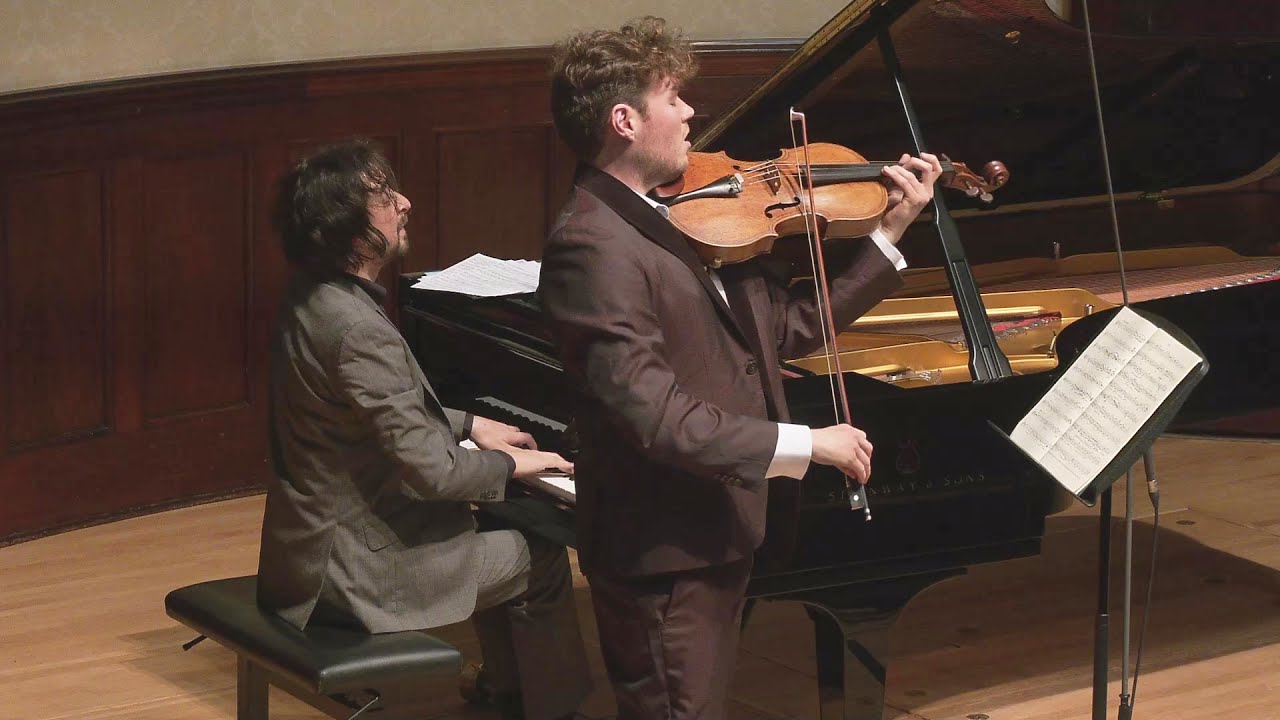
In concert – Timothy Ridout & Tom Poster: Brahms Sonatas & Schwertsik world premiere @ Wigmore Hall

ridout-poster

Timothy Ridout (viola), Tom Poster (piano)

Brahms Sonata for viola and piano in F minor Op.120/1 (1894)
Schwertsik Haydn lived in Eisenstadt (2021, world premiere)
Brahms Sonata for viola and piano no.2 in E flat major Op.120/2 (1894)

Wigmore Hall, London
Monday 10 May (review of the online broadcast)

Written by Ben Hogwood

This was, on paper, an ideal match of repertoire and performers – and it proved that way on screen too, as the Wigmore Hall served us the latest offering in its lunchtime concert program.

Timothy Ridout and Tom Poster are both beneficiaries of the invaluable Young Concert Artists Trust (YCAT) scheme and the BBC’s New Generation Artists program, of which Ridout is still a member. They are both plotting exciting paths as distinctive artists, and as a duo they enjoy an easy rapport, clearly relishing the music they play – an observation which can never be taken for granted!

The two sonatas published as Op.120 are Brahms’ final notes in chamber music, and indeed among his last works altogether. To have younger artists playing them is to reveal the youthful heart amid their autumnal colours, showing off their elusive qualities and winsome melodies.

Both works may have originated for clarinet and piano but work equally well through the burnished tones of the viola. Indeed Ridout proved with the first notes of the Sonata in F minor Op.120/1 that the range is ideal for his instrument, and the tone – not to mention Poster’s complementary piano line – was ideally weighted once he had fully secured the intonation.

The second movement had a cold shiver, thanks to the use of less vibrato, but grew warmer as it progressed. The genial Allegro grazioso was a treat, the finale more celebratory but enjoying its flowing second themes too.

The E flat sonata was if anything even more successful, lighter on its feet and with airy phrases and interplay. The first movement bobbed and weaved beautifully, especially when Ridout was playing in the higher register, which Poster clearly relished. The second movement literally rolled up its sleeves for a powerful outpouring, Ridout’s tone beautifully supple. By contrast the central section benefited from the burnished tones of the double-stopped viola. The finale’s theme and variations were well judged, thoughtful and mellow to begin with but then more capricious as they progressed, finishing with a thoroughly convincing flourish.

Between the two Brahms works was an interesting new piece by Kurt Schwertsik, commissioned by Ridout himself. Schwertsik is a Viennese composer now in his 70s, aware of his place in musical history but making original and intriguing music. This piece was characteristically elusive, under the intriguing title Haydn lived in Eisenstadt. Set in several movements, it posed questions and answers, but remained curiously unsettled. BBC Radio 3 presenter Andrew McGregor thought the piece had ended at one point, only for another two movements to follow – a situation we have all surely experienced as audience members! Ridout swept through the longer phrases of the penultimate movement against softly tolling chords from the piano, before the last movement threw furtive glances into the shadows amid bursts of activity, ending in a similar vein to early Schoenberg.

Poster ensured the harmonies were a point of focus throughout, hinting at exotic late Romanticism but never quite settling in that mood. This was a piece of intriguing thoughts and colours, a substantial utterance well worth hearing again. It proved the ideal complement to the poised Brahms sonatas around it – and the encore of the older composer’s Wie melodien, with which the concert softly concluded.

This concert is available to play for 30 days using the YouTube embedded link above.

RSNO Friday Night Club – Brahms’s German Requiem

A second installment for the RSNO Friday Night Club today – and an appropriate choice for Good Friday in the form of Brahms‘s German Requiem. This particular archive performance is conducted by Gregory Batsleer, with soloists Alison McNeill (soprano) and Oskar McCarthy (baritone), with the RSNO Chorus and pianists Edward Cohen and Christopher Baxter.

You can watch the on the orchestra’s website here, or join on Facebook here

Live review – CBSO Chorus and Orchestra / Mirga Gražinytė-Tyla: Brahms’ German Requiem & Mozart Serenade for wind

Camilla Tilling (soprano), Florian Boesch (baritone), CBSO Chorus, City of Birmingham Symphony Orchestra / Mirga Gražinytė-Tyla

Symphony Hall, Birmingham
Wednesday 4 March 2020

Mozart Serenade for wind in C minor K388 (1782-3)
Brahms Ein Deutsches Requiem Op.45 (1865-9)

Written by Richard Whitehouse

The City of Birmingham Symphony Orchestra’s current season features several major choral works that have long been central to this orchestra’s repertoire. While it has received numerous readings (most recently with Andrew Manze), Brahms‘s A German Requiem is not among these – so it was fascinating to hear what Mirga Gražinytė-Tyla might make of a piece that, though it has never fallen from favour since its premiere 152 years ago, remains a stern interpretive test in terms of projecting formal integration and an expressive essence more elusive for its restraint.

In the event the performance was a fine one – not least because this conductor found the right balance between flexibility of motion, without which the textures all too easily risk stolidity, and that seriousness of manner without which the music soon loses any sense of purpose. A balance as evident in the lengthy second movement, the inexorable tread of its outer sections framing an interlude of wistful grace then with the ensuing fugue building animatedly to its serene close, as in the brief fourth movement whose blithe exterior conceals music of artful dexterity. Camilla Tilling (above) summoned a winsome response in the fifth movement, a late but necessary addition in its opening-out the work’s emotional range, while Florian Boesch (below) was suitably if not unduly vehement in his initial contributions to the third and sixth; the former crowned by a fugue of visceral and unflagging energy, though that in the latter movement marginally lost focus as its grandly rhetorical gestures ran their (too?) predictable course.

It is in the first and seventh movements that Brahms’s highly personal concept of redemption through love is at its most explicit, MG-T duly having the measure of their calmly insistent searching towards eventual catharsis – even if the finale’s gradual winding-down resulted in less than the ideal repose. The CBSO Chorus was on fine form throughout – a tribute to the expertise of associate chorus director Julian Wilkins, who also made a pertinent contribution in an organ part no less crucial for its understatement; underpinning and often motivating an orchestration which adds in no small measure to the work’s humane and compassionate spirit.

A relatively short first half gave welcome opportunity for the CBSO’s woodwind to take the stage for an un-conducted reading of Mozart’s Serenade in C minor, last in his trilogy of such pieces which transcended an ostensibly lightweight genre and, in doing so, made possible the emotional substance of the symphonies that followed. Ensemble seemed a shade insecure in the opening Allegro, but its underlying intensity carried over to an Andante whose ineffable rapture was itself contrasted with the textural severity of the Menuetto. Best, though, was the final Allegro – a set of variation on an unassuming theme with the formal outline of a sonata-rondo made explicit with its major-key ending. Overall, a winning account of a piece whose scoring for wind octet has gained it less exposure than Mozart’s comparable orchestral works.

It also made for an unlikely while successful coupling and a similarly thought-provoking one is scheduled for next Tuesday, MG-T making her first foray into Bruckner with the erstwhile elusive Sixth Symphony alongside the deceptive simplicity of Bartók‘s Third Piano Concerto.

Further listening

Here is a Spotify playlist of music from the concert. The CBSO have not recorded either of these works before but these are fine alternatives:

For further information on the current season of CBSO concerts, visit the orchestra’s website