In concert – BBC Singers / Martyn Brabbins @ St Paul’s Knightsbridge – Holst, Britten, Garrard, Elgar & Pickard

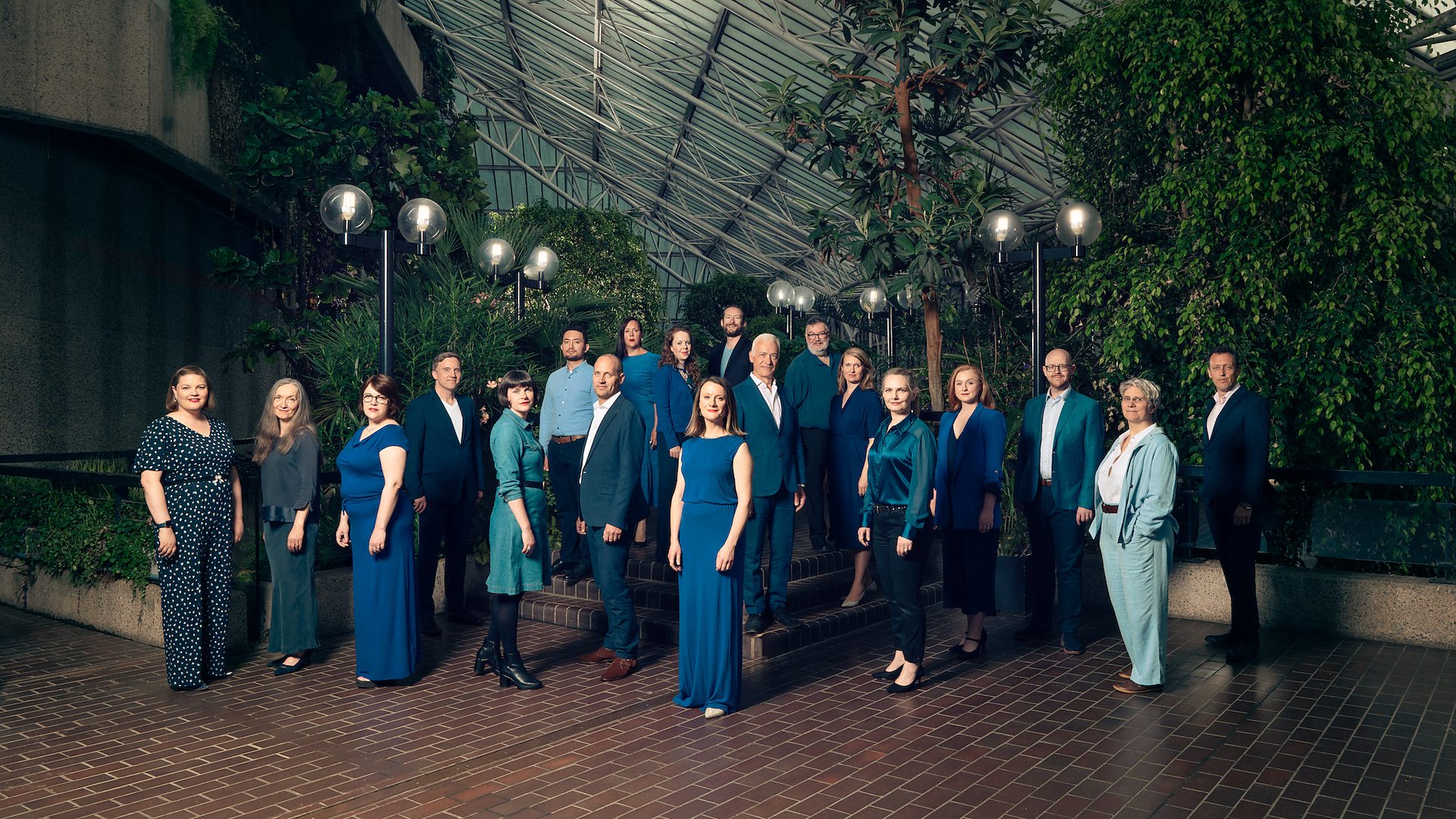
BBC Singers, Elizabeth Bass (harp), Richard Pearce (piano), Andrew Barclay (percussion) / Martyn Brabbins

Holst Choral Hymns from the Rig Veda – Group 3, H90 (1910)
Britten The Ballad of Little Musgrave and Lady Barnard (1943)
Garrard Missa Brevis (2017-18)
Elgar Five Part-Songs from the Greek Anthology Op.45 (1902)
Pickard Elemental (2024-25) (BBC commission: World premiere)

St Paul’s, Knightsbridge, London
Friday 19 September 2025

Reviewed by Richard Whitehouse

The upsurge of interest in and performances by the BBC Singers in the wake of its intended demise shows little sign of abating, and there could be few vocal ensembles able to put on a programme as stylistically inclusive or as technically demanding as that heard this afternoon.

Nowhere more so than Elemental by John Pickard, its first performance occupying the second half. Never absent from the composer’s output, choral music came into own with the powerful Mass in Troubles Times (premiered nearby at St Peter’s, Eaton Square in 2019) and the present work can be heard as a continuation in terms of its underlying concept. A further collaboration with author and theologian Gavin D’Costa, its form is of a journey through the elements such as Pickard had favoured earlier in his output but here with its emphasis firmly on the spiritual arising out of human concerns. Whether individually or collectively, the writing for 18 voices could hardly be more varied and imaginative, while the obbligato roles for harp plus a single percussionist playing across the spectrum of instruments enhances these settings accordingly.

After the evocative Prologue with its Paracelsian take on living matter, Earth draws on the recollections of those in the Tham Luang Cave Rescue – notably teenagers of the Wild Boars football team – in music whose initial bravado gradually assumes a near metaphysical import. Fire integrates its Shakespeare quotations into consideration of this most transformative and cathartic of elements. Air centres on Bessie Coleman with her ambition, racially rather than personally motivated, to become the first professional pilot from African-American ancestry – her combative and ultimately ill-fated career depicted with often graphic immediacy. Water then illustrates the Biblical flood narrative from an oblique and even ambivalent perspective, before Epilogue returns to evocation of the numinous as it builds with a frisson of emotion.

Not that the first half was any mere preparation. Most intimate and alluring of four such sets, the third group of Holst’s Choral Hymns from the Rig Veda traverses the ethereal, the limpid, the hieratic then the questing in the company of female voices and harp. The former were no less attuned to the greater astringency of Sara Garrard’s Missa Brevis – its bracing inclusion of traditional Estonian music offset by the greater introspection elsewhere; these contrasted aspects finding at least a degree of release with the emotional immediacy of the Agnus Dei.

Heard in alternation, the male voices duly came into their own with Britten’s The Ballad of Little Musgrave and Lady Barnard – its folk melody (Matty Groves) stretched through this plangent wartime setting with piano of illicit love, innocent betrayal, desperate revenge and stark lament. Facets that barely feature in Elgar’s Five Part-Songs from the Greek Anthology yet these brief if characterful treatments of translations by Alma Strettell, no less typical than his major choral and orchestral works from this period, were dispatched here with due relish.

Whatever else, this showcase with substance was conducted with unfailing insight by Martyn Brabbins, whose prowess in choral repertoire needs hardly more reiterating than his advocacy of Pickard, and is absolutely worth hearing when broadcast by BBC Radio 3 this Wednesday.

You can hear the BBC Radio 3 broadcast on Wednesday 24 September by clicking here

For more information on the artists, click on the names: BBC Singers, Martyn Brabbins, Elizabeth Bass, Richard Pearce and Andrew Barclay, and composers John Pickard and Sara Garrard

Published post no.2,664 – Sunday 21 September 2025

On Record – Emma Tring, BBC NoW / Martyn Brabbins – John Pickard: Symphonies 2 & 6; Verlaine Songs (BIS)

John Pickard
Symphony no.2 (1985-87)
Symphony no.6 (2021)
Verlaine Songs (2019-20, orch. 2022)

Emma Tring (soprano), BBC National Orchestra of Wales / Martyn Brabbins

BIS 2721 [72’51’’] French text and English translation included

Producer Thore Brinkman Engineers Simon Smith, Mike Cox
Recorded 29-31 March 2023, Hoddinott Hall, Cardiff

Written by Richard Whitehouse

What’s the story?

BIS continues its coverage of John Pickard (b.1963) with a pertinent coupling of his Second and Sixth Symphonies, heard alongside his song-cycle to poems by Verlaine, in what is the most wide-ranging release – whether chronologically or stylistically – to date in this series.

What’s the music like?

It hardly seems 35 years since the Second Symphony blazed forth at its Manchester premiere, so establishing Pickard’s reputation. The composer had earlier studied with Louis Andriessen, to whose confrontational minimalism this piece is indebted in certain particulars – but, unlike other among his contemporaries who were so influenced, Pickard was alive to its symphonic potential. Unfolding over six continuous sections, the work builds via an intensifying process of tension and release to a seismic culmination as marks a seamless, even inevitable return to its start. Those familiar with that pioneering version by Odaline de la Martínez (on YouTube) will find this new one hardly less attentive to the visceral power of what, given its predecessor remains unheard, is a symphonic debut with few equals and one that urgently warrants revival.

Almost 35 years on and the Sixth Symphony offers a very different though no less involving perspective on what this genre might be. The first of its two movements channels a modified sonata design such that an almost whimsical opening has become brutalized well before the despairing close. Its successor refashions the expected continuity from an even more oblique vantage – the music heading eloquently if funereally toward a plangent climax that subsides into a delicate intermezzo, infused with the sound of nature, then on to a final section which recalls earlier ideas in a mood of rapt anticipation. Not that this understatement offers in any sense an easy way out: indeed, the work concludes with its composer poised at a crossroads as much existential as musical, and from where the whole creative process can begin afresh.

Separating two substantial statements of intent, the Verlaine Songs continues Pickard’s recent involvement with poetic texts and, while Paul Verlaine might seem far removed from Edward Thomas or Laurence Binyon, his evocations fanciful while sometimes unnerving – hence Le sqelette with its graphic aural imagery – finds the composer reciprocating in kind. Coming in between scorings with ensemble or violin and piano, this version with orchestra finds Pickard enriching a lineage of French song-cycles from Berlioz, via Ravel and Messiaen, to Dutilleux.

Does it all work?

It does, not least because Pickard is conscious of the need for his music to determine its own course. However dissimilar these symphonies might seem, the sensibility behind them is the same and any stylistic differences more apparent than real. It helps when Martyn Brabbins is a conductor familiar with this idiom as to inspire a committed response by the BBC National Orchestra of Wales, with Emma Tring alive to the manifest subtlety of the vocal writing, and the recordings consistently heard to advantage in the spacious immediacy of Hoddinott Hall.

Is it recommended?

Indeed, in the hope this series will be continued. Both the First and Third Symphonies await recording, as do Partita for strings and large-scale choral work Agamemnon’s Tomb, so that Pickard’s discography has a way to go even without addition of new pieces to his catalogue.

Listen

Buy / Further information

For purchase options and more information on this release, visit the BIS website. Click on the names for more on composer John Pickard, the BBC National Orchestra of Wales, conductor Martyn Brabbins and soprano Emma Tring

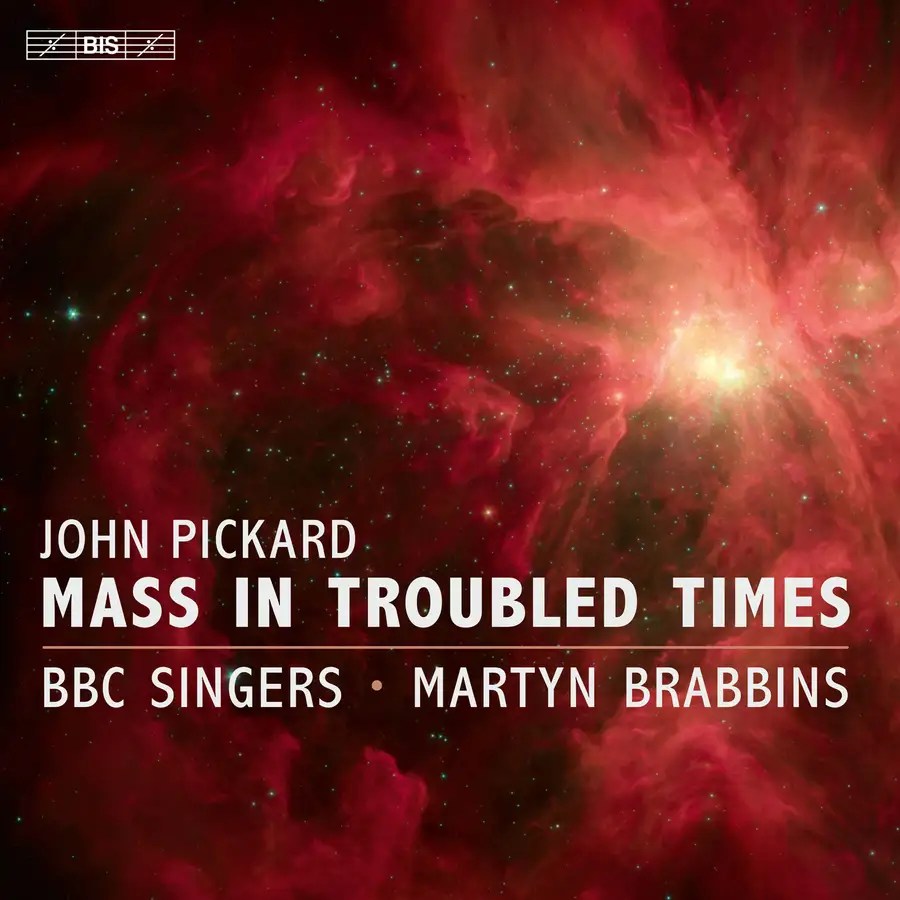
On Record – BBC Singers / Martyn Brabbins – John Pickard: Mass in Troubled Times (BIS)

John Pickard
Three Latin Motets (1983-7)
O magnum mysterium (2015)
Orion (2004)
Ave Maris Stella (1992)
Ozymandias (1983)
Tesserae (2009)
Mass in Troubled Times (2018)

BBC Singers / Martyn Brabbins with Chloë Abbott (trumpet/flugelhorn, Orion); David Goode (organ, Orion and Tesserae)

BIS 2651 [74’30’’] Texts and English translations included

Producer Adrian Peacock Engineer Pete Smith
Recorded 13 & 14 October, St Jude-on-the-Hill, Hampstead, London

Written by Richard Whitehouse

What’s the story?

Although known primarily for his substantial orchestral and chamber output, John Pickard has written several notable choral pieces. This latest release from BIS to be devoted to his music brings most of them together, and in the company of two major instrumental works.

What’s the music like?

Ranging across 35 years of his music, the collection features Pickard’s earliest acknowledged work – a teenage setting of Shelley’s Ozymandias that elicits a response both imaginative and impassioned. Already assured, his choral writing was further honed and refined in Three Latin Motets where limpid renderings of O nata lux and Ubi caritas et amor frame a melting Te lucis ante terminum for female voices. A rapturous Ave Maris stella and touchingly restrained O magnum mysterium duly reinforce Pickard’s confident handling of the a-cappella medium.

The two non-choral items indicate their composer’s abiding fascination with astronomy and antiquity. Scored for trumpet and organ, Orion strikingly evokes said constellation from the vantage of increasing energy in Nebula, an alternating lyricism (courtesy of the flugelhorn) and impetus in Alnitak, then incisive rhythmic interplay of Betelgeuse with its distanced close. Its title indicating those ‘tiles’ used in a mosaic, Tesserae builds cohesion via a steadily accumulating momentum such as tellingly underlies this showpiece with substance for organ.

For 18 unaccompanied voices (in six groups), Mass in Troubled Times is not a setting of the Mass, but a text assembled by the author Gavin D’Costa – lines from T. S. Eliot, Edith Sitwell and Matthew Arnold heard alongside extracts from the Syriac Orthodox Liturgy, the Shahada and the Qur’an. The key is a Turkish Twitter-hashtag from 2015, “Humanity washed ashore”, relating the flight from Aleppo then the drowning of Ayesha – her tragedy an emotional focus over six sections whose expressive intensity seems the greater for their formal concentration.

An Introitus precedes the customary sections of the Mass – reaching a dramatic apex at the climax of the Gloria while carrying the accrued intensity through those that follow; ending with the juxtaposition of lines from William Blake and thrice-repeated Agnus Dei that, next to an evocation of the child’s body off Palermo, has a poignancy shorn of sentiment thanks to Pickard’s acute eloquence. With its wide range of vocal techniques and demanding tessitura, Mass in Troubled Times is a rewarding challenge which all enterprising choirs should tackle.

Does it all work?

It does, not only through the quality of this music but also of these performances – the BBC Singers conveying the immediacy or pathos of Pickard’s response with unstinting clarity and precision. If a demonstration of this choir’s continued existence were needed, this surely is it – Martyn Brabbins (late of English National Opera) directing with his customary conviction. Nor are Chloë Abbott and David Goode to be found wanting in their pieces, rounding out a collection enhanced with vividly analytical recording and the composer’s informative notes.

Is it recommended?

It is, and not merely to those who have been following this invaluable series, which is set to continue with a coupling of Pickard’s Second and Sixth Symphonies. Certainly, the Mass in Troubled Times must feature in any representative selection of works from the 21st century.

For purchase options and more information on this release, visit the BIS website. Click on the names for more on composer John Pickard, the BBC Singers and conductor Martyn Brabbins, trumpeter Chloë Abbott and organist David Goode

On record – Nash Ensemble – John Pickard: The Gardener of Aleppo (BIS)

John Pickard
The Gardner of Aleppo (2016)
Daughters of Zion (2016)*
Snowbound (2010)
Serenata Concertata (1984)**
Three Chicken Studies (2008)
The Phagotus of Afranio (1992)
Ghost-Train (2016)

*Susan Bickley (mezzo); **Philippa Davies (flute); Nash Ensemble / Martyn Brabbins

BIS BIS 2461 SACD [79’22”]

Producer / Engineer Simon Fox-Gál

Recorded September 2018 at All Saints’ Church, East Finchley, London

Written by Richard Whitehouse

What’s the story?

BIS continues its coverage of music by John Pickard (b. 1963) with an extensive overview of chamber works surveying more than three decades of creativity, in performances by the Nash Ensemble that do ample justice to this composer’s combative while always accessible music.

What’s the music like?

Earliest is Serenata Concertata, written when Pickard was still an undergraduate and his first paid commission. Essentially a concerto for flute and five instruments, it unfolds continuously from a haunting Cadenza I then a pensive Aria I to the Scherzo-Notturno whose accrued energy carries over into the climactic Cadenza II, before Aria II brings an emotional poise that gradually dies away towards the close. Whatever its passing influences, Pickardian traits are everywhere apparent and the composer was surely right to keep this work in his catalogue.

Philippa Davies makes a fine showing, as does Ursula Leveaux in The Phagotus of Afranio – the title that of a fanciful forerunner of the bassoon, whose Hoffnung-like presence evinces humour and no little pathos in this entertaining ‘capriccio’. Hardly less diverting, the Three Chicken Studies evoke its subjects respectively laying, feeding then fighting in miniatures, as rendered by Gareth Hulse, both winsome and insouciant (and fully deserving of inclusion in Pickard’s catalogue). Alone among these pieces, Snowbound has been previously recorded (Toccata Classics) – the new account being more spacious and more graphic in its depiction of a familiar landscape as rendered unrecognizable through music that cannily emphasizes those darker sonorities of bass clarinet, cello and piano on route to a ‘glacial’ denouement.

The remaining three works followed in the wake of the imposing Fifth Symphony and testify to the variety of Pickard’s approach irrespective of genre or instrumentation. Setting a text by Gavin D’Costa, Daughters of Zion relates the fateful decision of Mary and its consequences in music by turns ominous and plangent – superbly sung by Susan Bickley. No less resonant in emotional impact, The Gardner of Aleppo was inspired by an incident in the Syrian civil war, where a flower-seller continued to ply his wares in the face of heavy bombardment up until his untimely death. Here, too, flute, viola and harp make for a (surprisingly?) tensile combination across its trajectory of evocation, animation and recollection. By comparison, Ghost-Train might appear humorous in its (often graphic) portrayal of the once obligatory fairground ride; as represented by a perpetuum mobile whose stealthy refrain finds contrast with sundry episodes of a more or less grotesque nature, duly culminating in an apotheosis whose sombre equivocation suggests this to be a journey from which there can be no return.

Does it all work?

Yes, given the alacrity with which these musicians respond to music that, for all its textural and harmonic intricacy, conveys that expressive immediacy manifest throughout Pickard’s output. By so doing, moreover, the stylistic consistency of his idiom is no less in evidence.

Is it recommended?

Indeed. Sound is well up to BIS’s customary standards as to clarity and perspective, with the composer’s booklet note typical in its keen observation and wry humour. Further releases of Pickard’s music, not least his first three symphonies, will hopefully follow from this source.

Listen

Buy

You can discover more about this release at the BIS website, where you can also purchase the recording.

On record: ENO Chorus & Orchestra / Martyn Brabbins – Havergal Brian: The Vision of Cleopatra (Epoch)

Claudia Boyle (soprano); Angharad Lyddon (mezzo); Claudia Huckle (contralto); Peter Auty (tenor) (all soloists in The Vision of Cleopatra), Chorus and Orchestra of English National Opera / Martyn Brabbins

Havergal Brian
The Vision of Cleopatra (1907)
For Valour (1904, rev 1906)
Fantastic Variations on an Old Rhyme (1907)
Two Poems (1912)

Dutton Epoch CDLX 7348 [73’37”]

Producer Alexander Van Ingen
Engineers Dexter Newman, Dillon Gallagher

Recorded July 5-6 2017 at St Jude-on-the-Hill, London
Recorded in association with the Havergal Brian Society

Reviewed by Richard Whitehouse

What’s the story?

Martyn Brabbins continues his series of Havergal Brian recordings for Dutton with a notable first – the ‘tragic poem’ The Vision of Cleopatra that is its composer’s largest surviving work from his earlier years, but which went unperformed for 105 years until its revival in Bristol.

What’s the music like?

Premiered at the 1909 Southport Festival, The Vision of Cleopatra enjoyed a passing success but received no further performances. Loss of the orchestral score and parts in the Blitz made revival impossible until 2014, when John Pickard (who writes the informative booklet note) made a new orchestration. The outcome is audacious in the context of British music from this period, taking on board possibilities opened-up by Richard Strauss in his controversial opera Salomé – unheard in the UK until 1910, but whose innovations Brian likely absorbed from the score.

Whatever else (and for all that Gerald Cumberland’s tepid libretto might suggest otherwise), Cleopatra is no anodyne Edwardian morality. After the Slave Dance which functions as a lively overture, the cantata proceeds as a sequence of nominally symphonic movements – a speculative dialogue between two of the queen’s retainers, then an increasingly fervent duet between Cleopatra and Antony followed by an expansive aria for the former; separated by a speculative choral interlude and concluded with a Funeral March of plangent immediacy.

Cleopatra may have fazed its first-night performers, but there is nothing at all tentative about this first recording. Claudia Boyle is sympathetic as Iris and Angharad Lyddon even more so as Charmion, while Peter Auty provides a not unduly histrionic showing as Antony. Although not ideally alluring in the title-role, Claudia Huckle brings eloquence to her climactic aria and throughout fulfils Brian’s exacting requirements. The Chorus of English National Opera sings with real lustre, and Brabbins secures a committed response from the ENO Orchestra.

The concert overture For Valour and Fantastic Variations on an Old Rhyme had already been recorded (on Naxos), but Brabbins’ teasing out of formal subtlety from expressive panache in the former and binding the latter’s (purposely) unbalanced variations into a cohesive if unwieldy whole ensures a decisive advantage. Setting contrasted poems by Robert Herrick, Two Poems receives its first professional recording: the wan plaintiveness of Requiem for the Rose then sardonic humour of The Hag make for a jarring duality redolent of Bartók’s Two Portraits Op.5.

Does it all work?

For the most part, yes. Uneven in continuity and inspiration, The Vision of Cleopatra contains the most audacious and prophetic music Brian wrote before his opera The Tigers; this account does it justice, even if the highly reverberant ambience entails a marginal lack of immediacy – notably a rather backwardly balanced chorus in its decisive contribution during Cleopatra’s aria. The orchestral playing leaves little to be desired – reinforcing gains in consistency instilled by Brabbins since he became the Music Director of English National Opera two seasons ago.

Is it recommended?

Yes. The Vision of Cleopatra is unlikely to receive regular performance (its demands putting it beyond reach of most choral societies), making this account more valuable for conveying its measure. Perhaps Pickard might follow it up with an orchestration of Brian’s Psalm 137?

You can read more about this release on the Epoch website, or read about The Vision of Cleopatra itself on the Havergal Brian Society website.