In Appreciation – Martin Neary

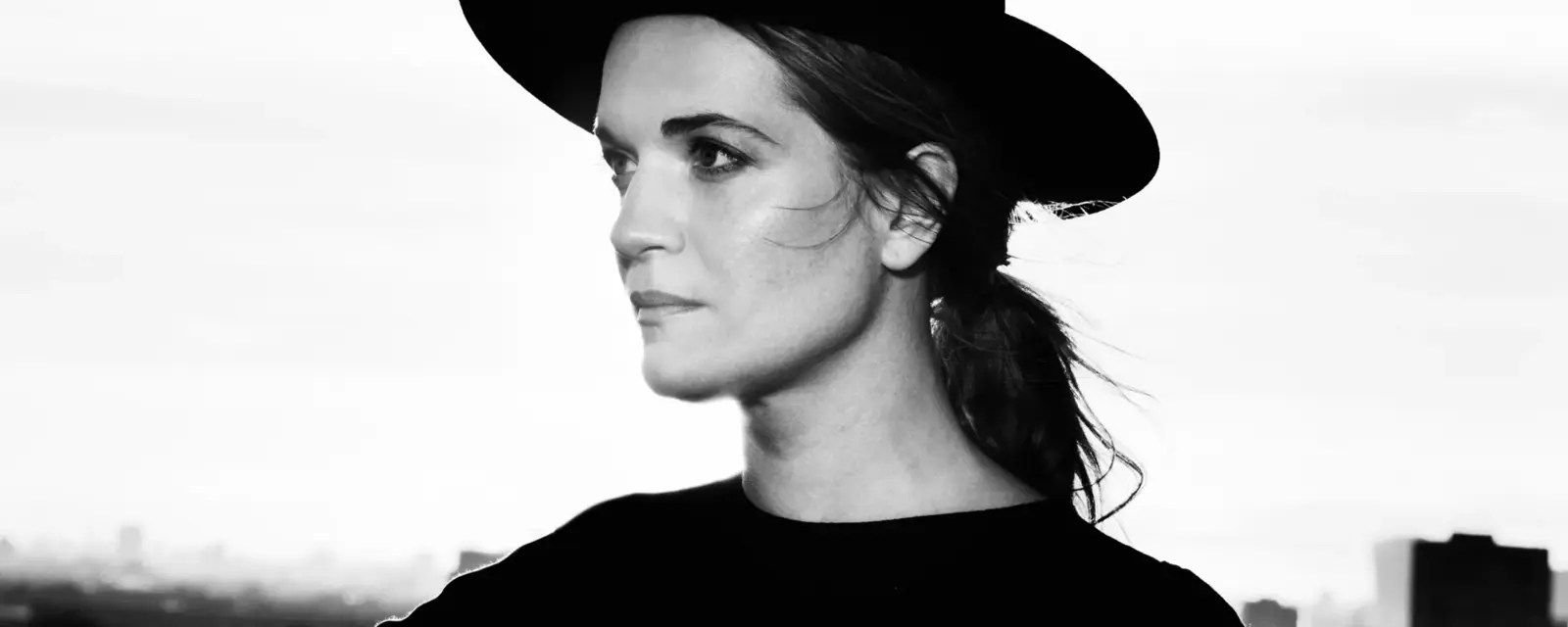
by Ben Hogwood Picture by Clive Barda

Earlier this week we learned of the sad news of the death of choral conductor and organist Martin Neary. Neary was known primarily for his work with the choir at Wesminster Abbey, put in to perspective by this fine obituary of his work on the Presto website. I wanted to take the opportunity to put together a short playlist of some of Neary’s recordings, which you can find below.

The funeral of Diana, Princess of Wales in 1997 was an incredibly intense event, a memorable occasion where it seemed the UK – and especially London, where I was – ground to a halt for an hour. The music that stayed in our consciousness afterwards, as well as Elton John’s reworking of Candle In The Wind, was the remarkable Song for Athene by John Tavener. Neary ensured it was given the best possible performance, which speaks volumes for his musicality and temperament.

Song For Athene leads the playlist below, which concludes with Neary playing Widor’s effervescent Toccata:

https://tidal.com/playlist/acf7f6d7-97c1-4786-8140-025a5f8cc913

Published post no.2,675 – Thursday 2 October 2025

New music – Guy Johnston’s British cello odyssey

from the press release, edited by Ben Hogwood

With his 1692 ‘Segelman, ex hart’ Stradivarius Cello, loaned to him from a private sponsor through the Beare’s International Violin Society, Guy Johnston embarks on a British cello odyssey, including the world premiere of a new cello concerto by Joseph Phibbs in January 2026.

To mark Bliss’ 50th anniversary, Johnston’s recording of Arthur BlissCello Concerto with the Royal Liverpool Philharmonic Orchestra conducted by Andrew Manze is released digitally on 25 July, 2025 on Onyx Classics. It will form a later album release with the Britten Cello Symphony.

Following a performance at the 2025 Hatfield Music Festival on 12 October 2025, Johnston will record The Protecting Veil with the Britten Sinfonia directed and led by Thomas Gould in live concerts on 28 and 29 October, 2025 at St. Sophia’s Greek Orthodox Church in London. The album will be released on Signum in the summer of 2026.

Completed in 1988, Tavener’s The Protecting Veil was begun in response to a request from cellist Steven Isserlis for a short piece. It developed into a more substantial work, and was subsequently commissioned by the BBC for the 1989 Proms season. Like many of Tavener’s compositions, this work reflects the composer’s Orthodox religious faith. The inspiration for the piece comes from the Orthodox feast of the Protecting Veil of the Mother of God, which commemorates the apparition of Mary the Theotokos in the early 10th century at the Blachernae Palace church in Constantinople in grave danger from a Saracen invasion.

As Tavener explained, “the cello representers the Mother of God and never stops singing throughout. One can think of the stings as a gigantic extension of her unending song…the first and last sections relate to her cosmic beauty and power over a shattered world.”

Johnston met Tavener on a number of occasions and was touched to be asked by Britten Sinfonia to perform The Protecting Veil last year on the occasion of what would have been the composer’s 80th anniversary. Johnston was keen to record The Protecting Veil at St Sophia’s, where Tavener used to attend mass.

On 16 January 2026, Johnston will give the world premiere of Joseph PhibbsCello Concerto at the Barbican with the BBC Symphony Orchestra conducted by Clemens Schuldt. In 2021, Johnston previously premiered Joseph Phibbs’ Cello Sonata, partly based on an Elizabethan pavane found in the archive of Hatfield House.

Phibbs, who is a huge admirer of Britten, commented,

“The main focus of this concerto is on melody, and how this might be explored in various ways over the uniquely wide range of the cello. The work is symphonic in structure, adopting a multi-movement form as opposed to the traditional three, and ends with a short ‘Vocalise’ (song) for cello and strings which soars to the very top of the cello’s high register. Elsewhere, a dramatic opposition between soloist and orchestra is emphasized. At the forefront of my mind while composing this work has been the wonderfully varied facets of Guy’s playing, which I have admired for many years. It’s been a huge privilege and excitement to write for such a special performer”

In September 2026, Johnston will record Britten’s Cello Symphony with the RLPO conducted by Andrew Manze for Onyx Classics to coincide with the composer’s 50th anniversary (Britten d. on 4 December 1976). The album will include the Bliss Cello Concerto (previously released digitally).

The 2025-2026 season coincides with Johnston’s returns to the Royal Academy of Music as a Professor of Cello. This role will see him offer bespoke tuition to cello students throughout the year. Johnston started out as a professor at the Academy in 2011, later becoming visiting professor. The appointment follows Johnston’s recent relocation back to the UK following his tenure at the Eastman School of Music in Rochester, NY, from 2018 to 2024.

Johnston commented,

“I’m thrilled to have returned last year to the UK with my family for this exciting series of recordings, commissions and performances.”

Published post no.2,600 – Saturday 19 July 2025

In concert – Ruby Hughes, Natalie Clein & Julius Drake: Schubert and Other Folksongs @ Queen Elizabeth Hall

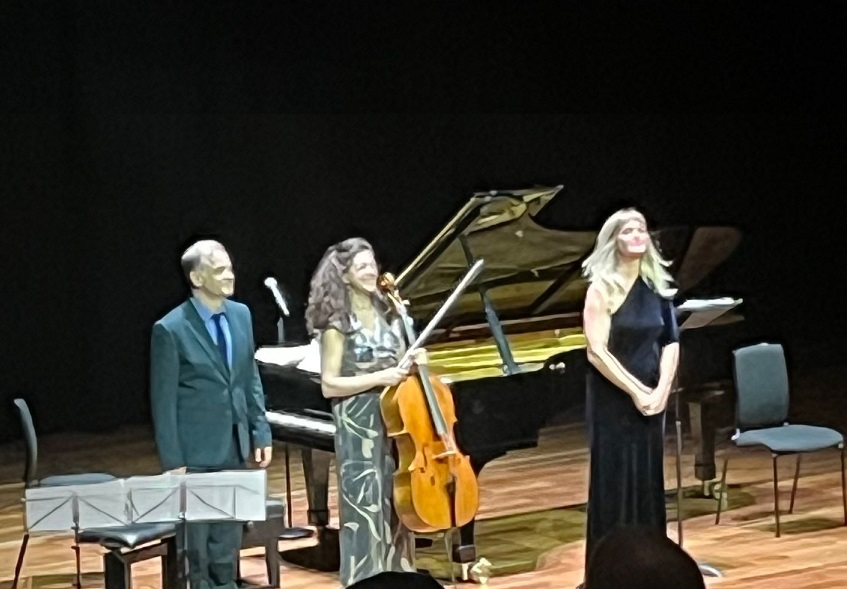
Ruby Hughes (soprano), Natalie Clein (cello), Julius Drake (piano)

Schubert arr. Jones Der Hirt auf dem Felsen (The Shepherd on the Rock) D965 (1828)
Kodály Sonatina for cello & piano (1922)
Tavener Akhmatova Songs: Dante, Boris Pasternak, Dvustishie (Couplet) (1993)
Brahms 2 Songs Op.91 (1884)
Trad arr. Britten I wonder as I wander (1940-41), At the mid hour of night (Molly, my dear), How sweet the answer (The Wren) (both 1957)
Deborah Pritchard Storm Song (2017)
Janáček Pohádka (Fairy tale) (1910, revised 1923)
Ravel Kaddisch from 2 Mélodies hébraïques (1914)
Bloch From Jewish Life (1924)
Schubert Auf dem Strom (On the river) D943 (1828)
(Encore) Berlioz La Captive

Queen Elizabeth Hall, London, 27 June 2025

by John Earls. Photo credits (c) Philip Sharp (above), John Earls (below)

Two of the most affecting sections of Ruby Hughes’ excellent 2024 album with the Manchester Collective End of My Days are three of John Tavener’s Akhmatova Songs (Dante, Boris Pasternak and  Couplet) and Maurice Ravel’s Kaddish (from 2 Mélodies hébraïques).

These also featured to dramatic effect in this fascinating concert programme of Schubert and Other Folksongs spanning two centuries, where Hughes was joined by Natalie Clein (cello) and Julius Drake (piano).

In this performance the Tavener song miniatures were performed for voice and cello and were at turns powerful, beautiful and urgent across their nine-minute duration. The prolonged silence from the audience afterwards was noticeable. Ravel’s lament-like Kaddish, this time for voice and (sparse) piano, was similarly respectfully performed and observed.

There were non-vocal pieces for cello and piano where Clein and Drake displayed what a well matched duo they are. Zoltán Kodály’s Sonatina was luminescent, Leoš Janáček’s Pohádka absorbing (not least the cello bowing and pizzicato) and Ernest Bloch’s From Jewish Life was both lovely and mournful.

But this was a concert where Ruby Hughes’ amazing voice was to the fore but often in an understated, but no less impactful way. The captivating trio of Benjamin Britten folksong arrangements with their minimal piano trills were a case in point.

The trio performances were also impressive in their delivery and range. Brahms2 Songs (Op.91) were both gorgeous, while Deborah Pritchard’s Storm Song (from 2017, the most recently written piece) was powerfully unnerving between its haunting start and end (the composer was in the audience to take a well deserved bow).

The concert was bookended by two songs written by Franz Schubert shortly before his death in 1828 at the age of just 31. As David Kettle remarks in his excellent programme notes, to call them simply songs is to do them a disservice. Der Hirt auf dem Felsen (The Shepherd on the rock), arranged by Peter Jones for voice, cello (replacing the clarinet) and piano, traversed a journey of yearning and joy that was both delicate and impassioned. The closing Auf dem Strom (On the river) saw Hughes capturing the drama convincingly throughout.

An encore of Berlioz’s La Captive concluded this concert that combined fascinating and thoughtful programming with performances of beautifully judged expression.

John Earls is Director of Research at Unite the Union and posts at @johnearls.bsky.social on Bluesky and @john_earls on X. You can subscribe (free) to his Hanging Out a Window Substack column here: https://johnearls.substack.com/

Published post no.2,579 – Sunday 29 June 2025

In concert – Guy Johnston, Britten Sinfonia / Thomas Gould @ Barbican Hall: The Protecting Veil

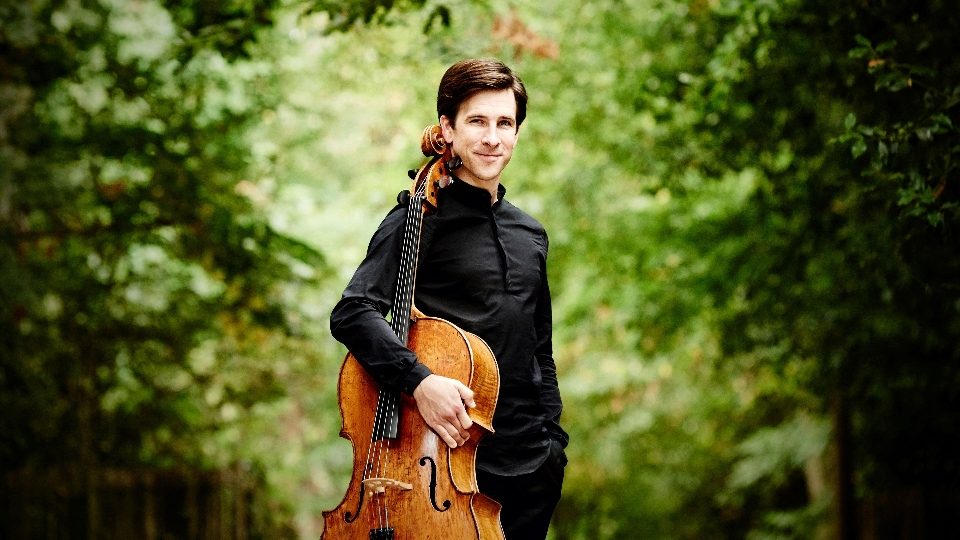
Guy Johnston (cello, above), Britten Sinfonia / Thomas Gould (violin)

Beethoven arr. Weingartner Grosse Fuge Op.133 (1826)
Bartók Divertimento for String Orchestra Sz113 (1939)
Tavener The Protecting Veil (1988)

Barbican Hall, London
Thursday 15 February 2024

Reviewed by Ben Hogwood

The Protecting Veil is a special piece. Written by John Tavener in 1988, this musical meditation for cello and orchestra is based on and inspired by the Greeks resisting Saracen invasion in the early tenth century. They are heartened by a vision of Mary, the Mother of God, surrounded by a host of saints and spreading out her Veil as a protective shelter over the Christians.

In what is effectively a single-movement concerto, the cello represents the Mother of God, leading the string orchestra in eight prayerful chapters that respond to landmark events in which she is present. It may sound elegiac and deeply ambient for much of its duration, but to achieve this elevated state the performers require poise, concentration and inner strength.

It is hard to imagine a better performance than this one experienced at the Barbican. Guy Johnston led us in contemplation, the serenity of his upper register cello line immediately establishing a mood of calm, in complete contrast to the bustling city outside. The Britten Sinfonia responded in kind, conducted where necessary by violinist Thomas Gould but largely following the cello, a congregation responding to his prompting.

In spite of its inner serenity, The Protecting Veil is troubled by the shadows of violence throughout the world. This performance was a stark reminder of how little has changed in eleven centuries, for in the ominous falling motif that recurs for the cello it was impossible not to think of bombs and missiles raining down in the many warzones we see today. The Barbican fell largely silent as those images undoubtedly projected to many listeners, aided by a sympathetic light show that cast the distinctive markings of the back of the stage as a wooden chapel. When Johnston played alone in the central section, The Lament of the Mother of God at the Cross, he could easily have been playing solo Bach, the intimacy of his and Tavener’s thoughts laid bare.

There was, ultimately, consolation and redemption, and the lights burned yellow when the music soared back to the heights with which it began. Feverish anticipation gripped the strings as they responded excitably to the higher cello, and with a surety of tone that never dimmed, Johnston led us to the end. His was a remarkable performance of stamina and poise, those long notes held for what seemed like an eternity, their pure tones never dipping.

The musical contrast with the opening piece, Beethoven’s Grosse Fuge, was notable. Here is a piece that still sounds as new and every bit as challenging as the day it was written, the Everest of fugues. In this arrangement for string orchestra by Felix Weingartner, its angular subject is a touch smoother at the edges, though here the sharp lines were just as clear as in the string quartet original, the fugue subject escaping its restrictions. The Britten Sinfonia found its core in a well-drilled performance.

Bartók’s Divertimento for String Orchestra was lighter in mood to begin with, the ensemble celebrating the great outdoors as the folksy first tune went with a swing. Yet here too there were troubled minds, the slow movement wary of its place in history. Bartók wrote the Divertimento in 1939 in Switzerland, with Europe on the brink of the Second World War. The oppressive approach of the conflict could be felt in a profound slow movement, which began with feathery violas and reached a forbidding climax, emotion wrought from its pages. Those worries were largely banished by the finale, whose powerful unisons were led by Gould as the piece swaggered and bustled to the finish.

Guy Johnston and the Britten Sinfonia continue their tour with The Protecting Veil to Dublin and Manchester – for more details visit the Britten Sinfonia website

Published post no.2,090 – Saturday 17 February 2024

In concert – City of London Sinfonia @ Southwark Cathedral: Origin: This is CLS

cls

Monteverdi arr. Wick Toccata from ‘L’Orfeo’ (1607)
Vaughan Williams
Fantasia on a theme by Thomas Tallis (1910)
Tabakova
Frozen River Flows (2005)
Finnis
The Centre is Everywhere (2019)
Vasks
Music for the fleeting birds (1977)
Tabakova
Origin (2022) (world premiere)
Carter
A Fantasy about Purcell’s ‘Fantasia on one note’ (1975)
Tavener
The Hidden Face (1996)

Hugh Cutting (countertenor), Dan Bates (oboe), City of London Sinfonia / Alexandra Wood (violin)

Southwark Cathedral, London
Thursday 3 March 2022

Written by Ben Hogwood

When the young Richard Hickox assembled a performing group in 1971, his vision was an extended family of talented musicians coming together to project the enjoyment of their art onto their audience.

Just over 50 years on, Hickox may sadly no longer be with us but his vision, realised by the City of London Sinfonia, burns with an ever brighter flame. This celebration in Southwark Cathedral may have been a year late, due to the consequences of the pandemic, but it brought everything together in a programme blending the old with the new.

Great credit should go to the orchestra’s creative director and leader, Alexandra Wood, for choosing music that looked simultaneously forwards and backwards, while utilising the vast spaces offered by the cathedral in inspiring and imaginative ways.

The audience were free to roam around during the concert, which was a considerable plus, for acoustic hotspots could be found and exploited, while it was also possible to stand to one side in contemplation. The mood was relaxed but focused, with audience members chosing a mixture of both options. The only danger of this was unexpectedly finding yourself in front of a group of instrumentalists when they were about to play, meaning the focus would suddenly shift in your direction! This was a risk well worth taking, for the rewards were many.

Before the concert, the Dean of Southwark Cathedral, Andrew Nunn, spoke warmly of the power of music to soothe the fevered mind, giving the pertinent Biblical example of David’s harp curing Saul’s war-torn temper, illustrated vividly by a stained-glass window depiction at the back of the church. The parallels with Russia and Ukraine were unmistakeable, and before the programme started everyone stood for the Ukraine national anthem.

The programme itself began under that very window, with Stephen Wick’s excellent arrangement of the Toccata from Monteverdi’s L’Orfeo, the brass filling the cathedral from back to front with sonorous colours.

The baton then passed to the strings for an unforgettable account of Vaughan WilliamsFantasia on a Theme of Thomas Tallis. This work was written for performance in Gloucester Cathedral in 1910, utilising the space in imaginative ways – and the City of London Sinfonia responded in kind, with the work’s solo group in the round in the nave, and the main body of the strings in the centre of the church. This was a deeply emotive performance, finding the intersection between the old of Tallis and Vaughan Williams’ own sweeping melodies and added-note harmonies. In doing so a composition that is often overplayed gained fresh insight, and, for your reviewer standing at the back of the church, a magical experience.

British-Bulgarian composer Dobrinka Tabakova has a close association with the Sinfonia. Frozen River Flows, an earlier work from 2005, appeared here in an arrangement for clarinet and percussion which was played in the south transept. This brightly coloured piece found Katherine Spencer’s clarinet evoking graceful lines not dissimilar to Poulenc, complemented by the richness of the vibraphone and crotales (antique cymbals), expertly managed by Chris Blundell.

We also heard Tabakova’s music in the world premiere of Origin, written for this concert. It was a brief but meaningful celebration placing violin soloist Alexandra Wood in the nave, with the accompanying musicians under the tower. Wood’s role was that of virtuoso, but she managed it carefully so that slower contributions from the strings and vibraphone were ideally balanced. Tabakova has a talent for the immediate creation of an atmosphere, and this may have been a relatively minimal piece but it left a lasting impression.

Complementing this was another work in the round of the nave, as 12 string players assembled for Edmund Finnis’s The Centre is Everywhere. This was a wholly appropriate choice, the soloists creating unusual and original sounds. On occasion the music swelled like the bellows of an accordion, then subsided to a barely audible whisper, then appeared to be reaching beyond the cathedral for the skies above. Finnis has an unusual and remarkable habit of writing music that becomes an out of body experience, and The Centre is Everywhere shows there is still so much more to achieve when writing for stringed instruments.

The programme turned to wind instruments for a timely reference to the troubles in Ukraine. Latvian composer Pēteris Vasks wrote Fleeting Birds in 1977 as an expression of his need for freedom. Restricted from travelling by the Soviet authorities, he made his feelings known through music. The City of London Sinfonia winds walked the length of the cathedral as they played, turning from joyous expressions of freedom and release to statements soured by compression, reflecting the composer’s earthbound plight.

Freedom lay in Elliott Carter’s Purcell Fantasy, richly expressed by the brass around a persistent middle C, before cutting without a break to John Tavener’s Hidden Face for a final contemplation. The stillness of this work is deceptive, achieved through great virtuosity from solo oboe and a countertenor, singing text written by Mother Maria. Oboist Dan Bates and singer Hugh Cutting were superb throughout, the latter floating his words effortlessly above the prayerful strings, whose sonorous tones were the ideal match for Bates’s keening oboe, which also scaled unfathomable heights with impressive ease.

It was a fitting way to finish a deeply felt concert and celebration, that of a performing group who continue to do their founder proud. Like their musical choices, the City of London Sinfonia look to the future, embracing new advances as well as nurturing past achievements while they do so. They deserve to continue as a treasured feature of the capital’s music making.

To read more about the City of London Sinfonia, visit their website – and for more on composers Dobrinka Tabakova and Edmund Finnis, click on their names