In concert – Laurence Kilsby, Christopher Parkes, Sinfonia of London / John Wilson: Serenade @ Barbican Hall, London

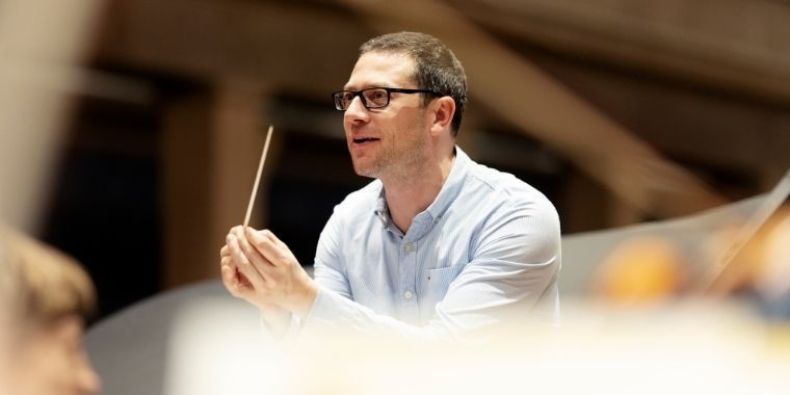
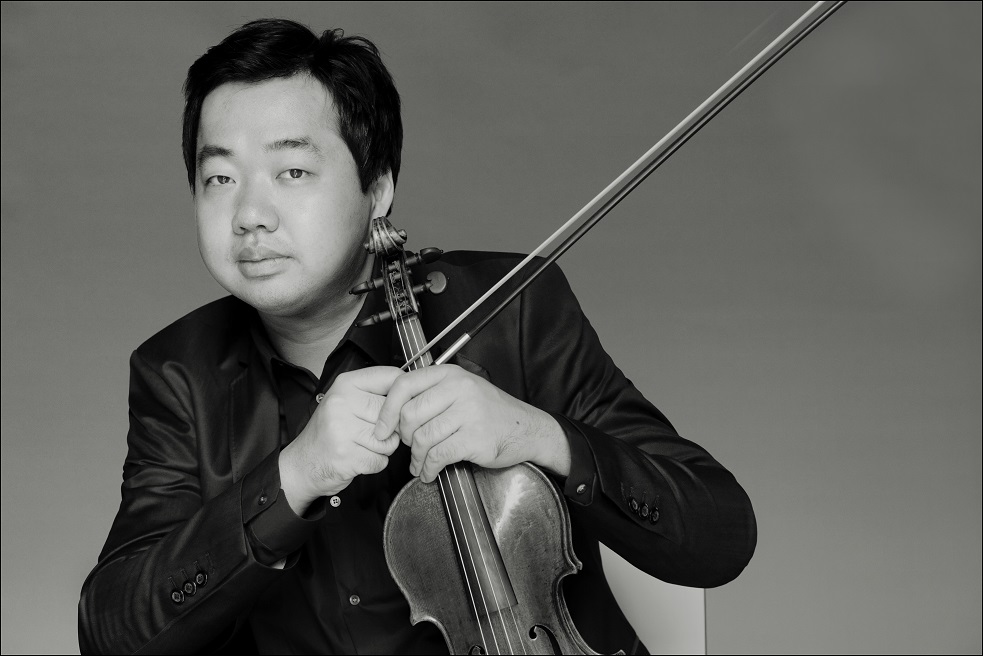
Laurence Kilsby (tenor), Christopher Parkes (horn), Sinfonia of London / John Wilson

Vaughan Williams Fantasia on a Theme by Thomas Tallis (1910)
Britten Serenade for Tenor, Horn and Strings Op.31 (1943)
Bliss Music for Strings B66 (1935)
Delius arr. Fenby Late Swallows (1916, arr. 1962)
Elgar Introduction and Allegro Op.47 (1904-05)

Barbican Hall, London
Wednesday 22 October 2025

Reviewed by Richard Whitehouse

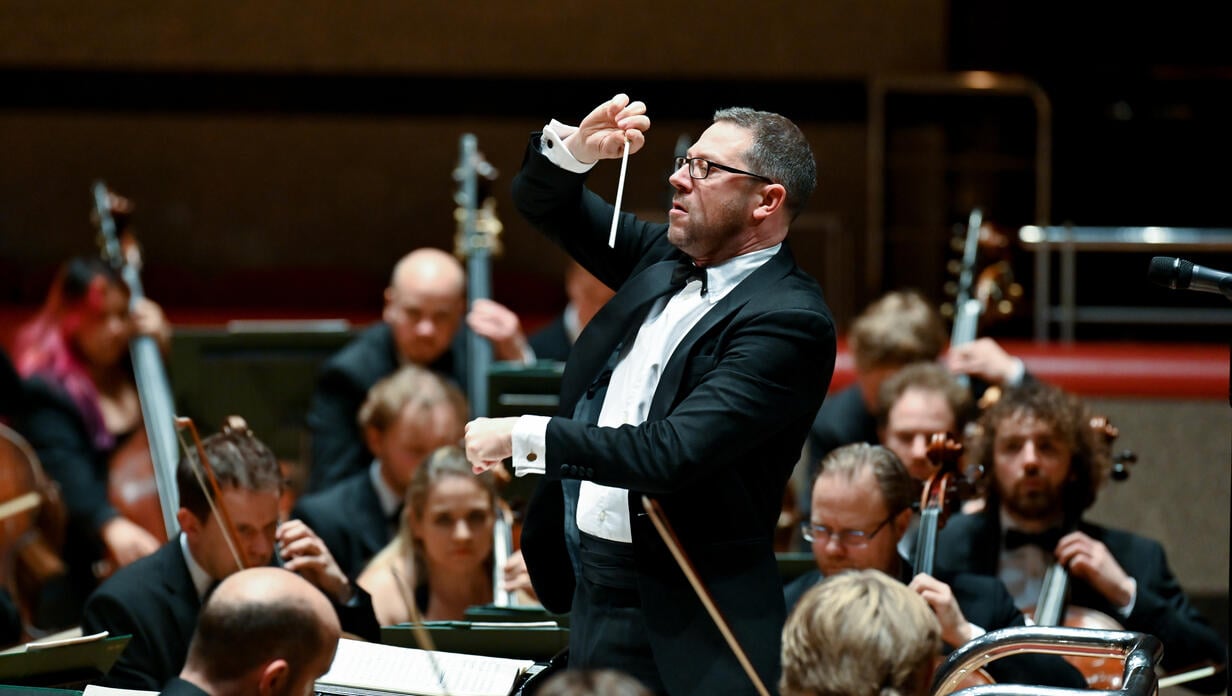
One can only commend John Wilson and Sinfonia of London for, in addition to an ambitious recording schedule for Chandos, frequently taking its programmes on tour – as has been the case with this judicious selection of works for string orchestra tonight being heard in London.

There could hardly be an acoustic less suited to Vaughan Williams’s Tallis Fantasia than that of Barbican Hall, yet Wilson went a good deal of the way toward making it succeed by having the main string body – and solo quartet – to the front of the platform with the subsidiary group arrayed along its rear. The outer section were taken slowly and almost impassively, but there was no lack of impetus or fervency as the central phase built cumulatively towards its climax.

The relatively modest number of strings seemed ideally suited to Britten’s Serenade. Laurence Kilsby (who made a fine contribution to Bliss’s The Beatitudes at this year’s Proms) brought real tenderness to Pastorale and ardour to Nocturne, while Christopher Parkes was suitably plangent in Elegy and dextrousness itself in Dirge. Tenor and hornist joined delightfully in Hymn, then Wilson drew playing of fastidious poise in Sonnet. Just a little unsteady in the Prologue, Parkes excelled in the offstage Epilogue with its ethereal reprise of that opening music – so rounding off a performance that proved affecting and unaffected in equal measure.

Live and in the studio, Wilson has affirmed a commitment to the music of Bliss which could hardly have been more evident than in Music for Strings which formed the centrepiece of this concert. It had been written for the Vienna Philharmonic to premiere at the Salzburg Festival and, if its formidable technical demands no longer sound forbidding, there can have been few performances of this virtuosity or insight. Trenchant and impulsive, the opening Allegro was followed by an Andante whose sustained eloquence never excluded lightness of touch – with the speculative transition into the final Allegro as deftly handled as the Presto with which this work surges to its headlong close. Not merely a timely revival, this was no less a vindication.

Introducing this second half, Wilson had remarked how Delius’ music needs to be coaxed into yielding up its secrets as surely as it needs selling to the musicians. Late Swallows succeeded on both fronts. As arranged by Eric Fenby from the composer’s only mature string quartet, it takes its place among the latter’s most haunting evocations, and not least in a central section whose rapt intensity brought an emotional frisson that tangibly held its listeners spellbound.

Elgar’s Introduction and Allegro may, by contrast, be a piece that plays itself but it still calls for interpretive input of a high order. Wilson responded with an unusually swift reading such as emphasized its nervous intensity and often volatile changes of mood, though there was no lack of cohesion or underlying momentum in a performance that took such testing passages as the central fugato assuredly in its stride prior to a glowing apotheosis then decisive close.

A performance, moreover, as set the seal on a memorable evening’s music-making. All these pieces, save the Britten, have been recorded by Wilson and Sinfonia of London for Chandos, their advocacy of Bliss hopefully continuing well beyond this 50th anniversary of his death.

Click here to read Arcana’s review of English Music for Strings, the Chandos album containing the Bliss and Vaughan Williams works performed in this concert.

Click also on the links for more information on the Sinfonia of London and their conductor John Wilson, along with soloists Laurence Kilsby and Christopher Parkes. For more information on Bliss, you can visit the Arthur Bliss Society

Published post no.2,697 – Friday 24 October 2025

In concert – Sheku Kanneh-Mason, Sinfonia of London / John Wilson: Hesketh, Shostakovich & Rachmaninov @ Barbican Hall

Sheku Kanneh-Mason (cello), Sinfonia of London / John Wilson

Hesketh PatterSongs (2008)
Shostakovich Cello Concerto no.2 in G major Op.126 (1966)
Rachmaninov Symphony no.1 in D minor Op.13 (1895-7)

Barbican Hall, London
Tuesday 15 October 2024

Reviewed by Ben Hogwood Picture (c) Mark Allan

This memorable concert enhanced the Sinfonia of London’s status as orchestral game changers. Conductor John Wilson re-established the ensemble in 2018 as a group taking on special projects, both in the studio for Chandos and in the concert hall. To date these have included early musicals, with Oklahoma! and Carousel in the bag, alongside top drawer recordings of orchestral works by Korngold, Ravel and Rachmaninov. The latter’s Symphony no.1, set down the previous week, completes a cycle of his symphonies.

Before that, we heard an orchestral tour de force from Kenneth Hesketh, fully established as a striking voice in British contemporary music. PatterSongs is a dense orchestral collage of music drawn from his opera The Overcoat, after Gogol. Its colourful score is decorated and ultimately dominated by the woodblock, part of a vibrant percussion section whose contributions bring the piece to theatrical life. They were brilliantly played here, as Wilson kept a tight grip on proceedings. With moods ranging from exuberant to grotesque, the sonics panned between slithering trombones, luscious strings and smoky, jazzy interludes with a slow drumkit. All contributed to the spirit of the dance in an ideal modern concert opener.

The Cello Concerto no.2 by Shostakovich offered a marked contrast. Sheku Kanneh-Mason has a special affinity with the composer’s music, having won the BBC Young Musician of the Year in 2016 with a performance of his first cello concerto. Since then he has also played the scarcely heard Cello Concerto by his contemporary and close friend Weinberg. The second concerto is a very different animal to the first, a private and often worrisome affair whose attempts at jollity and light-heartedness are compromised by music of latent menace. The personality of the concerto’s dedicatee, Mstislav Rostropovich, is never far from the music’s mind.

Kanneh-Mason and Wilson found the work’s qualities, if not its beating heart. This was down to a desire to push for faster tempi, their account not always pausing for breath where it might, as though the silence between notes might give something away. The first movement Largo was ideally pitched, questioning and with the occasional hint of a smile. Ultimately it succumbed to the brooding, omnipresent lower strings, who often finished the soloist’s sentences. The Allegro released this tension with impressive solo cadenzas from Kanneh-Mason, who inhabited the outbursts of energy but received the ideal complement in similar phrases from the outstanding horns (Chris Parkes and Jonathan Quaintrell-Evans), bassoons (Todd Gibson-Cornish and Angharad Thomas), timpani (Antoine Bedewi) and percussion (the superb quintet of Alex Neal, Owen Gunnell, Paul Stoneman, Fiona Ritchie and Elsa Bradley).

The transfer to the finale, while Allegretto as marked, felt breathless, the cello’s recurring sweep up to a top ‘B’ robbed of the room it needed for maximum impact. Similarly the macabre ticking of the percussion was clipped. In spite of this, however, Shostakovich’s feverish statement – direct from the sanatorium where he spent his sixtieth birthday – still made a profound impact. As a side note, how gratifying it was to see Kanneh-Mason, a gracious soloist, acknowledge the orchestral contributions mentioned above, before a well-chosen encore of Weinberg, the 18th of his 24 Preludes for solo cello.

Rachmaninov’s Symphony no.1 received a famously disastrous premiere in 1897, one that would affect its composer’s mental health for many years. Indeed he did not hear the work again in his life, the memory of its ragged and disrupted performance under an intoxicated Glazunov fuelling monumental bouts of self doubt. This account could hardly have been more different, John Wilson presiding over a performance of feverish intensity and white hot rhythmic precision. The Sinfonia of London were simply outstanding, led by a first violin section so fully invested in the music they were practically burning a hole in their musical scores!

Wilson clearly loves this piece, and as they set out the immediate drama of the first movement fugue the Sinfonia added clarity to their list of qualities. The silvery strings and rolling timpani of the Intermezzo were beautifully turned, Wilson heightening the connections with Tchaikovsky, whose Pathétique symphony predated this piece by just one year. It was possible to sense a passing of the baton between the two, such was the strength of feeling generated in this performance.

The slow movement had heavenly strings, its central section with increasingly fractious brass that dissolved with the return of the main theme, Wilson crouching towards the floor as he cajoled the strings to greater heights, with hints again of Tchaikovsky’s Romeo and Juliet.

Everything cut loose in the finale, a thrilling drive to the finish from the jubilant main theme to the crash of the gong at the end – where the percussion section were once again on top form, the full force of Rachmaninov’s orchestra laid bare. In these hands it was difficult to see how the first symphony could be perceived as anything other than a masterpiece, its lean structure supporting powerful emotions and meaningful tunes. Wilson and the Sinfonia of London had them all in spades, finishing a concert that will live long in the memory. My ears are still ringing!

You can find more information on further 2024 concerts of this program at the Sinfonia of London website

Published post no.2,333 – Wednesday 16 October 2024

On record: Sinfonia of London / John Wilson – John Ireland: Orchestral Works (Chandos)

John Ireland
Satyricon Overture (1946)
A Downland Suite [1941, arr. Ireland (movements 2 & 3), Geoffrey Bush (1 & 4)]
Mai-Dun (1920-21)
The Forgotten Rite (1913)
A London Overture (1936)
The Holy Boy (1941, Ireland’s string orchestra arrangement)
Epic March (1941-42)

Sinfonia of London / John Wilson

Chandos CHAN 5293 [67’16”]
Producer Brian Pidgeon
Engineer Ralph Couzens

Recorded 26-28 August 2021, Church of St. Augustine, Kilburn, London, UK

Reviewed by Ben Hogwood

What’s the story?

John Ireland is a well-respected composer in the scope of early 20th century British music. Often writing in shorter forms, his songs and piano music present a fine body of work and enable the listener to get to know this bittersweet musical personality. Meanwhile the more substantial chamber music shows Ireland was capable of handling larger structures.

A good way in to the composer’s output is through his orchestral music, and there are several attractive anthologies already available – from Sir Adrian Boult and from John Wilson himself, conducting the Halle Orchestra. Wilson returns to the composer here in the company of the Sinfonia of London to give us a collection of suites, tone poems and pictorial overtures. Perhaps inevitably, The Holy Boy – Ireland’s best-known song – is also included, in its arrangement for string orchestra.

What’s the music like?

Ireland’s music is simultaneously elusive, heartfelt, melodic and elegiac – and these fine performances get right to the heart of his thinking.

Wilson and his charges begin with a good-natured account of the overture Satyricon, enjoying its syncopations before a smooth and elegant second theme from the strings, who impress with their command of the longer phrases. They come to the fore in a co-arranged version of A Downland Suite, two movements each recast from the brass band original by Ireland himself an Geoffrey Bush. This is music of silvery tone and generous melodic content, with an incisive Prelude, solemn Elegy, poised Minuet and a crisp, upward looking Rondo. Contrasting this with Mai-Dun is a good move, revealing Ireland’s colourful orchestrations and some lavish harmonies while digging deep emotionally.

The Forgotten Rite, a prelude serving as Ireland’s first published orchestral work. also has deep underlying emotion, while The Holy Boy – Ireland’s favoured song – is more sentimental but not excessively so. Bigger sounds are promised by the Epic March, which certainly lives up to its billing and stature, and A London Overture, which may have less bustle than its Elgarian counterpart (Cockaigne) but creates a studied portrait of the English capital city.

Does it all work?

Yes. Wilson has an innate understanding of this music, and with top class performances and clarity of recording there is little if anything to dispute here. The bigger pieces fare particularly well, with a crisply deployed Epic March and a detailed account of A London Overture that has particular insight in the work’s quieter moment. The Sinfonia’s account of A Downland Suite is subtle but affecting, with a gently dancing Minuet and a thoughtful Elegy that tugs softly but insistently at the heartstrings.

Perhaps the most successful piece is Mai-Dun, exploring some glorious shades of colour and texture, while the dappled sunlight of The Forgotten Rite is also exquisitely painted.

Is it recommended?

Yes – even in comparison with the Halle anthology, which shares much of the repertoire recorded here – though that one includes the suite The Overlanders rather than A Downland Suite. Either are very fine collections, but this Sinfonia of London set of recordings is extremely well recorded and performed with rare insight, capturing the composer’s personality to a tee.

Listen

Buy

You can view buying options for this release – on download or SACD – on the Chandos website

In concert – Ning Feng, CBSO / John Wilson: Rachmaninoff Symphony no.3, Glazunov Violin Concerto & Gershwin’s symphonic Porgy & Bess

rachmaninoff-wilson

Gershwin (arr. Bennett) Porgy and Bess: A Symphonic Picture (1942)
Glazunov Violin Concerto in A minor Op.82 (1904)
Rachmaninoff Symphony no.3 in A minor Op.44 (1935-6)

Ning Feng (violin), City of Birmingham Symphony Orchestra / John Wilson

Symphony Hall, Birmingham
Wednesday 1 December 2021 (2.15pm)

Written by Richard Whitehouse. Photo of Ning Feng (c) Felix Broede

John Wilson may have been taken by surprise when asked to introduce this afternoon concert from the City of Birmingham Symphony Orchestra, but there was nothing left to chance as to the performances in what proved to be a judiciously planned and finely realized programme.

Gershwin’s Porgy and Bess is now well-established as an opera as much as a musical (hybrid or otherwise), not least through Wilson’s advocacy at English National Opera’s staging three seasons ago, but there is still a place for the ‘Symphonic Picture’ as posthumously realized by Robert Russell Bennett. The pre-eminent arranger and orchestrator from Broadway’s ‘golden age’, Bennett may have regarded Gershwin’s masterpiece as essentially a sequence of classy showtunes, but the finesse with which these were fashioned into a cumulative overview of the drama cannot be gainsaid. Wilson drew sumptuous playing from the CBSO in an arrangement by no means dismissive of Gershwin’s orchestration. Perhaps another time he could schedule the far more arresting Catfish Row suite, but so fine a reading of the Bennett was no hardship.

If Glazunov refused Gershwin’s request for tuition, he surely realized no amount of technique could compensate for – in the former’s case – limited or erratic inspiration. Not that his Violin Concerto is an unalloyed masterpiece, but its expressive elegance allied to a formal ingenuity have deservedly kept it in the repertoire and Ning Feng (above) audibly believed in every bar. Maybe the presentation of its main themes in the brief opening section was a little too matter-of-fact, but the central ‘slow movement’ then ensuing development and scherzo were rendered with the right deftness and incisiveness; nor did a relatively lengthy cadenza hang fire on the way to a ‘finale’ that ensured a scintillating close. A sympathetic accompanist, Wilson judged the orchestra’s contribution to a nicety, with some especially felicitous playing from woodwind.

It was Glazunov’s disastrous conducting that had sunk Rachmaninoff’s First Symphony but, four decades later, the Third Symphony finds the latter near the height of his creative powers – its pithy melodic content harnessed to an orchestral astringency that underlines the exiled composer’s confrontation with though not embracing of the musical present. Right from its haunting ‘motto’, through its contrasted themes (with exposition repeat) then a development that culminates in graphic anguish, Wilson had the measure of this masterly first movement.

What ensued was almost as fine, not least the seamlessness with which the slow movement’s scherzo emerged out of then back into the main Adagio – the playing off the acerbic against the bittersweet its own justification. If the finale felt a little too sectional in overall unfolding, there was no lack of characterization – not least the strings’ superb articulation in the central fugato as this headed towards the reprise, though a more continuous acceleration might have imbued the coda with even greater conclusiveness in what is a QED of unequivocal defiance.

Even so, this was a confident and, for the most part, insightful performance of a work whose true emotions are barely concealed beneath the enticing surface. The CBSO, which gave its all, will be back at Symphony Hall next Thursday in a major new work from Jonathan Dove.

For more information on the CBSO’s autumn season visit the orchestra’s website. For more on the artists, click here for John Wilson and here for Ning Feng

Talking Heads: Colin Matthews

colin-matthews

Interview by Ben Hogwood

The Aldeburgh Festival may not be with us in name this year, but its spirit burns brightly in the form of Summer at Snape, a series of safely distanced concerts to be given over every weekend in June.

As with the festival, these concerts feature imaginative programming, with contemporary music to the fore. Composer Colin Matthews has an illustrious history at Snape and Aldeburgh stretching back to his time as assistant to Benjamin Britten late in the composer’s life. He will be close at hand, with two new works receiving their premiere live performances. Firstly, the Nash Ensemble will feature in the first performance with an audience of Seascapes, setting poetry by Sidney Keyes. Conducted by Martyn Brabbins, the verses will be sung by soprano and dedicatee Claire Booth.

The next day will give audiences a chance to enjoy a new arrangement for string orchestra of the Double Concerto by Britten himself, a work completed at the age of 18 when the composer was still a student. Matthews arranged the original for full orchestra but has now reduced his forces, and the Royal Academy of Music Strings under John Wilson will reveal the new version with soloists Thomas Zehetmair (violin) and Ruth Killius (viola).

Matthews is a generous interviewee, taking time to consider questions from Arcana around both works and the return of live music – not to mention the problem of finding inspiration as a composer during the pandemic. First, however, we started by asking him about the poetry of Sidney Keyes, whose verse forms the bedrock of Seascapes.

“As far as I remember I first came across Sidney Keyes through Tippett’s The Heart’s Assurance”, Matthews recalls, “and I wrote a song cycle to Keyes’ words as long ago as 1968, long since withdrawn. Re-reading Keyes’ complete poems a few years back made me want to make a (hopefully better!) attempt to set him, and one of the poems (Night Estuary) was one I set more than 50 years ago – although I can’t recall it at all. The complexity of his thought doesn’t make for easy setting, but the words have a lyricism and power which calls for music.”

https://youtu.be/eA2ScSerjT8?t=2910

The work was first performed at London’s Wigmore Hall on 30 April, part of a Nash Ensemble program including works by Sir Harrison Birtwistle, Mark-Anthony Turnage, Julian Anderson and Simon Holt (which you can watch above).

What was it like seeing the work finally performed live? “Rather remarkable – only my third experience of live music in about 14 months, and an unusual experience to hear a work for the first time more than a year after it was completed.”

Claire Booth is the ideal singer for this work, and Matthews wrote the vocal line especially with her in mind. “Absolutely. I’ve known Claire since she took part in the Aldeburgh Composition Course in (I think) 2000, and this is the third piece that I’ve written for her. I chose a small ensemble whose colours are relatively subdued: a lot of the music is introspective in mood and is designed very much for the soloist to float over it.”

Moving on to the Britten, we consider the Double Concerto for violin, viola and orchestra, written at the age of 18 – and which Matthews has now reduced to the accompaniment of strings only. Does he detect is a lineage back to Mozart’s Sinfonia Concertante, a work for the same instrumental combination? “Obviously he (Britten) knew the Sinfonia Concertante, and he mentions a performance (with Lionel Tertis) in his 1931 diary, a few months before he started on the Concerto. It was one of the last pieces I heard him conduct. But there’s no influence from Mozart other than the soloists: instead, it follows very much the three-movement form of his Sinfonietta Op.1 which he had just completed, but on a larger scale.”

How much work was required between the 1997 version, made from the fully catalogued work (above), and the version we will hear at Snape? “A great deal! Making the 1997 version was comparatively simple, as Britten had made very detailed indications of instrumentation in his short score. Reducing it to strings alone – which was Thomas Zehetmair’s idea – meant a lot of rethinking and reworking. For instance, there is an important timpani part in the finale which took a lot of work to transfer satisfactorily to the double basses.”

We move on to talk about Britten’s writing for strings, and Matthews pinpoints several passages in his writing that have left a lasting admiration. “This work of course predates the most important of his string pieces, the 1936 Variations on a theme of Frank Bridge, whose string writing is a model of flair and virtuosity. The string writing for the original version of the Concerto is rarely as adventurous, so I was to some extent constrained by what was already there, as well of course as having to adapt music that was written for wind and brass. In many respects it had been easier to emulate Britten’s string writing in my orchestration of the Temporal Variations, originally for oboe and piano, and so starting from scratch.

We move on to discuss the last year, and how it has been for Matthews as a composer. Has he had plenty of material for new works or has it been hard to find inspiration at times? “At first there was a sense of freedom in not writing to commission or deadline”, he says, “and I wrote a fairly large-scale orchestral piece in the summer of last year. Subsequently I’ve been finding it a bit difficult to focus on projects other than small or solo pieces, and this is one of several arrangements I’ve made for the smaller forces that are necessary in these difficult times, which has been a good way to keep up momentum.”

The last question requires the simplest of answers to confirm just how valuable Summer at Snape promises to be. What does it mean to Colin to be part of live music making at Snape once again? “Very special.”

Summer at Snape runs from Friday 4 June until Saturday 11 July. For full details on all the live events, visit the Snape Maltings website. For more on Colin Matthews, you can visit the composer’s website here
.