Arcana at the Proms – Prom 49: Anastasia Kobekina, Czech Philharmonic Orchestra / Jakub Hrůša – Dvořák Cello Concerto & Suk ‘Asrael’ Symphony

Dvořák Cello Concerto in B minor Op.104 (1894-95)
Suk Symphony no.2 in C minor Op.27 ‘Asrael’ (1905-06)

Anastasia Kobekina (cello), Czech Philharmonic Orchestra / Jakub Hrůša

Royal Albert Hall, London
Tuesday 27 August 2024

reviewed by Richard Whitehouse Photos (c) Andy Paradise

First heard at the Proms in those testing times of 1969, the Czech Philharmonic Orchestra has since appeared at these concerts with some frequency during the past quarter-century, and this evening brought the first in a pair of concerts with its principal guest conductor Jakub Hrůša.

Each of these Proms features a Dvořák concerto, with that for cello undertaken by the highly regarded Anastasia Kobekina. The opening Allegro evinced an elegance and understatement abetted by the chamber-like interaction, Kobekina’s line faltering only marginally in its more intensive passagework, though the thrilling ascent up to the reprise of the second theme went for relatively little and its coda rather lacked decisiveness. Much the highlight was an Adagio of ruminative warmth and, after its restless central section, an exquisite poise when the main melody is entrusted to the soloist prior to a melting close. The final Allegro too went well for much of its length, but a tendency to drift came to the fore in its extended coda – Kobekina’s response rather selling short its pathos and, in turn, the inevitability of the orchestral pay-off.

A fine if not overly memorable account, but Kobekina (below) is an artist of style and personality – as she demonstrated in the rendition of Gallardo (Variations on an Ancient Theme) by her father Vladimir Kobekin, Pavel Polívka providing tambourine accompaniment for this lively encore.

Having already made two recordings and given a memorable account with the Philharmonia a decade ago, Hrůša is evidently on a mission to establish Suk’s ‘Asrael’ Symphony in the wider repertoire and tonight’s reading did not disappoint. Especially impressive was his maintaining emotional intensity across those three movements that make up its first part – the introduction to the opening of them starkly drawn so what followed needed only an incremental impetus to sustain itself over a complex yet cohesive sonata design then on to a peroration whose despair was unremitting. The intermezzo found ideal an accord between its ‘otherness’ and that ironic ambiguity where Mahler’s influence is apparent, its teetering on silence a foil for the scherzo whose anxiety was soulfully waylaid by the trio before it exploded in fury towards the close.

What had begun as the commemoration of Dvořák (Suk’s teacher) became a memorial to his daughter Otilie (Suk’s wife) in its second part. Compassionate but never cloying, the opening Adagio was enhanced by some alluring woodwind and an eloquent contribution from leader Jan Mráček as underlined the significance of solo violin for Suk’s output overall. Its subdued close was brusquely denied by timpani at the outset of the finale – a relatively loose but never diffuse structure, the headlong clamour of whose central build-up carried over into a dramatic climax before this subsided unerringly into the lengthy coda. The composer was explicit as to the nature of the latter – its barely fulfilled serenity perfectly captured by Hrůša as this music reaches, if not benediction, at least that repose from where further creativity became possible.

Acknowledging considerable applause, Hrůša explained that no encore would be played given how apposite were the final bars in their countering the ‘‘crazy world’’ around us. Something which could overall be said of what was a highly perceptive and often profound performance.

You can get details about this year’s season at the BBC Proms website – and you can click on the names to read more about cellist Anastasia Kobekina, the Czech Philharmonic Orchestra and conductor Jakub Hrůša

Published post no.2,287 – Wednesday 28 August 2024

Playlist – celebrating Mother’s Day

Today is Mothering Sunday in the UK – and here is a playlist celebrating mothers.

We begin with a touching suite for piano by Josef Suk. About Mother is dedicated not to his own mother but for his children about their mother, his wife Otilie Dvořák. Then we continue with a famous song from Suk’s father-in-law, Antonin Dvořák, Songs My Mother Taught Me.

Taking the theme a little loosely we move on to Ravel, and his delectable ballet Ma mère l’oye (Mother Goose) – evidence of the French composer’s beautiful writing for orchestra.

Finally something of an English rarity, Cecilia McDowall setting the Magnificat (the song of Mary, Mother of God) for chorus and orchestra. It is a striking piece with which to end.

I hope you enjoy!

This playlist is dedicated to the memory of my aunt, Angela – who passed away on Thursday. It is also posted in mind of her sister – my own mother Coralie (above), whose musical influence on my own life I celebrated on Arcana here.

Playlist – Josef Suk (born 4 January 1874)

by Ben Hogwood

Today marks 150 years since the birth of Czech composer Josef Suk in Křečovice, south of Prague, on 4 January 1874.

Over the last 25 years or so, Suk, has enjoyed a mini-musical renaissance, thanks in part to the advocacy of conductors such as Libor Pešek and Sir Simon Rattle. Yet he remains a composer whose music still doesn’t get out that much.

Closer inspection reveals an innovative musical mind, proud of his Czech ancestry but taking in influences from the likes of Brahms as well as Dvořák, who, as well as being Suk’s teacher, became his father-in-law when he married daughter Otilie.

Suk wrote evocatively about nature and the seasons, but a good deal of his music was inspired by family connections, such as the piano suite About Mother, or Czech / Bohemian heritage and history, as in the large orchestral work Praga.

Hopefully 2024 will see more performances of Suk’s music, so that attached Tidal playlist will help set the scene. It introduces the orchestral works for which he is best known, but also some fine chamber and piano compositions. Get a flavour for the music for Suk below:

https://embed.tidal.com/playlists/a43b1560-a91d-48ed-8dd4-e0bb1393ba7e?layout=gridify

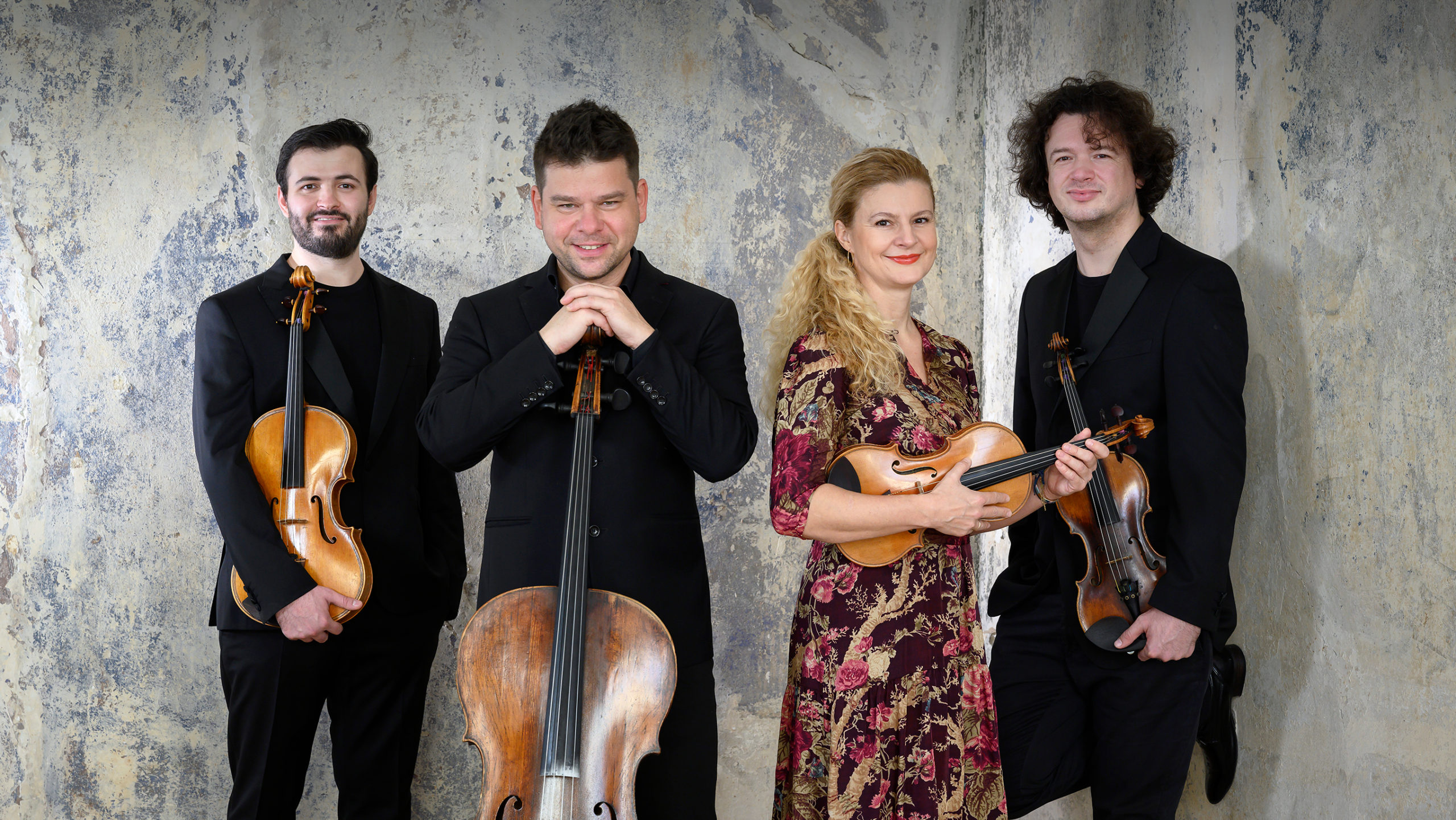
In concert: Pavel Haas Quartet at Wigmore Hall – Suk, Martinů & Korngold

Pavel Haas Quartet [Veronika Jarůšková, Marek Zwiebel (violins), Šimon Truszka (viola), Peter Jarůšek (cello)]

Suk Meditation on an old Bohemian Chorale (St Wenceslas) Op.35a (1914)
Martinů String Quartet no.2 (1925)
Korngold String Quartet no.3 in D major Op.34 (1944-45)

Wigmore Hall
Monday 12 June 2023 1pm

by Ben Hogwood

An unusual and intriguing program from the Pavel Haas Quartet contained music by two fellow Czech composers (Suk and Martinů) and one (Korngold) born in Moravia before moving to America.

The quartet began with a moving piece by Suk, his Meditation on an old Bohemian Chorale (St Wenceslas). This poignant pre-war utterance carried an air of deep profundity right from the first phrase of Simon Truszka’s viola, its elegiac tone enhanced by relative lack of vibrato. The air of solemnity carried throughout, though there was considerable strength in depth as the music grew in stature.

Though a Czech composer, Martinů spent a good deal of time overseas – largely out of necessity. By his early 30s he was in Paris, studying with Roussel, bringing a neoclassical language and tidiness to his music. The String Quartet no.2, though, is a curiously lopsided work, very front heavy with its first movement a combination of substantial slow introduction and quick section. There were close links to the St Wenceslas Chorale here, too, found in the solemn intonations of the Andante. This was the spiritual heart of the piece, dark and uncertain at times and contrasting greatly with the thoughtful but lightly coloured manner in which the quartet began. A resolute first movement found a mood that Martinů reprised in the closing Allegro, a propulsive dance number with a spring in its step. There was an undeniable French flavour to the music here, which the Pavel Haas Quartet brought forward, its elegance at odds on occasion with the rustic dance tunes.

There was tension in the final work, too, though this was undeniably the making of a mature composer. The String Quartet no.3 was Erich Korngold’s last published chamber piece, adjacent in publication to the Violin Concerto, with which it shares the same key of D major. The Pavel Haas Quartet gave a superb account of the piece, exploring its unusual musical language through music that would have presented considerable technical challenges.

The awkward but compelling violin melody in the first movement was brilliantly negotiated by Veronika Jaruskova, who conveyed its uncertainties through sweet tones and phrases. In spite of a convincing and full bodied outburst from all four players, the movement was dominated by this figure, which left a question in the mind. The Scherzo went some way to answering this, a black and white film scene easy to conjure up in the mind as the furtive darting of the main theme ensued. Again this was brilliantly played, as was the heart melting trio, its big tune (from the recently completed score to Between Two Worlds) full of tender longing and given appropriate glissando for expression.

The silvery slow movement flickered in the half light like a candle burning low, but with the flame essentially undimmed. The quartet’s sense of purpose was key here, with burnished lower string tones as viola and cello often combined, a notable cushion on which the searching violin melodies (using material from The Sea Wolf) could rest. Romance was in the air but although some of the music was borne of Hollywood, its intimate confines gave the music a deeply personal air. The atmosphere was heightened as a thundercloud hovered over the Wigmore Hall.

The motorised finale brought conviction and a strong sense of homecoming, not dissimilar to its equivalent movement in the Violin Concerto. Although emphatic in its resolution there were moments where the quartet moved into a different tempo or unexpectedly distant harmonies, Korngold momentarily distracted by edgier thoughts until his focus returned.

The Korngold string quartets have had something of a renaissance of late, with several new recorded versions and a marked increase in performance. On this very cultured evidence it would be no surprise if the Pavel Haas Quartet committed their version to disc soon – but it is to be hoped the other works will join it, for this was a fine concert indeed.

For more livestreamed concerts from the Wigmore Hall, click here

In Appreciation – Libor Pešek

by Ben Hogwood

Today we learned of the sad news that conductor Libor Pešek has died at the age of 89.

A tribute to him has been posted on social media by his management company IMG, while the artist page they held for him contains details on his conducting career.

Libor Pešek made some particularly fine recordings with the Royal Liverpool Philharmonic Orchestra when Virgin Classics was in the ascendancy in the 1990s. They include a cycle of the symphonies of Dvořák but also a rather wonderful disc introducing us to the music of Vítězslav Novák, and in particular his Slovak Suite. The recording became extremely popular with Classic FM listeners, and has led to something of a revival for the composer.

The playlist enclosed here is almost exclusively of Czech music, including works by Suk and Smetana, but we also include a nod to some extremely fine recordings of British music the conductor made, notably Britten’s Young Person’s Guide.

Any listener to classical music from the 1980s onwards will surely have encountered Libor Pešek’s art, and we can appreciate it here: