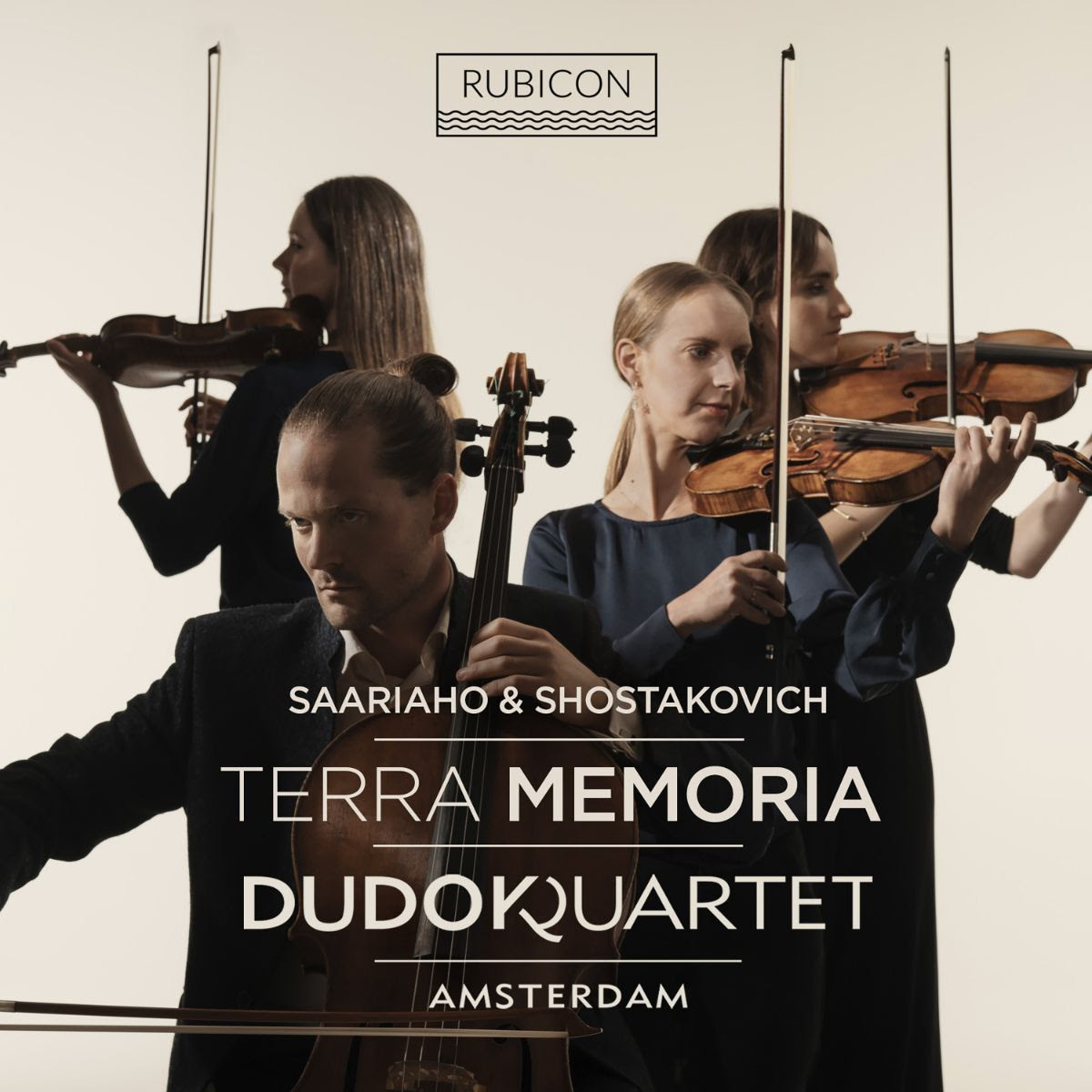
New music – Dudok Quartet: Terra Memoria (Rubicon Classics)

adapted from the press release by Ben Hogwood

TERRA MEMORIA
Kaija Saariaho String Quartet
Shostakovich String Quartet No 3 in F, Op. 73
plus a selection from 24 Preludes Op 34
Rubicon Classics RCD1218  Release date: 31 October 2025

I feel when writing for a string quartet that I’m entering into the intimate core of musical communication.
Kaija Saariaho 

Following two highly acclaimed composer-led volumes of Tchaikovsky’s string quartets last year, Dudok Quartet Amsterdam returns to another of its signature concept albums with a mix of thought-provoking repertoire.  Terra Memoria is the Quartet’s sixth album on the Rubicon Classics label and features Shostakovich’s third string quartet, from 1946, paired with Kaija Saariaho’s second String Quartet Terra Memoria from 2007. It is something of a partner to their 2022 album, Reflections, which paired Shostakovich’s String Quartet No 5 Op 92 with Grażyna Bacewicz’s String Quartet No 4and also featured other of the Quartet’s transcriptions of Shostakovich’s Preludes Op 34.
 
As a result of the Dudok Quartet’s inimitable and deeply inquisitive approach to understanding and expressing what they discover in these scores, they find that although Shostakovich and Saariaho are very different in their compositional approach, the outcome is similar; both possess unmistakeable musical signatures which empower their communication of imagination and emotion to performers and listeners alike.
 
Initially, Shostakovich gave titles to the five movements of his quartet No. 3, referencing a range of feelings and responses to the threat and ultimately the destruction and desolation of war.  If these titles intended any kind of narrative or explanation, the composer gave no reason for soon withdrawing them and, as Dudok violinist Judith van Driel explains, the force of the music cancels out any need for words; “Playing or listening to the third movement [for example] gives an infinitely more accurate meaning, by making adrenaline rush through your body causing your ears to ring from an unrelenting pounding. Its meaning is manifest in your sense of terror, fear and anger, whether or not you have ever experienced war up close.”
 
Throughout the quartet Shostakovich uses various compositional techniques to provoke immediate and reactive personal responses that are sometimes ambiguous and sometimes at odds – yet co-existing with each other. From the pastoral opening to the meandering melody searching for meaning in the fifth movement, it is the music that elicits inexplicable – in the most literal sense – and instinctive feelings.
 
Saariaho expressed a love for the richness and sensitivity of the string quartet sound, although she only composed two works in the genre. The second, Terra Memoria, captivated the Dudoks from the outset when they worked on it with her in 2011 (they were enchanted further by her music when they  collaborated in the world premiere of her penultimate opera, Only the Sound Remains, in 2016). Saariaho references the work as being ‘for those departed’, those whose lives are over, with nothing to be added, while those left behind are haunted by dreams and memories and find that the shape of remembrance can change as time passes.
 
But this explanation is only a starting point for the listener or player to make personal associations through experience of the composer’s sound world. Familiarising itself with her unique musical vocabulary was an absorbing and rewarding journey for the Dudok Quartet as they encountered a variety of unusual playing techniques and inventive musical mutations that include experimental threads of electronic music, minimalist-type repetition and operatic styles. For them, Saariaho’s music evokes a kind of intermediate zone between the known and the unknown, the living and the dead.
 
The Dudok Quartet is also known for its own transcriptions of works not originally composed for string quartet and rounds off the album with a selection from Shostakovich’s Preludes Op. 34 written for piano, all of them tiny gems which elicit personal stories and associations in the listener and player.

We aim to show that music affects people; that music can lead us to profundity and connection especially when it provokes friction. The true meaning of music reveals itself in a shared experience in which you, as a listener, play a vital role.
Dudok Quartet Amsterdam
 
The Dudok regularly performs in the UK and will feature Saariaho’s Terra Memoria in recital with Schubert’s Death and the Maiden in Portsmouth, Sheffield, Macclesfield and Hastings in November 2025, and Shostakovich’s String Quartet No 3 on tour in early 2026 – to the US in January and Scotland in February. Click here for further information.
 
Terra Memoria
Dudok Quartet Amsterdam 
Rubicon Classics RCD1218   Release date: 31 October 2025
 
Dmitri Shostakovich – String Quartet No. 3 in F, Op. 73 (1946)
I. Allegretto
II. Moderato con moto
III. Allegro non troppo
IV. Adagio (attacca)
V. Moderato
 
Kaija Saariaho – Terra Memoria (2007) for String Quartet
Shostakovich – 24 Preludes, Op. 34
No. 1 in C major – Moderato
No. 2 in A minor – Allegretto
No. 4 in E minor – Moderato
No. 6 in B minor – Allegretto
No. 12 in G sharp minor – Allegro non troppo
No. 22 in G minor – Adagio
 
DUDOK QUARTET AMSTERDAM 
dudokquartet.com

Published post no.2,668 – Thursday 25 September 2025

Arcana at the Proms – Prom 27: Silja Aalto, Anssi Kartunen, Seong-Jin Cho, BBC Symphony Orchestra / Sakari Oramo – Saariaho, Mozart & Richard Strauss ‘Alpine’ Symphony

Saariaho Mirage (2007) [Proms premiere]
Mozart Piano Concerto no.9 in E flat major K271 ‘Jeunehomme’ (1777)
Richard Strauss Eine Alpensinfonie Op.64 (1911-15)

Silja Aalto (soprano), Anssi Karttunen (cello), Seong-Jin Cho (piano), BBC Symphony Orchestra / Sakari Oramo

Royal Albert Hall, London
Friday 9 August 2024, 6pm

reviewed by Richard Whitehouse Photos (c) Mark Allan

Soon to begin his 12th season as chief conductor of the BBC Symphony Orchestra, Sakari Oramo made his second Proms appearance this season for what proved a typically diverse and resourceful programme whose stretching over 230 years of Western music was the least of its fascinations.

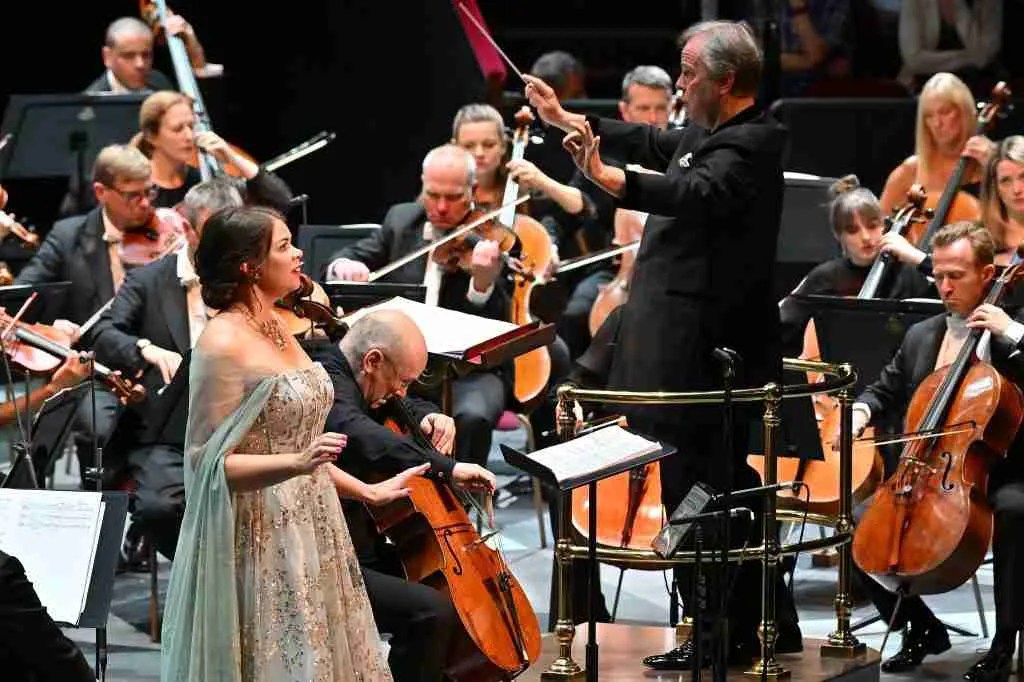
Her untimely death last year made a memorial to Kaija Saariaho more necessary and Mirage was a judicious choice, its setting lines by Mexican shaman María Sabina drawing a suitably theatrical response from Silja Aalto (above) – alongside who, Anssi Karttunen (long-time collaborator with this composer) weaved between the vocal and orchestral writing almost as an ‘alter-ego’ of subdued if beneficent presence. Musically the piece is typical of Saariaho from this period in aligning intricate texture with a mounting fervour at times ecstatic and ultimately fulfilled.

It may have been a ‘jeunefemme’ for whom Mozart actually wrote his Ninth Piano Concerto, but this remains its composer’s earliest unequivocal masterpiece and one with which Seong-Jin Cho (below) evidently feels real affinity. Not least in an opening Allegro whose arresting repartee at the start set the tone for an incisive traversal whose pianistic agility, not least in the first of Mozart’s cadenzas, was never without its inward asides. Such introspection came to the fore in the Andantino, its interplay of archaic and ‘modern’ harmonies yielding a plangency which found soloist and conductor as one. Nor was the finale’s central Menuetto without ruminative poise, set in relief by the buoyant Presto sections either side. Impressive music-making, then, that Cho continued with his deftly eloquent take on the second movement of Ravel’s Sonatine.

The last and most inclusive of Richard Strauss’s tone poems, An Alpine Symphony has received more than its share of tendentious reviews (and perfunctory programme notes), so credit to Oramo for emphasizing those purely musical qualities which, much more than its being a ‘bourgeois travelogue’ or even existential statement, duly determine this most formally and expressively integrated of its composer’s such works. As was evident at the outset: Alpine vistas emerged via a preludial crescendo that headed seamlessly into the ascent with its assembly of offstage horns, placed to advantage on the right of the gallery, then frequently arduous traversal above the treeline and on to the glacier prior to the summit. Its attendant ‘Vision’ drew an affecting soliloquy from oboist Tom Blomfield, then resplendent response from a 125-strong BBCSO.

What goes up tending to come down makes the following portion most difficult to sustain in terms of its ongoing momentum. The present account marginally lost focus here, but not in a mesmeric evocation of that eerie calm before the thunderstorm; organ and percussion adding to the overall mayhem before the relative calm of encroaching sunset. Ausklang is no mere epilogue – here, it afforded transcendence in the amalgam between those human and natural domains, while ensuring an overall fulfilment in the face of night with its inevitable closure.

The piece has come into its own since first appearing at these concerts 42 years ago and, if tonight’s reading did not quite touch all relevant bases, it conveyed the work’s measure like few others in tribute to the continuing creative partnership of this conductor and orchestra.

For more on this year’s festival, visit the BBC Proms website – and to read more on the artists involved, click on the names: Seong-Jin Cho, Silja Aalto, Anssi Karttunen, the BBC Symphony Orchestra and their chief conductor Sakari Oramo, and the official website of Kaija Saariaho and her works

Published post no.2,268 – Monday 9 August 2024

In appreciation: Kaija Saariaho

Yesterday we learned the very sad news of the death of Finnish composer Kaija Saariaho at the age of 70. Saariaho blossomed as a unique voice in 20th and 21st-century classical music, her music notable for its picturesque qualities and colourful, often exotic instrumentation.

Thankfully a good deal of her work has been recorded by the ever-enterprising Ondine Records, who put this playlist together in celebration of her 70th birthday earlier in the year:

Meanwhile you can watch Vista, one of Saariaho’s most striking recent orchestral works, in the performance below with the Helsinki Philharmonic Orchestra conducted by Susanna Mälkki

BBC Proms #25 – Carolina Eyck, BBC Philharmonic Orchestra / John Storgårds: Kalevi Aho Theremin Concerto, Saariaho & Shostakovich

Prom 25 – Carolina Eyck (theremin), BBC Philharmonic Orchestra / John Storgårds

Aho Eight Seasons (Concerto for Theremin & Chamber Orchestra) (2011) (London premiere)
Saariaho Vista (2019) (Proms premiere)
Shostakovich Symphony no.15 in A major Op.141 (1971)

Royal Albert Hall, London
Thursday 4 August 2022

Reviewed by Richard Whitehouse Photo (c) Chris Christodoulou

John Storgårds has given some memorable Proms with the BBC Philharmonic in the decade since he became this orchestra’s guest conductor, and tonight was no exception for featuring a theremin concerto by Finnish composer Kalevi Aho. Its title Eight Seasons should be taken advisedly – the eight continuous sections encompassing a period from autumn to spring, as is reflected in the mostly restrained yet constantly changing textures which define a progression from the richness of Harvest to Midnight Sun with its serenity informed by new potential.

An instrument as fascinating to watch being played as it is to hear, the theremin has become the victim of its own ubiquity as an enhancer of atmosphere in film-scores and for musicians from Brian Wilson to Jonny Greenwood. Carolina Eyck was a dedicated exponent (evident in her encore-demonstration) – not least in the latter stages when her vocalise proved an enticing extension of her instrumental prowess, and the myriad timbral shifts more than compensated for the intermittent blandness of Aho’s acutely fastidious if not consistently involving music.

The layout of this piece (wind quintet and percussion alongside reduced strings) necessitated an early interval to prepare for those relatively lavish forces of Vista, Kaija Saariaho’s latest return to the orchestra and inspired by traversing the Californian coast from Los Angeles to San Diego. This is embodied over two cumulative movements – the expectancy of Horizons duly fulfilled with the mounting activity of Targets which itself subsides into an intensified recollection of the opening, now sounding as expansive as that ‘vista’ envisaged by the title.

Music so complex needs a sure hand to maintain its focus, the BBC Philharmonic responding with alacrity to Storgård’s attentive direction while he steered a convincing trajectory through what is likely Saariaho’s finest large-scale work for years – the intricacy and translucency of her writing having a panache which ensured this was manifestly a showpiece with substance. In particular, the sense of ideas being tentatively anticipated then vividly recalled added much to the evocative quality of music as formally substantial as it sounded expressively involving.

From recent Finnish orchestral works to Shostakovich’s last and most equivocal symphony is a fair step aesthetically, but Storgårds ensured the succession was a meaningful one. If it did not evince the ultimate in ominous irony, those laughs elicited from the opening movement’s stealthy activity and allusive inanity were for real – as, more regrettably, were those hesitant coughs denoting uneasy response to the slow movement’s emotional intensity as heightened by its sparseness of gesture, while not forgetting an eloquent response by cellist Peter Dixon.

Nor was the percussion found wanting in its almost concertante role, to the fore in a scherzo where the whimsical and sardonic found an unlikely accord. From its sombre initial gestures, Storgårds then had the measure of a finale whose central passacaglia built toward a powerful climax, and while tension dropped with the resumption of earlier ideas, the spectral transition into the coda was judiciously handled with the latter mesmeric in its deft profundity. Should the BBC Philharmonic need a new chief conductor, Storgårds might be worth approaching.

For more information, click on the names of composers Kalevi Aho and Kaija Saariaho – and for more on the artists, click on the names of Carolina Eyck, John Storgårds and the BBC Philharmonic Orchestra

Live review – Kirill Gerstein, Helsinki Philharmonic Orchestra / Susanna Mälkki: World premiere of Saariaho’s ‘Vista’; Schumann & Debussy

susanna-malkki

Kirill Gerstein (piano), Helsinki Philharmonic Orchestra / Susanna Mälkki (above, photo (c) Jiyang Chen)

Helsinki Music Centre, Helsinki
Broadcast Wednesday 12 May 2021, available online

Schumann Piano Concerto in A minor Op.54 (1841)
Debussy Pièce pour Le Vêtement du blessé (unknown, publ. 1925); Berceuse héroïque (1914); Les soirs illumines par l’ardeur du charbon (unknown, publ. 2001); Élégie; Étude retrouvée (both 1915)
Saariaho Vista (2019, world premiere)

Written by Ben Hogwood

One of the very few advantages of being restricted to online concerts in the last year has been the chance to enjoy music making on an international scale. This happily gave the opportunity to hear a major world premiere, a new orchestral work from Finnish composer Kaija Saariaho.

A truly international piece, Vista was co-commissioned by the Helsinki Philharmonic Orchestra, the Berlin Philharmonic, the Oslo Philharmonic and the Los Angeles Philharmonic Association. Its title page has the inscription For Susanna – presumably a dedication to the night’s conductor, Susanna Mälkki.

Although scored for a large orchestra, Vista is economical in its use of the forces. Inspired by road signs the composer saw in California – all promising great ‘vistas’ – the work has something of the West Coast about it, a shimmering heat haze and dust on the horizon. In its darker moments the twinkling of the stars, and the metropolis, can be discerned.

Vista impressed from the outset. Its first section, Horizons, began with a high oboe solo, played with very impressive control in this performance. As always with Saariaho’s music, the vivid colours in the orchestra made themselves known early on and after the initial intimacy of the wind instruments the view panned out appreciably, to an expansive picture.

Microtones and almost imperceptible changes in pitch were part of the evocation, and when the music alighted on a particular pitch the effect was striking. Saariaho’s music continuously evolved – shimmering, glistening, darkening, lightening, or casting shadow, as it did in a particularly vivid section where the metallic percussion took centre stage. Here the twinkling of glockenspiel contrasted with the spidery flurries of the strings.

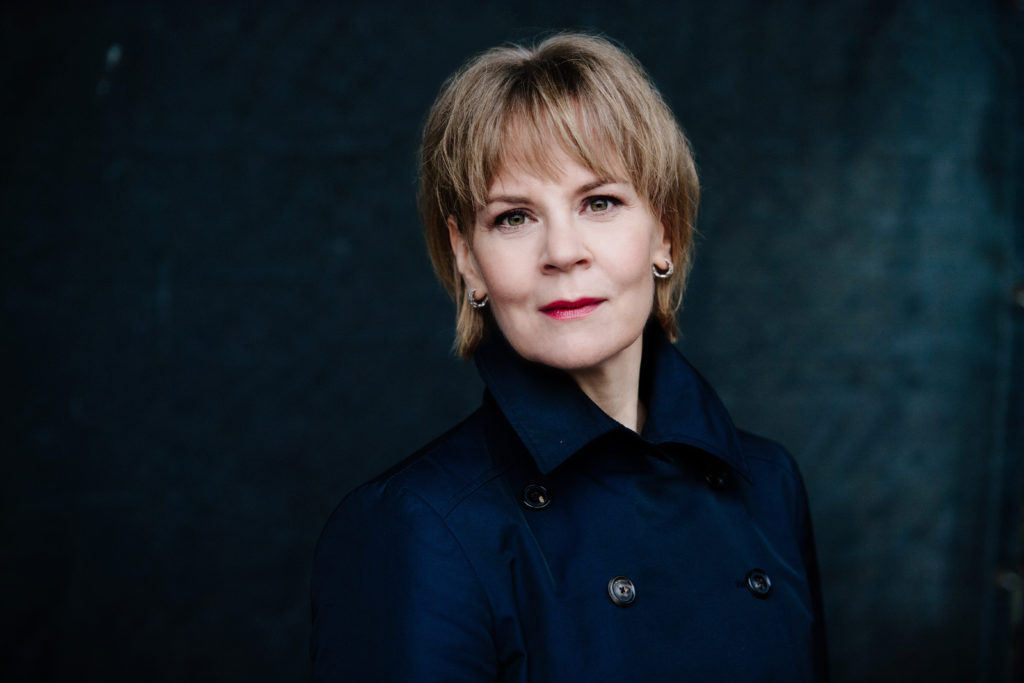
saariaho

Targets, the second section, began with a blast of sound, before brass and strings were involved in dialogue – and we heard a flurry of activity from the whole orchestra, after which all the forces reached the same pitch, the view panning out again. Now the vista was nocturnal, with a shiver in the air.

Saariaho (above) was present, and in a rather moving response to the piece the orchestra and conductor applauded the composer, rather than the other way around. It is always difficult to appraise a major orchestral piece on the basis of its premiere, but on this evidence Vista is a major achievement and a piece to return to as often, Thankfully Mälkki is conducting it with the Berliner Philharmoniker on 22 May, but this was a special performance from the composer’s ‘home’ orchestra.

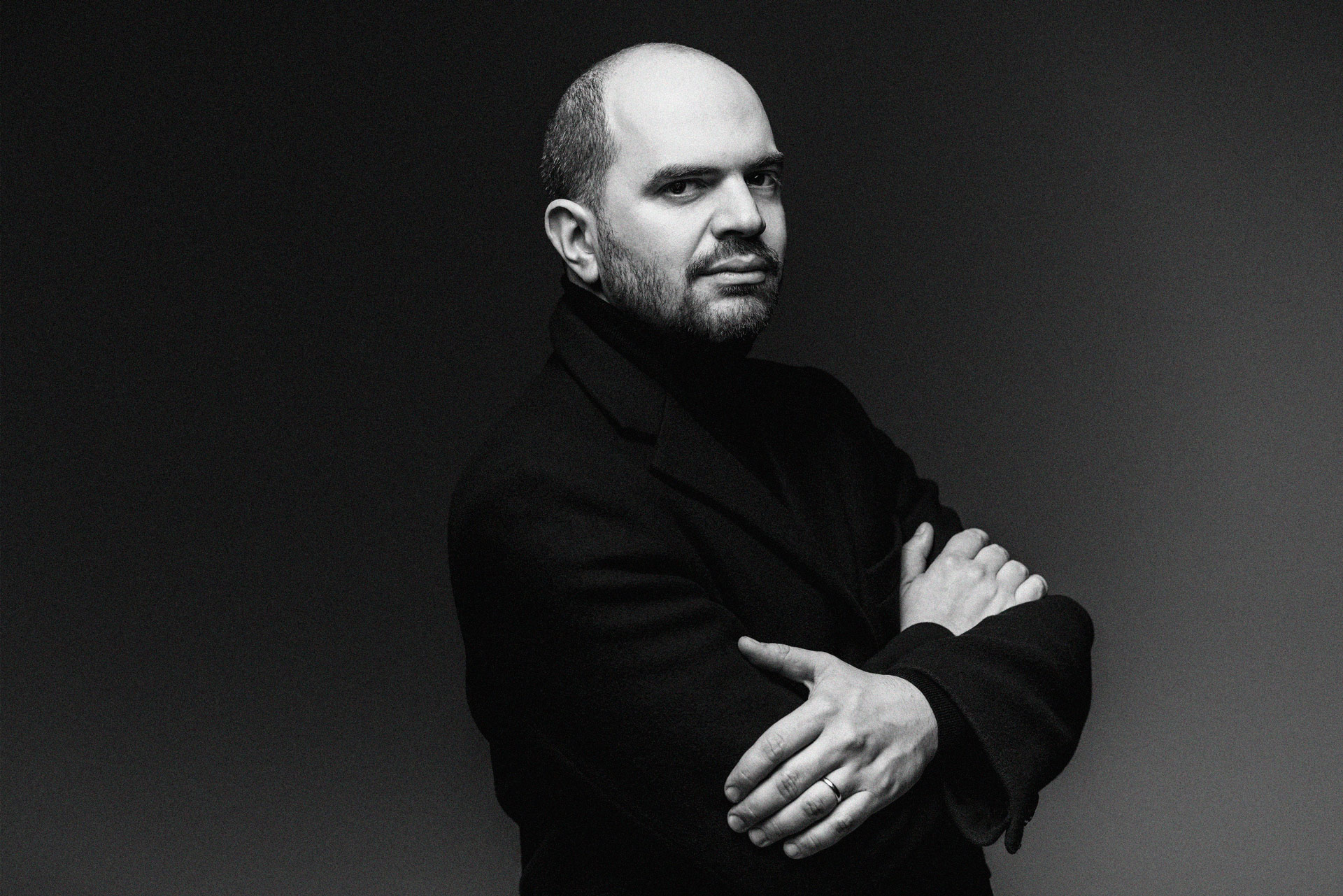
kirill_gerstein

Elsewhere on the program we enjoyed a fresh, vibrant performance of Schumann’s Piano Concerto in which the soloist was Kirill Gerstein (above). He clearly enjoys the piece, and the fast movements were notable for the clarity of their phrasing and lightness of touch. The first movement had an attractive lilt and some very appealing dialogue with the orchestra woodwind, oboe particularly. The slow movement gave plenty of room for Schumann’s softer sentiments, and the finale danced attractively.

The Schumann was complemented by some well-chosen solo Debussy, Gerstein opting for five lesser-known piano works. A palette-cleansing Pièce pour Le Vêtement du blesse, a posthumous publication, was followed by the steady tread of the Berceuse héroïque, given a solemn account. Les soirs illumines par l’ardeur du charbon was next, a piece unearthed in 2001 – sounding like a previously unreleased Prélude in these descriptive hands. The profound Élégie was next, then a rippling Étude retrouvée, a seldom-heard study written prior to the book of Études in 1915.

This was a fine concert, nicely structured and pointed towards the Saariaho – which fully lived up to its billing. Catch it if you can!

You can watch the concert on the Helsinki Philharmonic Orchestra website here

For more information on the Helsinki Philharmonic Orchestra digital season, you can visit their website here