Live review – English Symphony Orchestra / Kenneth Woods: Elgar Reimagined Part 2

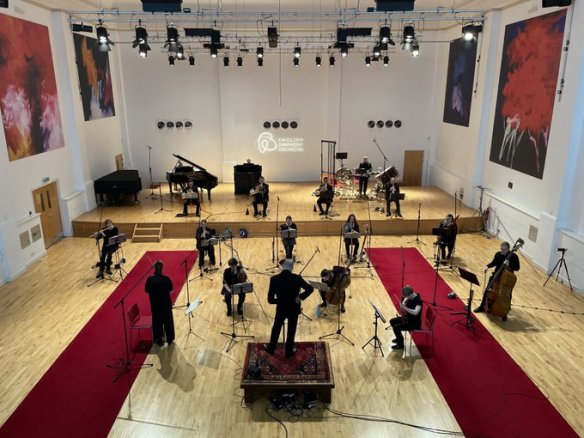
ElgarStringQuartet-Screenshot

English Symphony Orchestra / Kenneth Woods

Elgar, arr. David Matthews String Quartet in E minor Op.83 (1918)

Wyastone Concert Hall, Monmouth
Recorded September 22 2020 for online broadcast from Friday 14 May 2021

Written by Richard Whitehouse

Following its programme of miniatures – original and arrangements – for cello and strings in March, this latest online concert by the English Symphony Orchestra returned to Elgar for a reading of his String Quartet arranged by David Matthews for a full complement of strings.

This was the second in a triptych of chamber works composed in rural seclusion at Brinkwells in Sussex, Elgar having escaped the wartime disillusion of London for what was to be his last sustained period of creativity. Less introspective than the Violin Sonata that preceded it while less emotionally charged than the Piano Quintet that came after, the String Quartet is the most finely proportioned of the three – unfolding as a sustained sweep whose subtle transformation of thematic elements across and between its three movements make it among the finest of his later compositions. Heard in this guise, it follows on from the Serenade then Introduction and Allegro as the hitherto missing large-scale work for string orchestra of Elgar’s high maturity – which should hopefully commend it to an audience beyond that of the composer’s devotees.

Matthews has numerous arrangements to his credit (not least Schumann’s Piano Concerto as recast for marimba), and he has been mindful to balance the soloistic and ensemble potential of this music, so the result is neither straightforward transcription nor radical re-conception. The opening Allegro moderato discreetly emphasises an autumnal musing that sets the tone for much of what follows; even finer is the second movement – marked Piacevole – whose equability yields a main theme suffused with intensity, the extent of which is only revealed towards the close. If the emotional acuity of the final Allegro is marginally diffused when rendered for larger forces, there is no lack of rhythmic definition as the music proceeds to a coda whose terse decisiveness is far removed from the opulence of just a few years before.

Its idiomatic nature was enhanced by the ESO’s attentive playing under Kenneth Woods, a natural follow-on to their take on the Piano Quintet in Donald Fraser’s arrangement (Avie). Heard together, these two parts of Elgar Reimagined should make for a desirable recording.

You can watch the concert on the English Symphony Orchestra website here

For more information on the English Symphony Orchestra you can visit their website here

Live review – Kile Smith, Gemma Whelan, English Symphony Orchestra / Kenneth Woods: The Art of Storytelling – The Bremen Town Musicians

eso-bremen-town

Kile Smith (music), Gemma Whelan (narrator), English Symphony Orchestra / Kenneth Woods

Wyastone Concert Hall, Monmouth
Recorded 30 July 2020, available online from Friday 16 April 2021

Written by Richard Whitehouse

The English Symphony Orchestra reaches the concluding instalment of its series for virtual storytelling with one of the most appealing fairy tales – The Bremen Town Musicians, here given in a discreetly updated version which preserves its salient narrative and robust charm.

Maybe through its specifically German setting, what is among the more life-enhancing tales by the Brothers Grimm has never enjoyed the popularity of various other such stories (those who remember an enticingly illustrated version published by Ladybird in the 1960s would no doubt disagree!). The more reason, then, why it should not find renewed currency today – not least with the assistance of this online rendering, which has been vividly and imaginatively illustrated by students from Chadsgrove School in the Worcestershire town of Bromsgrove.

The story is breezily and resourcefully told by Gemma Whelan, assuming a variety of accents and intonations to differentiate those characters – donkey, dog, cat and cockerel – who defy imminent demise to become travelling musicians on a journey to Bremen that (at least in this version) they never reach. Their travails and unlikely victory over a band of rural robbers is underpinned with a score by Kile Smith whose echoes of Stravinsky, Hindemith and lesser-known but worthwhile figures such as Walter Piston is effectively geared to events at hand

The ESO musicians play with style and assurance, while Kenneth Woods ensures poise and humour – not least in several meaningful ‘wrong entries’. The overall presentation is sure to win this story new friends and, as usual, a range of sundry material enhances the experience.

You can watch the concert on the English Symphony Orchestra website here

For more information on the English Symphony Orchestra you can visit their website here

For information about Auricolae, visit Kenneth Woods’ website here

Live review – Thomas Kraines, Henry Goodman, English Symphony Orchestra / Kenneth Woods: The Art of Storytelling – Hansel and Gretel

eso-hansel

Thomas Kraines (music), Henry Goodman (narrator), Members of the English Symphony Orchestra / Kenneth Woods

Wyastone Concert Hall, Monmouth
Recorded 20 July 2020, available online from Friday 9 April 2021

Written by Richard Whitehouse

The English Symphony Orchestra reaches the penultimate instalment of its series for virtual storytelling with one of the most enduring among fairy tales – Hansel and Gretel, here given in the more abrasive version such as leaves little or no room for sentimental embellishments.

Although it has always been a parable for the playing-off of good against evil, the intensified recent concern about the exploitation of children has given this story a more ominous undertow. Little of that was emphasized here, yet the scenario remains one where the brutal corrupting of innocence is foremost; whether in the guise of the stepmother, rendered here in scarifying Irish, or that of the witch whose tendency to caricature is judged to a nicety. That neither children nor woodcutter exudes much in the way of persona may itself be significant.

As will have been realized, Henry Goodman is an animated and appealing narrator as he leads the listener through a story where incident likely counts for more than the ultimate destination. The score itself shows Thomas Kraines’s knack for moving across genres and styles with real sureness of touch, alighting on elements of German romanticism and expressionism to inflect those highpoints of the narrative. That the theme for the stepmother and the witch is a 12-note row brings a fresh perspective to a conceit whose lineage stretches back over nearly a century.

As in previous instalments the ESO musicians play with skill and sensitivity, Kenneth Woods ensuring clarity and balance even in the densest textures. The presentation is sure to provoke children of all ages and, as usual, a range of sundry material enhances the overall experience.

You can watch the concert on the English Symphony Orchestra website here

For more information on the English Symphony Orchestra you can visit their website here

For information about Auricolae, visit Kenneth Woods’ website here

Live review – Raphael Wallfisch, English Symphony Orchestra / Kenneth Woods: Elgar Reimagined Part 1

raphael-wallfisch

Raphael Wallfisch (cello), English Symphony Orchestra / Kenneth Woods

Elgar, arr. Fraser Miniatures for cello and strings
Chanson de Matin, Op.15 No.2 (1899)
Chanson de Nuit, Op.15 No.1 (1899)
The Wild Bears, Op, 1b No. 6 (1908)
Nimrod, Op.36 No. 9 (1899)
Romance in D minor, Op.62 (1910)
Sospiri, Op.70 (1914)
Mazurka, Op.10 No.1 (1899)
Pleading, Op.48 (1908)
In Moonlight (1904)
Salut d’Amour, Op.12 (1888)
Adieu (1933)

Wyastone Concert Hall, Monmouth
Recorded October 9 2020 for online broadcast from Wednesday 19 March 2021

Written by Richard Whitehouse

This latest in the English Symphony Orchestra’s online concerts focussed on Elgar – namely a series of miniatures for cello and strings arranged by Donald Fraser and played by Raphael Wallfisch, whose commitment to and conviction in this music hardly needs reiterating here.

Chanson de Matin launched proceedings in mellifluous fashion, and if the cello’s assuming of the melodic line was slightly to the detriment of the original scoring, that could hardly be said of Chanson de Nuit whose more sombre contours and ruminative character were ideally realized. Nor did The Wild Bears lose out on vivacity, and if this arrangement brought it into the orbit of Saint-Saëns, that served to underline the significance of ‘Second Empire’ French music on Elgar’s own thinking. In Nimrod, the cello’s dominance rather detracted from the subtlety of the original instrumentation; conversely, Fraser’s take on the Romance brought soloist and strings into even closer accord than the composer’s own version with orchestra.

Nevertheless, the undoubted highlight here was Sospiri – the cello’s subsuming of the harp’s crucial contribution just one aspect of an arrangement which presented one of Elgar’s finest inspirations (miniature or otherwise) in a striking new light. Lighter fare next with the robust tread of the Mazurka, proceeded by a rendering of the song Pleading of unforced eloquence. The evergreen In Moonlight (adapted from the overture In the South) responded well to this suitably limpid treatment, as did Salut d’Amour to one that underlined its wholly un-cloying essence. A wistful take on the piano piece Adieu saw this programme to an affecting close.

Throughout, the idiomatic feel of Wallfisch’s playing was complemented by that of the ESO under Kenneth Woods, as discreet or understated as the music requited. Forty minutes came and went effortlessly – the ‘Part 1’ designation happily meaning there will be more to come.

You can watch the concert on the English Symphony Orchestra website here

For more information on the English Symphony Orchestra you can visit their website here

Live review – Emily Davis, English Symphony Orchestra / Kenneth Woods: A Portrait of Steven R. Gerber

Emily Davis (violin), English Symphony Orchestra / Kenneth Woods

Gerber (arr. Hagen) Sinfonietta No. 1 (1991)
Gerber (arr. Williams) String Sinfonia No. 1 (1995)
Gerber Two Lyric Pieces (2005)
Gerber (arr. Williams) String Sinfonia No. 2 (2011)
Gerber (arr. Williams) Sinfonietta No. 2 (2000)

Wyastone Concert Hall, Monmouth
Recorded in 2020 for online broadcast, Wednesday 26 February 2021

Written by Richard Whitehouse

The English Symphony Orchestra’s online (hopefully not too much longer!) season continued tonight with this portrait of American composer Steven R. Gerber (1948-2015). Little heard in the UK (but extensively in Russia during the immediate post-Soviet era), his output follows a not unusual trajectory for someone of his generation – that from serialism to a rapprochement with tonality, though his evident success over these nominally opposing aesthetics is far rarer and confirms a creative zeal as was underlined by the works featured in this ESO programme.

Although he essayed a sizable number of orchestral works (including two symphonies), those pieces heard here were arrangements of chamber pieces. Not that they were at all unidiomatic or lacking impact – witness that of his Piano Quintet by Daron Hagen as the First Sinfonietta, whose five movements evolve in opposition between a pungent incisiveness and an emotional plangency which finds its culmination in the powerfully sustained fourth movement. Kenneth Woods secured a trenchant response from an ESO likely at or near its socially distanced limit.

The other arrangements were all undertaken by Adrian Williams, himself a notable composer of whom the ESO will be playing more in due course. Derived from Gerber’s Fourth Quartet, the First String Sinfonietta is notable for the comparable intensity of its central movements – a Lento then a Maestoso which might have functioned as a finale had not the composer opted, effectively as it turned out, to let such emotions subside over the curse of a brief yet affecting Postlude. It was astute programming to follow this with the Two Lyric Pieces for violin and strings, the only item played in its original guise and one whose mingling of wistfulness and eloquence finds the composer at his most approachable; not least when Emily Davis rendered the solo part with such fluency and poise. These pieces could yet enjoy a widespread success.

As derived from Gerber’s Sixth Quartet, the Second String Sinfonia appears to be among his more quizzical works – the angular while not a little ambivalent opening movement making way for a quizzical Intermezzo, then a closing set of variations that does not so much reach a climax as wind down into an uncertain repose. A more elaborate and methodical take on the Variations template is pursued by the second and final movement of Gerber’s Fifth Quartet, here arranged as the Second Sinfonietta which again has recourse to a fuller instrumentation and more charged expression. Notably the opening Fantasy, whose stark contrasts of mood make for a disjunctive overall trajectory as is subsequently countered, if not wholly resolved, through a steady and always inevitable build-up of the finale towards its forceful apotheosis.

Intriguing and engaging music which, if tending to an unrelieved earnestness, could hardly be faulted for emotional immediacy. It certainly found worthy exponents in the musicians of the ESO, directed by Woods with his customary conviction, while hopefully the tendency of the sound to distort in louder or more fully scored passages – what used to be termed ‘flutter’ in recorded parlance – was a factor of the online broadcast and not of the actual session. Those coming anew to Steven R. Gerber will doubtless have responded to his unwavering sincerity.

You can watch the concert on the English Symphony Orchestra website here

For more information on the English Symphony Orchestra you can visit their website here For more on Steven R. Gerber, visit his website