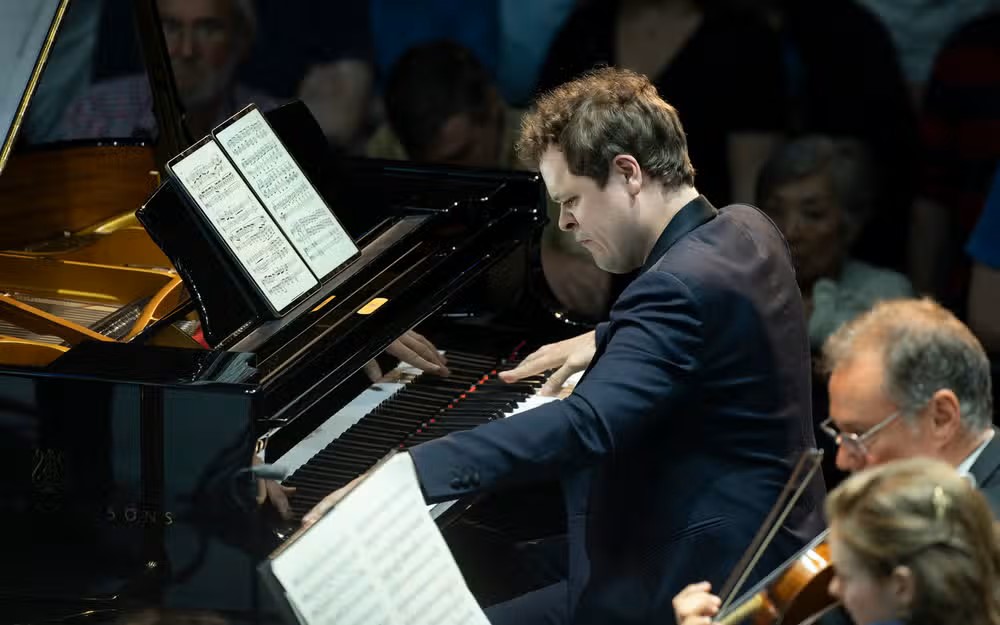
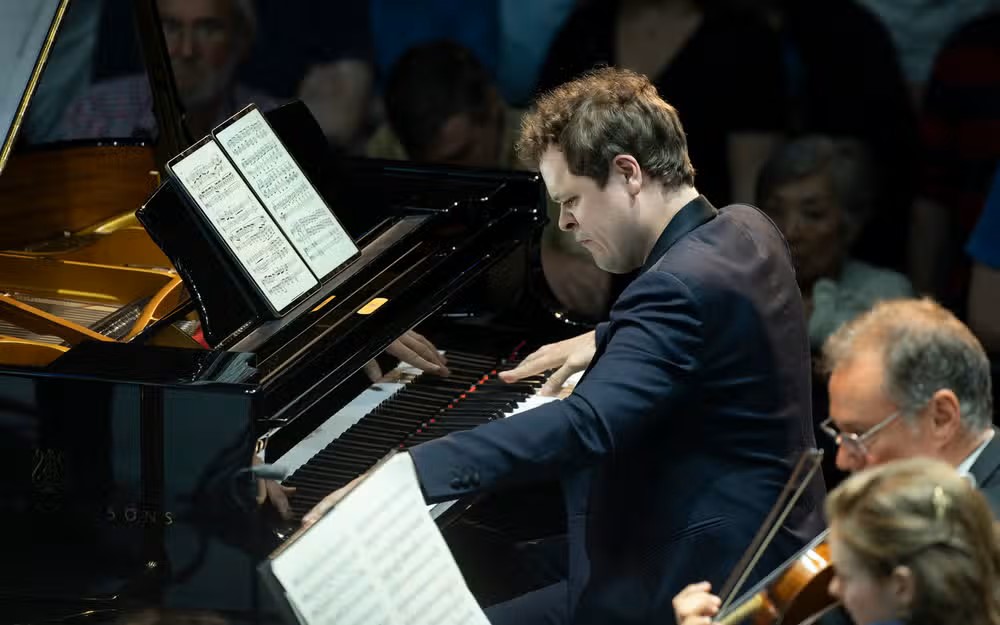
In concert – Jennifer France, London Philharmonic Orchestra / Edward Gardner @ Royal Festival Hall – Abrahamsen & Mahler

Jennifer France (soprano), London Philharmonic Orchestra / Edward Gardner

Abrahamsen let me tell you (2012-3)
Mahler Symphony no.4 in G major (1892, 1899-1900)

Royal Festival Hall, London
Friday 3 October 2025

Reviewed by Richard Whitehouse

Tonight’s London Philharmonic Orchestra concert featured the welcome revival of a 21st-century classic. Hans Abrahamsen’s recent output may be relatively sparing, but the works that have emerged represent a triumph of quality over quantity and not least let me tell you.

Set to fragmentary lines drawn by Paul Griffiths from his eponymous novel, this centres on the character of Ophelia – its seven songs falling into three larger parts whose outlining of a ‘before, now and after’ trajectory gives focus to the arching intensity of its 30-minute span. The first, fourth and sixth of these anticipate what comes to fruition during the second, fifth and seventh – the exception being the third whose speculative vocal line is underpinned by a stealthy progress in the lower registers evoking the motion, if not the form, of a passacaglia. Elsewhere the voice evinces an intricacy and translucency that effortlessly carries the word-setting as it pivots between thought of oblivion and transcendence, before eventually being subsumed into the orchestra for a conclusion among the most affecting in recent memory.

The LPO acquitted itself ably in music which is texturally complex for all its harmonic clarity, though it was Jennifer France (above) who (not unreasonably) most impressed with a rendering of the solo part as did ample justice to its high-lying melisma and airborne flights of fancy. Edward Gardner directed with an innate sense of where this music was headed, not least in those final bars with their tapering off into silence. Relatively few pieces are recognized as seminal from the outset, but let me tell you is one such and seems destined to remain so well into the future.

France then returned (or rather stole in) for the finale of Mahler’s Fourth Symphony after the interval. His setting of ‘Das himmlische Leben’ from the folk-inspired anthology Das Knaben Wunderhorn had actually been written almost a decade earlier and was once envisaged as the finale to the Third Symphony, but it makes a natural conclusion to a successor whose relative understatement is sustained right through to this movement’s intangible end: a ‘child’s vision of heaven’ whose intended innocence becomes informed with no little experience by the close.

Gardner had steered a convincing trajectory through the preceding movements – not least the opening one whose mingled whimsy and wistfulness took on a more ominous demeanour in its eventful development, before conveying unalloyed resolve in a warm-hearted reprise and beatific coda. What is among the most striking of Mahler’s scherzo’s proceeded with audible appreciation of its pivoting between the sardonic and sublime, Pieter Schoeman’s ‘mistuned’ violin being first among equals in music whose soloistic textures were thrown into relief by the homogenous stability of the Adagio. Its double variations unfolded with a fluid intensity capped by a coda whose ‘portal to heaven’ yielded thrilling resplendence as subsided into a transcendent raptness that, in other circumstances, could have made a satisfying conclusion.

That this lead so seamlessly into the vocal finale says a great deal for Mahler’s foresight, but also Gardner’s ability to fashion so cohesive a symphonic entity. As the music subsided into subterranean chords on harp, the audience was (necessarily) held spellbound a while longer.

Click on the links for more information on the London Philharmonic Orchestra, conductor Edward Gardner, soprano Jennifer France and composer Hans Abrahamsen

Published post no.2,679 – Monday 6 October 2025

Arcana at the Proms – Prom 23: Benjamin Grosvenor, Rodolfus Choir, London Philharmonic Chorus & Orchestra / Edward Gardner – Busoni & Rachmaninoff

Rachmaninoff Symphonic Dances Op.45 (1940)
Busoni Piano Concerto in C major Op. XXXIX (1902-4)

Benjamin Grosvenor (piano), The Rodolfus Choir (men’s voices), London Philharmonic Choir (men’s voices), London Philharmonic Orchestra / Edward Gardner

Royal Albert Hall, London
Monday 5 August 2024

reviewed by Richard Whitehouse Photos (c) Andy Paradise

This centenary of Busoni’s death has not thus far seen a great deal of activity in the UK, so it was gratifying to find the Proms scheduling his most (in)famous work – the Piano Concerto tonight receiving its second performance at these concerts, 36 years to the day after its previous outing.

Back then, the first half featured Beethoven’s Fourth Symphony and a more apposite coupling than Rachmaninoff’s Symphonic Dances. Now firmly ensconced in the orchestral repertoire, it remains a stern test the London Philharmonic Orchestra did not quite meet on this occasion – despite such felicities as Martin Robertson’s eloquent alto sax in the first movement and Edward Gardner’s conjuring of a tangible malevolence in its successor. Impulsive but erratic in its outer sections, the finale’s evocative central span had a superficial quality typical of this performance overall.

This was not the case in the Busoni. Benjamin Grosvenor (above) might not the first name who comes to mind for this concerto but, having already given performances in Reykjavik and Berlin, he was audibly attuned to an idiom not as elusive as often supposed in its canny amalgam of the Germanic and Italianate, while his playing was fully equal to its technical demands. That he is not a pianist looking to confront the orchestra head on ensured a more than usually close-knit coordination with players and conductor, which was almost always to the benefit of this piece.

Not least in Prologo e Introito, its orchestral introduction enticingly shaded by Gardner with Grosvenor integrating his unequivocal entry into what are essentially variations on the theme at the outset. Few pianists have weighted Busoni’s complex chords or his intricate harmonies with such translucency, not least the end of this movement where piano and orchestra melded to spellbinding effect. Straight into Pezzo giocoso, its capricious outer sections framing one of stealthy ambivalence as perceptively rendered as was that spectral angularity near its close.

Grosvenor managed the rare trick of making Pezzo serioso simultaneously cumulative and cohesive. He duly channelled the slow-burning momentum of its introduction into the rolled chords of its barcarolle-like first part – Gardner sustaining impetus across its successor to an imperious climax, during which the soloist never risked being obliterated. The lead-in to its third part had a poise equal to that at the end, where subtle rhythmic contrasts between piano and timpani against undulating strings had an enfolding calm to diffuse any lingering tension.

A general pause for retuning, then All’italiana burst forth – the underlying tarantella rhythm a springboard for its motley succession of vernacular elements initially humorous and latterly uproarious, held in check by the scintillating give-and-take of soloist and orchestra. Grosvenor almost topped these shenanigans with his electrifying cadenza – after which, Gardner prepared admirably for Cantico in which male voices (above) hymned Allah’s praises with mounting fervour; Grosvenor a largely passive observer until he belatedly returned for the headlong signing-off.

Quite a performance, then, that will hopefully be released commercially. Did Busoni offer an encore at that Berlin premiere? It could not have been more suitable than J.S. Bach’s Prelude in E minor BWV855, transposed and arranged by Alexander Siloti – three minutes of balm bringing us gently down to earth.

For more on this year’s festival, visit the BBC Proms website – and to read more on the artists involved, click on the names: Benjamin Grosvenor, Edward Gardner, The Rodolfus Choir, London Philharmonic Choir and the London Philharmonic Orchestra

Published post no.2,264 – Thursday 5 August 2024

Arcana at the Proms – Prom 23: Thoughts on Busoni’s Piano Concerto

Benjamin Grosvenor (piano), The Rodolfus Choir, London Philharmonic Choir, London Philharmonic Orchestra / Edward Gardner

Royal Albert Hall, London
Monday 5 August 2024

by Ben Hogwood Photo (c) Andy Paradise

A full review of Prom 23 will follow from Richard Whitehouse, but I wanted to register some thoughts on my first live encounter with one of the most extraordinary piano concertos you could ever hope to hear.

In the last few months pianist Benjamin Grosvenor has taken Ferruccio Busoni’s Piano Concerto on something of a concert tour, and has written of his love and admiration for the piece in a Guardian article, which proves a helpful guide for anyone not fully attuned to the piece.

The centenary of Busoni’s death falls this year, hence the first appearance of this piece at the Proms in 36 years, since a memorable occasion when Peter Donohoe squared up to the solo part in the company of the BBC Symphony Orchestra and Mark Elder. Oh, and the BBC Singers – for this work, unbelievably, has a male chorus in the finale, singing “Lift up your hearts to the Power Eternal”, a hymn to Allah from Adam Oehlenschläger’s Aladdin. Busoni’s quote in the score at this point is that “The Pillars of Rock begin to make soft and gentle music.”

Yet even before we got to that fifth movement the extraordinary power and individuality of Busoni’s music was shining through. The London Philharmonic Orchestra under Edward Gardner had a big part to play here, setting the scene in the Prologo e introito as though we were standing in a cathedral, awestruck at the architecture but still taking in a new sight with each about turn.

Grosvenor’s interpretation of his part was balletic, and the music really danced – swooping down from the heights or bubbling up from the depths, the pianist finding remarkable clarity in even the most complex passagework. Busoni, a formidable concert pianist himself, really tests his soloist, but retains a well-judged balance between piano and orchestra. Grosvenor and Gardner somehow found this equilibrium in the notoriously tricky acoustics of the Royal Albert Hall, where from the arena you could hear the clear communication of Busoni’s ideas. The orchestra were superb here – percussion ideally balanced, strings and wind interacting with the piano cleanly and the brass sensitively placing their chorale interventions. The clarinet and viola solos in the second movement had all the room they needed, while the orchestral colour that appears so unexpectedly and vividly in this work was richly shaded.

And what of the piece itself? In many ways it was like listening to a progressive rock album from the 1970s, which in itself is extraordinary when you think the Piano Concerto was completed in 1904. The sheer scope of Busoni’s imagination knew no bounds, then – taking on board more obvious influences from Bach, Beethoven, Chopin and Liszt, while using harmonic techniques to remind us that we were now in the age of Sibelius, Elgar and even Schoenberg.

The fourth movement was perhaps the most remarkable in this performance. With the gargantuan third completed, a kind of meditation in four parts, Busoni summons even greater invention for a Tarantella of remarkable energy, the solo part whirling round in a circle and brilliantly played here by Grosvenor. Just as it seemed all possibilities had been exhausted, the appearance of the male chorus was a masterstroke, their sonorous tones floating above much of the audience in the Royal Albert Hall. They leant a whole new dimension to the work, meaning that even those who might have been struggling 55 minutes into a piece found the new impetus and energy in Busoni’s exultation.

If you have not yet encountered this extraordinary piece I encourage you to without delay – but don’t stop there, for Busoni’s solo piano output, while very different, has many riches to impart in a fraction of the time. First, though, you have to try the Piano Concerto. It will knock your socks off!

You can listen to this concert on BBC Sounds – with the Busoni Piano Concerto beginning at 1:03:55. For more on this year’s festival, visit the BBC Proms website

Published post no.2,263 – Wednesday 7 August 2024

In concert – Seong-Jin Cho, London Philharmonic Orchestra / Edward Gardner: Wagner, Beethoven & Tippett

Seong-Jin Cho (piano), London Philharmonic Orchestra / Edward Gardner

Wagner Parsifal – Prelude to Act One (1878)
Beethoven Piano Concerto no.4 in G major Op.58 (1805-6)
Tippett Symphony no. 2 (1956-7)

Symphony Hall, Birmingham
Wednesday 10 April 2024

Reviewed by Richard Whitehouse

Although the London Philharmonic Orchestra’s ongoing season might not have been among its most enterprising, this evening’s concert confirmed how Edward Gardner is influencing both this orchestra’s programmes and its approach to standard repertoire as well as modern classics.

Beginning with the Prelude from Wagner’s Parsifal is certainly playing for high stakes and, while it afforded no revelations, this performance seemed nothing if not aware of the piece’s searching grandeur where the placing of motifs and those silences between them is crucial to its overall cohesion. A pity, perhaps, that Gardner opted for the ‘concert ending’ in which the close of the first act is laminated onto what went before instead of merely allowing the music to remain in expectancy, but this detracted only slightly from the majesty of what was heard.

Beethoven’s Fourth Piano Concerto then provided a perfect foil, not least in a performance so attentive to the interplay between soloist and orchestra. It helped that Seong-Jin Cho, winner of the Chopin International Competition in 2015, had an innate feeling for that ‘give and take’ necessary in this most integrated of the cycle; his fastidious while never uninvolving pianism heard to advantage over an initial movement where gradual evolution was uppermost, though his take on Beethoven’s earlier and less capricious cadenza was not lacking virtuosity. He and Gardner were at one in conveying the elemental call-and-response of the Andante, a brief but profound entry into a final Rondo whose vivacity was judiciously balanced with a ruminative poise, where lower woodwinds and strings emerged at the fore prior to the exhilarating close.

Some 66 years following its problematic premiere (restarted after a collapse of ensemble just minutes in), Tippett’s Second Symphony now enjoys regular revival though it could hardly be said to play itself. A keen advocate of this composer (witness his acclaimed recording of The Midsummer Marriage), Gardner paced the opening Allegro unerringly – pointing up contrast between its vigorous and yielding themes, while securing the requisite impetus in its lengthy development then a surging energy in its coda. Punctuated by Paul Beniston’s superb trumpet playing, the Adagio was almost as fine even if a slower underlying tempo might have brought even more depth to some of Tippett’s most evocative and spellbinding music; not least during its central build-up in the strings to a climax whose stark curtailing feels more than prescient.

Reservations as such centred on the Presto – undeniably well articulated in terms of rhythmic precision, while lacking the swiftness or velocity for its obsessive interplay and its Dionysiac culmination really to hit home. By contrast, the final Allegro was far from the anti-climax it can seem. Gardner had its measure from the jazzy introduction, via an inventive sequence of variations then sensuously descending melody on strings against shimmering woodwinds, to those cumulative ‘gestures of farewell’ that ended this performance in ecstatic ambivalence.

If not definitive, this was certainly an absorbing and memorable account as will hopefully be made available on the LPO’s own label (the concert having been broadcast live on Radio 3): one that rounded off what proved to be a judiciously planned and finely executed programme.

Click on the link to read more on the current LPO concert season, and on the names for more on pianist Seong-Jin Cho, conductor Edward Gardner and a website devoted to composer Sir Michael Tippett. The LPO’s new recording of The Midsummer Marriage can be found here

Published post no.2,148 – Sunday 14 April 2024

On record – George Zacharias, Alexandros Koustas, LPO / Brabbins – Skalkottas: Two Concertos (BIS)

George Zacharias (violin), Alexandros Koustas (viola), London Philharmonic Orchestra / Martyn Brabbins

Skalkottas
Violin Concerto (1937-8, ed. Mantzourani)
Double Concerto (1939-40, ed. Zacharias)

BIS BIS 2554 SACD [57’57”]

Producers Matthew Bennett (Violin Concerto), Alexander Van Ingen (Double Concerto)
Engineers Dave Rowell (Violin Concerto), Andrew Mellor, Brett Cox (Double Concerto)

Recorded 5-6 January 2020 (Violin Concerto), 19-20 April 2022 (Double Concerto), Henry Wood Hall, London

Written by Richard Whitehouse

What’s the story?

BIS continues its long-running project devoted to music by Nikos Skalkottas (1904-49) with this revisiting of his Violin Concerto, alongside a first recording for his Double Concerto in what is a typically apposite pairing which none the less points up the diversity of his output.

What’s the music like?

It was with a release featuring the Violin Concerto that BIS inaugurated its Skalkottas series a quarter-century ago. This recording uses the ‘new critical edition’ prepared in 2019 by Eva Mantzourani, whose volume The Life and Twelve-Note Music of Nikos Skalkottas (Routledge: 2011) is necessary reading for anyone interested in this composer. Many of these corrections will only be evident to those having access to the score, but interpretive differences between Gorgios Demertzis in 1997 and George Zacharias in 2022 are clear from the outset. The latter adopts appreciably quicker tempos for the first two movements that make the opening Molto appassionato more febrile in its expressive contrasts, then the Andante spirito feels closer to an intermezzo after the example of Schoenberg’s Violin Concerto as is brought more directly into focus. Demertzis launches the final Allegro rapidly, Zacharias gaining momentum more gradually before tackling the Prestissimo coda with abandon. Which one prefers depends on how one views the competing expressionist and classicizing impulses of this masterly work.

Although finished barely two years later and pursuing a nominally similar formal trajectory, the Concerto for Violin, Viola and Wind Orchestra presents a markedly different take on its composer’s thinking. Different though not unexpectedly so, given Skalkottas’s approach to serial composition was anything but predictable while it took shape, moreover, in a cultural milieu where Hindemith and Weill (briefly his teacher) were as necessary a creative catalyst as Schoenberg. Not only does the scoring of this piece find accord with that of Hindemith’s concertante works and Weill’s Violin Concerto during that period, but the evolution of each movement in sometimes oblique though always discernible terms gives the overall design a distinctly neo-classical feel. Zacharias sounds even more ‘inside’ this work, and Alexandros Koustas is no less assured in viola writing which is (surprisingly?) always audible against an orchestra whose saxophone section accentuates the presence of jazz as against the militaristic element of brass and other woodwind. The result is a piece by turns engaging and disturbing.

Does it all work?

Pretty much always. Thoughtfully conceived and impressively executed, Skalkottas’s music does not play itself so that performers need to take the lead in rendering its inherent qualities as comprehensively as possible. Which is undoubtedly the case here – Zacharias and Koustas convincingly overcome any incidental technical difficulties, while Martyn Brabbins secures a trenchant and committed response from the London Philharmonic Orchestra in works with which neither he nor they have had the opportunity to come to terms via live performances.

Is it recommended?

It is. Those who already have that earlier recording of the Violin Concerto still need this new release which, with its immediate sound and detailed notes, brings the Skalkottas discography nearer fruition. How about a complete version of the Second Symphonic Suite as a follow-up?

Stream

Buy

For more information on this release visit the BIS website