There is an enticing potpourri of 20th and 21st century music from the London Symphony Orchestra on tonight’s installment of the LSO’s online series ‘Always Playing’.
Sir Simon Rattle conducts the orchestra in the Hungarian Peasant Songs from Bartók before they are joined by tenor Edgaras Montvidas for Szymanowski‘s seldom heard but exotic ballet Harnasie. Then clarinetist Chris Richards steps up as the soloist for works composed by Stravinsky and Bernstein for the great Woody Herman</strong).
However the main work of the evening's concert is a big, half-hour concerto for two pianos, percussion and orchestra from Osvaldo Golijov. Nazareno, completed in 2009, is based on themes from La Pasión según San Marcos, and is fronted by the Labèque sisters, with percussionists Gonzalo Grau and Raphaël Séguinier.
The performance, from Thursday 13 December 2018, can be seen on the orchestra’s YouTube channel from 7pm tonight here:
A real treat lies in store tonight in the form of Mahler‘s Symphony no.2, the Resurrection – and you can sing along.
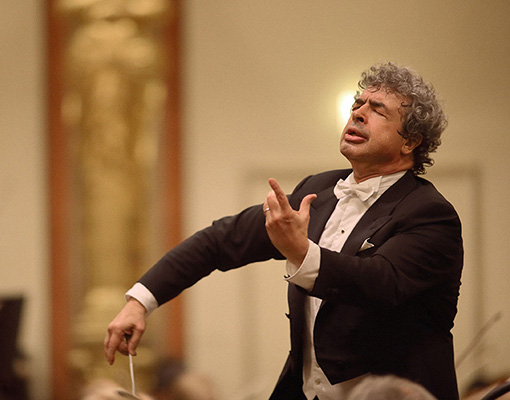
This stream from the London Symphony Orchestra is conducted by Semyon Bychkov (above), with vocal soloists Christiane Karg (soprano) and Ana Larsson (contralto).
The London Symphony Chorus and their director Simon Halsey provide the incredibly uplifting choral passages in the fifth and final movement – and you too can take part! For one night only the vocal score for the Resurrection is free to download, by following the link from the LSO website here
You could even pause the action at the end of the first movement, clap for the UK’s NHS staff, carers and delivery drivers, and resume after the ‘interval’. The performance, from Sunday 4 February 2018, can be seen on the orchestra’s YouTube channel from 7.15pm tonight here:
Tonight’s London Symphony Orchestra concert promises a trio of Russian treats. Firstly Seong-Jin Cho is the soloist in Rachmaninov‘s Piano Concerto no.2 – surely one of the best-loved of all piano concertos. Following this is another Russian work with piano, Balakirev‘s Islamey – only this time in the orchestral arrangement by the Italian composer Alfredo Casella. An exotic piece, it is a travelogue inspired by a visit to the Caucasus.
Following this we have the chance to marvel at the prodigious Symphony no.1 by the teenage Shostakovich. His graduation piece, it shows already the hallmarks that were to distinguish him as an exceptional symphonist in the 20th century.
Gianandrea Noseda, currently in the midst of a Shostakovich symphony cycle with the London Symphony Orchestra for their LSO Live label, conducts this performance from March 2019, which you can watch on the orchestra’s YouTube channel from 7pm tonight here:
Tonight’s recommendation for online musical fulfillment comes in the form of Verdi’s Requiem. This can be viewed on the London Symphony Orchestra’s YouTube channel, with principal guest conductor Gianandrea Noseda leading a performance with soloists Erika Grimaldi (soprano), Daniela Barcellona (mezzo-soprano), Francesco Meli (tenor) and Michele Pertusi (baritone). The London Symphony Chorus, prepared by their director Simon Halsey, provide the choral fireworks.
The performance began at 7pm BST but you can still watch the whole work from the start below:
Interviewed by Ben Hogwood
Picture courtesy of Decca Classics
Sheku Kanneh-Mason is a rare commodity. In the midst of dazzling publicity, he is helping open doors for classical music by his very approachable demeanour and an approach to album-making that brings it into closer contact with other forms. On the evidence of this interview he is refreshingly grounded and intently focussed on his first love, which of course is music.
While some have expressed concern that the cellist might be overworked early in his career, our discussions around second album Elgar confirm him to be relaxed and deeply satisfied with the newest addition to his discography.
His debut album Inspirations, released this time in 2019, presented the ShostakovichCello Concerto no.1, the piece he played to win the final of the BBC Young Musician of the Year in 2016. Kanneh-Mason coupled it with diverse pieces from Pablo Casals, Offenbach, Leonard Cohen and Bob Marley. This time however his main focus is the work of a much older man, the Cello Concerto in E minor of Sir Edward Elgar.
The recording of this much-loved corner of the cello repertoire was made with conductor Sir Simon Rattle and the London Symphony Orchestra. It has an intensity which belies Kanneh-Mason’s tender years, offering new viewpoints into what will be familiar music to a lot of people. Again the context into which Sheku puts the Elgar on his album is intriguing, of which more later. But where did he first hear the music of Elgar – and was it the piece he has just recorded?
“It would have been the concerto, definitely”, he recalls. “I listened to it a lot when I was younger, and I grew up with the famous Jacqueline du Pré version. While we were working on it I listened to a lot of different recordings of the piece, it’s such a special work. Other recordings I really love are the most recent Steven Isserlis recording, Truls Mørk with Simon Rattle, and the famous one from Beatrice Harrison with Elgar himself conducting. There is a huge range of ways in which people approach the piece, and what strikes me about the piece is that everyone reacts in a different way.”
The second movement (a Scherzo) finds Kanneh-Mason and Rattle scooting along with a particularly quick choice of tempo, and the cellist clearly relishes the fast bow strokes required. “It’s a fun piece to play, and you get swept up in it but you have to work on getting a lightness of touch with the repeated notes.”
Elgar’s concerto may be the main piece on the album but there are a variety of shorter pieces imaginatively included by Kanneh-Mason. One composer in particular we may be hearing from again is the Swiss-born American Ernest Bloch, born to Jewish parents. Two of his shorter pieces are included here. “I love his music”, says Sheku. “For Grade 8 I did the Prayer for cello and piano, which is a piece I knew to play young. It’s music I really love, and there’s also the piece for cello and orchestra, Schelomo, which I hope to record in the future. You can feel some of the pain in the harmonies he uses.”
More obscure still is a piece for cello ensemble, Hymnus, by the German composer Julius Klengel. “It’s an amazing piece”, he says. “He was a cellist as well, so I think that’s how he ended up writing for 12 instruments. Every week at the Royal Academy of Music we had a cello ensemble, and that’s how we got to know it. There’s a nice link there, as there is for all the pieces on the album. It’s very inspiring being around really young hardworking musicians and all of us being based in one place.”
How does Kanneh-Mason balance his studies with days like today, where he has a whole day of promotional interviews to navigate? “I just have to be very organised with my time, which is a good thing for us anyway. I never feel that I have too much on.”
He is particularly gushing when talk turns to his work with Sir Simon Rattle, and the bond they share in the interpretation of the Elgar. “Definitely. I think what I love about working with someone is the freedom to do what I want but knowing that they can do everything as well. It’s the spirit of true collaboration I think”.
The theme of collaborating runs through both albums, and Kanneh-Mason identifies with this original approach. “It’s nice to have a link and a reason for putting them together, like creating a concert program. It’s great to record a masterpiece and a big piece, and put it with smaller pieces that have an equal range of colour and harmony, and perhaps more subtleties.”
For Elgar he was helped by Simon Parkin, with sensitive arrangements for cello and orchestra of Elgar’s Nimrod, from the Enigma Variations, and the Romance originally written for bassoon and orchestra. To that he adds Frank Bridge’s Spring Song, the folksongs Blow The Wind Southerly and Scarborough Fair, and Fauré’s profound Elégie.
“He’s an amazingly skilled arranger”, says Sheku of Parkin, “and he keeps the heart of the pieces while making the most of the instruments. I love mixing the arrangements that complement the pieces of music in their original form, and it’s great to record them in respect of friends and teachers, which makes it more personal. I’m always excited and open to lots of new things and working with new people. I’ve had some amazing experiences with these recordings, and you can hopefully hear the enjoyment from them.”
As you might expect given his album programming, Sheku’s ‘out of hours’ musical tastes are varied. “I listen to a mixture of classical, jazz, reggae, and different kinds of folk music”, he says. “Growing up with music all around me has been really inspiring, and it has kept me grounded and motivated. Now I live with students, and the people below me are also musicians.”
Thinking back to his BBC Young Musician of the Year triumph brings Kanneh-Mason onto a subject close to his heart, musical education. “I think we should have as many young people in music as possible. The Young Musician of the Year is great as it shows people playing to the highest standard. When I did it I found watching people three or four years older than me was really inspiring, and it ultimately gives people the opportunity to do many more things.”
He also notes the importance of after care. “Afterwards there was so much attention, but the BBC really looked after me. It was important to have the right people around me and to be working with the right people. A competition is only good if what comes after is good.”
With time running out, we conclude by discussing his favourite musicians of the moment. “I love Steven Isserlis”, he says. “He’s my favourite cellist to watch…and I also love listening to the violinist Daniel Lozakovich. Martha Argerich is also someone I find really inspiring, I love watching her play the piano.”
This blend of youth and maturity, established and new, is perhaps the most inspiring thing about Sheku Kanneh-Mason’s success. His approach is very inclusive, and his next ventures will be very interesting to chart and appraise. With Elgar reaching the heights of number eight in the album charts so far, the musical world is very open to him right now.
Sheku Kanneh-Mason’s Elgar album is out now on Decca Classics – it can be purchased here, via Apple Music, or streamed below via Spotify:




 Arcana.fm