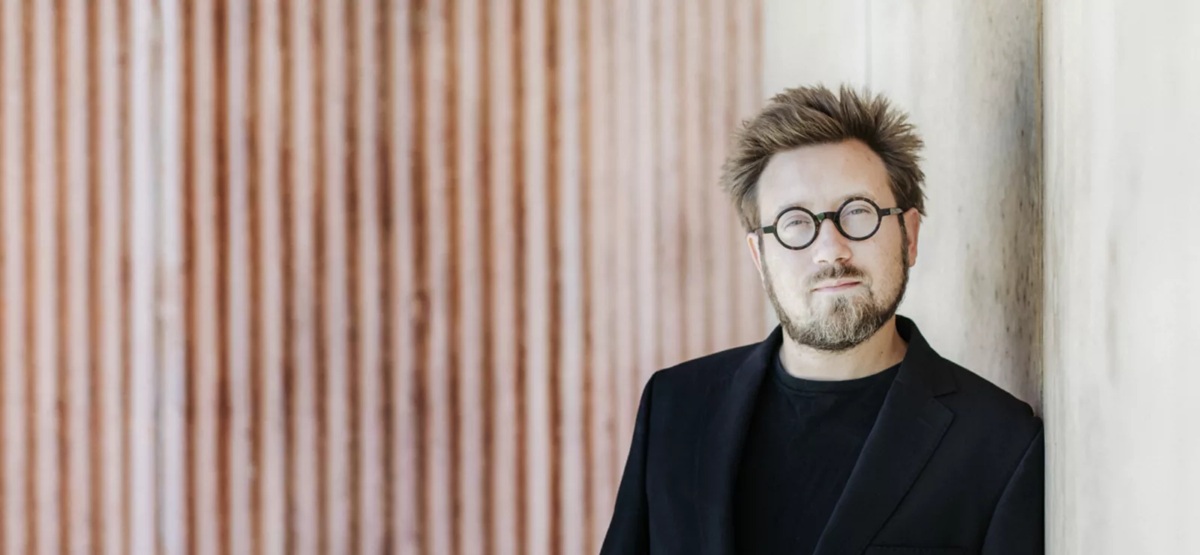
In concert – Heath Quartet @ London Chamber Music Society, St John’s Church Waterloo – Haydn, Bacewicz, Locke & Beethoven

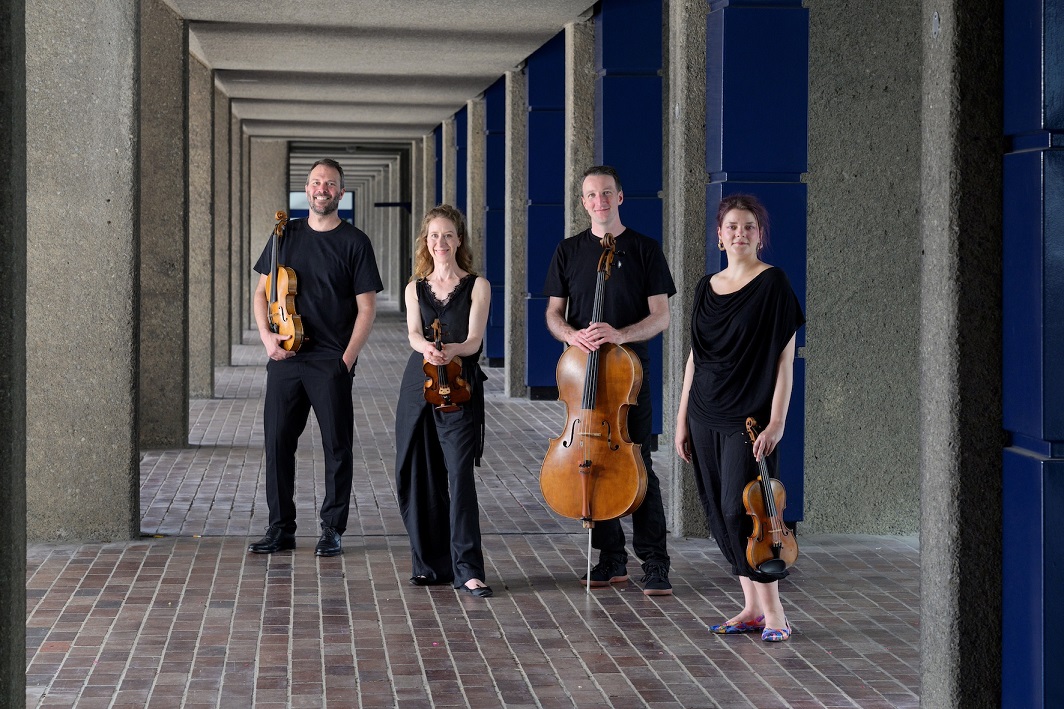
Heath Quartet [Maja Horvat & Sara Wolstenholme (violins), Gary Pomeroy (viola), Christopher Murray (cello)]

Haydn String Quartet in G major Op.33/5 ‘How Do You Do?’ (1781)
Bacewicz String Quartet no.6 (1960)
Locke Suite III in F (c1660)
Beethoven String Quartet no.16 in F major Op.135 (1826)

St John’s Church, Waterloo, London
Sunday 28 September 2025, 6pm

Reviewed by Richard Whitehouse

This early evening concert marked not just the start of London Chamber Music Society’s new season but also that of its first at St John’s Waterloo, following some 17 seasons in residence at King’s Place. The actual programme, however, could not have been more typically LCMS.

What better than to start with a Haydn quartet? His Op. 33 abounds in ‘less is more’ writing, not least the fifth in this set whose buoyant opening Vivace features a cadential figure which provides the nickname, then a Largo whose keening melody for first violin and cadenza-like passage betrays likely operatic origin. The Heath Quartet was equally inside the Scherzo with its amiable impulsiveness, while the final Allegretto had a genial humour that carried through to its good-natured payoff. A piece deserving of greater prominence within the Haydn canon.

As does the Sixth Quartet in Grażyna Bacewicz’s output. Evidently a breakthrough in terms of her writing for strings, its stealthy yet never brazen Modernism is clear from the opening movement in its subtle overhaul of sonata design, then the Vivace with its intensive rhythmic interplay. A ‘song without words’ centred on cello, the slow movement is a soulful interlude prior to a final Allegro as makes inventive play with rondo design – the widening expressive gulf between its stable refrain and its unpredictable episodes deftly sidestepped at the close.

Purcell’s music for consort might be the most directly acknowledged precursor of the string quartet, but that by Matthew Locke is hardly less significant and preceded it by almost two decades. This third of his six four-part suites is no exception – the substantial and teasingly discursive Fantasia being followed with an elegant Courante and a soulful Ayre then a (surprisingly?) trenchant Saraband. Throughout, the Heath’s seamless interplay was such as to relativize any distinction between a consort of viols and the ensemble of strings it became.

An ensemble taken to a peak of perfection on the cusp of the Romantic era with Beethoven’s last string quartet. Here the Heath judged the equable poise of its opening Allegretto then the quixotic humour of its scherzo to perfection. Neither was there any lack of feeling in a slow movement whose pathos becomes the greater for its understatement; the ‘difficult decision’ that informs the finale duly rendered with a sure sense of this music’s venturing towards its playful conclusion. Beethoven was rarely so profound as when he was being this disarming. A persuasive start to a new season and a new chapter in the illustrious history of the LCMS. A wide range of recitals is scheduled between now and June, while those unfamiliar with St John’s need have no doubt as to the excellence of its acoustic or attractiveness of its setting.

Click on the links for more information on the Heath String Quartet, the London Chamber Music Society and events at St. John’s Church, Waterloo. You can also click for more on composer Grażyna Bacewicz

Published post no.2,676 – Friday 3 October 2025

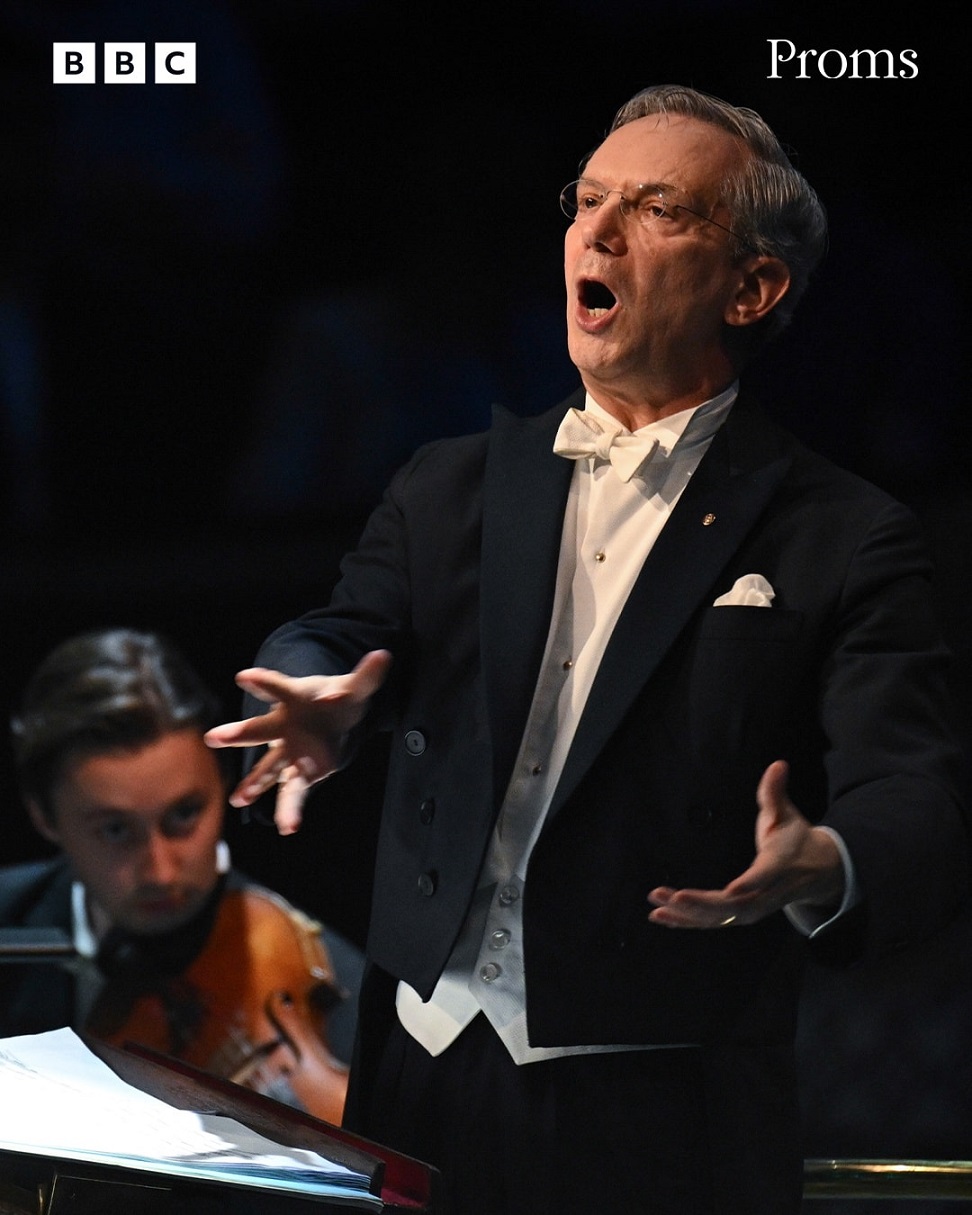
In concert – Soloists, Danish National Concert Choir & Symphony Orchestra / Fabio Luisi @ BBC Proms: Beethoven 9th Symphony, Bent Sørensen & Anna Clyne

Clara Cecile Thomsen (soprano), Jasmin White (contralto), Issachah Savage (tenor), Adam Palka (bass), Danish National Concert Choir, Danish National Symphony Orchestra / Fabio Luisi

Bent Sørensen Evening Land (2017)
Anna Clyne The Years (2021)
Beethoven Symphony no.9 in D minor Op.125 ‘Choral’ (1811-24)

Royal Albert Hall, London
Thursday 21 August 2025

Reviewed by Ben Hogwood Photos (c) BBC / Chris Christodoulou, Ben Hogwood (soloists)

Celebrating their centenary this year, the Danish National Symphony Orchestra and chief conductor Fabio Luisi led us from the quiet of evening to the blazing light of a sunny morning in the course of this concert.

The challenge facing any concert programmer containing Beethoven’s Choral Symphony is how to lead up to it. This Prom approached from a contemporary angle, beginning in near silence with Bent Sørensen’s contemplative Evening Land. The Danish composer’s imaginative orchestration was key to the success of his picture painting, beautifully rendered by Luisi, as was the threadbare violin solo with which leader Christina Åstrand began. Childhood reminiscences of the Danish island Zealand took place in the half-light, contrasting with visions of nocturnal Manhattan that came through in bursts of technicolour, honouring Leonard Bernstein. Making a lasting impression, however, was the beautiful oboe solo from Kristine Vestergaard that marked the illness and subsequent passing of Sørensen’s father.

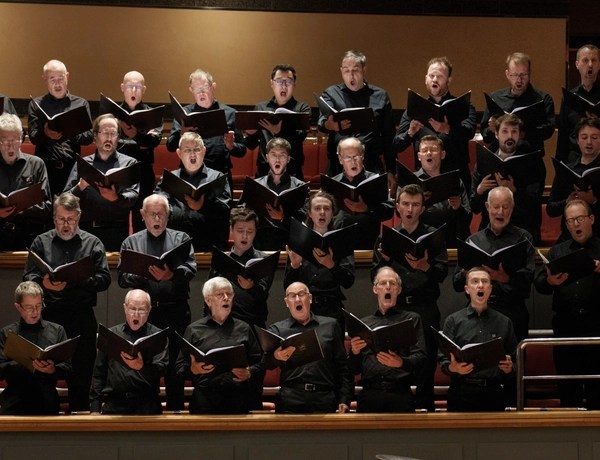
Having eavesdropped on this intimate opening piece, the Danish National Concert Choir rose for Anna Clyne’s musical account of the Covid pandemic – already consigned to history, it seems. Few people would like to revisit those days in a concert experience, but Clyne’s message – channelling the text of Stephanie Fleischmann – was one of underlying resilience. The choir began in stasis, occupying an added note chord which somehow drew parallels with the Björk song Possibly Maybe for this correspondent, before the piece flourished. A dreamlike mood was enhanced by a pure, almost complete lack of vibrato from both choir and orchestra, while the harmonic language drew strong parallels with the latter stages of Holst’s suite The PlanetsSaturn and Neptune in particular. An autumnal chill was evident in spite of increasingly frenetic activity in the orchestra, and the piece ended in an uneasy acceptance of events passed, rather like our own emergence from lockdown.

Beethoven’s Ninth Symphony is the ultimate hymn to freedom, though it does of course go through a titanic struggle before that release, in the form of Schiller’s Ode To Joy, can be attained. Luisi led us through the dark, pre-twilight moments in an account notable for its poise and guile. Using relatively fast speeds, the first movement took a little while to light the touch paper, but once ignited the music powered forward with increasing determination. The scherzo was quick, quite matter of fact with its timpani interventions, and balanced by a bucolic trio where the wind kept pace heroically with Luisi’s quick baton. Their attractive textures and warm melodic phrasing were a key feature of both this and the Adagio, again on the quick side, but managing its fanfare interventions impeccably.

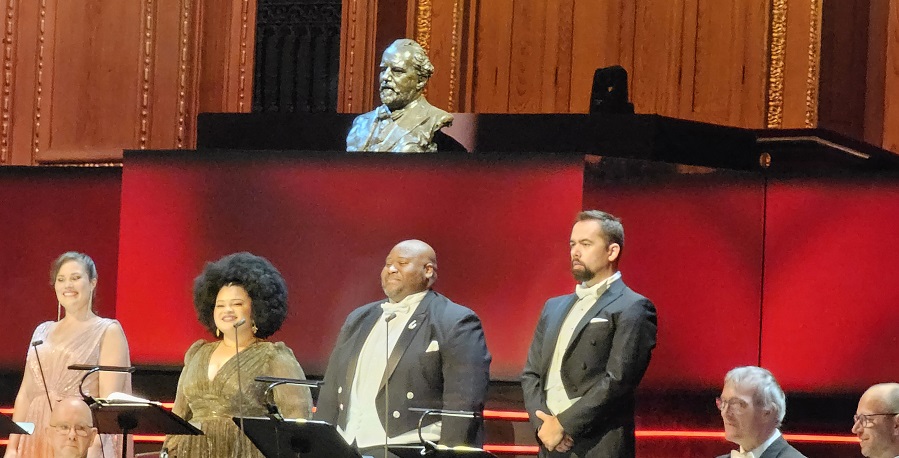
Left to right: Clara Cecile Thomsen (soprano), Jasmin White (contralto), Issachah Savage (tenor), Adam Palka (bass), beneath the bust of Sir Henry Wood @ BBC Proms

And so to the finale, with a memorable exposition for the Ode to Joy theme from sotto voce cellos and basses, the Royal Albert Hall hushed in anticipation. The choral passages were suitably exultant, the 75-strong choir drilled to perfection if cooler in temperature than the orchestra. The four soloists (above) were led by impressive bass Adam Palka, whose authoritative recitative “O Freunde, nicht diese Töne!” was a highlight, and while the quartet’s ensemble pieces wavered a little in tuning the sense of release and elation was keenly felt and clearly relished. The smile on the face of the music spread to the audience in the exhilarating closing bars as the orchestra took flight, completing an impeccably controlled interpretation on the part of Luisi that came to the boil at just the right time.

You can listen back to this Prom concert on BBC Sounds until Sunday 12 October.

Click to read more about the BBC Proms

Published post no.2,634 – Friday 22 August 2025

In concert – BBC Scottish SO / Ryan Wigglesworth @ BBC Proms: Birtwistle Earth Dances & Beethoven ‘Eroica’ Symphony

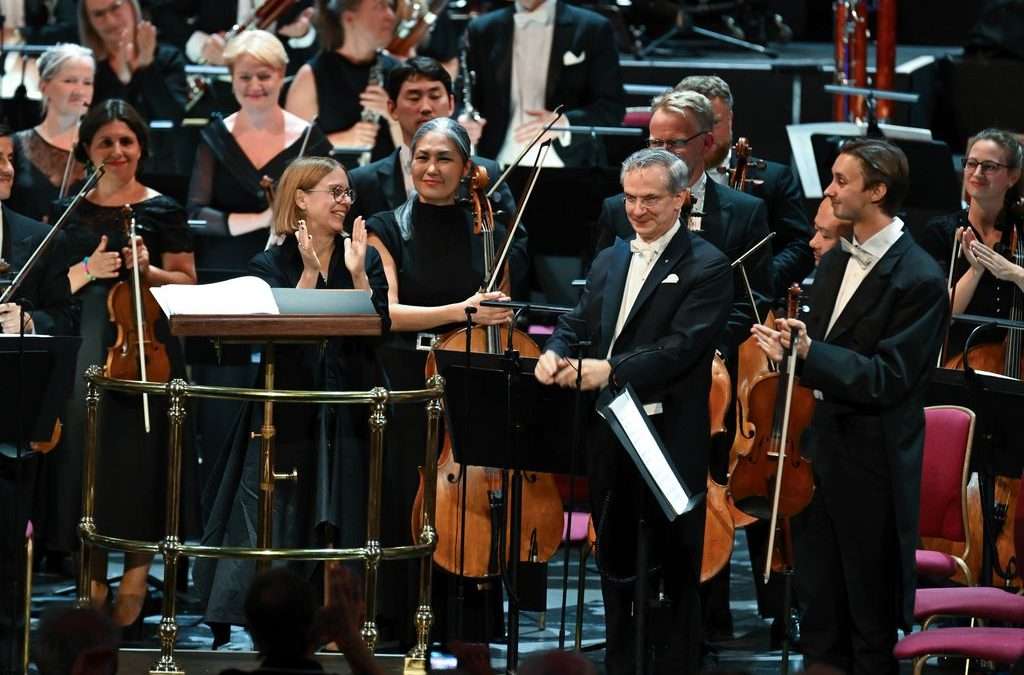
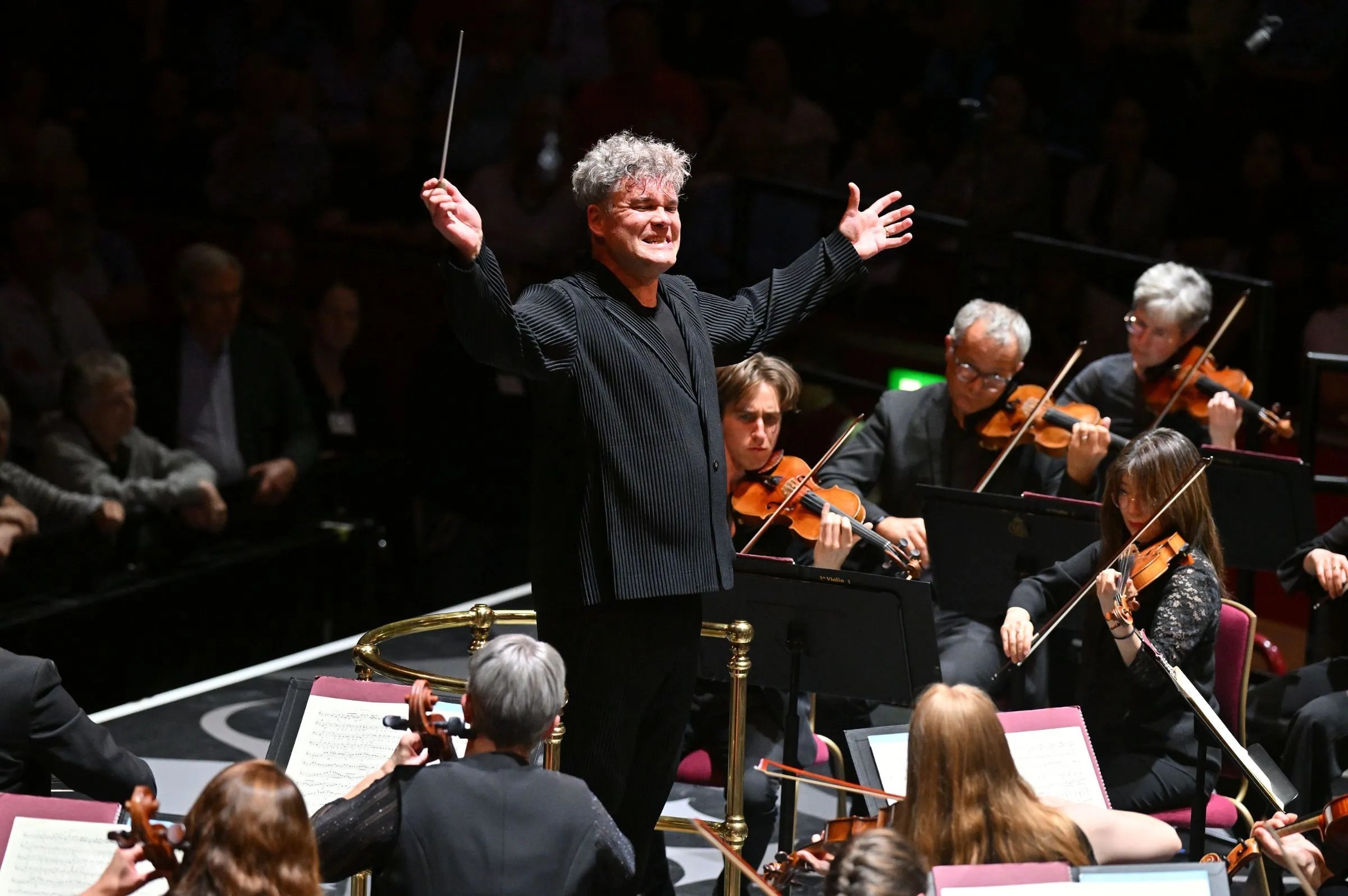
BBC Scottish Symphony Orchestra / Ryan Wigglesworth (above)

Birtwistle Earth Dances (1985-6)
Beethoven Symphony no.3 in E flat major Op.55 ‘Eroica’ (1802-4)

Royal Albert Hall, London
Monday 28 July 2025

Reviewed by Richard Whitehouse Photos (c) BBC / Mark Allan

The emphasis on Ryan Wigglesworth’s activities may have changed during recent years, but this is certainly no hardship when his conducting of so broad a repertoire is as convincing as in his brace of concerts from this year’s Proms with the BBC Scottish Symphony Orchestra.

Performed three times at the Proms during its first decade of existence, Sir Harrison Birtwistle’s Earth Dances tonight reappeared after 31 years. Much may have changed over that time (not least the passing of the composer), though this piece remains a sure highpoint of his output as of British music from the period. Premiered by the late Peter Eötvös before being taken up by Christoph von Dohnányi, Peter Boulez and Simon Rattle, it has now found an ideal advocate in Wigglesworth who surely gets to the heart of this particular matter like no-one before him.

Essentially this is about finding a balance between the facets of its title – those often densely arrayed yet always sharply differentiated strata of the orchestral texture, allied to a rhythmic fluidity which keeps the music moving forward even during its most intricate passages. Not an easy task such as previous exponents have conveyed with varying degrees of success, but Wigglesworth had the work’s measure from the beginning. Rather than a set of more or less complex episodes that follow on sequentially, what came across was a series of interrelated layers fused in an audible process of continual variation – one, moreover, in constant motion to a point at which it did not so much end as disperse into silence. Almost four decades after its premiere, Earth Dances has now emerged as that multi-faceted masterpiece it always was.

It likely took at least as long for the Eroica to be rendered, rather than merely recognized, as such – which could be a factor with their being juxtaposed in the same concert. Whatever the case, it made for judicious programming with Wigglesworth and the BBCSSO rising to their comparable challenges. First performed at these concerts 129 years ago then subsequently in almost every season, Beethoven’s Third Symphony is a testing assignment conceptually and interpretatively – as was not shirked by this involving though often understated performance.

An understatement evident in the opening Allegro, with its subtly modified exposition repeat, the more involving for rendering this movement as an unbroken while cumulative continuity through to an affirmative if not wantonly triumphal coda. Even finer was the Marcia funèbre, its steady undertow flexible enough to accommodate the lilting counter-theme as well as the intensifying fugato at its centre on route to a conclusion the more affecting for its emotional deftness. Nor was this latter quality absent from a Scherzo whose shimmering outer sections found ideal contrast in the trio, its incisive part-writing for three horns buoyantly articulated. The Finale was all of a piece with what went before, its variations on the ‘Prometheus’ theme enticingly characterized but with a keen underlying momentum toward the joyous apotheosis. While no single account of so trail-blazing a work could possibly convey all the answers, this was impressive in its formal focus and expressive balance as saw the symphony whole. Make no mistake, Ryan Wigglesworth now numbers among the finest conductors of his generation.

You can listen back to this Prom concert on BBC Sounds until Sunday 12 October – or listen to recommended recordings of the two works from the Cleveland Orchestra on Tidal here

Click on the artist names to read more about the BBC Scottish Symphony Orchestra and their chief conductor Ryan Wigglesworth. Click also for more on the BBC Proms

Published post no.2,613 – Friday 1 August 2025

In concert – Alexandre Kantorow (piano), Scottish Chamber Orchestra / Maxim Emelyanychev @ BBC Proms: Rameau, Saint-Saëns, Capperauld & Beethoven

Alexandre Kantorow (piano), Scottish Chamber Orchestra / Maxim Emelyanychev

Rameau Les Indes galantes – suite (1735)
Saint-Saëns Piano Concerto no.5 in F major Op.103 ‘Egyptian’ (1896)
Capperauld Bruckner’s Skull (2024)
Beethoven Symphony no.5 in C minor Op.67 (1807-08)

Royal Albert Hall, London
Friday 25 July 2025

Reviewed by Ben Hogwood Photos (c) BBC / Mark Allan

This colourful program marking the Scottish Chamber Orchestra’s BBC Proms visit began with music written nearly 300 years ago. Rameau’s characterful ballet score Les Indes galantes looks introduce French sophistication to the culture of exotic destinations overseas. After an elegant Entrée there were boisterous dance encounters in the Rigaudons, with the extremities of loud and quiet, and a colourful Chaconne to finish. The SCO were on fine form, their affectionate performance complemented with tasteful harpsichord contributions from Jan Waterfield. Percussionists Louise Lewis Goodwin and Iain Sandilands were joined by conductor Maxim Emelyanychev himself, wielding a side drum in the Danse du grand calumet de paix (below). Unfortunately the Royal Albert Hall acoustics ensured the beat of his instrument was slightly ahead of his colleagues, but it matter little, adding to the outdoor feel of a performance that left the audience wreathed in smiles.

Saint-Saëns wrote his Piano Concerto no.5 in F major in Luxor, Egypt, where temperatures were surely similar to those on a summer night in the Royal Albert Hall! Taking us back to north Africa was pianist Alexandre Kantorow, with a dazzling account showcasing his virtuosity but also his musical acumen. The picture painting in the rhapsodic second movement was vivid, the quiet playing exquisite, while the orchestra provided the heat haze to the decorative homespun themes. Here Kantorow provided the overtones, evoking North African piped instruments. The concerto’s outer movements were a little more strait-laced in their musical language, but soloist and orchestra had fun here too, Saint-Saëns’ push-pull figurations lapped up and delivered with aplomb. For his well-chosen encore, Kantorow held the audience in the palm of his hand for a delicate arrangement of the composer’s most famous aria, Mon coeur s’ouvre à ta voix, by none other than Nina Simone.

After the interval, the SCO first violins began Jay Capperauld’s Bruckner’s Skull with a line akin to that from Bernard Herrmann’s score to Hitchcock’s Psycho. There was something kind of ‘Eeew’ about the newly orchestrated version of this piece, less a homage to Bruckner than an account of his morbid fascination with death. Bruckner is alleged to have held the skulls of both Beethoven and Schubert after their exhumations, and Capperauld reflected these events in a score quoting from both composers, subjecting the music to ghostly twists and turns. This was in effect a musical exhumation, laced with dark humour and a touch of madness. With Bruckner’s own death mask staring out of the Proms programme, the piece wore a haunted expression throughout, a ghoulish but enduring tale.

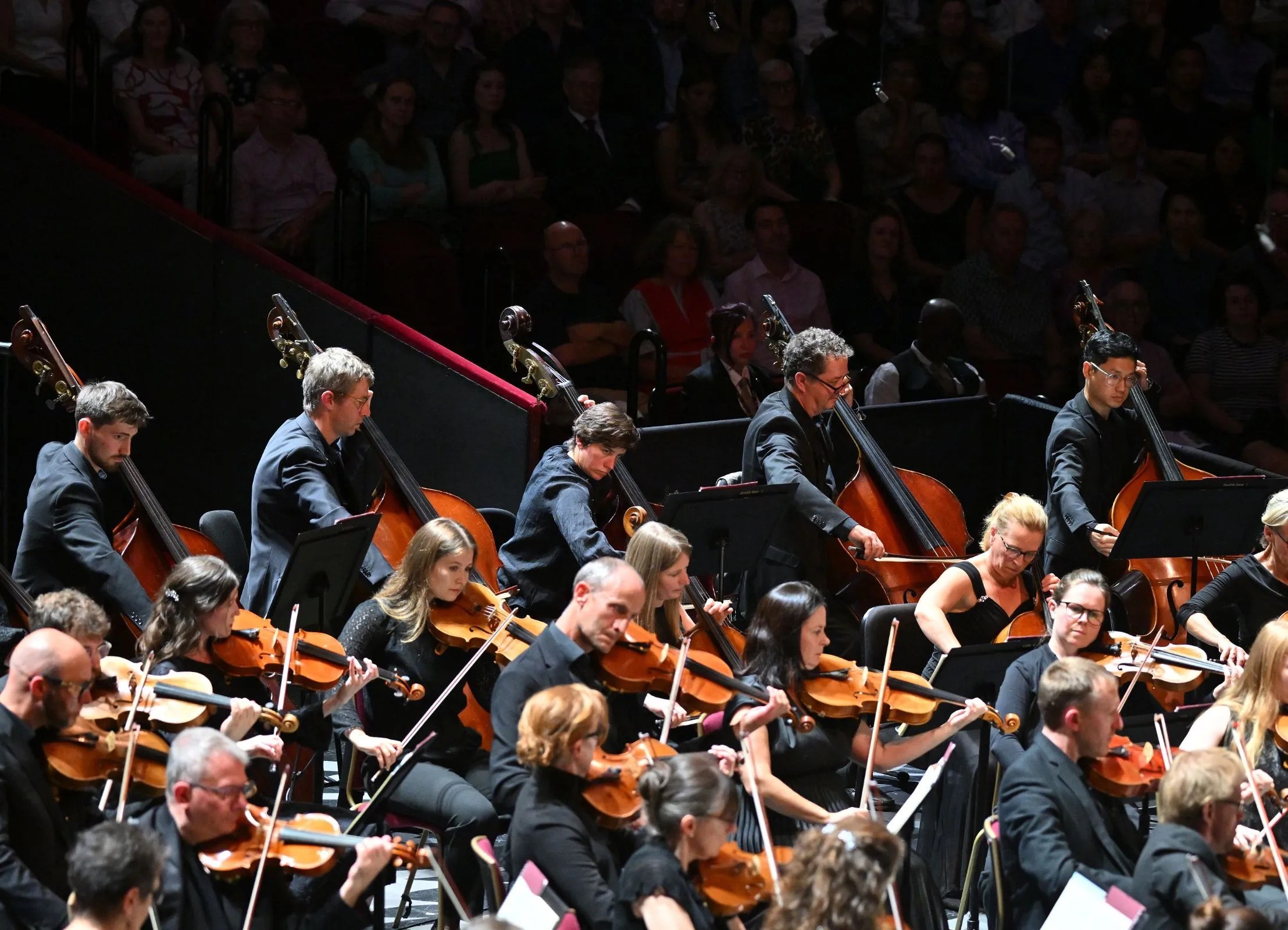
There were ghostly outlines, too, in Beethoven’s Symphony no.5 in C minor, notably at the memorable transition between scherzo and finale that marked the high point of this performance. This was a fine account indeed, launched before the audience were fully settled back in their seats but on the front foot from then on. The lean interpretation, such as chamber orchestras can bring to this work, was heightened by a relative absence of vibrato in the strings. Some of the heft of Beethoven’s climaxes was missed, particularly in such a large venue, but the four double basses ensured the lower end of the frequency spectrum was amply covered.

With fine woodwind solos, springy timpani and tightly focussed strings, the rhythmic insights were strong. The slow movement did not linger, and was less affectionate as a result, but Kenneth Henderson and Anna Drysdale took an assertive lead on their natural horns in the scherzo. Then the magical moment, Emelyanychev drawing the orchestra back to a barely audible pianissimo, the launch pad from which the finale sprang forward. Now the music wore a resolute smile, its struggle ultimately won.

You can listen back to this Prom concert on BBC Sounds until Sunday 12 October.

Click to read more about the BBC Proms

Published post no.2,608 – Sunday 27 July 2025

Arcana at the opera: Fidelio @ Garsington Opera

Beethoven’s Fidelio, Garsington Opera at Wormsley, Stokenchurch, UK | Pictured: Robert Murray (Florestan); Sally Matthews (Leonore) | Image © Julian Guidera 2025

Fidelio (1804-5, rev. 1814)

Music by Ludwig van Beethoven
Libretto by Joseph Sonnleithner and Georg Friedrich Treitschke, after Jean-Nicolas Bouilly
Sung in German with English surtitles

Leonore, disguised as Fidelio – Sally Matthews (soprano), Florestan, her imprisoned husband – Robert Murray (tenor), Don Pizzarro, prison governor – Musa Ngqungwana (bass-baritone), Rocco, gaoler – Jonathan Lemalu (bass-baritone), Marzelline, his daughter – Isabelle Peters (soprano), Jacquino, prison warder – Oliver Johnston (tenor), Don Fernando, king’s minister – Richard Burkhard (baritone), First Prisoner – Alfred Mitchell (tenor), Second Prisoner – Wonsick Oh (bass)

John Cox (original director), Jamie Manton (revival director), Gary McCann (designer), Ben Pickersgill (lighting)

Garsington Opera Chorus, The English Concert / Douglas Boyd

Garsington Opera, Wormsley
Friday 27 June 2025

review by Richard Whitehouse Photos by (c) Julian Guidera

Few operas have been subject to matters of time and place as has Fidelio. Beethoven’s sole opera, by his own admission, caused him the greatest difficulty among all his works to ‘get right’ and, even today, it can all too easily emerge as a compromise between what had been intended and what (conceptually at least) was feasible. All credit, then, to Garsington Opera for this revival which not only avoided the likely pitfalls first time around but has improved with age – in short, a production that amply conveys the essence of this flawed masterpiece.

Beethoven’s Fidelio, Garsington Opera at Wormsley, Stokenchurch, UK | Pictured: Isabelle Peters (Marzelline) | Image © Julian Guidera 2025

That original staging had been directed by John Cox, whose productions are rarely less than durable and with such as his 1973 Capriccio or his 1975 The Rake’s Progress being close to definitive. For this second revival, Jamie Manton has streamlined the basic concept such that everything which takes place can be envisaged from the outset and hence ensures consistency across the production as a whole. He is abetted by Gary McCann’s designs, their monochrome stylings imparting a grim uniformity which could not be more fitting given that this drama is played out around and inside a prison. In particular, the hole front-of-stage from out of which the prisoners emerge and into which Florestan is to be committed is a device made elemental merely by its presence, while the final scene avoids the agitprop from an earlier era in favour of a straightforward tying-up of narrative loose-ends the more affecting for its understatement. Effective without being intrusive, Ben Pickersgill’s lighting enhances the changing moods of an opera which takes in domestic comedy and visceral drama prior to its heroic denouement.

Beethoven’s Fidelio, Garsington Opera at Wormsley, Stokenchurch, UK | Pictured: Garsington Opera Chorus | Image © Julian Guidera 2025

Vocally the opening night was a little uneven without there any real disappointments. If Sally Matthews initially sounded a little inhibited in the title-role, this most probably reflected its ambivalent nature rather than any lack of expressive focus; certainly, her commitment in the ‘Abscheulicher…Komm Hoffnung’ aria such as defines her emotional persona was absolute, as was her seizing hold of that climactic quartet to which the entire drama has been heading. Sounding as well as looking his part, Robert Murray avoided the rhetorical overkill that too often mars portrayals of Florestan – his mingled vulnerability and fatalism maintained right through to the duet ‘O namenlose Freude’ whose eliding of elation and doubt intensified its emotive force whatever its actual length, though without pre-empting what is still to come.

Beethoven’s Fidelio, Garsington Opera at Wormsley, Stokenchurch, UK | Pictured: Musa Ngqungwana (Don Pizarro); Richard Burkhard (Don Fernando) | Image © Julian Guidera 2025

As Don Pizarro, Musa Ngqungwana was imposing in presence and thoughtful in approach – his lack of histrionics preferable in a role which too often descends into caricature. That said, he was upstaged in their duet ‘Jetzt, Alter, jetzt hat es Eile!’ by Jonathan Lemalu who was in his element as Rocco; materialist aspiration outweighed by the humanity invested into a role where comedy rapidly gives way to pathos. Marzelline and Jaquino may have but little to do after the first scene, but Isabelle Peters was eloquence itself in her aria ‘O war ich schon mit dir vereint’ while Oliver Johnston veered engagingly between eagerness and consternation. Richard Burkhard made for an authoritative if never portentous Don Fernando, while Alfred Mitchell and Wonsick Oh afforded touching cameos during a memorable ‘Prisoners’ chorus’.

Beethoven’s Fidelio, Garsington Opera at Wormsley, Stokenchurch, UK | Pictured: Jonathan Lemalu (Rocco); Isabelle Peters (Marzelline); Garsington Opera Chorus | Image © Julian Guidera 2025

Nor was the Garsington Opera Chorus to be found wanting as a whole in its contribution to the finales of each act – the first as moving in its pallor, infused with radiance, as the second was in the unfettered joyousness which offset any risk of that final scene becoming merely a celebratory tableau. The English Concert sounded rarely less then characterful, even though humid conditions likely explained some occasionally approximate intonation – happily not in Rachel Chaplin’s scintillating oboe obligato which shadows Florestan’s aria ‘In des Lebens Frühlingstagen’ as if an extension of his character. Douglas Boyd directed with assurance an opera with which he has long been familiar, his tempos unexceptionally right and always at the service of the opera. The author Michael Oliver was surely correct in his observation that the Leonore original is superior in theatrical terms to the Fidelio revision, yet this latter was nothing if not cohesive through Boyd’s astute dovetailing of individual numbers, as between speech and music, so that any seeming discontinuities were made more apparent than real.

Some 211 years after the successful launch of its final version and Fidelio remains an opera acutely sensitive to political context and polemical intent. Beethoven himself was, of course, partly responsible for this but subsequent generations have sought, often recklessly, to foist their own preoccupations onto his music so as to distort or even negate its essence. There was no risk of that happening here thanks to the balanced objectivity of this production but also to its conviction that the composer’s guiding vision is, and always will be, its own justification.

Fidelio runs until 22 July 2025 – and for further information and performances, visit the Garsington Opera website

Published post no.2,581 – Monday 30 June 2025