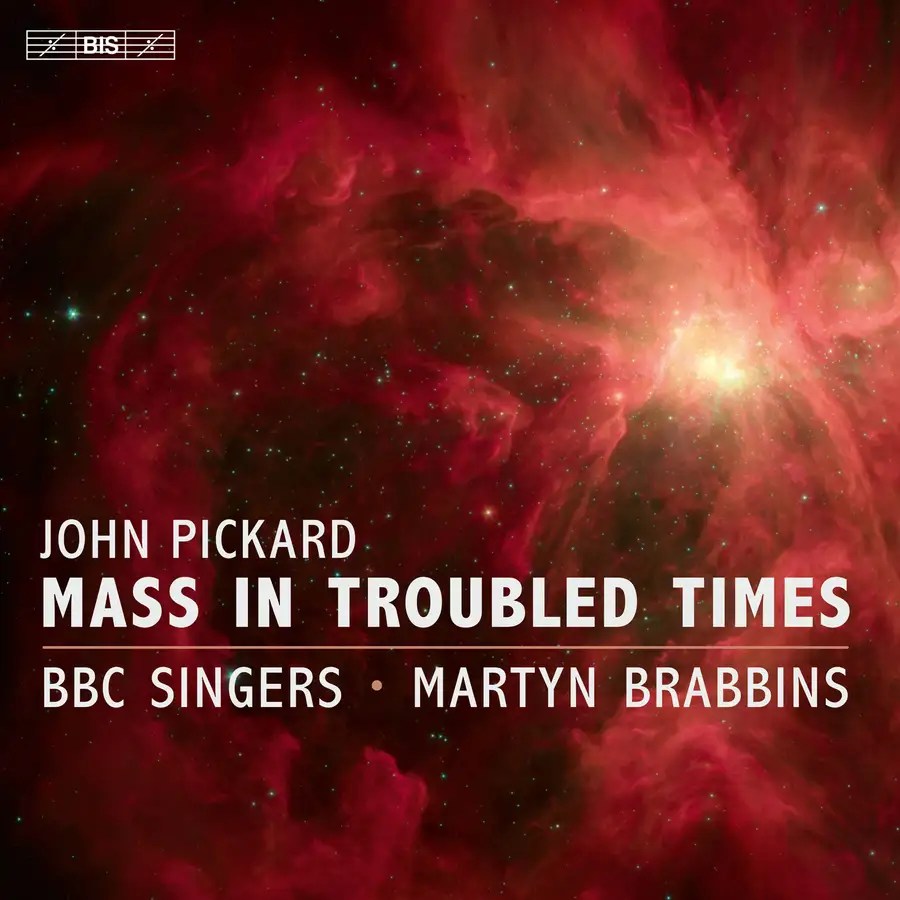
On Record – BBC Singers / Martyn Brabbins – John Pickard: Mass in Troubled Times (BIS)

John Pickard
Three Latin Motets (1983-7)
O magnum mysterium (2015)
Orion (2004)
Ave Maris Stella (1992)
Ozymandias (1983)
Tesserae (2009)
Mass in Troubled Times (2018)

BBC Singers / Martyn Brabbins with Chloë Abbott (trumpet/flugelhorn, Orion); David Goode (organ, Orion and Tesserae)

BIS 2651 [74’30’’] Texts and English translations included

Producer Adrian Peacock Engineer Pete Smith
Recorded 13 & 14 October, St Jude-on-the-Hill, Hampstead, London

Written by Richard Whitehouse

What’s the story?

Although known primarily for his substantial orchestral and chamber output, John Pickard has written several notable choral pieces. This latest release from BIS to be devoted to his music brings most of them together, and in the company of two major instrumental works.

What’s the music like?

Ranging across 35 years of his music, the collection features Pickard’s earliest acknowledged work – a teenage setting of Shelley’s Ozymandias that elicits a response both imaginative and impassioned. Already assured, his choral writing was further honed and refined in Three Latin Motets where limpid renderings of O nata lux and Ubi caritas et amor frame a melting Te lucis ante terminum for female voices. A rapturous Ave Maris stella and touchingly restrained O magnum mysterium duly reinforce Pickard’s confident handling of the a-cappella medium.

The two non-choral items indicate their composer’s abiding fascination with astronomy and antiquity. Scored for trumpet and organ, Orion strikingly evokes said constellation from the vantage of increasing energy in Nebula, an alternating lyricism (courtesy of the flugelhorn) and impetus in Alnitak, then incisive rhythmic interplay of Betelgeuse with its distanced close. Its title indicating those ‘tiles’ used in a mosaic, Tesserae builds cohesion via a steadily accumulating momentum such as tellingly underlies this showpiece with substance for organ.

For 18 unaccompanied voices (in six groups), Mass in Troubled Times is not a setting of the Mass, but a text assembled by the author Gavin D’Costa – lines from T. S. Eliot, Edith Sitwell and Matthew Arnold heard alongside extracts from the Syriac Orthodox Liturgy, the Shahada and the Qur’an. The key is a Turkish Twitter-hashtag from 2015, “Humanity washed ashore”, relating the flight from Aleppo then the drowning of Ayesha – her tragedy an emotional focus over six sections whose expressive intensity seems the greater for their formal concentration.

An Introitus precedes the customary sections of the Mass – reaching a dramatic apex at the climax of the Gloria while carrying the accrued intensity through those that follow; ending with the juxtaposition of lines from William Blake and thrice-repeated Agnus Dei that, next to an evocation of the child’s body off Palermo, has a poignancy shorn of sentiment thanks to Pickard’s acute eloquence. With its wide range of vocal techniques and demanding tessitura, Mass in Troubled Times is a rewarding challenge which all enterprising choirs should tackle.

Does it all work?

It does, not only through the quality of this music but also of these performances – the BBC Singers conveying the immediacy or pathos of Pickard’s response with unstinting clarity and precision. If a demonstration of this choir’s continued existence were needed, this surely is it – Martyn Brabbins (late of English National Opera) directing with his customary conviction. Nor are Chloë Abbott and David Goode to be found wanting in their pieces, rounding out a collection enhanced with vividly analytical recording and the composer’s informative notes.

Is it recommended?

It is, and not merely to those who have been following this invaluable series, which is set to continue with a coupling of Pickard’s Second and Sixth Symphonies. Certainly, the Mass in Troubled Times must feature in any representative selection of works from the 21st century.

For purchase options and more information on this release, visit the BIS website. Click on the names for more on composer John Pickard, the BBC Singers and conductor Martyn Brabbins, trumpeter Chloë Abbott and organist David Goode

On record – George Zacharias, Alexandros Koustas, LPO / Brabbins – Skalkottas: Two Concertos (BIS)

George Zacharias (violin), Alexandros Koustas (viola), London Philharmonic Orchestra / Martyn Brabbins

Skalkottas
Violin Concerto (1937-8, ed. Mantzourani)
Double Concerto (1939-40, ed. Zacharias)

BIS BIS 2554 SACD [57’57”]

Producers Matthew Bennett (Violin Concerto), Alexander Van Ingen (Double Concerto)
Engineers Dave Rowell (Violin Concerto), Andrew Mellor, Brett Cox (Double Concerto)

Recorded 5-6 January 2020 (Violin Concerto), 19-20 April 2022 (Double Concerto), Henry Wood Hall, London

Written by Richard Whitehouse

What’s the story?

BIS continues its long-running project devoted to music by Nikos Skalkottas (1904-49) with this revisiting of his Violin Concerto, alongside a first recording for his Double Concerto in what is a typically apposite pairing which none the less points up the diversity of his output.

What’s the music like?

It was with a release featuring the Violin Concerto that BIS inaugurated its Skalkottas series a quarter-century ago. This recording uses the ‘new critical edition’ prepared in 2019 by Eva Mantzourani, whose volume The Life and Twelve-Note Music of Nikos Skalkottas (Routledge: 2011) is necessary reading for anyone interested in this composer. Many of these corrections will only be evident to those having access to the score, but interpretive differences between Gorgios Demertzis in 1997 and George Zacharias in 2022 are clear from the outset. The latter adopts appreciably quicker tempos for the first two movements that make the opening Molto appassionato more febrile in its expressive contrasts, then the Andante spirito feels closer to an intermezzo after the example of Schoenberg’s Violin Concerto as is brought more directly into focus. Demertzis launches the final Allegro rapidly, Zacharias gaining momentum more gradually before tackling the Prestissimo coda with abandon. Which one prefers depends on how one views the competing expressionist and classicizing impulses of this masterly work.

Although finished barely two years later and pursuing a nominally similar formal trajectory, the Concerto for Violin, Viola and Wind Orchestra presents a markedly different take on its composer’s thinking. Different though not unexpectedly so, given Skalkottas’s approach to serial composition was anything but predictable while it took shape, moreover, in a cultural milieu where Hindemith and Weill (briefly his teacher) were as necessary a creative catalyst as Schoenberg. Not only does the scoring of this piece find accord with that of Hindemith’s concertante works and Weill’s Violin Concerto during that period, but the evolution of each movement in sometimes oblique though always discernible terms gives the overall design a distinctly neo-classical feel. Zacharias sounds even more ‘inside’ this work, and Alexandros Koustas is no less assured in viola writing which is (surprisingly?) always audible against an orchestra whose saxophone section accentuates the presence of jazz as against the militaristic element of brass and other woodwind. The result is a piece by turns engaging and disturbing.

Does it all work?

Pretty much always. Thoughtfully conceived and impressively executed, Skalkottas’s music does not play itself so that performers need to take the lead in rendering its inherent qualities as comprehensively as possible. Which is undoubtedly the case here – Zacharias and Koustas convincingly overcome any incidental technical difficulties, while Martyn Brabbins secures a trenchant and committed response from the London Philharmonic Orchestra in works with which neither he nor they have had the opportunity to come to terms via live performances.

Is it recommended?

It is. Those who already have that earlier recording of the Violin Concerto still need this new release which, with its immediate sound and detailed notes, brings the Skalkottas discography nearer fruition. How about a complete version of the Second Symphonic Suite as a follow-up?

Stream

Buy

For more information on this release visit the BIS website

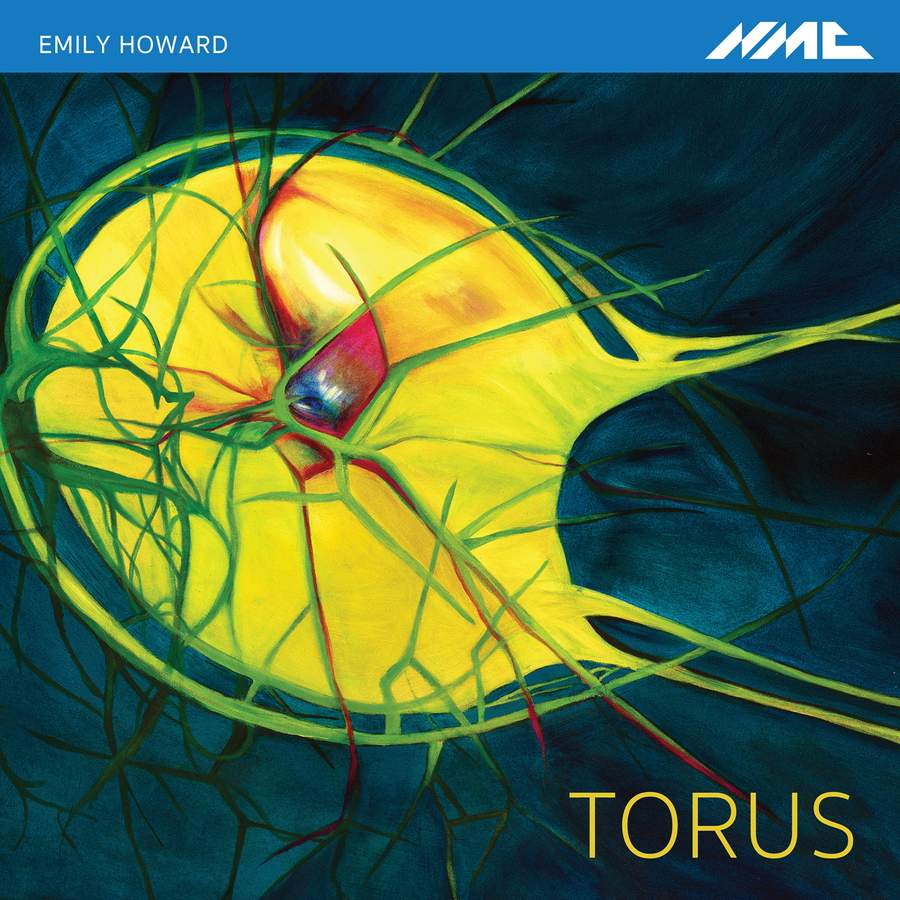
On Record: Emily Howard: Torus (NMC Recordings)

Emily Howard

Antisphere (BBC Philharmonic Orchestra / Vimbayi Kaziboni)
Producer Matthew Bennett, Engineer Stephen Rinker
Recorded 29 November 2022, Bridgewater Hall, Manchester

sphere (BBC National Orchestra of Wales / Mark Wigglesworth)
Producer Dean Craven, Engineer Stephen Rinker
Recorded at the Aldeburgh Festival, 23 June 2018, The Maltings, Snape

Compass (Julian Warburton (percussion), Birmingham Contemporary Music Group / Gabrielle Taychenné)
Producer & Engineer David Lefeber
Recorded 4 December 2022, Royal Northern College of Music, Manchester

Torus (BBC Symphony Orchestra / Martyn Brabbins)
Producer Ann McKay, Engineer Christopher Rouse
Recorded 11 November 2019, Barbican Hall, London

NMC Recordings D274 [68’58″]

Reviewed by Richard Whitehouse

What’s the story?

NMC releases a second collection of music by Emily Howard – now in her early forties and established among the most distinctive while forward-looking composers of her generation, heard in scrupulous performances by a notable line-up of British orchestras and ensembles.

What’s the music like?

Few world premieres from recent years have left an impression comparable to that of Taurus at the Proms in 2016. Its appearance, moreover, marked a further stage in an evolution which had commenced just over a decade earlier and has continued apace, with major commissions from British and European organizations. This has been paralleled by Howard’s commitment into researching the intrinsic properties of sound, most recently via the Centre for Practice & Research in Science and Music (PRiSM) at Manchester’s Royal Northern College of Music.

As it now stands, Torus is the first part in an informal trilogy of pieces collectively entitled Orchestral Geometries. It evolves along the perceived trajectory of a doughnut-shaped ball whose central void is crucial to music evoking absence as much as presence. Not that a work subtitled Concerto for Orchestra could be found lacking in either immediacy of content or virtuosity of gesture, which qualities come demonstrably to the fore as it unfolds and make for a composition involving in its expressive profile and fascinating in its formal process.

By contrast, Sphere is a succinct yet eventful journey through and around the global shape in question and which, in this context, might reasonably be thought an extra-terrestrial interlude – its ideas pithy while exuding enough potential for their development in subsequent pieces.

This is what happens in Antisphere which forms its conceptual opposite though also its aural continuation, the piece gradually encompassing the ‘sound-space’ through an engrossing and imaginative demonstration of orchestral prowess. Evident too is an increased focus upon the visceral nature of the musical content, likely reflecting a form which can precisely be defined in mathematical terms but remains all but intangible as regards human perception. Fortunate, then, that Howard has been able to render this concept as an emotional and affective whole.

Hardly less absorbing is Compass, the most recent of these pieces. This takes the spatial and nautical connotations of its title as the basis for music which unfolds as a cohesive dialogue between string septet and percussion that complements it and offers contrasts at every turn.

Does it all work?

It does, not least for providing an arresting take on that interplay of ‘heart and brain’ that has been a mainstay of Western music. The cerebral basis of all these pieces may be undeniable, though equally so is the precision of their forms and, above all, the allure of their expression judged intrinsically as sound. Much the same could be said of the music of Iannis Xenakis, the centenary of whose birth was commemorated last year, and whose thinking is continued by Howard from a vantage that is inherently personal while being decisively of the present.

Is it recommended?

It is, not least for its excellent performances by three of the BBC orchestras and Birmingham Contemporary Music Group, with booklet notes by Paul Griffiths and mathematician Marcus du Sautoy. This impressive release reinforces Howard’s significance in no uncertain terms.

Listen & Buy

Torus is released on Friday 28 April. You can explore buying options at the NMC Recordings website, and listen to clips from the album at the Presto Music site. You can read Arcana’s interview with Emily Howard by clicking on the link, and click on the names for more on the composer Emily Howard, plus performers Vimbayi Kaziboni, Mark Wigglesworth, Julian Warburton, Gabrielle Teychenné and Martyn Brabbins

In concert – Nash Ensemble @ Wigmore Hall: Side by Side & Nash Inventions

Side by Side

Royal Academy of Music Students [Christopher Vettraino (oboe), Silvia Bettoli, Johan Stone (horns), Magdalena Riedl (violin), Gordon Cervoni (viola)], Members of the Nash Ensemble – Adrian Brendel (cello), Alasdair Beatson (piano)

Colin Matthews Time Stands Still (2004)
Balency-Bearn Entre-Deux (2022)
Alberga No-Man’s-Land Lullaby (1996)
Keting before we were ocean (2021)
Colin Matthews Dual (2021)
Abrahamsen Congratulations Greeting (2022)

Nash Inventions

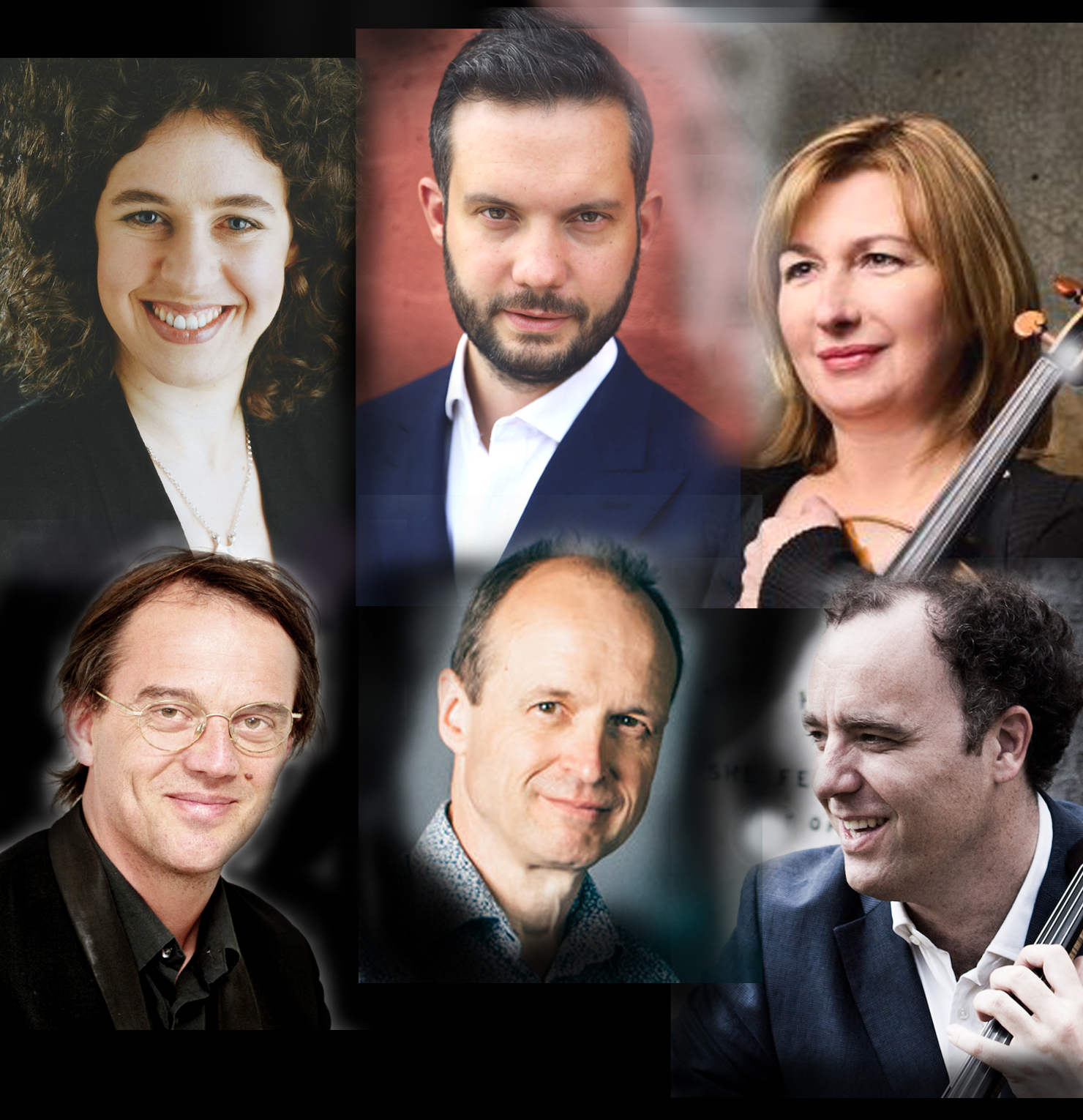
Claire Booth (soprano), Mark Padmore (tenor), Nash Ensemble [(Philippa Davies (flute), Gareth Hulse (oboe), Richard Hosford, Marie Lloyd (clarinets), Richard Watkins (horn), Sally Pryce (harp), Benjamin Nabarro, Michael Gurevich (violins), Lars Anders Tomter, Jennifer Stumm (violas), Adrian Brendel (cello), Graham Mitchell (double bass), Alasdair Beatson (piano)] / Martyn Brabbins

Casken Misted Land (2017)
Colin Matthews Seascapes (2021)
Anderson Van Gough Blue (2015); Three Songs (2018-22) [World Premiere of THUS]
Benjamin Viola, Viola (1997)
Turnage A Constant Obsession (2007)

Wigmore Hall, London
Tuesday 28 March 2023 (5pm and 7.30pm)

Reviewed by Richard Whitehouse

It has become such a fixture on the London calendar that Nash Inventions, given annually by the Nash Ensemble at Wigmore Hall, could easily be taken for granted. As tonight’s concert proved, however, the range and quality of those works performed is anything but predictable.

His long-time drawing inspiration from the landscape of the North-East might suggest Misted Land as a ready-made title for John Casken. Yet this quintet for clarinet and strings focusses on emotion as much, if not more than evocation by unfolding from the intangible impressions of its initial movement, via impulsive contrasts of its intermezzo, to a finale whose visceral progress is curtailed by a timely return to the initial equivocation. Richard Hosford made the most of his alternately insinuating and forceful writing in a piece that well deserved revival.

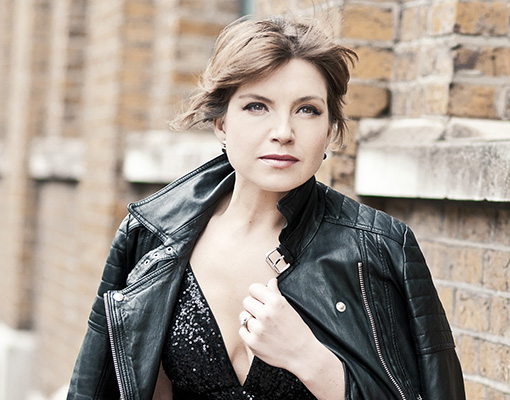
Although settings by Michael Tippett early on confirmed the musicality of his verse, Sidney Keyes (1922-43) has been relatively little set – making this selection by Colin Matthews in Seascapes the more welcome. From the unforced rhetoric of The Island City, it takes in the fleeting sensations of From : North Sea and the tense rumination of Night Estuary; a brief Interlude leading to the heartfelt expression of Seascape – one of Keyes’s greatest poems, in which Claire Booth’s commanding eloquence (above) more than vindicated the cycle as a whole.

Last in an informal trilogy centred on the colour, Van Gough Blue sees Julian Anderson pay tribute to this artist in a sequence traversing dawn to night. A speculative emergence of sound and texture in l’Aube, soleil naissant precedes the heady rhythmic and melodic interplay of Les Vignobles then mounting animation of Les Alpilles. Nothing, though, prepares for the inward rapture of Eygalières or the dance toward destruction of la nuit, peindre les étoiles: pieces wholly characteristic of this composer and as finely realized as anything he has written.

Further music by Anderson followed the interval – three in an ongoing series for soprano and ensemble identical to, but very different in usage from, that of Schoenberg’s Pierrot Lunaire. The viscerally sensual overload of Mallarmé’s Le Tombeau d’Edgar Poe (here made a tribute to Debussy in the centenary of his death) contrasted with the disarming sincerity of le 3 Mai – an email by composer Ahmed Essyad written during the pandemic, then lines by Longfellow in THUS – Claire Booth here enacting what is less a setting than a musical riposte to its text.

Writing what had become a tribute to Takemitsu 18 months after his death, George Benjamin turned what might have reflected the viola’s innate introspection into an intensive exploration by two of these instruments of how they might discover rhythmic then melodic and harmonic accord. Music diverse in content and logical in its unfolding, its technical challenges remain considerable – making this performance by Jennifer Stumm (having replaced Timothy Ridout at short notice) and Lars Anders Tomter the more engaging through its audible conviction.

It might come a fair way back in his sizable output, but the song-cycle A Constant Obsession remains among Mark-Anthony Turnage’s finest vocal works. This reflection on ‘love’ – what it might be, what it becomes and what it could have been – is articulated across five settings of Keats, Hardy, Edward Thomas, Graves and Tennyson; its course predicted in a ‘Prologue’ and encapsulated in the bleakly humorous final poem. Mark Padmore (above) conveyed its measure now as 14 years before, as did Martyn Brabbins (below) with his attentive and unobtrusive direction.

The early evening slot brought together players from the Nash and Royal Academy of Music. Entre-Deux saw Andrea Balency-Béarn opening out the timbral and harmonic space between pitches with discreet elegance, and No-Man’s-Land Lullaby found Eleanor Alberga working toward a totemic melody with combative fervency. Sun Keting contributed music laced with nostalgia but also indignation in before we were ocean while, in Congratulations Greeting, Hans Abrahamsen commemorated the RAM’s bicentenary in lively and resourceful terms.

Colin Matthews provided a more quixotic take on that event in the subtle contrasted sections of Dual, with his music also opening and concluding this selection. Time Stands Still marked Simon Rattle’s 50th birthday in (surprisingly?) inward and even inscrutable terms, while 23 Frames marked the 30th anniversary of the Nash through that number of miniatures whose character felt as distinctive as their order was random. The outcome found this composer as his most entertaining, with no complaints if several ‘frames’ exceeded their 30-second remit.

A lengthy evening, then, and an impressive showcase for the Nash in term of marking those achievements past or present. Now is hardly the time for any complacency regarding events such as this, which remains a template for what is possible in matters of artistic excellence.

Click here for the Nash Ensemble website, and here for the Royal Academy of Music

Live review – Royal Philharmonic Society Awards 2023 @ Queen Elizabeth Hall

From left: RPS Awards winners Anna Lapwood, Abel Selaocoe, Leeds Piano Trail, The Endz, Manchester Collective

Queen Elizabeth Hall
2 March 2023

by Ben Hogwood

Timing is everything in music – and as the attendees of the Royal Philharmonic Society Awards unanimously agreed, both the show and its message at the Queen Elizabeth Hall were just what classical music needed.

As RPS chairman John Gilhooly emphasised in his no holds barred opening address, times in the industry are hard. Arts Council England have never been less connected with classical music than they are currently, looking past its versatility and potential to make increasingly bizarre funding decisions. All working in music are affected, from those starting out in education and learning their first instrument to those receiving music as therapy and stimulation for dementia and good mental health. Music, it is clear, should not be treated as a ‘nice to have’ extra. Rather, it is a galvanizing force bringing good into the lives of everyone ready to receive it, as we all saw during lockdown and as we experience from day to day.

Gilhooly’s passionate speech threw down a gauntlet to the government and Arts Council but did so in the spirit of collaboration and community. These two words appeared at regular intervals throughout the evening, which captured a wide range of heartwarming and inspirational work taking place around the country, in spite of these restrictions.

Winners included the Torbay Symphony Orchestra, representative of so many life-giving amateur ensembles around the UK in the joy they bring to so many who take part or spectate. Joy, too, is at the heart of Anna Lapwood’s tireless and effervescent work, the organist deservedly collecting the Gamechanger award for her achievements in bringing the instrument to a whole new audience. Put #playlikeagirl into TikTok or Instagram, and you’ll see what I mean!

The awards, stylishly presented by BBC Radio 3 anchors Petroc Trelawny and Hannah French, captured classical music in so many different forms. Timothy Ridout, a shining viola player of the present and future, credited his Luton and Bedfordshire musical roots as key to the Young Artist Award. Abel Selaocoe won the Instrumentalist Award, the cellist expanding the scope of his instrument to encapsulate non-Western musical traditions. How remarkable that an instrument with such a long history continues to develop.

There were even happy pandemic stories. Theatre of Sound won the Opera and Musical Theatre award, their production of Bartók’s Bluebeard’s Castle born during lockdown and executed in Stone Nest, just off Shaftesbury Avenue in London. Martyn Brabbins, music director of English National Opera, deservedly won the Conductor award for his fearless work with the beleaguered company, in which he continues to form strong connections with his musicians, old and new alike.

The Multi-Story Orchestra won the Impact Award for their searing production The Endz, expressing the feelings of a young Peckham group for the death of teenager Malcolm Mide-Madariola, killed while standing up for a friend in a knife fight. Even the brief excerpt we heard conveyed their strength of feeling, and their acceptance speech confirmed how cathartic music had been in expressing their feelings.

One of the most poignant moments of the night came when Manchester Camerata’s film Untold – Keith (above) earned them the Storytelling Award, confirming once again the power of music to help people cope better with dementia. Meanwhile on the streets Leeds Piano Trail won the Series and Events Award for their strategically placed pianos, bringing more than 200,000 aspiring musicians to the city centre, while composer Gavin Higgins took the Large-Scale Composition Award for his Concerto Grosso, a rousing success at the BBC Proms with the Tredegar Town Band and BBC National Orchestra of Wales under Ryan Bancroft.

The live music in the awards was astutely programmed. Sheku Kanneh-Mason gave a striking excerpt from the Cello Sonata no.2 by Leo Brouwer, written for him and fresh off the page in a first performance. Soprano Anna Dennis, winner of the Singer Award, sang a striking song of Elena Langer, Stay O Sweet beautifully weighted with beautifully floated counterpoint from oboist Nicholas Daniel.

The most distinctive musical voice of the night, however, was that of composer Ben Nobuto. Having won the Chamber-Scale Composition Award for the innovative SERENITY 2.0, and somehow achieving an authentic and wholly original balance between Frank Ocean and Caroline Shaw in the process, he joined Ensemble Award winners Manchester Collective for a performance of Danish folk song Old Reinlender. This was cleverly approached from the first movement of Bach’s Violin Concerto in A minor, the join between the two almost imperceptible but negotiated in joyful, songful music.

Sadly no members of Arts Council England were present to witness any of these musical tonics – it is to be hoped they will listen when the awards are aired on BBC Radio 3 on Monday 6 March. You should listen too, for you will find classical music, in spite of all its challenges, is swimming strongly against the tide.

You can watch the Royal Philharmonic Society Awards on the RPS website within the next week – while BBC Radio 3 will broadcast the ceremony, presented by Petroc Trelawny and Hannah French, on Monday 6 March. Click here to listen