
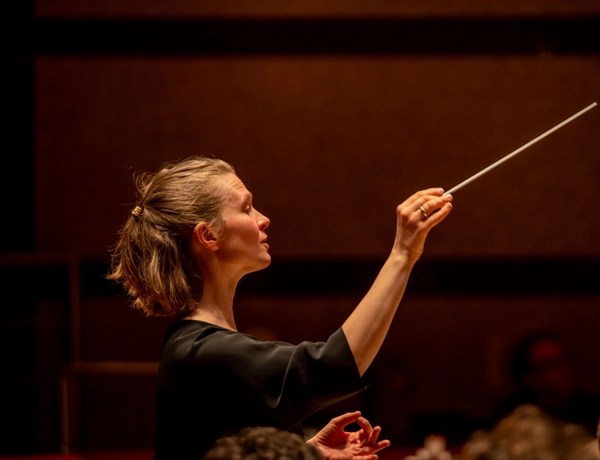
In concert – Stephen Waarts, CBSO / Mirga Gražinytė-Tyla: Brahms Violin Concerto & Weinberg Symphony no.5

Stephen Waarts (violin), City of Birmingham Symphony Orchestra / Mirga Gražinytė-Tyla

Brahms Violin Concerto in D major Op.77 (1878)
Weinberg Symphony no.5 in F minor Op.76 (1962)

Symphony Hall, Birmingham
Wednesday 11 June 2025

Reviewed by Richard Whitehouse Picture of Stephen Waarts (c) Maarten Kools

Seriously disrupted as it was by the pandemic and attendant lockdowns, the period of Mirga Gražinytė-Tyla as music director of the City of the Birmingham Symphony Orchestra (2016-22) was a successful one, especially in terms of bringing unfamiliar music to the orchestra’s repertoire.

Not least that by Mieczysław Weinberg, his Fifth Symphony tonight receiving only its second UK hearing, almost 63 years after Kiril Kondrashin and the Moscow Philharmonic had given it at the Royal Festival Hall while on tour. Weinberg was unable to attend and the performance attracted minimal comment, but the Fifth is arguably the greatest among his purely orchestral symphonies – a work whose size and scope had merely been hinted at by its predecessors. Six decades on and those qualities confirming its significance then still ensure its relevance today.

The influence of Shostakovich’s Fourth Symphony, written over a quarter century earlier but premiered just months before, has often been noted but whereas this piece is inclusive to the point of overkill, Weinberg’s Fifth has a formal rigour and expressive focus as could only be that of full maturity. Not least in the moderately-paced opening Allegro, its content deriving from the pithy motifs on lower strings and trumpet heard against oscillating chords on upper strings at the outset, and which builds to a febrile culmination before retreating into agitated uncertainty. MGT has its measure as surely as that of the ensuing Adagio, its threnodic string writing palpably sustained prior to a heartfelt climax; either side of which, woodwind comes into its own in a slow movement comparable to that of Shostakovich’s own Fifth Symphony.

Playing without a pause, the latter two movements consolidate the overall design accordingly. Thus, the scherzo-like Allegro alternates furtive anticipation and barbed anger with a dextrous virtuosity that found the CBSO at its collective best – subsiding into a finale whose Andantino marking rather belies the purposefulness with which it elaborates on earlier ideas as it builds towards a searingly emotional apex. Once again, however, the music winds down into a coda whose rhythmic pulsing underpins resigned solo gestures at the close of this eventful journey.
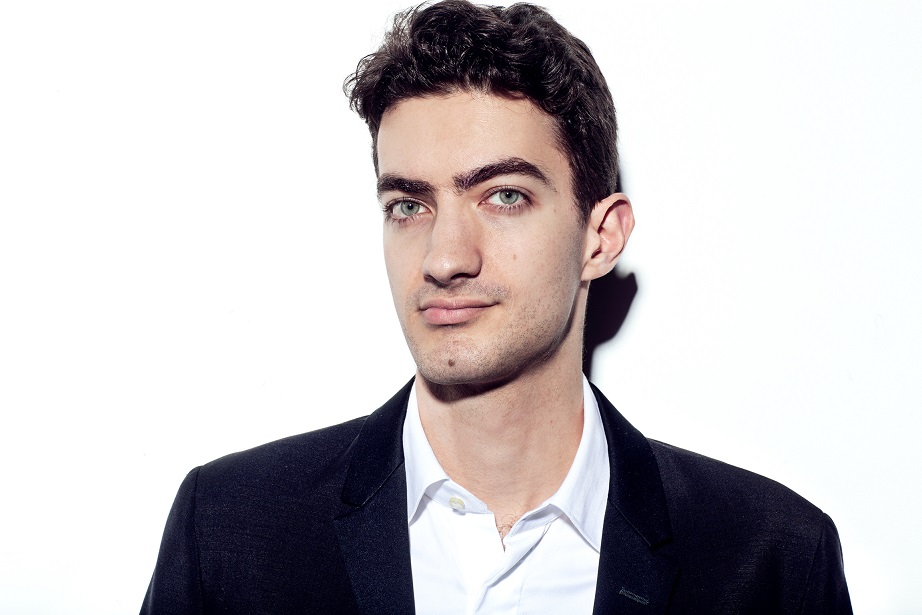
Whether or not Brahms’s Violin Concerto was an ideal coupling, it certainly received a most impressive reading by Stephen Waarts (above). Winner of the 2014 Yehudi Menuhin International and 2015 Queen Elizabeth competitions, this was his debut with the CBSO but there was no lack of rapport – not least an imposing first movement whose technical challenges were assuredly negotiated and with a rendering of the Joachim cadenza that integrated it seamlessly into the overall design. Waarts’ interplay with woodwind in the Adagio was never less than felicitous, then the finale pivoted deftly between panache and insouciance on its way to a decisive close. MGT was as perceptive an accompanist as always, with an encore of the opening ‘L’Aurore’ movement from Eugène Ysaÿe’s Fifth Solo Sonata an appropriate entrée into the second half.

Ultimately, though, this concert was about MGT’s continued advocacy of Weinberg as of her association with the CBSO. Good news that the Fifth Symphony has been recorded for future release by Deutsche Grammophon, so enabling this fine performance to be savoured at length.

For details on the 2025-26 season, Orchestral music that’s right up your street!, head to the City of Birmingham Symphony Orchestra website. Click on the names to read more about soloist Stephen Waarts and conductor Mirga Gražinytė-Tyla, or composer Mieczysław Weinberg

Published post no.2,564 – Saturday 14 June 2025
In concert – CBSO / Mirga Gražinytė-Tyla: From Mirga With Love

Marie-Christine Zupancic (flute), Oliver Janes (clarinet), Eugene Tzikindelean (violin), Adam Römer (viola), Onutė Gražinytė (piano), City of Birmingham Symphony Orchestra / Mirga Gražinytė-Tyla

Traditional (arr. Raminta Šerkšnytė) Anksti rytą kėliau
Čiurlionis (ed. Charalampos Efthymiou) Miške (1901) [UK premiere]
Weinberg Clarinet Concerto Op.104 (1970)
Loboda Requiem for Ukraine (2014)
Weinberg 12 Miniatures for Flute (1945, orch. 1983) [UK premiere]
Kakhidze Bruderschaft (1996) [UK premiere]

Symphony Hall, Birmingham
Wednesday 6 December 2023

Reviewed by Richard Whitehouse. Picture of Mirga (c) Beki Smith

The sound of a Lithuanian folksong I got up early in the morning, plaintively sung by Mirga Gražinytė-Tyla and accompanied by her sister Onutė, introduced tonight’s concert where the conductor made a welcome reappearance with the City of Birmingham Symphony Orchestra.

MGT gave a memorable performance (not for all the right reasons) of Mikalojus Čiurlionis’s symphonic poem The Sea during her tenure as music director, and the CBSO sounded equally assured with his earlier such piece In the Forest that opened the programme. Here once again the composer’s over-ambition is evident from a rather episodic construction and the textural overload (odd in music this opulently scored to have had no timpani, as might have brought greater definition to emotional highpoints), though had Čiurlionis heard this in performance the outcome might have been otherwise. What remains is a sequence of enticing paragraphs, framed by ones whose formal and expressive aims seemed impressively as one in pointing towards just what might have been possible were it not for his demise at the age of only 35.

The music of Mieczysław Weinberg has been a preoccupation of MGT for over a decade, and it was good to hear this continue through two pieces in which CBSO principals played to their strengths. Oliver Janes sounded enthused by the Clarinet Concerto, its initial Allegro pivoting between incisiveness and inwardness typical of the composer’s maturity. The Andante brought a plangent interplay of soloist and strings, with the sardonic humour of the ensuing Allegretto building toward a cadenza whose entreaties were curtailed by the peremptory closing gestures.

Commissioned after Russia’s occupation of the Crimea, Igor Loboda’s Requiem for Ukraine has only become timelier this decade since – its heady series of variations within a chaconne-like form offering no mean technical challenges that Eugene Tzikindelean met with panache.

As did Marie-Christine Zupancic the more restrained subtleties of Weinberg’s 12 Miniatures for Flute. Composed with piano accompaniment and arranged for strings almost four decades later, these deft and often characterful vignettes follow a methodical tonal progression, while the opting to render them as three groups of four implied a latent fast-slow-fast format akin to that of a concerto. At no time was there any sense of Weinberg being less idiomatic or more impersonal in pieces which are as meticulously realized as any of his larger compositions.

After this, the paucity of content in Vakhtang Kakhidze’s Bruderschaft (Brotherhood) was only too evident. A ‘sinfonia concertante’ for viola, piano and strings, its easeful opening section had a certain charm of which Adam Römer’s playing was nothing if not persuasive, but the livelier music that followed was lounge-jazz at its most cliched and neither the violist’s input nor an almost choreographed response from Onutė Gražinytė raised it above the commonplace. Both these sections were elaborated to little intrinsic purpose, other than to prolong what was already a lengthy concert such that numerous attendees could be seen departing in those final minutes.

A pity in what was otherwise a rewarding programme as reaffirmed MGT’s continued rapport with her former orchestra. Hopefully there will be more such collaborations in future seasons.

You can read all about the 2023/24 season and book tickets at the CBSO website. Click on the artist names for more information on Mirga Gražinytė-Tyla, Marie-Christine Zupancic, Oliver Janes, Eugene Tzikindelean, Adam Römer and finally Onutė Gražinytė

Published post no.2,033 – Friday 8 December 2023

In concert – Vilde Frang, CBSO Chorus and Orchestra / Mirga Gražinytė-Tyla – Elgar: Violin Concerto; The Panufniks & Schumann

Vilde Frang (violin), City of Birmingham Symphony Orchestra / Mirga Gražinytė-Tyla

Elgar Violin Concerto in B minor Op.61 (1909-10)
Andrzej & Roxanna Panufnik Five Polish Folk Songs (1940, rec. 1945, rev, 1959, orch. 2022) [CBSO Centenary Commission: World Premiere]
Schumann Symphony no.1 in B flat major Op.38 ‘Spring’ (1841)

Symphony Hall, Birmingham
Wednesday 8 March 2023

Reviewed by Richard Whitehouse

The relationship between Elgar and Schumann is a fascinating one, aspects of which surfaced in this coupling of the former’s Violin Concerto with the latter’s First Symphony; the City of Birmingham Symphony Orchestra joined by principal guest conductor Mirga Gražinytė-Tyla.

As with Sibelius not long before, Elgar was an able violinist whose solitary concerto for his instrument makes no technical concessions. There is also a symphonic dimension as seemed uppermost in the thoughts of Vilde Frang, her formidable technique (rightly) geared towards the work’s conveying emotions within an expansive while methodical framework. This was evident in the opening Allegro, the impetus of its initial tutti maintained by flexible handling of contrasted themes on to a climactic development whose intricacy was abetted by the clarity of the orchestral playing. Even finer was a central Andante whose main melodies, among the composer’s most affecting, were never indulged across the course of a movement where the expressive profile remains teasingly intangible right through to those soulful concluding bars.

Maybe the balance between display and insight slipped in the final Allegro molto, with Frang losing focus slightly during its more extrovert passages. Once the accompanied cadenza was underway, however, there was no doubting the rapport of soloist and orchestra as earlier ideas are recalled and speculatively transformed in what comes near to being a confession of intent. Nor was the sudden re-emergence of that earlier energy at all underplayed as the coda heads to its affirmative resolution: one whose conviction duly set the seal on a memorable reading.

After the interval, an additional item in the guise of Five Polish Folksongs written by Andrzej Panufnik after the outbreak of war, reconstructed at its close and orchestrated by his daughter Roxanna so the stark originals for children’s or female voices – with pairs of flutes, clarinets and bass clarinet – were cushioned by these richer orchestral textures. The CBSO Youth and Children’s choruses (finely prepared by Julian Wilkins) gave their all in what were appealing yet at times overly diffuse arrangements of settings that are best heard in their original guise.

So to Schumann’s ‘Spring’ Symphony, a piece whose encapsulating mid-Romantic sentiment seemed uppermost in MG-T’s insightful and, for the most part, convincing account. Evocative fanfares launched the opening Allegro in fine style, the often fitful momentum of its lengthy development vividly maintained through to a sparkling coda. Arguably too slow for its ‘song without words’ format, the Larghetto yet exuded undeniable pathos and made a spellbinding transition into the Scherzo. A (too?) leisurely take on its first trio took the listener unawares, but the winsome closing bars prepared well for a final Allegro whose animated progress was enlivened by delectable woodwind and horn playing on the way to its decisive close. Should MG-T return in future seasons, further Schumann symphonies would be more than welcome.

The CBSO returns next week in a rare UK hearing of Weinberg’s First Sinfonietta, alongside Schumann’s Piano Concerto with Kirill Gerstein and an extended selection from Prokofiev’s Romeo and Juliet – this latter and the Elgar also featuring in a Barbican concert the next day.

You can read all about the 2022/23 season and book tickets at the CBSO website, and click here for the Romeo and Juliet concert, repeated at the Barbican here. Click on the artist names for more on Vilde Frang and Mirga Gražinytė-Tyla, or composer Roxanna Panufnik

In concert – Sheku Kanneh-Mason, Marie-Christine Zupancic, CBSO / Mirga Gražinytė-Tyla: Vaughan Williams, Haydn, Elgar, Weinberg & Britten

Vaughan Williams Fantasia on a Theme of Thomas Tallis (1910)
Haydn Cello Concerto no.1 in C major Hob.VIIb/1 (c1761)
Elgar Sospiri Op.70 (1914)
Weinberg Flute Concerto no.1 Op.75 (1961)
Britten The Young Person’s Guide to the Orchestra Op.34 (1945)

Sheku Kanneh-Mason (cello), Marie-Christine Zupancic (flute), City of Birmingham Symphony Orchestra / Mirga Gražinytė-Tyla

Symphony Hall, Birmingham
Wednesday 6 October 2022

Reviewed by Richard Whitehouse

Shortly to embark on its first tour of the United States in almost a quarter-century, the City of Birmingham Symphony Orchestra tonight played some of the pieces to be included there – a diverse selection that amounted to a cohesive and well-balanced programme on its own terms.

Opening the concert was one of those pieces heard on the CBSO’s album The British Project, and while this orchestra has performed Vaughan Williams’s Fantasia on a Theme of Thomas Tallis often, Mirga Gražinyte-Tyla relatively swift traversal compelled attention. The opening stages felt a little detached – the offstage ‘orchestra’, placed offstage-left, more a background presence than active participant – but the string quartet contribution was eloquently rendered while the approach to the main climax was as unerringly judged as that resonant final chord.

Sheku Kanneh-Mason has been playing Haydn’s cello concertos extensively, so there was no doubting the control and insight brought to the C major work – earliest of the pair and poised between the Baroque and Classical eras in its combining formal lucidity with melodic poise. Kanneh-Mason was mindful of the opening movement’s Moderato indication, maintaining a steady and never headlong tempo that allowed his tonal finesse and elegance of phrasing full rein. The Adagio could have had greater inward intensity, but not that stealthy transition into the return of the main theme, and the final Allegro had wit and incisiveness aplenty. A much-reduced CBSO was responsive in support – Kanneh-Mason offering an unlikely yet appealing pizzicato take on Bacharach’s I Say a Little Prayer (found on his new album Song) as encore.

There cannot have been many times when Elgar’s Sospiri began the second half, but it did so this evening to enticing effect. MG-T drew out its pathos without no trace of affectation, and if the organ part was missing, the strings’ burnished eloquence was more than compensation.

After last week’s public premiere of his Jewish Rhapsody, MG-T turned to (relatively) more familiar Weinberg with his First Flute Concerto. It also proved an ideal showcase for Marie-Christine Zupancic, longstanding section-leader of the CBSO, to demonstrate her prowess as soloist – whether in the energetic interplay of the initial Allegro, deftly understated threnody of the Adagio, or whimsical humour of an Allegro that anticipates Weinberg finales to come. The strings responded with alacrity to a piece now taking its place in a still-limited repertoire.

Britten‘s The Young Person’s Guide to the Orchestra has not been out of the repertoire in 77 years and it remains not just the finest educational work of its kind but an impressive showpiece in its own right. With the CBSO heard at full strength for the only time tonight, MG-T directed a performance which only fell short in the rather stolid rendering of the theme at the start. The traversal through the four orchestral sections threw up various distinctive cameos, while the closing fugue duly put the orchestra back together for what was an exhilarating apotheosis.

This was not quite the end, MG-T introducing the encore to feature on tour – Thomas Adès’s O Albion (from his quartet Arcadiana), here suitably evocative even if the irony of playing so -named a piece to a Birmingham audience can hardly have been lost on most of those present.

You can read all about the 2022/23 season and book tickets at the CBSO website. For more information on the artists, click on the names of Mirga Gražinyte-Tyla, Sheku Kanneh-Mason, Marie-Christine Zupancic for more information, and head to the website of Mieczyslaw Weinberg for more information on the composer.

In concert – CBSO / Mirga Gražinytė-Tyla: The Sea – Britten, Adès, Weinberg & Debussy

Britten Four Sea Interludes from Peter Grimes, Op. 33a (1945)
Adès The Exterminating Angel Symphony (2020)
Weinberg Jewish Rhapsody, Op. 36 No. 2 (1947) [First public performance]
Debussy La mer (1905)

City of Birmingham Symphony Orchestra / Mirga Gražinytė-Tyla

Symphony Hall, Birmingham
Wednesday 28 September 2022

Reviewed by Richard Whitehouse

This afternoon concert by the City of Birmingham Symphony Orchestra found Mirga Gražinytė-Tyla at the helm for her first concert as the orchestra’s principal guest conductor in what was a varied programme featuring music of (more or less) Jewish emphasis framed by evocations of the sea.

The Four Sea Interludes that Britten extracted from his opera Peter Grimes invariably makes a worthwhile concert-opener, not least with Dawn as hauntingly poised as this. MG-T drove Sunday Morning hard, so that the cross-rhythmic interplay between wind and strings came close to decoupling, but there was no lack of atmosphere either here or in Moonlight where a sense of emotional disintegration was almost tangible. Storm was as relentless and, in its latter stages, imploring as the music requires – hurtling forth toward a close of brutal finality.

Next, a revival of The Exterminating Angel Symphony as derived from the eponymous opera by Thomas Adès, commissioned and premiered by the CBSO last August. As previously, its four sections feel more a symphonic suite than symphony per se – the whole still amounting to more than the sum of its constituent parts. MG-T secured a virtuoso response – whether in the encroaching expressive ambivalence of Entrances, or relentless build-up and malevolent aura of March. Berceuse remains uninvolving in emotional content despite the allure of its scoring, while Waltzes provides a suavely ingenious finale in its inexorable motion towards catastrophe. It would be hard to imagine a more committed or convincing account, such that the composer – making one of his rare appearances as a non-performer – looked well pleased.

After the interval, MG-T continued her advocacy of Mieczysław Weinberg in what was billed as a ‘first public performance’ for his Jewish Rhapsody. One of various pieces at a time when Soviet composers attempted (inevitably unsuccessfully) to placate officialdom with music of an outwardly populist nature, it forms the middle part of a Festive Scenes trilogy only recently located in its entirety. Beginning with an affecting melody for flutes it proceeds, via solos for clarinet and violin, to sombrely eloquent music (a little akin to that of Kodály’s folk-inspired works from the 1930s) which gains in energy until breaking out in dance-music of decidedly manic cast – a recall of the initial melody on flute then oboe leading to the headlong pay-off. Superbly rendered by the CBSO, this is no mean discovery and warrants repeated hearings.

Finally, to La mer – a piece of which this orchestra has given many memorable performances over the decades, and which did not disappoint here. If the opening stages of From Dawn to Midday on the Sea were a little tentative, the theme for divided cellos was finely articulated and the apotheosis powerfully wrought. Play of the Waves had no lack of capriciousness or delicacy, while Dialogue of the Wind and the Sea duly contrasted those visceral and poetic elements towards a peroration that never lost sight of the essential pathos within its triumph. An impressive close, then, to a concert such as gave notice of the continued rapport between orchestra and conductor. MG-T returns next week for an equally diverse selection with Sheku Kanneh-Mason in Haydn and the CBSO’s own Marie-Christine Zupancic in more Weinberg.

You can read all about the 2022/23 season and book tickets at the CBSO website. You can visit Mirga Gražinyte-Tyla‘s website here – and for further information on Weinberg or Adès, click on the composer names