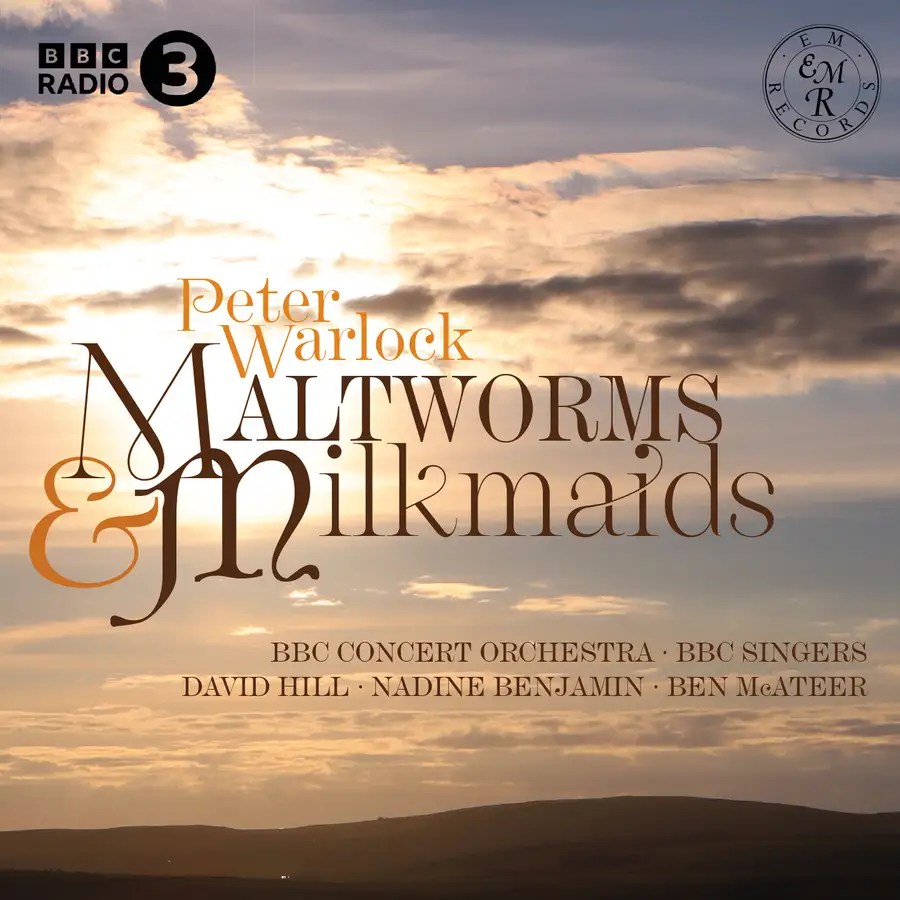
On Record – Maltworms and Milkmaids: Warlock and the Orchestra (EM Records)

Warlock
As Ever I Saw (1918, orch. anon)
An Old Song (1917-23)
Mr Belloc’s Fancy (1921/30, orch. Frederick Bye)
Captain Stratton’s Fancy (1921, orch. Peter Hope)
Serenade (1921-2)
Milkmaids (1923, orch. Henry Geehl)
Adam Lay Ybounden (1922, orch. Reginald Jacques)
Little Trotty Wagtail (1922, orch. David Lane)
The Birds (1926, orch. anon)
The Country-man (1926, orch. Gerrard Williams)
Yarmouth Fair (1924, orch. Kenneth Regan)
Sorrow’s Lullaby (1926-7)
One More River (1925)
Maltworms (1926, with E. J. Moeran)
Capriol (1926-8)
A Sad Song (1926)
Pretty Ring Time (1925)
The First Mercy (1927, orch. Fred Tomlinson/John Mitchell and William Davies)
Three Carols (1923)

Nadine Benjamin (soprano), Ben McAteer (baritone), BBC Singers, BBC Concert Orchestra / David Hill

EM Records EMRCD080 [73’52”] English texts included. Orchestrations by Warlock unless stated
Producer Neil Varley Engineer Robert Winter
Recorded 14-16 January 2022 at the Colosseum, Watford

Reviewed by Richard Whitehouse

What’s the story?

The always enterprising EM Records issues yet another ‘first’ in the guise of this collection featuring the songs with orchestra by Peter Warlock (aka Philip Heseltine), which includes many of those orchestrated by others with two-thirds of them here recorded for the first time.

What’s the music like?

Although his output barely extended beyond a decade and centred largely upon miniatures, Warlock left a substantial legacy of songs whose piano accompaniments mostly respond well when arranged for larger forces. Most of them are divided between soprano and baritone, in which latter Ben McAteer fairly captures their essence – whether the modal poise of the early If Ever I Saw, the heady (slightly forced?) jollity of those ‘fancies’ inspired by Mr Belloc and Captain Stratton, or the deftly barbed humour of Milkmaids. He draws tangible pathos from The Countryman and panache from Yarmouth Fair, with the rumbustious One More River and uproarious The Cricketers of Hambledon duly given their head. A highlight is the first recording of Maltworms, co-written with Ernest Moeran and rendered with suitable levity.

Nor is Nadine Benjamin other than fully attuned to the sentiments of her selection. Hence the soulfulness of A Sad Song or limpidity of Pretty Ring Time, both heard in what are Warlock’s only orchestrations of his solo songs, with The First Mercy an eloquent setting of words by frequent collaborator Bruce Blunt. Most affecting, though, is Sorrow’s Lullaby where soprano and baritone combine for a lengthy and often plangent setting of Thomas Beddoes in which the stark introspection of Warlock’s masterpiece The Curlew is never far beneath the surface.

The BBC Singers make their presence felt in the carol Adam Lay Ybounden and the whimsical Little Trotty Wagtail and winsome The Birds. No compromise is brooked in the rousing Fill the Cup, Philip or wistful choral incarnation of The First Mercy, then a closing trio of carols takes in the capricious Tyrley, Tyrley, the serene Balulalow and the aminated As I Sat Under a Sycamore Tree for a suitably rousing conclusion. Warlock would surely have approved and, had he known of the Singers’ recent travails, doubtless have responded in no uncertain terms.

The BBC Concert Orchestra gives of its best throughout under the astute direction of David Hill, duly coming into its own with the three orchestral pieces that Warlock completed. The evergreen suite Capriol is heard in its seldom heard and appealingly astringent version for full orchestra, the Serenade commemorates Delius’s sixtieth birthday in suitably rapturous terms, and the little-played An Old Song exudes a potent atmosphere as indicates what might have been possible had Warlock felt able to realize his musical ambitions on a larger canvas.

Does it all work?

It does, especially when heard in the continuous sequence as presented here. Warlock might increasingly have fretted about his ability as a composer, but the best of what he did achieve is sure to keep his name alive well beyond the approaching centenary of his untimely demise.

Is it recommended?

It is and not least when the presentation – with full texts, together with detailed notes from David Lane (vice-chairman of the Peter Warlock Society) reflects the always high standards of EM Records. In the words of a latter-day songster, ‘‘a splendid time is guaranteed for all’’.

Listen

Buy

You can explore purchase options for this album at the EM Records website. For more information on the artists click on the names of David Hill, Nadine Benjamin, Ben McAteer, BBC Singers and BBC Concert Orchestra. For more on all things Warlock, click on the name to head to the Peter Warlock Society

Published post no.2,078 – Monday 5 February 2024

In concert – Soloists, CBSO Chorus, CBSO / Joshua Weilerstein: Robert Nathaniel Dett – The Ordering of Moses

Ives (orch. Schuman) Variations on ‘America’ (1891/1962)
Bernstein (orch. Ramin & Kostal)
 Symphonic Dances from ‘West Side Story’ (1957/61)
Dett
The Ordering of Moses (1937) [UK premiere]

Nadine Benjamin (soprano), Chrystal E Williams (mezzo-soprano), Rodrick Dixon (tenor), Eric Greene (baritone), CBSO Chorus, City of Birmingham Symphony Orchestra / Joshua Weilerstein

Symphony Hall, Birmingham
Wednesday 23 February 2022

Written by Richard Whitehouse

This evening’s concert by the City of Birmingham Symphony Orchestra was an all-American programme, centred as it was upon the first performance in this country for what is likely the most ambitious work by the African/American composer Robert Nathaniel Dett (1882-1943).

Although he gained prominence as a choral conductor (his Hampton Choir having performed for President Hoover and Britain’s Prime Minister Ramsay MacDonald), Canadian-born Dett failed to make a lasting breakthrough as composer – his death when barely 61 confining him to a footnote in American cultural history. The ‘sacred cantata’ The Ordering of Moses was a statement of intent when submitted for his MMus in June 1932. Adapted from Exodus and Lamentations, its text describes the Hebrews escaping slavery in Egypt by the parting of the Red Sea over the course of 55 eventful minutes. The brooding prelude is rich in atmospheric writing for lower woodwind and brass, while the climactic sequence draws wordless chorus and orchestra into a graphic depiction of the ‘crossing’; after which, thanks is rendered unto God in suitably festive terms – Walton’s Belshazzar’s Feast an audible precedent. Much has been made of the use of spirituals but, apart from the rallying presence of ‘Go down, Moses’, they serve more a textural and harmonic role in heightening the music’s expressive potency.

A potency owing in no small part to its vocal and choral forces. Eric Greene was predictably sonorous in his eloquence when setting the scene as ‘The Word’, while Chrystal E Williams made the most of her small if crucial part as ‘The Voice of Israel’. Most memorable, though, were those contributions of Rodrick Dixon as the impulsive and ardent Moses, then Nadine Benjamin whose Miriam exuded poignancy and fervour in equal measure. The CBSO Chorus represented ‘The Children of Israel’ in suitably implacable and ultimately affirmative terms.

The whole performance was ably handled by Joshua Weilerstein, who ensured certain more discursive episodes in the cantata’s earlier stages never hung fire and drew a lusty response from the CBSO. Astute programming, moreover, in preceding a still little-known work with staples from the American repertoire. It might not encapsulate the whole of the musical, but Bernstein’s Symphonic Dances from ‘West Side Story’ captures its essence via orchestration (with judicious assistance from Sid Ramin and Irwin Kostal) as made a suitable impact here.

Surprising that William Schuman’s bracing orchestration of the teenage Charles Ives’s bravura organ piece Variations on ‘America’ does not enjoy more regular performance this side of the pond, or perhaps the quirky and increasingly uproarious incarnations of what Weilerstein pointedly referred to as the National Anthem of Lichtenstein still rankles with home-grown listeners? Whatever the case, the conductor made a persuasive case for this engaging and effervescent music to be heard more frequently – the CBSO players remaining straight-faced throughout.

It certainly provided an irreverent curtain-raiser to an engrossing programme as may yet have blazed a trail. More little-known American music on Sunday when Weilerstein directs only a second UK outing for Florence Price’s Piano Concerto, alongside Korngold and Tchaikovsky.

For more information on the next CBSO Youth Orchestra concert, click here. For more on the composer Robert Nathaniel Dett, head to a website devoted to his work. Meanwhile click on the links for information on the artsts – Joshua Weilerstein, Nadine Benjamin, Chrystal E Williams, Roderick Dixon and Eric Greene

Arcana at the Proms – Prom 35: Martyn Brabbins – Enigma Variations

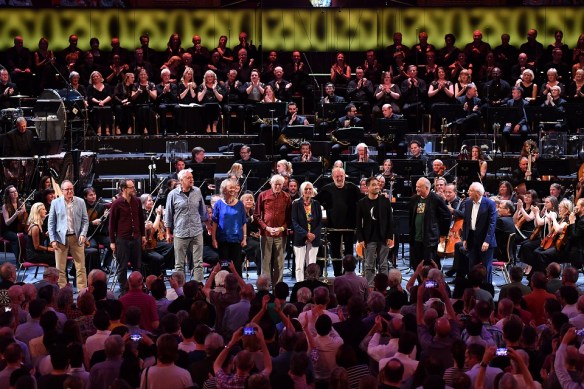
Idunnu Münch (mezzo-soprano), William Morgan (tenor), Nadine Benjamin (soprano), David Ireland (bass-baritone), English National Opera Chorus, BBC Singers, BBC Scottish Symphony Orchestra / Martyn Brabbins (above)

Various composers Pictured Within: Birthday Variations for M. C. B. (2019, BBC commission: world premiere)
Vaughan Williams Serenade to Music (1938)
Brahms Schicksalslied (Song of Destiny) Op.54 (1871)
Elgar Enigma Variations Op.36 (1899)

Royal Albert Hall, Tuesday 13 August 2019

Reviewed by Richard Whitehouse
Photo credits Chris Christodoulou

You can listen to this Prom on BBC Sounds here

It was clearly a great idea that the BBC commission a piece to mark Martyn Brabbins’s 60th birthday, this concert also being his 36th appearance at these concerts, as well as featuring 14 composers with whom this most stylistically wide-ranging of conductors has been associated.

The result was Pictured Within: Birthday Variations for M.C.B, each composer contributing a variation on an anonymous theme in what is an inverse take on Elgar’s procedure in his own Variations on an Original Theme – whose ground-plan also furnished the formal framework. Space precludes more detailed discussion, though it is worth noting the degree to which these composers (the full list is here) were inhibited or liberated by their placing in the overall scheme. And as this theme yielded its potential more from a harmonic then melodic or rhythmic angle, the most successful made a virtue of such constraints – not least Judith Weir in her engaging 10th variation and John Pickard in a finale, The Art of Beginning, whose deft mingling of portentousness with humour might yet become the springboard for an entirely new venture.

Vaughan Williams’s Serenade to Music (premiered in this venue – but not at these concerts – 81 years ago) was conceived for 16 solo singers and the choral alternative inevitably loses some of the original’s intimacy, though not the distinctiveness in its setting of lines drawn from Shakespeare’s The Merchant of Venice. Joining the BBC Singers and members of the ENO Chorus were participants on the Harwood Young Artists programme, of whom Nadine Benjamin brought a wide-eyed wonder to the soprano solos which motivate the latter stages.

Less often heard in the UK, Brahms’s Song of Destiny is among his most ruminative choral works. Its setting of the eponymous poem by Friedrich Hölderlin might be seen as continuing from A German Requiem in its subdued fatalism, albeit with a more animated central section as hints at that starker resignation which overcame the composer in his later years. Brabbins presided over an unforced yet insightful account of a piece that, for its relative unfamiliarity, has garnered numerous distinguished admirers – among them the composer William Walton.

Closing this concert with Elgar’s Enigma Variations made for an effective symmetry as well as bringing the programme full circle. Brabbins is no stranger to the work and duly galvanized the BBC Scottish Symphony Orchestra in a performance which gave full rein to these widely contrasted portraits (never caricatures!) of the composer’s friends while also ensuring an overall unity to the greater design – with the only lengthy pause coming after a luminous account of the ninth Nimrod variation – that carried through to a finale whose elation was shorn of any bombast. There were various delights on the way, not least a winsome take on the fifth variation, with the numerous instrumental solos eloquently taken. Hard to believe Elgar extended that final variation only at the urging of others, so inevitably does this build to its resplendent ending.

Some might have wondered whether building a full Prom around the birthday of its conductor was excessive but, given the regard in which Brabbins is held and the conviction he invested into each of these pieces, that decision was manifestly justified. Many Happy Returns M.C.B!

Martyn Brabbins has recorded Elgar’s Enigma Variations with the BBC Scottish Symphony Orchestra for Hyperion. More details can be found on their website, or on the YouTube clip below: