Opera in Four Acts (Nine Scenes) Music by Dmitri Shostakovich Libretto by Alaxander Preys and the composer after the novella by Nikolai Leskov English translation by David Poutney Semi-staged performance, sung in English with English surtitles
Katerina – Amanda Majeski (soprano); Boris/Ghost of Boris – Brindley Sherratt (bass); Zinovy – John Findon (tenor); Mill-hand/Priest – Thomas Mole (baritone); Sergey – Nicky Spence (tenor); Aksinya/Convict – Ava Dodd (soprano); Shabby Peasant – Ronald Samm (tenor); Steward – Alaric Green (baritone); Police Sergeant – Chuma Sijeqa (baritone); Teacher – William Morgan (tenor); Old Convict – Sir Willard White (bass-baritone); Sonyetka – Niamh O’Sullivan (mezzo-soprano)
BBC Singers, Chorus of English National Opera, Brass Section of English National Opera, BBC Philharmonic Orchestra / John Storgårds
Ruth Knight (director)
Royal Albert Hall, London Monday 1 September 2025
Reviewed by Richard Whitehouse Photos (c) BBC / Andy Paradise
In this 50th anniversary year of Shostakovich’s death it made sense for the Proms to schedule Lady Macbeth of Mtsensk, his second and final completed opera, in a performance reminding one of English National Opera’s commitment to this work stretching back almost four decades.
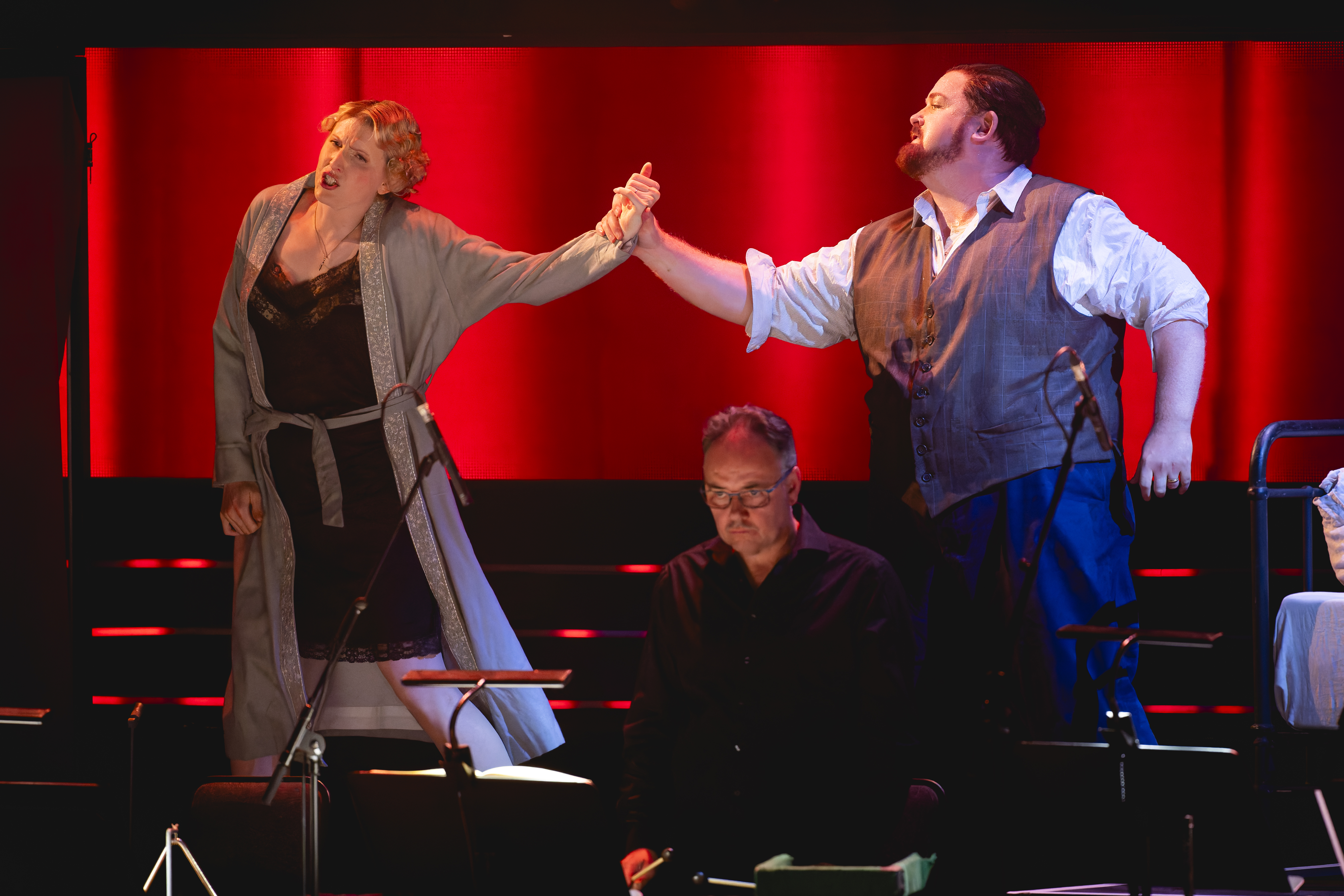
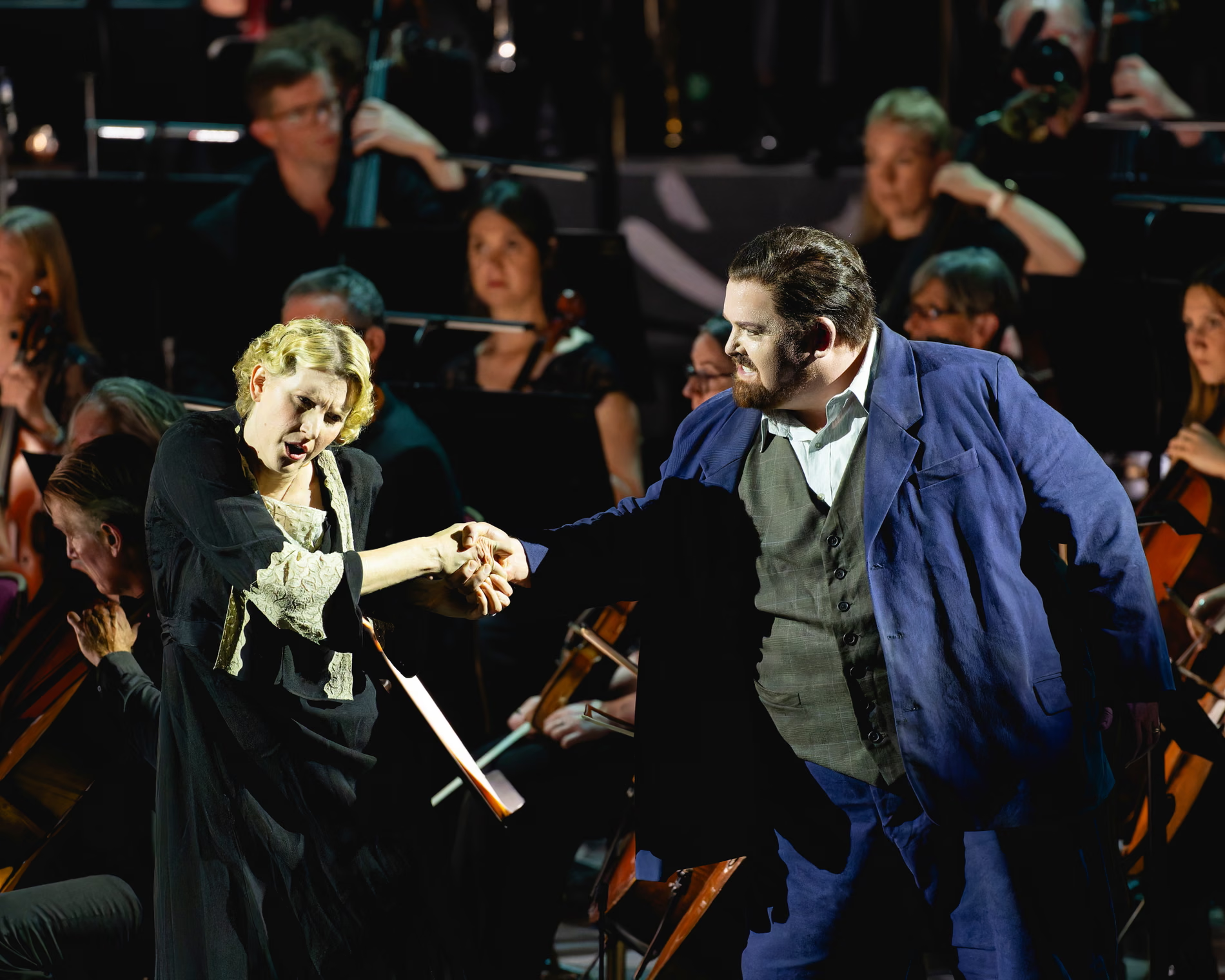
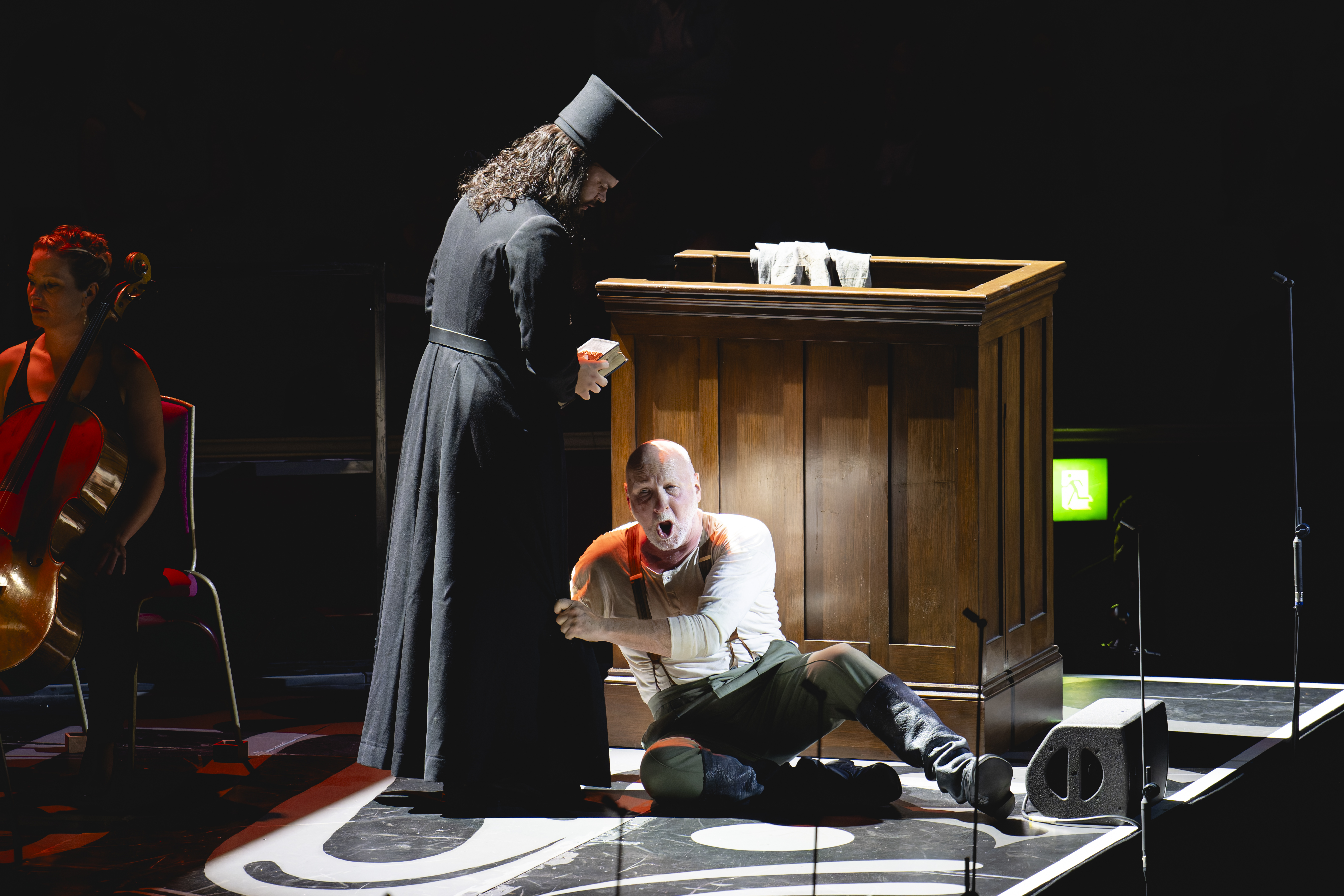
In scenic terms, the semi-staging directed by Ruth Knight was little more than a gloss on what was heard. Its framing device of the heroine in the witness box now seems a tired device that served little purpose, and the emergence of a bed at rear of the platform as a focus for sexual activity had surely passed its sell-by date at the end of the David Poutney era. More effective was the use of lighting to accentuate dramatic highpoints; incidentally reminding one such a procedure had come of age around the time that Shostakovich’s opera first appeared on stage.
Vocally this was a mixed bag. No-one could accuse Amanda Majeski of lacking presence or, moreover, eloquence in her assumption of the title-role, yet her emotional aloofness made her seem not so much distinct as overly detached from the wretched circumstances all around her. Brindley Sharatt was a shoo-in for Boris, his boorishness yet evincing a cunning intelligence who easily held the stage – not least his latter ‘ghost’ incarnation. Nicky Spence was vocally assured but dramatically two-dimensional as Sergey and, as Zinovy, John Findon resembled more a provincial critic than a merchant, though Thomas Mole made a lively contribution as a dipsomaniac Priest with Chuma Sijeqa uproarious as the Police Sergeant. His cameo as an Old Convict found Sir Willard White in gratifyingly fine voice near the end of his eighth decade.
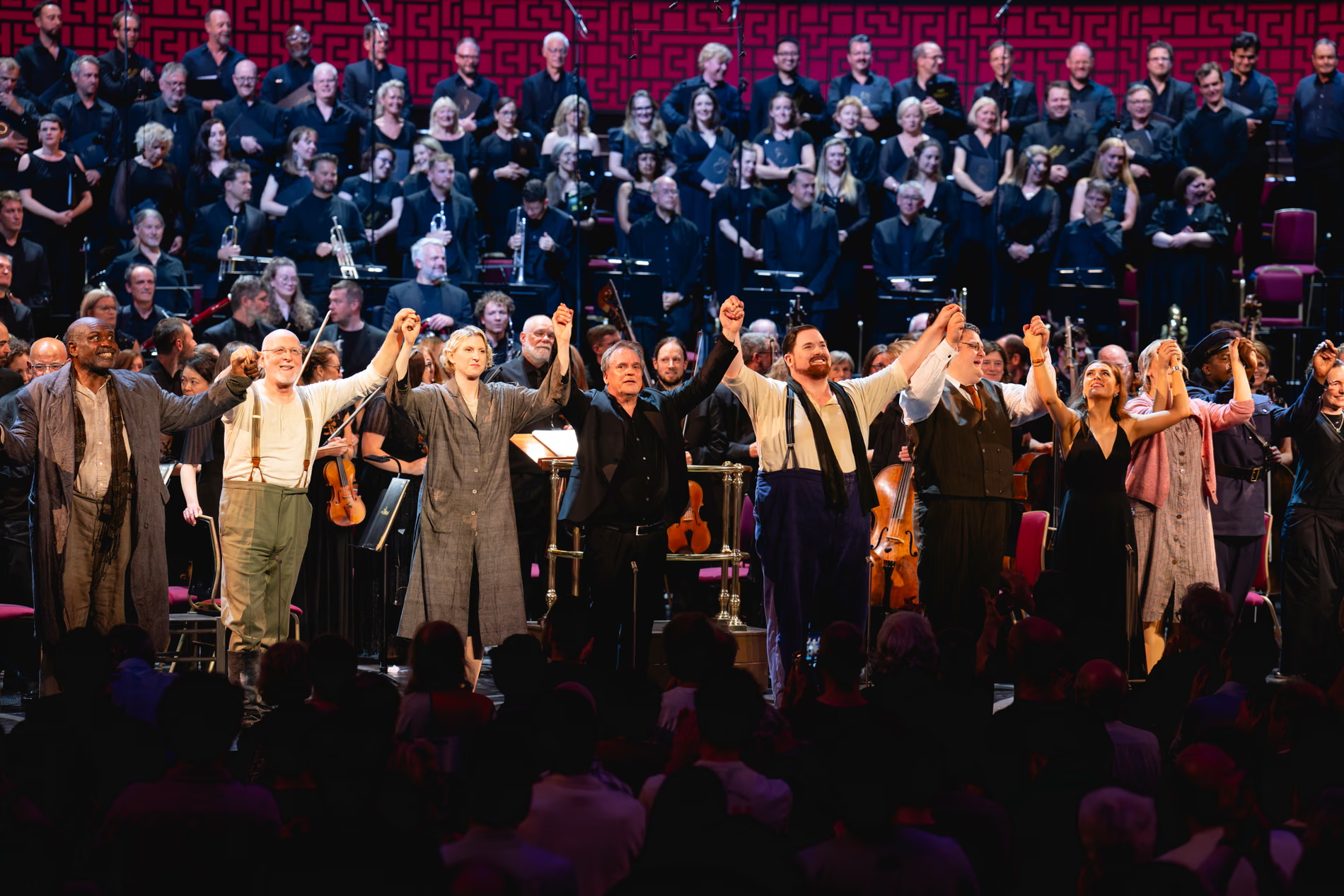
Smaller roles were generally well taken, not least Ava Dodd’s hapless Aksinya and Niamh O’ Sullivan’s scheming Sonyetka, while the ENO Chorus lacked little in forcefulness or clarity of diction, though this latter might have been felt a drawback given the frequent contrivance of Poutney’s translation – which has not aged well. Otherwise, this was very much the BBC Philharmonic Orchestra and John Storgårds’s show. Having impressed with Shostakovich symphonies over recent seasons, the latter had a sure grasp of this opera’s dramatic unfolding and paced it accordingly. No stranger to this composer’s music, his orchestra was as responsive to the seismic climaxes (suitably abetted by ENO brass) as to passages of mesmeric introspection which, in many respects, prefigure the composer Shostakovich was increasingly to become.
It has often been claimed that, had his fortunes not reversed so dramatically as on that fateful evening of 26th January 1936, Shostakovich would have continued upon his path as an opera composer. Yet there is a nagging sense that, whatever its theatrical potency, Lady Macbeth of Mtsensk is intrinsically no more than the sum of its best parts. Leaving aside the intermittent success of his and Alexander Freys’ remodelling of Nikolai Leskov’s ‘shabby little shocker’, dramatic characterization frequently seems to have been laminated onto its musical context.
If tonight’s performance never entirely banished these thoughts, it certainly gave this opera its head in what was a memorable night for orchestra, conductor and, for the ENO contingent, an impressive bowing-out as it prepares for the next phase of its existence – based in Manchester.
Roger Vignoles is one of Britain’s best-established accompanists. Respected for his technical ability, experience, breadth of repertoire and the work he does nurturing singers old and new, he is regularly seen at the illustrious venues worldwide.
More recently at the Wigmore Hall he has plotted a course through the daunting output of songs by Richard Strauss, a lesser known corner of the composer’s output. This has been complemented on disc courtesy of Hyperion, their series recently completed by an eighth and final disc with tenor Nicky Spence and soprano Rebecca Evans.
In a fascinating interview he talks with Arcana about his own introduction to classical music, the technical and psychological challenges in performing Strauss, his highlights from the series and the principles of accompanying a singer.
Can you remember your first encounters with classical music?
I have an early memory of a concert at Cheltenham Town Hall when Tchaikovsky’s Pathétique Symphony was performed – it was one of my father’s favourite pieces, hence one of his first LPs, together with Beethoven‘s Fifth Symphony and Franck’s Symphonic Variations. But he also loved Gilbert & Sullivan, so my brothers and I who were all choristers were basically brought up on a diet of English Cathedral Music and HMS Pinafore.
I also remember Peter and the Wolf loomed quite large (my favourite bit was the appearance of the wolf out of the forest), as well as the audience songs from Let’s Make an Opera. And I treasured a 78 single of Sousa’s Stars & Stripes played by the Coldstream Guards Band: nowadays my favourite version is Vladimir Horovitz’s – he gives it such an aristocratic swagger, like a Grande Polonaise in 4/4 time.
What was it about Gerald Moore that made you want to follow in his footsteps?
It was when my elder brother Charles (on whom I really learnt the basics of accompanying when we were both in our teens) gave me the first LP of Winterreise, sung by Dietrich Fischer-Dieskau with Gerald Moore. I was fascinated by the piano parts, but especially by Gerald’s beautifully judged piano sound and his wonderful sense of rhythm and pace, and I just thought: “I’d love to be able to do that.”
When did you first discover the songs of Richard Strauss?
It was probably when I went to the RCM in 1966. Hubert Dawkes, to whom I’d been assigned for accompaniment, plunged me in at the deep end with the Four Last Songs. But I also thrilled to songs like Allerseelen, Die Nacht, Ständchen, etc.
Listen to Rebecca Evans singing September, the second of Strauss’s Four Last Songs, with Roger Vignoles. This is part of the eighth and final volume of Strauss songs released by Hyperion and available here
Are the piano parts particularly challenging? When I have seen you play at the Wigmore Hall before they often feel orchestral in concept, as though you are having to voice a whole ensemble.
Strauss’s early songs sound much like Schumann: pianistic in quality and perfect for a domestic soirée. But with Zueignung, the first of his Opus 10 group (his first published songs), there is an unmistakable sea change. It’s as though the Vienna Philharmonic has entered the drawing room, and from then on Strauss never looked back. Challenging? Indeed, but Strauss also has a wonderful feel for the piano, and with very few exceptions his accompaniments are very grateful to play. Of course there can be a lot of notes to deal with and every now and then he does go completely over the top: Lied an meinem Sohn for instance, which sounds like a cross between Die Walküre and a Tchaikovsky piano concerto and was declared unplayable by Alfred Brendel, no less. It’s wonderfully sung by Christopher Maltman on Volume 4 (listen below):
As it happens thinking orchestrally has always come naturally to me, ever since my time studying with Paul Hamburger, for whom it was axiomatic that all song composers from Schubert onwards have a miniature orchestra in their heads. A couple of years playing Wagner and Strauss at Covent Garden helped cement this approach: many pianists make the mistake with Strauss of learning all the little notes first, but a stint in the opera house teaches you to see the wood for the trees, and as Paul Hamburger would often say, “If you get the gesture right, the little notes will fall into place”.
I should like to add that I owe an enormous amount to Paul, who taught me not only more about piano technique than any “real” pianist I ever worked with, but also about vocal coaching, style, language and poetry (even down to explaining Thomas Hardy to me in his thick Viennes accent). Quite coincidentally the first song I ever took to him was by Strauss – Schlagende Herzen.
The Strauss series on Hyperion has had a really nice blend of singers new and slightly older, English and European. Was that a deliberate aim?
It wasn’t a deliberate aim, so much as the result of the series having taken twelve years to record, and at each stage looking for artists with the appropriate vocal and musical character for the volume in hand. It also very much reflects the singers whom I already was enjoying working with at any given time.
Do you think that in the Strauss songs we get a different view of him as a composer?
Strauss was naturally a composer of the large gesture, the panoramic sweep, with a distinct tendency to overblown romanticism of the kind that can turn some listeners off. And of course the opera composer often shines through – there can be no doubt that the 25 years of song-writing that preceded his first operas were the laboratory in which he developed his gift for vocal characterisation.
But in the song format he is obliged to distil his musical ideas to their simplest essence. Just occasionally he doesn’t succeed, but on the many occasions when he does the result can be pure magic. If I had to give just one example it might be Nachtgang, a tiny love-song of breathtaking tenderness – and unfathomable poignancy (listen below):
‘Accompanist’ feels like a slightly derogatory term for a role that requires such control and artistry. Is it your view that both performers have equal billing in a vocal recital?
It’s not often realised that the Lied or Mélodie is as much a piano art as a vocal one – it’s no accident that Schubert’s Lieder evolved with the early years of the piano – so of course singer and pianist should have equal billing. It is indeed a truly symbiotic partnership. But as for the A-word, I am proud to follow Gerald Moore as an “Unashamed Accompanist”. To me it’s the only term that naturally describes what I and my colleagues do. Nevertheless I can understand those who baulk at its negative associations and prefer the American coinage “collaborative pianist”. Just for the record the billing should of course always read “So-and-So, piano”, never “So-and-so, accompanist”.
What is the most common piece of advice you give to your students on accompanying a singer?
This from Geoffrey Parsons, another mentor: “Always have your own idea of how the song goes, rather than just be a blank canvas for the singer to draw on”.
But two other rules of thumb are useful: “It’s the singer’s job to slow down, the pianist’s to speed up again” and “Balance is as much a function of texture (ie transparency and clarity) as of decibels (as in am I too loud?)”
Is it important to have a personal affinity with the singer you are performing with, as well as a musical one?
It helps of course, especially if you are going on tour together. But I have had many experiences of wonderful music-making on minimal rehearsal, when there was no time at all to find out whether you got on personally offstage.
Are there any composers you have not yet recorded that you are keen to explore?
I love playing Rachmaninov songs (probably for the same reason that I love playing Strauss). And one day I might get round to Schoenberg’s Buch der hängenden Gärten.
If you could recommend a Strauss song to Arcana readers listening for the first time, which one would it be?
So many to choose from… But for a real out-of-body experience, try Am Ufer, sung exquisitely by Christopher Maltman on Volume 4 (listen below):
Or for a remarkable stream of consciousness, Anne Schwanewilms singing O wärst du mein! on Volume 2 (listen below):
You are a painter as well, looking at Twitter…does music inspire your paintings at any point?
Not precisely: but a friend once told me they thought I painted with the same part of the brain that I play with. Which is probably true. It is a fact that I have a very visual conception of the music that I play, especially in song where so much of the verbal imagery is itself visual. So in either medium I am playing with light and shade, with colour and texture, and with contrast – perhaps the most important tool in both.
You can read more about Roger Vignoles on his artist page, or click here for his Hyperion discography. With grateful thanks to Hyperion for the provision of highlights from their Strauss series, which are of course (c) Hyperion Records Ltd.

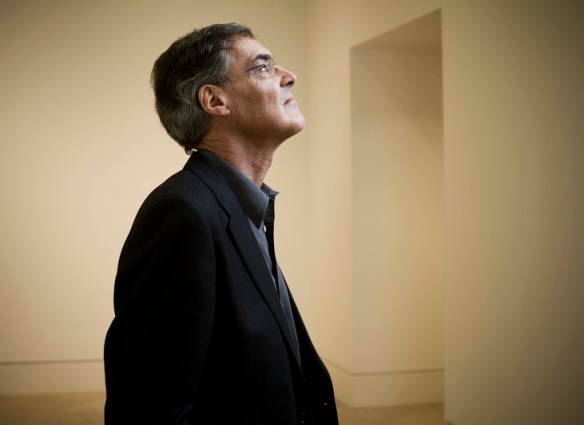 Roger Vignoles is one of Britain’s best-established accompanists. Respected for his technical ability, experience, breadth of repertoire and the work he does nurturing singers old and new, he is regularly seen at the illustrious venues worldwide.
 Are the piano parts particularly challenging? When I have seen you play at the Wigmore Hall before they often feel orchestral in concept, as though you are having to voice a whole ensemble.
 Arcana.fm