
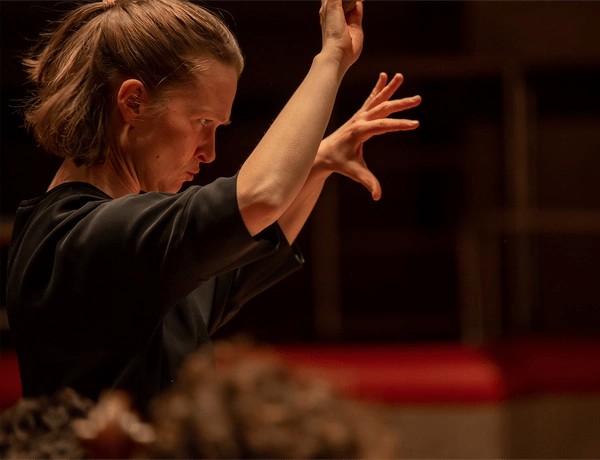
Marie-Christine Zupancic (flute), Oliver Janes (clarinet), Eugene Tzikindelean (violin), Adam Römer (viola), Onutė Gražinytė (piano), City of Birmingham Symphony Orchestra / Mirga Gražinytė-Tyla
Traditional (arr. Raminta Šerkšnytė) Anksti rytą kėliau
Čiurlionis (ed. Charalampos Efthymiou) Miške (1901) [UK premiere]
Weinberg Clarinet Concerto Op.104 (1970)
Loboda Requiem for Ukraine (2014)
Weinberg 12 Miniatures for Flute (1945, orch. 1983) [UK premiere]
Kakhidze Bruderschaft (1996) [UK premiere]
Symphony Hall, Birmingham
Wednesday 6 December 2023
Reviewed by Richard Whitehouse. Picture of Mirga (c) Beki Smith
The sound of a Lithuanian folksong I got up early in the morning, plaintively sung by Mirga Gražinytė-Tyla and accompanied by her sister Onutė, introduced tonight’s concert where the conductor made a welcome reappearance with the City of Birmingham Symphony Orchestra.
MGT gave a memorable performance (not for all the right reasons) of Mikalojus Čiurlionis’s symphonic poem The Sea during her tenure as music director, and the CBSO sounded equally assured with his earlier such piece In the Forest that opened the programme. Here once again the composer’s over-ambition is evident from a rather episodic construction and the textural overload (odd in music this opulently scored to have had no timpani, as might have brought greater definition to emotional highpoints), though had Čiurlionis heard this in performance the outcome might have been otherwise. What remains is a sequence of enticing paragraphs, framed by ones whose formal and expressive aims seemed impressively as one in pointing towards just what might have been possible were it not for his demise at the age of only 35.
The music of Mieczysław Weinberg has been a preoccupation of MGT for over a decade, and it was good to hear this continue through two pieces in which CBSO principals played to their strengths. Oliver Janes sounded enthused by the Clarinet Concerto, its initial Allegro pivoting between incisiveness and inwardness typical of the composer’s maturity. The Andante brought a plangent interplay of soloist and strings, with the sardonic humour of the ensuing Allegretto building toward a cadenza whose entreaties were curtailed by the peremptory closing gestures.
Commissioned after Russia’s occupation of the Crimea, Igor Loboda’s Requiem for Ukraine has only become timelier this decade since – its heady series of variations within a chaconne-like form offering no mean technical challenges that Eugene Tzikindelean met with panache.
As did Marie-Christine Zupancic the more restrained subtleties of Weinberg’s 12 Miniatures for Flute. Composed with piano accompaniment and arranged for strings almost four decades later, these deft and often characterful vignettes follow a methodical tonal progression, while the opting to render them as three groups of four implied a latent fast-slow-fast format akin to that of a concerto. At no time was there any sense of Weinberg being less idiomatic or more impersonal in pieces which are as meticulously realized as any of his larger compositions.
After this, the paucity of content in Vakhtang Kakhidze’s Bruderschaft (Brotherhood) was only too evident. A ‘sinfonia concertante’ for viola, piano and strings, its easeful opening section had a certain charm of which Adam Römer’s playing was nothing if not persuasive, but the livelier music that followed was lounge-jazz at its most cliched and neither the violist’s input nor an almost choreographed response from Onutė Gražinytė raised it above the commonplace. Both these sections were elaborated to little intrinsic purpose, other than to prolong what was already a lengthy concert such that numerous attendees could be seen departing in those final minutes.
A pity in what was otherwise a rewarding programme as reaffirmed MGT’s continued rapport with her former orchestra. Hopefully there will be more such collaborations in future seasons.
You can read all about the 2023/24 season and book tickets at the CBSO website. Click on the artist names for more information on Mirga Gražinytė-Tyla, Marie-Christine Zupancic, Oliver Janes, Eugene Tzikindelean, Adam Römer and finally Onutė Gražinytė
Published post no.2,033 – Friday 8 December 2023



 Arcana.fm