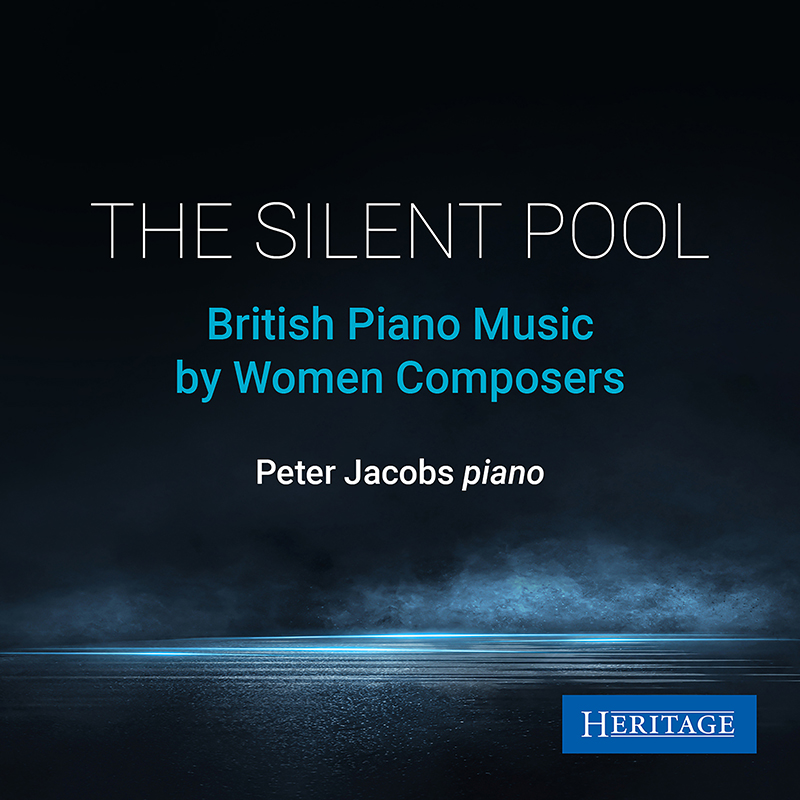
On Record – Peter Jacobs: The Silent Pool: British Piano Music by Women Composers (Heritage Records)

Peter Jacobs (piano)

Smyth Piano Sonata no.3 (1877); Piano Sonata no.2 (Andante) (1877)
Maconchy A Country Town (nos. 1, 3, 4, 5 & 7) (1945)
Williams The Silent Pool (1932)
Grime The Silver Moon (2025)
Dring Colour Suite (1963)
Bingham The Moon Over Westminster Cathedral (2003)
Woodforde-Finden Indian Love Lyrics (nos.2 & 1) (1903)
McDowall Vespers in Venice (2002)
Bingham Christmas Past, Christmas Present (1991)
Roe A Mystery of Cats (nos. 1, 4 & 5) (1994)
Beamish Lullaby for Owain (2016)
Da Costa Gigue; Moods (both 1930)
Lehmann Cobweb Castle (nos. 2 & 5) (1908)

Heritage Records HTGCD126 [75’40”]
Producer / Engineer Paul Arden-Taylor

Recorded 16 September 2024 & 26 January 2025 at Wyastone Concert Hall, Wyastone Leys, Monmouth

Reviewed by Richard Whitehouse

What’s the story?

Peter Jacobs continues his productive association with the Heritage label with this anthology that takes in a well-planned overview of piano music by female British composers, ranging across over more than 130 years of creativity in an impressive variety of idioms and genres.

What’s the music like?

Although female composers had been active in the UK from the outset of the English Musical Renaissance and before, relatively few came to prominence during their lifetime, with many others destined to be rediscovered only years and sometimes decades after their death. While hardly the first of its kind, the present collection is among the most representative in terms of its stylistic coverage which, in turn, underlines they should not be pigeon-holed any more than their male counterparts. Moreover, what was the loss to earlier generations is our gain today.

This recital opens with the redoubtable Ethel Smyth – her Third Piano Sonata contrasting the equable motion of its initial Allegro with the impetuous manner of its closing Allegro vivace. From its larger scale predecessor, the central Song Without Words affords ruminative space between the dynamism and tensions of those movements either side. Of the five (out of nine) pieces in Elizabeth Maconchy’s suite, the eloquent Lament and limpid Bells are especially appealing. Grace Williams is at her most haunting in the piece as gives this collection its title, and Helen Grime pens a miniature stark yet pellucid. Among the most versatile composers of her generation, Madeleine Dring is represented here by a five-movement themed suite which includes such delights as the quizzical Pink Mirror or the appropriately sensuous Blue Air. Judith Bingham may be best known for her choral and brass band music, but there is nothing unpianistic about so translucently textured a nocturne.

Two of Amy Woodforde-Finden’s four-piece suite include the elegant poise of Less than the Dust, while Cecilia McDowall sounds a note of spatial immensity in her Venetian evocation. The four pieces of her Christmas suite find Bingham pursuing an altogether more winsome vein of expression – duly complemented by three out of five whimsical feline homages by Betty Roe, happily still going strong in her 96th year. Sally Beamish contributes a (surprisingly?) capricious lullaby, with two pieces by the short-lived Raie da Costa typifying her witty and sassy manner. The wistful charm of Liza Lehmann, two of six pieces from her only piano suite, affords an elegant then touching envoi.

Does it all work?

As an overall sequence, absolutely. At around 75 minutes, this concert-length recital can be enjoyed as a continuous sequence or in any number of selections. It helps when Jacobs is so persuasive an exponent of this music, much of it remaining little known other than to pianists with his breadth of sympathies but which ought to find an audience given exposure in a live context. As he himself notes, this “random selection [is] united by being rewarding to play, beautifully written for the instrument, varied in style and intellectual depth”. Enough said.

Is it recommended?

It is. Piano sound is as full and spacious as expected given its Wyastone source, while Jacobs contributes laconically insightful notes on the recital overall. Most enjoyable, with hopefully enough material in this pianist’s “library of over 60 years collecting” to warrant a follow-up.

Listen / Buy

You can read more about this release and explore purchase options at the Heritage Records website

Published post no.2,682 – Thursday 9 October 2025

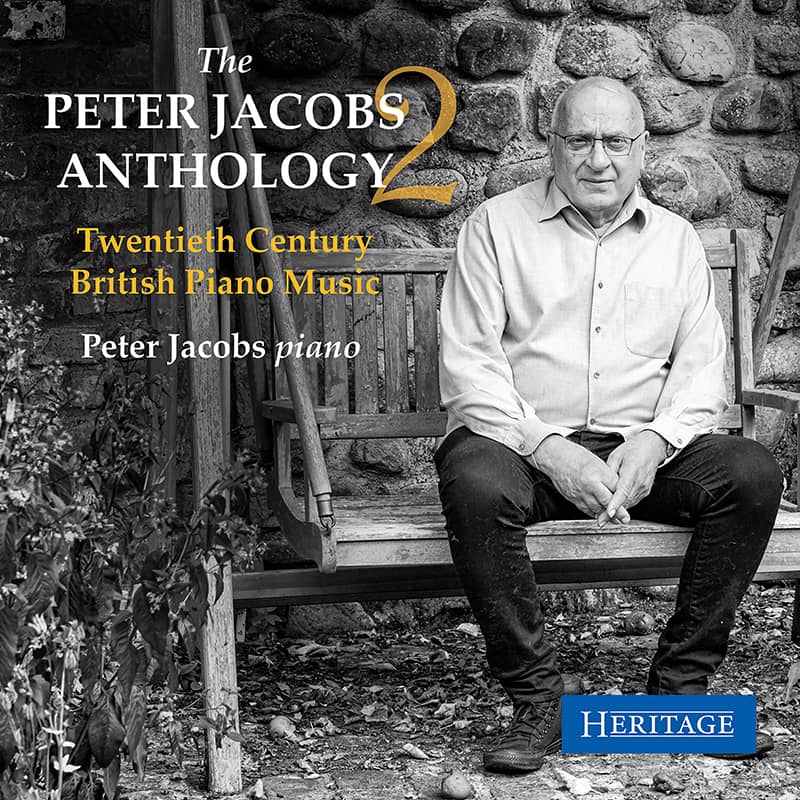
On Record – The Peter Jacobs Anthology Vol. 2 – Twentieth Century British Piano Music (Heritage)

Coleridge-Taylor Petite Suite de Concert Op.77 (1911)
Cooke High Marley Rest (1933)
Delius Mazurka and Waltz for a Little Girl RTIX/7, 1 & 2 (1922-3)
Headington Toccata (1963)
Rubbra Eight Preludes Op.131 (1967)
Scott Lotus Land Op.47/1 (1905)
Armstrong Gibbs Lakeland Pictures Op.98 (1940) – no.2, After Rain (Rydal Beck); no.8, Quiet Water (Tarn Howe)
Baumer Idyll (1935)
Mayer Calcutta-Nagar (1993)

Peter Jacobs (piano)

Heritage HTGCD131 [73’30″]
Producer & Engineer Paul Arden-Taylor

Recorded 14 & 16 September 2014 at Wyastone Concert Hall, Wyastone Leys, Monmouth

Reviewed by Richard Whitehouse

What’s the story?

Heritage extends an already extensive discography of British music with its follow-up to the Peter Jacobs Anthology, a further volume featuring collections of or standalone miniatures with a wide range of musical idioms given focus through the persuasiveness of the pianism.

What’s the music like?

Among the miscellaneous pieces included here are Greville Cooke’s ruminative ‘portrait’ of the home of pianist (and his former teacher) Tobias Matthay, Delius’s respectively pert and fey offerings, or Christopher Headington’s scintillating study for John Ogdon. Cyril Scott’s evergreen is treated to a subtly understated reading, while two out of a set of eight by Cecil Armstrong Gibbs provide enticing evocations of Rydal Beck then Tarn Howe – their innate Englishness sounding removed from the overtly Russian manner of that from Cecil Baumer.

Forming the backbone of this collection are three sets that in themselves attest to the variety of the music featured. Best known in its orchestral guise (a recording of which can be found on Heritage HTGCD249), Samuel Coleridge-Taylor’s Petite Suite de Concert is light music of a superior kind – witness its flighty initial Caprice, its ingratiating Sonnet or its lively closing Tarantelle, though its ostensible highlight is Demande et Réponse whose alluring sentiment helped with keeping the composer’s memory alive prior to his belated rediscovery.

Other than figuring among its composer’s later works, the Eight Preludes by Edmund Rubbra could hardly have been more different. As with his Eighth Symphony written soon afterward, these short while arresting pieces likewise focus on specific musical intervals rather than any overall key scheme, though their cohesiveness heard as an integral sequence could never be in doubt. Introspective without being inscrutable, this is wholly absorbing music and Jacobs accords ample justice to what is only the second complete recording this set has yet received.

As the most unlikely inclusion, John Mayer’s Calcutta-Nagar proves nothing less than a total delight. Known primarily for his syntheses of Indian and European elements, notably through the group Indo-Jazz Fusions, Mayer wrote extensively for Western media with this collection a notable instance. Only two of its 18 pieces last over a minute, yet their capturing of places recalled from the Calcutta of the composer’s youth is absolute. Jacobs notes his favourite as being the 13th (Kali Temple), but listeners will doubtless come up with their own favourites.

Does it all work?

Yes, whether as a judiciously planned collection or an anthology from which one can select individual items as preferred. The three collections are each among the most distinctive of its kind, while they and the various individual pieces provide ready-made encores in recital. Evidently this is music which Jacobs has long included in his repertoire, the performances exuding that combination of technical finesse allied to a probing insight as have long been hallmarks of his interpretations. Those who are unfamiliar with this music are in for a treat.

Is it recommended?

Indeed, not least as the sound has a combination of clarity and warmth ideal for piano music. The pianist pens informative notes, and one hopes that there will be further such anthologies. Meanwhile, Jacobs approaches his 80th birthday (this August) with his pianism undimmed.

Listen & Buy

For purchase options, you can visit the Heritage Records website

Published post no.2,448 – Monday 17 February 2025