Online concert – English Symphony Orchestra / Kenneth Woods: The music of Saxton & Sawyers

eso-saxton-sawyers

English Symphony Orchestra / Kenneth Woods

Sawyers Remembrance (2020); Octet (2007)
Saxton
The Resurrection of the Soldiers (2016)

Wyastone Concert Hall, Monmouth
7-8 April 2021

Written by Ben Hogwood

For the latest in their online series, the English Symphony Orchestra and their conductor Kenneth Woods presented a trio of works written in the last 20 years. The music of Philip Sawyers, their Composer Laureate, featured in two contrasting pieces.

A recent work, Remembrance for Strings, made an instant impact. This deeply emotive, thought provoking piece has a hint of Elgar in its profoundly elegiac tone and scoring, but unmistakably bears Sawyers’ fingerprints as the theme evolves, gradually creeping upwards. The strings of the ESO were perfectly paced by Woods, giving the theme plenty of room and bringing the important viola and cello lines through the texture. Sawyers finds effective contrasts between notable pain points of discord and an almost complete stillness as the strings collect their thoughts, holding their collective breath in ideally weighted phrasing. This deeply affecting piece deserves to be heard much further afield, its impact comparable (if notably different) to that of Barber’s Adagio for Strings. A note for Emily Davis, the ESO guest leader, who gave a touching final solo.

Sawyers’ Octet was next, a single movement work from 2007 written for the youthful ensemble Liquid Architecture. With a scoring for clarinet, horn, bassoon, string quartet and double bass, its colours provided the ideal contrast to Remembrance, as did its series of compact melodies and increasingly busy exchanges, carefully interwoven throughout the ensemble. Written in a single movement, the Octet is an involving work, treating the eight players as soloists but exploring and enjoying their properties in smaller group discussions. Perhaps inevitably the mind is briefly cast back to Stravinsky’s work for the same number of players, but also the harmonic language of Berg and Hindemith. When all the instruments play together the dense contrapuntal writing is at its most effective, while Sawyers ensures the component melodies can be appreciated in a solo capacity too. Kenneth Woods conducted a fine account here, the ESO soloists playing with flair and sensitivity, all the while gathering momentum towards an emphatic arrival in C major. The instrumentalists’ placing, and some sensitive camera work under the direction of videographer Tim Burton, allowed heightened insight into the speed of Sawyers’ rapidly evolving ideas.

As he approaches his 70th birthday, Robert Saxton is a British composer arguably yet to receive the full recognition of which his music is surely due. The Resurrection of The Soldiers is an illustration of his ability to respond to art from another form with remarkable perception. A 12-minute tone poem for string orchestra, written in 2016 and dedicated to George Vass, The Resurrection of The Soldiers is a powerfully concentrated work, responding as it does to the final panel of Stanley Spencer’s commission for Sandham Memorial Chapel. The set of paintings result from the artist’s experiences in the British army in World War One, depicting soldiers emerging from their graves on the last day.

Clearly this depiction struck a lasting emotional chord with the composer, his response speaking initially of searing pain but progressing to a much more hopeful outcome. The upper strings of the ESO spoke powerfully here, maintaining their intensity in the long notes before digging in to an eventful exchange in the energetic central section. This culminated in a powerful chord, richly scored – and with a reverent pause from which the resurrection itself evolved with increasing surety, reaching an exultant if not un-scarred E major.

You may wish to complement the ESO’s performance with detail from the artwork itself, from the National Trust website, or you may wish to form your own images which the music powerfully imprints. Either way, do catch the whole of this compelling program, for these are three very meaningful pieces of music given in the best possible performances.

You can view this concert from 18-22 February at the ESO website, and thereafter for ESO digital supporters here

In concert – Colorado MahlerFest Orchestra / Kenneth Woods – MahlerFest XXXIV: Sawyers & Mahler Fifth Symphonies

MahlerFest01_square-01

Colorado MahlerFest Orchestra / Kenneth Woods

Sawyers Symphony No. 5 (2020) [World Premiere]
Mahler
Symphony no.5 in C sharp minor (1901-2)

Macky Auditorium, Boulder
Saturday 28th August 2021

Written by Richard Whitehouse

A programme of two five-movement Fifths might not have been what Kenneth Woods had envisaged at this stage of his symphonic traversal in the Colorado MahlerFest but, after an inevitably curtailed season last year, the need to jump-start the festival this time round was evident, and the present double-bill did so impressively. Mahler’s cycle is often viewed as the ‘end of the line’ for the genre of the symphony, yet its ongoing evolution is not hard to discern, and it is to Woods’s credit that he is making this aspect a crucial part of his tenure.

Woods has championed the music of Philip Sawyers for more than a decade, with this Fifth Symphony continuing along a stylistic path comparable to those two before it. Its immediate predecessor ended with an expansive Adagio as was his most impressive such movement so far, and the present work continues from such inward (never self-conscious) seriousness in a Moderato (each of the movements being designated with Shostakovich-like inscrutability) that overrides clear-cut sonata procedures for a gradual unfolding whose thoughtful opening theme takes on greater emotional intensity as it builds to an ominous climax then closes in a mood of some ambivalence. Here, as throughout, the writing for a standard orchestra (with fifth horn and harp though no percussion other than timpani) is never less than resourceful.

From here an Allegro picks-up the pace incrementally to capering and, in its middle stages, wistful effect; before the central Lento pursues a sustained course (not a little unlike that of Rubbra’s slow movements) over two cumulative paragraphs – the second of which climaxes with the most anguished music in the whole work, prior to the brief yet affecting coda from strings. More overtly a scherzo, the ensuing Presto also evinces greater expressive contrast between its impulsive outer sections and a chorale-like ‘trio’ of affecting poise. From here, the final Allegro is the most orthodox movement in its energetic and reflective main themes – taking in an intensive development and subtly modified reprise prior to an apotheosis that ensures a decisive yet, as might be expected from this composer, never bathetic conclusion.

On this first hearing, Sawyers’s new symphony proved a cohesive and absorbing piece – less arresting in content, perhaps, than either of its predecessors but with an unfailing formal logic and expressive eloquence that are not to be gainsaid. Interesting, too, this Fifth should mark something of a rapprochement with ‘classical’ tonality; whereas Mahler’s Fifth, which came after the interval, sets in motion that often fractious discourse which duly informs almost all this composer’s symphonic works from his final decade of creativity – indeed, of existence.

Pacing is crucial in Mahler’s symphonies, with this being no exception. From the outset of a trenchant trumpet solo, the Funeral March was almost ideally judged – its development not too histrionic, and coda whose eruptive force subsided into numbed uncertainty. Proceeding (rightly) without pause, its successor – as if a fantasia to the prelude just heard – steered with unobtrusive authority to its climactic if ill-fated chorale, and if the final return of the opening music lacked vehemence, the pulsating expectancy of the closing bars was tangibly rendered.

That the central Scherzo has long divided opinion is not in doubt (Otto Klemperer avoided the work because of it while Hermann Scherchen reduced it by two-thirds), and though Woods’s conception had its merits – a rustically evocative trio plus the transitions on either side – the unforced equability of its outer portions underlined just how closely this music verges on the platitudinous; its ländler-informed coyness and contrapuntal contrivance over-exploiting the potential of its content. At least the coda wrapped up this movement with real decisiveness.

The remaining movements were finely realized, Woods taking the Adagietto at a flowing yet flexible pace that enabled its rapture to emerge without risk of indulgence (here, as throughout, the strings’ articulation of grace notes served a structural as well as expressive purpose). The deftest of transitions duly prepared for a finale whose elaborate interplay of rondo and sonata elements was replete with a cumulative impetus as carried through to a fervent peroration, the chorale blazing forth during a close where affirmation and nonchalance were irresistibly fused.

It should be added that the playing of the Colorado MahlerFest Orchestra was of a consistently high standard – testifying to the excellence of the individual musicians as, also, their collective responsiveness to Woods’s technical acumen and interpretative insight. Its latter-day status as mainstream repertoire may have obscured its innovative qualities (and drawn attention away from its unevenness), but to hear this work so authoritatively realized and within the context of a major new symphonic statement says much for the continued importance of MahlerFest.

Further information on the Colorado MahlerFest can be found on their YouTube channel. For more on the festival, visit their website – and click on the names to visit the websites of Kenneth Woods and Philip Sawyers respectively.

In concert – Sarah Beth Briggs, English Symphony Orchestra / Kenneth Woods: Mozart in Cheltenham

sarah-beth-briggs

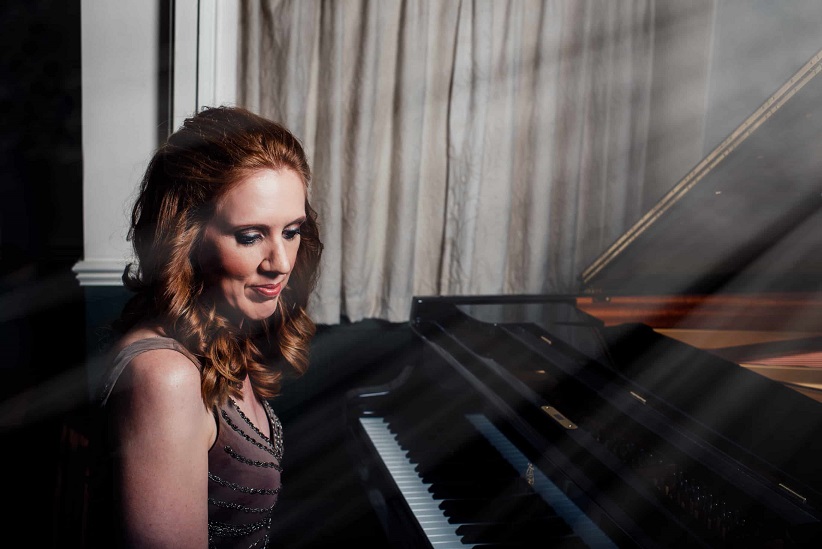
Sarah Beth Briggs (piano, above), English Symphony Orchestra / Kenneth Woods

Sawyers The Valley of Vision (2017)
Mozart
Piano Concerto no.22 in E flat major K482 (1785)
Beethoven
Symphony no.6 in F major Op.68 ‘Pastoral’ (1808)

Town Hall, Cheltenham
Monday 25 October 2021

Written by Richard Whitehouse; picture of Sarah Beth Briggs by Carolyn Mendelsohn

Tonight’s concert found the English Symphony Orchestra at the Town Hall in Cheltenham, a building of Victorian opulence with an expansive while (surprisingly?) immediate acoustic to match, in a programme featuring classics of their respective media by Mozart and Beethoven.

First, though, a welcome revival for The Valley of Vision – the tone poem by Philip Sawyers that surveys the environs around Shoreham, Kent as were immortalized in the visionary early landscapes of Samuel Palmer. Although the composer had identified five continuous sections, the probing intensity of this music makes for a seamless unfolding which was to the fore in a superbly focussed account as directed by Kenneth Woods (who recently premiered Sawyers’ Fifth Symphony at the Colorado Mahler Festival). No less tangible was the control over this music’s momentum, extending through to a climactic faster section before soon regaining its initial pensiveness. In its subtly evocative aura and persuasive handling of tonality, moreover, this piece can rank with the most significant British orchestral works of the past two decades.

From the six piano concertos that Mozart wrote for his subscription concerts during the mid-1780s, the Twenty-Second is likely the least often heard. A pity, when its relatively expansive form and unpredictability of content are striking even in the context of this most exploratory phase from the composer’s output. Certainly, it is a piece of which Sarah Beth Briggs had the measure – whether in the forceful impetus of its opening Allegro, winsome interplay between soloist and woodwind in the central Andante (arguably the most eloquent among Mozart’s sets of variations) or blithe unfolding of a final Rondo afforded greater pathos by the ‘harmonien’ episode whose interposing was an inspired departure. Nor were Dennis Matthews’s succinct and artfully integrated cadenzas other than an enhancement of what was a fine performance.

Not that there was there anything routine about Beethoven’s Pastoral following the interval, a worthy successor to those performances of the Fifth and Seventh Symphonies that Woods and the ESO have given in recent concerts. Thus, a purposeful though never inflexible take on the opening movement left sufficient room to characterize its reflective asides, with the ‘Scene by the brook’ even more engrossing through its homogeneity of texture and seamless continuity; the closing bird-calls elegantly phrased and enticingly integrated into the whole.

Too rapid a tempo for the scherzo left Woods with insufficient room to point up contrasts in motion with its trio sections, but the Thunderstorm was finely rendered as an extended introduction into the finale – this Shepherd’s Song emerging as the formal and emotional culmination in all respects. Not the least of these strengths was an inevitability of progress – here maintained right through to a coda of serene poise and, in the process, underlining the degree to which any vestige of self has been sublimated into the enveloping cosmic dance.

An absorbing performance as made one look forward to further Beethoven symphonies from this source. Woods and ESO are in Worcester at the weekend with two concerts as part of the Autumn Elgar Festival, the first featuring the masterly Elegy for Strings by Harold Truscott.

Further information on the ESO’s current season can be found at their website. For more on composer Philip Sawyers, visit his website here, while more on pianist Sarah Beth Briggs can be found at her website

Arcana’s best of 2020

written by Ben Hogwood

Before finishing for Christmas and New Year celebrations, I wanted to offer some thoughts on the musical year that has been 2020. And what a year. I doubt we will experience its like again, that’s for sure – and those of you reading this will no doubt have had some incredible challenges to overcome, or have been instrumental in helping other with their challenges. Everything is firmly in perspective, that is for sure.

In the year of a global pandemic, as in all times of strife, music has been there offering a consoling shoulder to lean on. Much of my listening this year has been of the ambient kind, a place of retreat when all has been too frenetic / inhuman / scary. Music has really shown us its true colours again this year, offering the required escape route along with some real inspiration.

Live music, of course, has suffered greatly, and my thoughts are with all those musicians and people working behind the scenes in the arts, their lives irrevocably affected by COVID. As listeners we thank them for their remarkable resilience and inventiveness, bringing live-streamed concerts of such quality they have been the best possible substitute for the real thing. Wigmore Hall set the scene in June, and many others have followed. The orchestras and choirs should be held in the highest regard for their efforts.

Needless to say I did not attend many concerts in 2020, but two of great note were from soprano Louise Alder (above) and pianist Joseph Middleton, showcasing their exceptional album Lines written during a sleepless night at Wigmore Hall in January, and the Orchestra of the Age of Enlightenment under Iván Fischer performing the last three Mozart symphonies at the Royal Festival Hall in February.

I wanted to share with you my favourite music on record this year. It was of course Beethoven 250, and my aim was to listen to the composer’s entire works. That aim continues, but the deadline has been extended massively! It is proving a thoroughly enjoyable experience but circumstances mean it has taken much longer than expected. To enjoy the listening project to its full potential, I look forward to reconvening with the first Sonatas for cello and piano in 2021, and taking it over the finishing line later in the year.

This year’s new releases have been extremely fine – and I have eight to share with you here, beginning with Steven Osborne’s remarkable disc of three Prokofiev piano sonatas on Hyperion. This appeared at the same time as the Coronavirus and felt like a direct response to it. Prokofiev was writing these works during the Second World War, in part a reaction to intense world and personal strife, and what a performance they get from the Hyperion pianist. You can read about them here

On the orchestral front, John Wilson and his Sinfonia of London came out with a simply outstanding program of French music. Escales did the wonderful job of blending seasoned favourites such as Chabrier’s España with gems that benefited from a dusting off – Duruflé’s Trois Danses and Ibert’s Escales among them. My thoughts on the disc are here

One of the most striking contemporary releases this year capped a fine showing from Kenneth Woods, both with the English Symphony Orchestra and as here with the BBC National Orchestra of Wales. Philip Sawyers’ Symphony no.4 and Hommage to Kandinsky are captured by Richard Whitehouse in this review of two exceptional pieces of new music, given great performances under conductor Kenneth Woods.

Of the electronica that I mentioned, there are some rather special examples. First among them is Kaitlyn Aurelia Smith’s The Mosaic Of Transformation, an enchanting journey of vividly coloured musical motifs. I attempted to describe them and their impact here

https://www.youtube.com/watch?v=iB4uqD1IOiw

For something closer to home, Erland Cooper’s Hether Blether signed off his Orcadian trilogy with deeply emotive recollections and portraits of home. Complementing the previous instalments Solan Goose and Sule Skerry, it was a life affirming, communal piece of work uniting thoughts at just the right time. You can read Arcana’s interview with Erland here

Meanwhile Bruce Brubaker & Max Cooper took a minimalist composer as their inspiration for Glassforms, a set of electronic reworkings of the music of Philip Glass. Rather than simply dress up the originals, it is an imaginative and very well thought-out set of recastings, detailed here

Also taking inspiration from similarly minimal sources were New York’s Bing & Ruth, through the excellent Species long player. You can read about it here – and the background to the album in an emotive interview with leader David Moore here

On the other end of the scale sit Rick Wakeman and the English Rock Ensemble. After a series of stripped back piano albums this is Wakeman at his progressive best, in the company of some exceptional musicians, creating some dramatic and involving music. You can read Arcana’s review here – and an extensive interview with the keyboard wizard here

For music of great verve and positivity, drummer Tony Allen’s collaboration with trumpeter Hugh Masekela, posthumously published, took some beating. The recordings were made in 2010, but were unfinished at the time of Masekela’s death. The passing of Allen himself this year lent their completion extra poignancy. It was the closest I could find to pure musical joy in 2020, as documented here!

Meanwhile, returning after a long break was Charles Webster, making Decision Time – an album of very fine, futuristic soul and deep house. Much has changed since we last heard from Webster in this way, but his musical values remain the same, as reported here

It is not too much of a stylistic shift from Webster to Róisín Murphy, where we find my personal album of the year. Róisín Machine is a brilliant combination of Murphy’s effervescent, spiky personality and some really fine future disco, created with the help of Crooked Man (aka Richard Barratt). As noted here, it has the resilience and strength in the face of adversity we all needed in 2020, but crucially the sense of fun we will still need – and will surely get back – in 2021. Happy Christmas!

On record – Philip Sawyers: Symphony no.4 & Hommage to Kandinsky (BBC NOW / Woods)

Philip Sawyers
Symphony no.4 (2018)
Hommage to Kandinsky (2014)

BBC National Orchestra of Wales / Kenneth Woods

Nimbus Alliance NI6405 [64’32”]

Producer Simon Fox-Gál
Engineers Simon Smith, Mike Cox

Recorded 15 & 16 January 2020 at Hoddinott Hall, Cardiff

Written by Richard Whitehouse

What’s the story?

Nimbus continues its coverage of Philip Sawyers (b1951) with this release of his most recent symphony, heard alongside a major symphonic poem written some years earlier, in what are impressively assured readings by the BBC National Orchestra of Wales and Kenneth Woods.

What’s the music like?

The emergence of Sawyers as a major symphonist of his generation has been among the more significant aspects of latter-day British music. From the overtly demonstrative First Symphony (2004), via the highly concentrated Second (2008) to the decidedly equivocal Third (2015), is to encounter a composer intent on expanding his idiom incrementally and without any fear of repeating himself. Hence the Fourth Symphony, whose three movements might be felt to take on the (unintentional) model of Bruckner’s Ninth from a distinctly contemporary perspective.

Such is immediately clear from the opening Moderato whose tonal ambivalence underpins an emotional restlessness set in motion by those granitic brass chords at the outset. Formally this is Sawyers’ most individual sonata design to date, its accrued tension duly carrying over into a scherzo with passing elements of intermezzo rather than an actual trio as ensures maximum continuity. There follows an extended Adagio of tangible weight and no little profundity, its focus ensured through a long-term transition from D minor to D accomplished as seamlessly as its incorporation of motifs from earlier in the score. Sawyers says that after this ‘‘there was nothing more to say’’, reinforced by a sustained apotheosis which resolves those chords from the outset with a finality only viable for a composer in command of his musical components.

Little that Sawyers writes is without symphonic potential, as is evident from his Hommage to Kandinsky. Scored for large forces and lasting almost 30 minutes, its subtitle A Symphonic Poem for Orchestra indicates this is no mere evoking of the Russian-born artist’s canvasses – though one aspect of his Composition IV has been transmuted into musical terms towards the start. Structurally the piece unfolds through alternating passages of relative stasis and motion, and if slower sections predominate as it progresses, there is never a risk of expressive inertia owing to the deftness with which existing motifs take on greater intensity while timbral and textural aspects are enriched accordingly. This latter aspect is crystallized at the close when an emphatic chordal cluster gradually dies down, to leave only the purest of C major tones.

Does it all work?

Yes, not least when this release judiciously combines two of Sawyers’ most distinctive and absorbing pieces. Never a composer who could be accused of favouring the easy option, his large-scale organization is, in both instances, as fascinating as it is resourceful. It helps when Kenneth Woods, who premiered Sawyers’ previous two symphonies (the Third as the initial commission of his 21st Century Symphony Project), is unstinting in his advocacy – securing playing of verve and finesse from the BBC NOW in the spacious ambience of Hoddinott Hall.

Is it recommended?

Indeed. The annotations deftly interlace Woods’ descriptive commentary with Sawyers’ own analytical observations, and the booklet cover is graced by artwork from Philip Groom. It will be fascinating to hear just where Sawyers goes from here on his eventful symphonic odyssey.

Listen

Buy

You can listen to clips from the recording and purchase, either in physical or digital form, at the Presto website

Read

You can discover more about this release at the Wyastone website, and more about Philip Sawyers by heading to his own website