
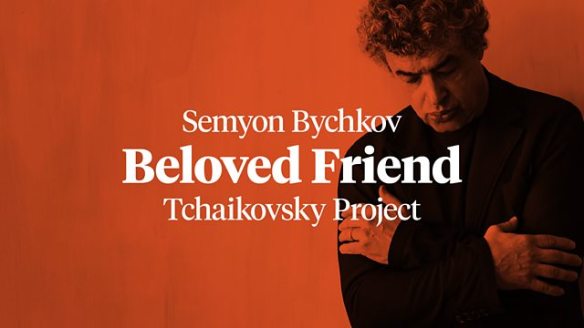
BBC Symphony Orchestra & Semyon Bychkov – Beloved Friend: Tchaikovsky Project

semyon-bychkov

Richard Whitehouse on the BBC Symphony Orchestra, conducted by Semyon Bychkov (above) in the second of their Tchaikovsky-themed concerts

Tchaikovsky Serenade for strings in C major, Op. 48 (1880)

Tchaikovsky Piano Concerto No.3 in E flat major, Op. 75 (1893)

Taneyev Overture: The Oresteia, Op.6 (1889)

Tchaikovsky Francesca da Rimini, Op. 32 (1876)

Kirill Gerstein (piano), BBC Symphony Orchestra / Semyon Bychkov

Barbican Hall, London; Monday 24 October

The Beloved Friend series being curated by Semyon Bychkov provides a revealing overview of Tchaikovsky through some lesser performed works. Not the least of which is the Serenade for strings that, though its individual movements emerge frequently on radio, is not so often encountered in concert. Too short to occupy a second or even first half, it makes for a lengthy yet viable opening item when, as tonight, a full-sized string section is deployed with panache.

Bychkov ensured a fervent response in the first movement, its animated main sections framed by the rhetorical motto theme that ultimately returns as an apotheosis, then found suavity as well as elegance in the Waltz. Despite lack of inwardness, the Elegy yielded real clarity in its denser passages, while the Finale proceeded briskly yet characterfully to its resolute close.

kirill-gersteinNext followed a rare revival of the Third Piano Concerto, itself reworked from an abandoned symphony and what would doubtless have become a three-movement entity had Tchaikovsky completed its Andante and Finale to his satisfaction prior to his death (these latter, as realized posthumously by Taneyev, make an effective whole – as Alexander Markovich demonstrated in a Royal Festival Hall account eight years ago).

As a stand-alone piece, the Allegro brillante (best known in its ballet incarnation by George Balanchine) unfolds a quirky and characterful sonata design – its themes distinctive for their emotional restraint, with a stealthy interplay between piano and orchestra that Kirill Gerstein (above) audibly relished. Momentum faltered marginally after a scintillating cadenza, but the final pages strode onwards to a decisive if peremptory ending.

Overall, a convincing account of music which warrants greater exposure. Hopefully Gerstein will yet tackle this work’s three-movement incarnation: for now, he returned for a reading of Méditation – the fifth of Tchaikovsky’s Op. 72 collection – that oozed eloquence and poise.

More discussed than played in the West, Sergey Taneyev was as least as much a composer as pedagogue; a notable output of orchestral and chamber music capped by his ambitious opera The Oresteia. Beginning life as this latter’s introduction, the present overture expanded into an autonomous entity that surveys the opera’s dramatic content and is an eventful symphonic poem in its own right. Its complementary halves representing an archetypal ‘war and peace’ in dramatic as well as musical terms, the piece is harmonically questing and often texturally adventurous – not least in its extensive though never self-conscious writing for harps. Some 15 years after Taneyev last enjoyed a fair measure of exposure in London, Bychkov directed a fastidious performance to remind listeners that they are the poorer for this music’s neglect.

Even in an era intent on ‘concerto and symphony’ programming, Tchaikovsky’s Francesca da Rimini has never lacked for performances – this symphonic fantasia mingling drama with pathos to a heady degree even for this composer. Bychkov accordingly upped the ante in the tempestuous opening, then secured a suitably rapt response from woodwind and strings in the central section depicting Paolo and Francesca. Its balletic continuation drifted as is often the case, but the final pages portrayed the hapless lovers’ descent into hell with unerring ferocity.

Recorded by BBC Radio 3 for future broadcast in Afternoon on 3, and available for 30 days thereafter via the Radio 3 website

BBC Proms 2016 – Pekka Suusisto, Thomas Dausgaard and the BBC Scottish Symphony Orchestra

Pekka Kuusisto High Res 6 - credit Maija Tammi

Pekka Kuusisto (c) Maija Tammi

Prom 27; Royal Albert Hall, 5 August 2016

You can watch this Prom from its BBC broadcast – the Grime and Tchaikovsky here and the Stravinsky here

For sheer musical enjoyment this Prom took some beating.

Right from the start it was clear the players of the BBC Scottish Symphony Orchestra were at the Royal Albert Hall to enjoy their Friday night, and in Pekka Kuusisto they had a more than willing accomplice.

It was Kuusisto’s first appearance at the festival, and as he arrived onstage he gazed in wonder at the full hall, taking in its scope and bidding a cheery ‘hello’ to the front ranks of the Prommers. At that moment you sensed his performance, even before he played a note, had gone up a gear.

Sure enough, his performance of Tchaikovksy’s Violin Concerto was dazzling, but he was careful not to let technical feats overshadow the core of the music’s emotion. As the longer first movement unfolded so did the ardent, lyrical phrases, until we reached the solo cadenza, where just a flick of the eyes and arms were enough to get the audience laughing. Kuusisto plays a lot of his music as though for the first time, the childlike innocence (not to mention his boyish face!) a combination of pure enjoyment. The audience, wrapped up in the occasion, applauded as though he had finished, fully aware there were two more movements to come.

These were the doleful Canzonetta, reminding us of the serious circumstances in which the piece was composed (Tchaikovsky’s disastrous and shortlived marriage, made in spite of his convictions around his homosexual orientation) and a finale that brushed all that aside, its main tune from the violin scampering all over the orchestra as they tried to keep up.

Both violinist and orchestra rightly received a rapturous ovation, but Kuusisto was not done, returning for a traditional Finnish song. Following Sol Gabetta’s lead from the First Night he did the singing, while BBC SSO leader Laura Samuel gamely added a rustic accompaniment. Even the audience were involved, singing one of the phrases as Kuusisto brought the house down.

Even after that the enjoyment was yet to peak, for Thomas Dausgaard – who had shaped Tchaikovksy’s phrases rather beautifully – led them in a vibrant account of Stravinsky’s Petrushka. The composer’s second ballet is perhaps his most tuneful, full of Russian folk song references as it tells the tale of the ultimately doomed puppet. The colours of this performance were given by the BBC SSO at their very best, with superb contributions from Mark O’Keeffe and Eric Dunlea (trumpets), a beautiful, child-like solo from flautist Charlotte Ashton, and wonderful contributions from solo woodwind, brass and percussion alike – not to mention the brilliant efforts of pianist Lynda Cochrane and Julia Lynch on celesta.

Dausgaard was enjoying himself, and although on occasion the music was a little fast it was never less than energetic, the players relishing the shades of colour in The Shrovetide Fair, and the irresistible hooks and dance rhythms Stravinsky threads through the music.

Dausgaard is due to take over full time as chief conductor of the orchestra in the autumn, and on this evidence the two look set for a fruitful musical relationship.

eardleyCatterline in Winter (c) The estate of Joan Eardley.

Beginning the concert was the first part of Helen Grime’s Two Eardley Pictures, a new piece commissioned by the BBC and with its second part today. This one, Catterline in Winter, portrayed the fishing village of the North of Scotland, capturing it in steely, metallic colours – reflecting the dark grey sky and the icy blasts of a seemingly ever present wind. It is always difficult to appraise a new piece on first hearing, but this was an impressive and brightly lit score that is well worth hearing for a second time – preferably in the company of the second, Snow.

Ben Hogwood

BBC Proms – Of Land, Sea and Sky…

prom-15

Andrew Davis conducting the BBC Symphony Chorus and Orchestra

(c) Chris Christodolou

Prom 15; Royal Albert Hall, Tuesday 27 July 2016

Tchaikovsky The Tempest (1873)

Anthony Payne Of Land, Sea and Sky (2016) [BBC commission: World premiere]

Bruch: Violin Concerto No. 1 in G minor (1866) (Ray Chen, violin)

Vaughan Williams Toward the Unknown Region (1906)

The focal point of this evening’s Prom was a first hearing for Of Land, Sea and Sky, the latest work from Anthony Payne and a BBC commission to mark his 80th birthday in a week’s time.

Taking its departure from a description of white horses in the Rhône Valley as they seemed to merge into the surrounding water, this piece comprises eight continuous sections in which the relationship between image and illusion is considered from numerous perspectives.

Payne evidently looked at various texts before deciding to write his own: what resulted is functional in the best sense, each of the choral sections conveying its appropriate imagery without any superfluous literariness. Choral writing is less certain in that it often feels more of a textural gloss on, than integrated into orchestral writing whose clarity and resourcefulness continues from Payne’s previous large-scale works; indeed, the piece as a whole seems to unfold as a sequence of variations on the motifs set out in the opening pages, with an orchestral postlude effecting a final synthesis as the very notion of illusion is rendered in suitably elusive terms.

Of Land, Sea and Sky is typical of Payne in that its approachable (and recognizably English) while never derivative idiom is likely to yield any number of subtleties on repeated hearings. The present performance seemed an assured one, Andrew Davis securing a committed response from the BBC Symphony Orchestra and Chorus in music whose intricacy benefited from the cushioning resonance of the Albert Hall acoustic. This also marked the fourth Proms collaboration between conductor, orchestra and composer, and will hopefully not be the last.

The programme had opened with a hearing for The Tempest, Tchaikovsky’s still relatively unfamiliar symphonic fantasy inspired by, yet by no means indebted to Shakespeare’s play. The framing seascape music, with its sombre horn writing, resonates long after the music has ended, and if what comes in-between – notably the eloquent but unmemorable ‘love’ theme – finds the composer at less than his best, this was perhaps reinforced by a reading that lacked nothing in cohesion without sustaining a cumulative momentum across the piece as a whole.

After the interval, Ray Chen made his much-heralded Proms debut with Bruch’s First Violin Concerto. A little histrionic, the preludial first movement was vividly and at times ardently projected, with a heightened transition into an Adagio whose fervency was purposefully held in check. Nor, other than a slightly hectoring edge in passagework, was there much to fault in the final Allegro; despatched with a flamboyance continued in the encore – Paganini’s 21st Caprice in A, which provided ample means for Chen to display his meaningful virtuosity.

The concert ended with a welcome revival for Vaughan Williams’s Toward the Unknown Region, the composer’s first major success and a piece whose impression is greater than its modest length. If the rapt inwardness of the first half feels more successful than the fervency of what follows, Davis ensured a cumulative tension such as made the final pages – the BBC Symphony Chorus giving its all and the Albert Hall’s organ enhancing the resplendence – a fitting testimony to Walt Whitman’s conviction as to the soul’s tangibility in death as in life.

Richard Whitehouse

The 2016 BBC Proms are go! Here’s what happened in Prom 1…

proms-2016

The national flag of Argentina waves in response to Sol Gabetta‘s account of the Elgar Cello Concerto

(c) Ben Hogwood

The BBC Proms are go!

The 2016 season is underway, and in a packed Royal Albert Hall this evening we were treated to the first of 75 Proms. As is traditional Sakari Oramo and the BBC Symphony Orchestra gave us a flavour of the season, but also a substantial second half in the form of Prokofiev‘s cantata and film score, Alexander Nevsky.

To begin, a sad reflection of the world’s troubles could be keenly felt in La Marseillaise, the Proms showing solidarity with France after the horrors in Nice. After such an event music can feel inconsequential but it can also bring people together and provide some sort of comfort – and in the big, swooning tunes of Tchaikovsky‘s Romeo and Juliet Oramo provided just that. The woodwind chorale on the approach to the end was particularly moving.

Sol Gabetta then stamped her own personality on Elgar‘s Cello Concerto, taking a few liberties with the tempo – but none of these were for personal gain, rather reflecting her own interpretation of the music. The pauses at the end of some of Elgar’s phrases were unexpected but profound, while the silvery accompaniment of the BBC SO spoke of Autumn rather than our supposed high summer. Gabetta’s encore, Dolcissimo by the Latvian composer Peteris Vasks, found her singing as well as playing cello, reducing the Royal Albert Hall to reverent silence.

Things got even colder for Prokofiev‘s film score Alexander Nevsky, though there were thrilling moments when the massed choir of the BBC National Chorus of Wales – just over 200 in all – let rip. The basses reached their lowest notes with commendable accuracy, while the Battle On The Ice, where Nevsky faces his German and Estonian foes, was thrilling and immediate.

Yet the show was stolen by Olga Borodina, the Russian mezzo-soprano ghosting onto the stage for a keenly felt account of The Field of the Dead near the end. Her emotion was first hand, and Oramo’s sensitive hand on the tiller encouraged a similarly heartfelt response from the orchestra.

It was a concert that bodes well for the season – and this year Arcana is planning two different approaches to its coverage of the BBC Proms. There will be a few straight ‘reviewed’ concerts, but the focus of our coverage will be on taking people to the Proms who have not been before. To that end our reviews of Proms will not be by experts, rather by first-time punters chosen from a pool of friends and contacts. Further to that, all reviews will be from the Arena, which is the ultimate Proms experience – and which to my knowledge is the best place for sound quality, let alone atmosphere.

No other source reviews from here as far as I am aware…so stick with Arcana in the weeks ahead, particularly through August. I can assure you we will be bringing classical music to new audiences on a weekly basis!

Ben Hogwood

Wigmore Mondays – Michael Collins and the Borodin String Quartet play Mozart

borodin-quartet

Michael Collins (clarinet) and the Borodin String Quartet (above) (Ruben Aharonian and Sergei Lomovsky (violins), Igor Naidin (viola), Vladimir Balshin (cello)

Wigmore Hall, London, 25 April 2016

written by Ben Hogwood

Audio (open in a new window)

http://www.bbc.co.uk/programmes/b07866f4

Available until 24 May

What’s the music?

Tchaikovsky, arr. Rostislav Dubinsky – Album d’enfants, Op.39 (1878) (29 minutes)

Mozart – Clarinet Quintet in A major, K581 (28 minutes) (1789)

Spotify

In case you cannot hear the broadcast, recordings of the music played can be found on the Spotify playlist below, including a recording of Rostislav Dubinsky’s arrangement:

About the music

Tchaikovsky’s Album d’enfants follows in the footsteps of Schumann’s collection for piano of the same name, yet this set of 24 piano miniatures is designed to be played by children as well. It includes dances, children’s pieces, portraits and flights of fancy, with most pieces little more than a minute and a half in length.

In it the composer allows his inner child to run free, in the same manner it was to do later in life in the ballets The Sleeping Beauty and The Nutcracker. This arrangement for string quartet was made by the Borodin String Quartet’s previous first violinist, Rostislav Dubinsky.

michael-collins

Clarinetist Michael Collins

Mozart’s Clarinet Quintet is probably the best known work for the combination of clarinet and string quartet, and it was written late in his life – 1789 – for the clarinettist Anton Stadler. It is written in A major, the same key the composer was to use for his final orchestral work, the Clarinet Concerto, and is notable for its sunny mood.

Performance verdict

This was a charming concert, though the Borodin String Quartet did take quite a serious approach to even the most infantile of Tchaikovsky’s character pieces. They were effective in their arrangements, and the quartet played with charm, delicacy and poise.

The Clarinet Quintet enjoyed a similar performance – serious but enjoying the work’s abundance of melody, although the decision not to employ the repeats Mozart marks in the first two movements changed its dimensions rather. Michael Collins was a good match, allowing himself a freer rein at times in the solo part, and while the quartet and clarinettist did not exchange much in the way of glances during the performance, theirs was an account notable for its unity. When played as beautifully as it was here, the Clarinet Quintet is as vivid an evocation of spring as you could wish to hear!

What should I listen out for?

Tchaikovsky

1:20 Morning prayer a charming, contented slow piece

2:42 A Winter morning – quite a blustery one by the sounds of it! Quicker interplay between the instruments

3:32 The Hobby-Horse – a quick portrait of a horse that seems to be difficult to capture!

4:17 Little Mother – soft and reassuring music that speaks of safety and warmth

5:55 March of the Wooden Soldiers – the title sounds like something out of The Nutracker, and the tune is similar. A crisp march.

6:49 The Sick Doll – the mutes are on for this fragile, mournful portrait, which sinks despondently into its minor key.

8:20 The Doll’s Funeral – the doll has now died, and this movement marks its passing with plaintive pizzicato.

9:49 The New Doll – the funeral has passed and a relatively quick and brief waltz, the face of the new doll lifts the mood from the doldrums.

10:29 Old French Song – A solemn piece, but with elements of warmth too. A beautifully scored movement, this has a lovely unison between first violin and cello.

11:48 German Song – this cheery dance has a jagged rhythm and opens out into quite a knees-up! The viola (I think) can be heard tapping its strings rhythmically half way through.

13:00 Italian Song – this has a lovely warmth, and the full part writing allows us to hear a lovely, rich quartet sound, with the cello plucking underneath.

14:15 Neapolitan Song – here the peasant is playing a form of concertina – and it sounds a lot of fun from the cello plucking and the sprightly tunes from the quartet!

15:24 Waltz – this has a lovely, simple tune for first violin, with the other instruments mostly off the beat.

16:52 Mazurka – a grand introduction from the cello with multiple stopping (playing more than one string at once), taken over by the violin

18:10 Polka – a charming, brief dance, lively and with some imaginative violin harmonics at the top end.

19:21 Russian Song – a solemn intonation from each instrument in turn, taking on the form of a canon but then settling to a relatively calm finish

20:21 The Peasant Plays His Ziehharmonika­ – the instrument effectively portrayed here is the concertina, the quartet playing as one.

21:05 Popular Song (Kamarainskaya) – this is brilliantly sent up by the violin especially, with squeaky high harmonicas like an old creaking chest of drawers

22:28 Sweet Dreams – a sentimental tune where Tchaikovsky allows some indulgence

24:43 The Old Nurse’s Tale The scratchy strings here give a lovely impression of old age, and the tale itself is lightly humorous.

25:40 The Witch: Baba-Yaga Even more scratchy is the old witch, played with the bows right close to the finger board for a more scary sound.

26:22 Song of the Lark The lark makes a beautiful sound here, thanks to the first violin over warm string accompaniment.

27:52 The Organ-Grinder Sings – over the held chords of the organ the first violin sings in a rather small voice.

29:02 In Church – a solemn finish to the cycle, given by the quartet in very subdued and rather eerie tones.

Mozart

27:07 – the first movement (marked Allegro) begins with the strings, a restful series of chords that are actually the first theme, a support for when the clarinet rises through the texture. Then, a minute later, the clarinet enjoys a tune that rises through the texture, floating gracefully. At 30:06 Mozart develops his ideas, the main theme coming back at 31:18.

34:01 – the second movement is marked Larghetto. In the key of D major, it is notable for its restraint and beautiful, spaced out melody heard on the clarinet at the outset. The melody returns at 37:50 in an even softer guise, peaceful and rather moving.

40:44 – a stately Minuet for the third movement, led by the clarinet but egged on by the strings. Mozart includes two contrasting ‘Trio’ sections – the first in the key of A minor (42:01). The Minuet section is repeated at 43:59 before a second trio at 44:40, another graceful dance led by the clarinet. The Minuet returns for the final time at 47:00.

47:47 – the final movement consists of a perky theme from the strings, embellished by the clarinet – and then five variations on it. The first (48:36) gives the clarinet a free reign, the next (49:30) hands over the baton to the first violin in an energetic section. The third (50:25) moves into the minor key and a brief shadow falls over the music, before 51:36, where the clarinet joyously lets itself go in the fourth variation. Then the music pauses, almost in an operatic sense, with a complete freedom of tempo as the clarinet leads the movement towards a close – where the perky theme reappears (54:36).

Further listening

Having heard the Borodin Quartet in sympathetic versions of Tchaikovsky, it makes perfect sense to expand that to the composer’s three published string quartets, which are relatively rare in concert these days. They are extremely enjoyable works. The First is notable for its slow movement, the Andante cantabile, which Tchaikovsky arranged for string orchestra, while the Third is a particularly poignant piece of work. As a bonus the album below includes the Souvenir de Florence, the composer’s String Sextet: