Taking time to pay tribute to an old, sadly departed friend. Martyn Granville would have been 62 today, and I realised I had not yet dedicated music to him on these pages, for Martyn sadly left us in May 2014. Here is his favourite classical piece, the wonderful Fantasia on a theme by Thomas Tallis by Vaughan Williams, from a lockdown session revealing its emotive core:
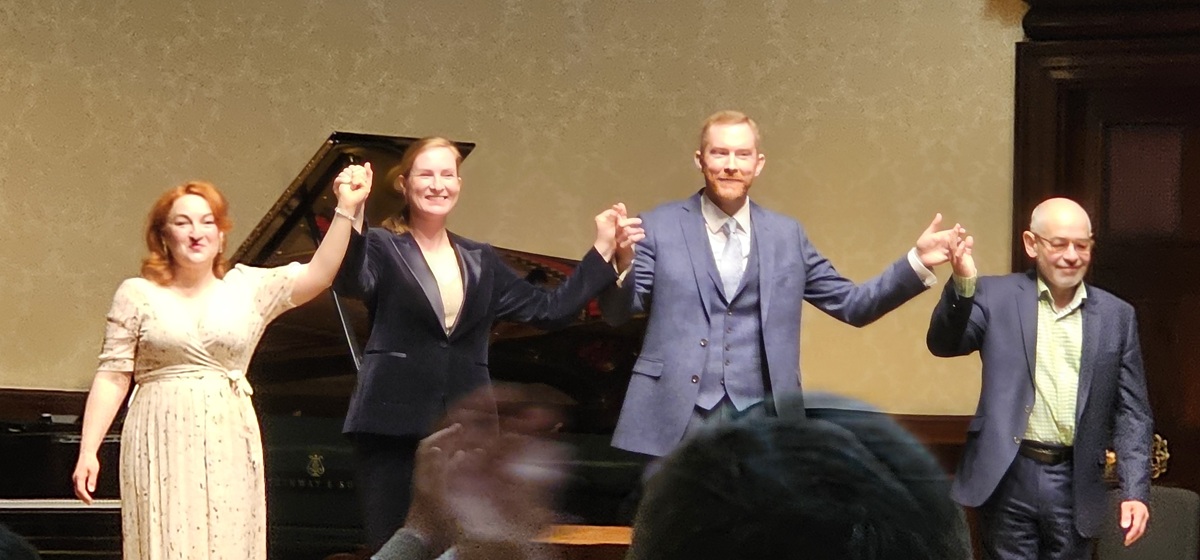
Ailish Tynan (soprano), Paula Murrihy (mezzo-soprano), Robin Tritschler (tenor), Iain Burnside (piano)
Boyle A soft day, thank God (1912); Looking Back: Carrowdore (1961-6); The Joy of Earth (1914); 2 Christmas Songs: Blyssid be the Tyme (1923-4); Himself and his Fiddle (1929); Have you news of my boy Jack (1916); Looking Back: O ghost, that has gone Vaughan Williams Orpheus with his Lute (1925) Boyle Looking Back: The mill-water Vaughan Williams The Water Mill (c1922) Maconchy Sun, Moon and Stars from Sun, Moon and Stars (1977) Boyle Spring goeth all in white (1924); A Song of Enchantment (1921-2) Wood The blackberry blossom (1897) Boyle Roses (1909) Wood Oh! Skylark, for thy wing! (1884) Boyle All Souls’ Flower (1928) Wood Darest thou now, O Soul (1897) Boyle The Last Invocation (1913)
Wigmore Hall, London Tuesday 9 March, 1pm
Reviewed by Ben Hogwood Photo (c) Ben Hogwood
“I think it is most courageous of you to go on with such little recognition,” wrote Vaughan Williams to his pupil, Irish composer Ina Boyle. “The only thing to say is that it does come finally.”
This Wigmore Hall concert gave the strongest possible proof of recognition at last for Boyle’s work, her songs brought to life by a starry cast of singers with pianist Iain Burnside. The program helpfully complemented her work with that of teacher Vaughan Williams, cousin by marriage Charles Wood, and good friend Elizabeth Maconchy.
The texts reflected a love of the outdoors, surely gained during her relative seclusion in home territory at County Wicklow, and also celebrated the season of spring, evident to all arriving at the Wigmore Hall for this lunchtime recital.
The brightly voiced A soft day, thank God, took us outdoors immediately, the ‘scent of drenching leaves’ and the rain that ‘drips, drips, drips from the leaves’ brought to life from Winifred M Letts’ words. They were sung with clarity by Robin Tritschler in the first verse and a brightly voiced Ailish Tynan in the second. Boyle’s songwriting is simple – not a criticism – and direct in its communication, reflecting the shy disposition of its composer but growing in assurance as her style developed.
This was evident in the selections from the song cycle Looking Back, with Carrowdore lost in thought through Paula Murrihy’s thoughtful account. The elusive and more playful O ghost, was laced with humour by Tritschler, while Murrihy’s full-bodied vocal was complemented by the flowing current of Burnside’s piano in The Mill Water.
The Joy Of Earth was noticeably more demonstrative, while Blyssid be the Tyme benefitted from both Tynan’s effortless projection and Boyle’s clean melodic line. Murrihy did extremely well with the wordy Himself and his Fiddle, accentuating the song’s folksy triple time with Burnside, while the brief but bright Robert Bridges setting, Spring goeth all in white, was beautifully phrased by Tynan.
Boyle’s inwardly facing songs were the most moving, notably A Song of Enchantment, a setting of De la Mare given mysterious light and shade from Tritschler, who held the stillness of twilight exquisitely as the shadows advanced. The tenor also kept the inner questions of Roses in a confidential tone, while Burnside’s wandering right hand line aided the wonder of All Souls’ Flower, where the three singers took a verse each. Most affecting of all Boyle’s songs here was a setting of Rudyard Kipling’s First World War poem, Have you news of my boy Jack?, Murrihy and Tritschler playing a tense scene of anxious questions, with answers that a mother dreaded to hear.
Vaughan Williams was represented by a beautifully sung account of Orpheus with his Lute from Tynan, then a vividly pictorial account of The Water Mill from Tritschler, where Burnside’s characterisations of the roaring waters, the ticking of the mill clock and the miller’s tabby cat were exquisite.
The composer Charles Wood, Boyle’s cousin by marriage, is known primarily for Anglican church music rather than exploits in the concert hall, so it was satisfying that the centenary of his death this year was marked with three characterful songs. Paula Murrihy worked wonders with another wordy composition, the frivolous The blackberry blossom, and with the serious tones of Whitman setting Darest thou now, O Soul. Tynan was in her element for the soft tones of Oh! Skylark, for thy wing!, Burnside allowing her room to spread her wings.
Elizabeth Maconchy nearly stole the show with Sun, Moon and Stars, a modern song of striking musical language reflecting the ‘new and strange’ of its first line. The top notes reached for celestial highs, and were found unerringly in an exceptional performance by Tynan.
Wrapping up a memorable hour of music was Boyle’s The Last Invocation, an impassioned setting of Whitman throwing open the doors with the strongest possible advocacy from Robin Tritschler. It completed a concert where the songwriting craft of Ina Boyle was confirmed beyond doubt, her voice at last projecting further afield.
You can listen to the music from this concert in a Tidal playlist, including songs by Ina Boyle recorded by the artists at the Wigmore Hall for Delphian in 2020.
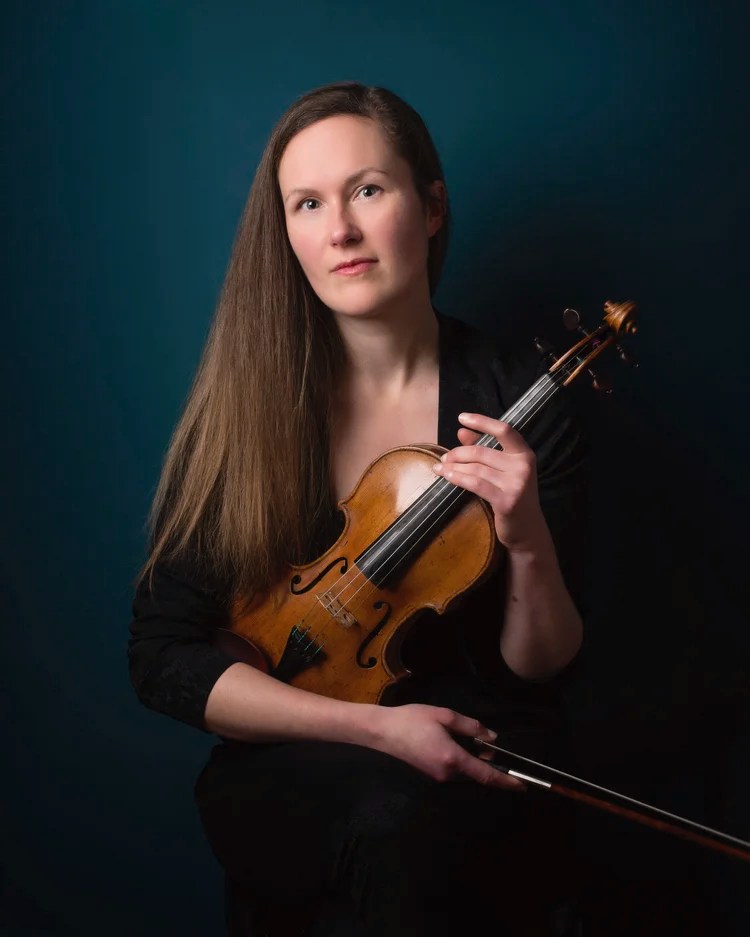
Zoë Beyers (violin, above), English Symphony Orchestra / Kenneth Woods
Vaughan Williams The Wasps (1909) – Overture Sawyers Symphony no.6 ‘A Pastoral’ (2022) [World Premiere] Elgar Violin Concerto in B minor Op.61 (1909-10)
Town Hall, Cheltenham Sunday 1 February 2026
Reviewed by Richard Whitehouse Photo of Zoë Beyers (c) Bill Leighton
This afternoon’s concert in the second season of its Cheltenham residency found the English Symphony Orchestra tackling, appropriately enough, an all-English programme; the Overture from Vaughan Williams’s incidental music to The Wasps being an ideal curtain-raiser with its interplay of incisiveness and eloquence ideally judged. The performance was enhanced by an unerring balance that allowed such as Rita Schindler’s dextrous harp playing to register with real clarity. Hopefully the whole suite will appear at an ESO concert sometime in the future.
The music of Philip Sawyers has appeared frequently on ESO programmes this past decade, with his Third Symphony launching the orchestra’s 21st Century Symphony Project back in 2016. A decade on bought the premiere of his Sixth Symphony – less epic in scope than the Third or Fourth in this cycle and without the searching ambiguities of the Fifth, but a piece whose modest length (30 minutes) or forces (double woodwind, horns and trumpets) likely belie the emotional range of what is being played out across these four compact movements.
Its subtitle evidently an afterthought, ‘A Pastoral’ deftly characterizes this symphony audibly influenced by if never beholden to that by Beethoven. Hence the opening Moderato implies a journey whose destination seems at best uncertain, its accumulating tension carried over into an Andante where scenic aspect is countered with more subjective preoccupations. Nor is the Allegro of an unchecked jollity, the insistent rhythmic profile accumulating an impetus such as takes on more elemental qualities in its visceral latter stages. The final Allegretto surveys all that went before (whether motivically or emotionally) through a process of clarifying and honing earlier ideas towards an ending which, with its evocation of birdsong, affords closure but not catharsis. An ambivalence Sawyers will hopefully address in his Seventh Symphony.
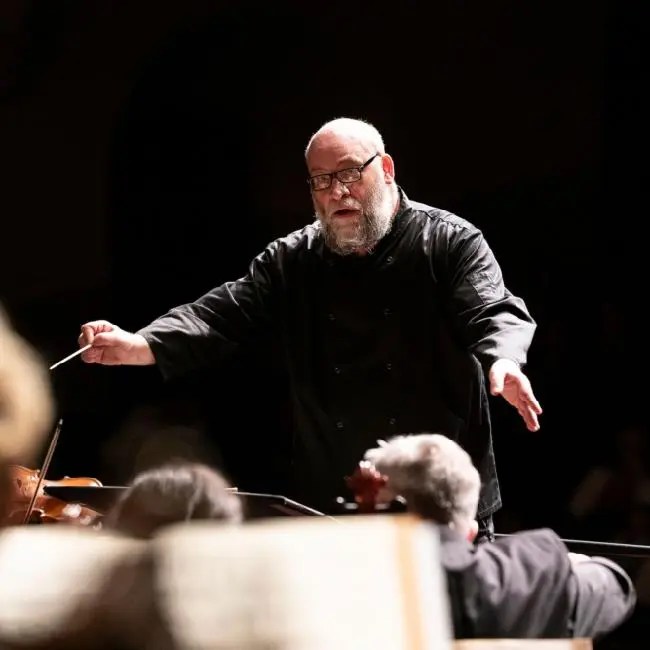
Assuredly directed by Kenneth Woods (below), this first performance was almost all that could have been wished as to accuracy of ensemble or interpretive insight. Good to hear it was recorded for future release, and hopefully Sawyers’s Sixth will receive more hearings before too long.
After the interval, Zoë Beyers repeated what was a well-received account of Elgar’s Violin Concerto from last year’s Elgar Festival. With its opulent scale and solo part that had been conceived for Fritz Kreisler, this could never be other than a testing proposition but Beyers succeeded admirably in conveying that formal intricacy and expressive force which typify this work. The opening Allegro was rarely other than cohesive, thanks not least to Woods’s astute accompanying, and the Andante radiated an emotional warmth with no risk of undue emoting. Beyers had the measure of the lengthy finale, duly coming into her own with that accompanied cadenza such as reviews previous themes at an emotional remove and whose ambivalence resonated long after activity had been resumed on the way to a decisive close.
An engrossing performance which concluded this concert in impressive fashion. Woods and the ESO return to Cheltenham Town Hall next month with a new piece by David Matthews, alongside Mozart’s Sinfonia Concertante (for strings) and Beethoven’s Seventh Symphony.
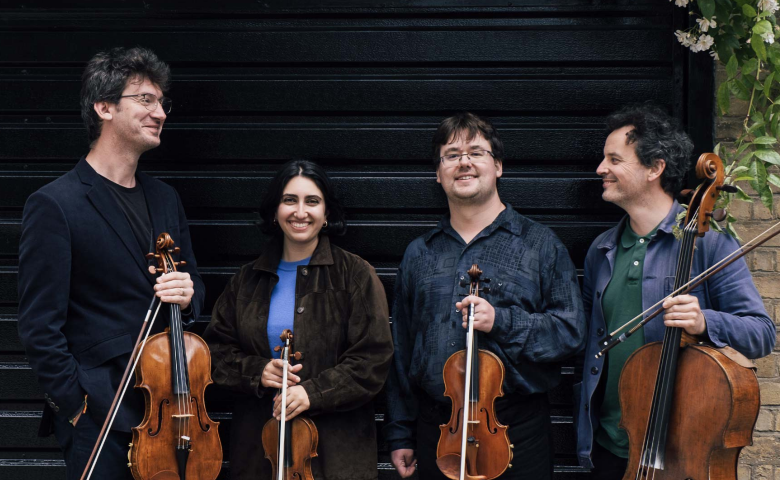
Gwilym Bowen (tenor), Gareth Brynmor John (baritone), William Vann (piano), Navarra Quartet [Benjamin Marquise Gilmore, Eva Aronian (violins), Sascha Bota (viola), Brian O’Kane (cello)]
Venables Out of the Shadows Op.55 (2023) Vaughan Williamsarr. Vann Fantasia on Greensleeves (1934) Vaughan Williams On Wenlock Edge (1909) Vaughan Williams Love Bade Me Welcome (1911) Venables Portraits of a Mind Op.54 (2022) Howells An Old Man’s Lullaby (1947)
The Temple Church, London Tuesday 4 November 2025
Reviewed by Richard Whitehouse
The emergence of Ian Venables as the leading British art-song composer was suitably marked with a 70th-birthday concert, sponsored by the Morris-Venables Charitable Foundation under the auspices of Temple Music Foundation and held in the evocative setting of Temple Church.
Song cycles being at the forefront of Venables’s output, it made sense to start with one of his most recent – Out of the Shadows a wide-ranging overview of male love. From the coyness of Constantine Cavafy’s At the Cafè Door and the barbed humour of Horatio Brown’s Bored, this takes in the fleeting ecstasy of Cavafy’s The Mirror in the Hall and stark soulfulness of Alfred Tennyson’s Dark House, prior to the overt playfulness of John Addington Symonds’s Love’s Olympian Laughter and calm affirmation of Edward Perry Warren’s Body and Soul.
Affectingly sung by Gareth Brynmor John (above), it preceded likely the most influential such cycle in English. A. E. Housman may have disliked his settings, but Vaughan Williams always gets to the heart of the matter in On Wenlock Edge. Hence the volatile imaginings of its title-number or hymnic poise of ‘From Far, from Eve and Morning’, the brooding dialogue of ‘Is My Team Ploughing’ or nonchalant wit of ‘Oh, When I Was in Love with You’; reaching a climax in the innocence to experience of ‘Bredon Hill’, with ‘Clun’ ending the sequence in fatalistic repose.
Gwilym Bowen gave a searching account of this cycle (doubly so having replaced Alessandro Fisher at such short notice), with Brynmor John comparably attuned to the understatement of George Butterworth’s Love Blows as the Wind Blows. These settings of W. E. Henley amount to a cohesive yet subtly contrasted entity – the existential musing of In the Year that’s Come and Gone followed by the deadpan charm of Life in Her Creaking Shoes and effervescence of Fill a Glass with Golden Wine, then On the Way to Kew brings a close of deftest poise.
Bowen duly tackled a further Venables cycle. Written to commemorate the 150th anniversary of Vaughan Williams’s birth, Portraits of a Mind is a notably inclusive one of the composer. Hence the gentle pantheism of George Meredith’s The Lark Ascending and the meditation on creativity of Ursula VW’s Man Makes Delight His Own; the engaging impetus of R. L. Stevenson’s From a Railway Carriage a perfect foil to the resignation of Christina Rosetti’s Echo, before lines from Walt Whitman’s A Clear Midnight conjure a warm transcendence.
Throughout these performances, the playing of the Navarra Quartet (above) evinced an incisiveness and eloquence always at the service of this music; William Vann’s attentive pianism astutely deployed in his appealing arrangement of VW’s Fantasia on ‘Greensleeves’. Brynmor John opened the second half with that composer’s disarming take on George Herbert’s Love Bade Me Welcome (first of Five Mystical Songs), with both vocalists heard to advantage in An Old Man’s Lullaby – Herbert Howells’s setting of Thomas Dekker that made for a winsome envoi.
Taken overall, this was a wholly pleasurable evening and welcome confirmation of Venables’ creative prowess – his corpus of songs or song-cycles surely second to none among those for whom the English language is a source of never-ending and always unexpected possibilities.
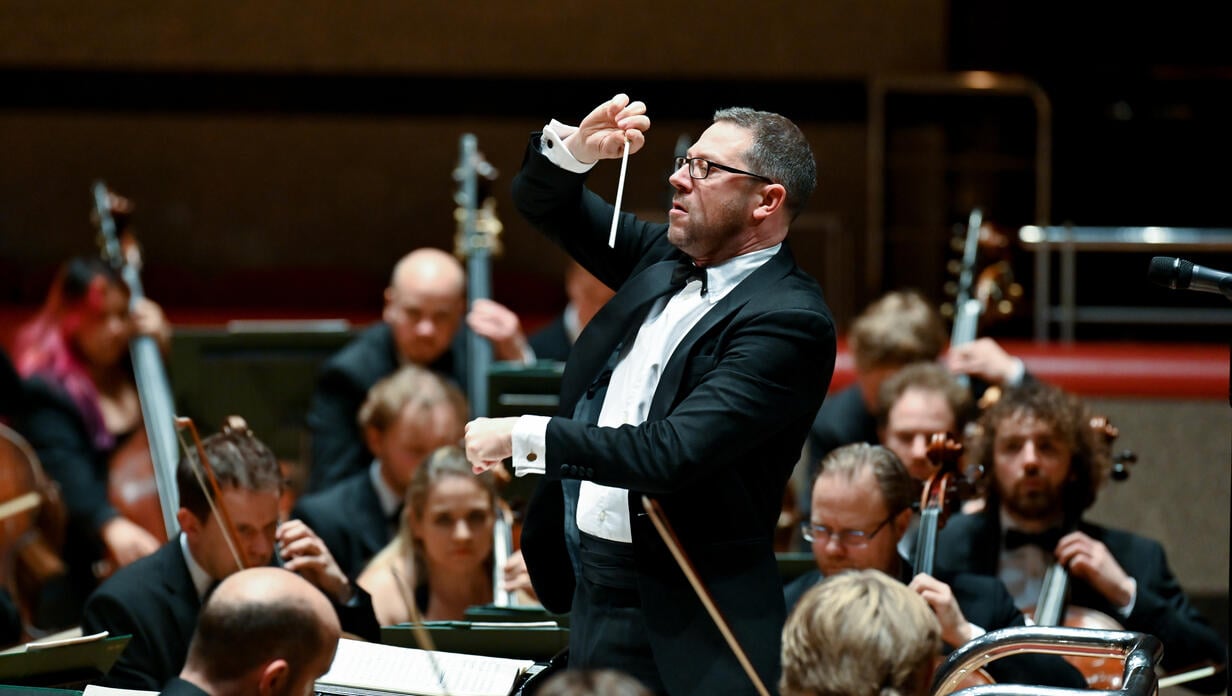
Laurence Kilsby (tenor), Christopher Parkes (horn), Sinfonia of London / John Wilson
Vaughan Williams Fantasia on a Theme by Thomas Tallis (1910) Britten Serenade for Tenor, Horn and Strings Op.31 (1943) Bliss Music for Strings B66 (1935) Delius arr. Fenby Late Swallows (1916, arr. 1962) Elgar Introduction and Allegro Op.47 (1904-05)
Barbican Hall, London Wednesday 22 October 2025
Reviewed by Richard Whitehouse
One can only commend John Wilson and Sinfonia of London for, in addition to an ambitious recording schedule for Chandos, frequently taking its programmes on tour – as has been the case with this judicious selection of works for string orchestra tonight being heard in London.
There could hardly be an acoustic less suited to Vaughan Williams’s Tallis Fantasia than that of Barbican Hall, yet Wilson went a good deal of the way toward making it succeed by having the main string body – and solo quartet – to the front of the platform with the subsidiary group arrayed along its rear. The outer section were taken slowly and almost impassively, but there was no lack of impetus or fervency as the central phase built cumulatively towards its climax.
The relatively modest number of strings seemed ideally suited to Britten’s Serenade. Laurence Kilsby (who made a fine contribution to Bliss’s The Beatitudes at this year’s Proms) brought real tenderness to Pastorale and ardour to Nocturne, while Christopher Parkes was suitably plangent in Elegy and dextrousness itself in Dirge. Tenor and hornist joined delightfully in Hymn, then Wilson drew playing of fastidious poise in Sonnet. Just a little unsteady in the Prologue, Parkes excelled in the offstage Epilogue with its ethereal reprise of that opening music – so rounding off a performance that proved affecting and unaffected in equal measure.
Live and in the studio, Wilson has affirmed a commitment to the music of Bliss which could hardly have been more evident than in Music for Strings which formed the centrepiece of this concert. It had been written for the Vienna Philharmonic to premiere at the Salzburg Festival and, if its formidable technical demands no longer sound forbidding, there can have been few performances of this virtuosity or insight. Trenchant and impulsive, the opening Allegro was followed by an Andante whose sustained eloquence never excluded lightness of touch – with the speculative transition into the final Allegro as deftly handled as the Presto with which this work surges to its headlong close. Not merely a timely revival, this was no less a vindication.
Introducing this second half, Wilson had remarked how Delius’ music needs to be coaxed into yielding up its secrets as surely as it needs selling to the musicians. Late Swallows succeeded on both fronts. As arranged by Eric Fenby from the composer’s only mature string quartet, it takes its place among the latter’s most haunting evocations, and not least in a central section whose rapt intensity brought an emotional frisson that tangibly held its listeners spellbound.
Elgar’s Introduction and Allegro may, by contrast, be a piece that plays itself but it still calls for interpretive input of a high order. Wilson responded with an unusually swift reading such as emphasized its nervous intensity and often volatile changes of mood, though there was no lack of cohesion or underlying momentum in a performance that took such testing passages as the central fugato assuredly in its stride prior to a glowing apotheosis then decisive close.
A performance, moreover, as set the seal on a memorable evening’s music-making. All these pieces, save the Britten, have been recorded by Wilson and Sinfonia of London for Chandos, their advocacy of Bliss hopefully continuing well beyond this 50th anniversary of his death.
Click here to read Arcana’s review of English Music for Strings, the Chandos album containing the Bliss and Vaughan Williams works performed in this concert.


 Arcana.fm