BBC Proms #6 – BBC Philharmonic Orchestra / Sir Andrew Davis: Vaughan Williams & Tippett Fourth Symphonies

Prom 6 – BBC Philharmonic Orchestra / Sir Andrew Davis

Vaughan Williams Symphony no.4 in F minor (1931-4)
Tippett Symphony no.4 (1976-7)

Royal Albert Hall, London
Tuesday 19 July 2022

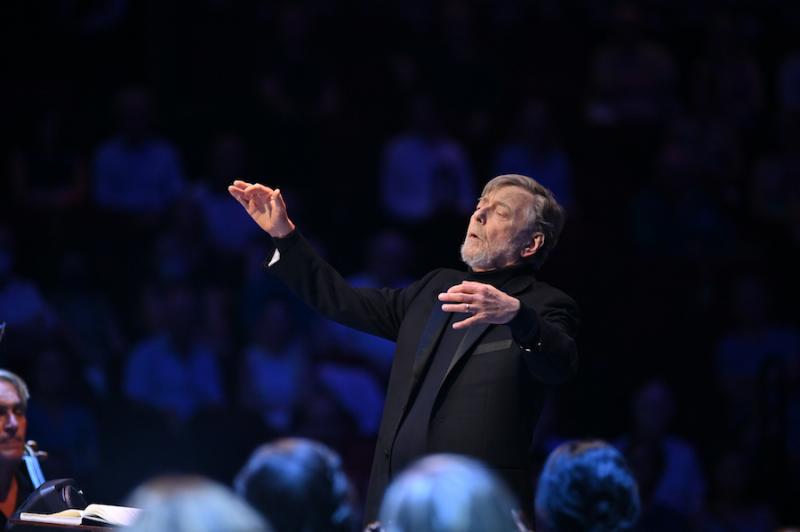
Reviewed by Richard Whitehouse Photo (c) Chris Christodoulou

Whether or not the Fourth Symphonies by Vaughan Williams and Tippett had previously been scheduled together, they made for a striking and provocative programme such as was its own justification. Omer Meir Wellber clearly thought so when this concert was planned and, even though indisposition had led to withdrawing from this year’s Proms, the presence of Sir Andrew Davis on the podium could hardly have been more conducive to the BBC Philharmonic Orchestra giving performances of the interpretive insight and technical conviction as were evident this evening.

Admittedly the Albert Hall’s opulent acoustic is never the best setting for VW4, the visceral impact of whose opening was inevitably diluted. Allowing for rather more expressive leeway than he might otherwise have done, Davis paced this explosive movement securely with just a slightly listless take on its coda detracting from the whole. The Andante was the highlight here – its fatalistic course exuding gravitas but never dragging, with the tritonal plangency of its main climaxes palpably in evidence and pathos of its final bars enhanced by an affecting contribution from flautist Alex Jakeman. This acoustic may have obscured something of the Scherzo’s contrapuntal ingenuity but not its sardonic humour or, in the trio, didactic coyness. The stealthy transition into the Finale could have had even greater cumulative focus, but what followed had all the requisite impetus – its central interlude raptly delineated, then the drama of its ‘epilogo fugato’ conveying increasing velocity through to the starkly inevitable return of the opening gesture and what is the most unequivocal four-letter ending of any symphony.

Interesting to recall the temporal distance between these pieces is now less than that between the Tippett and the present. Enthusiastically received at its Chicago premiere and one among a handful of his works still revived following his death, Tippett’s Fourth Symphony evinces  a ‘birth to death’ trajectory that differs – crucially so – from its assumed model of Sibelius’s Seventh in not being a cumulative design; its climax being rather the kinetic developmental paragraph at its centre and from where the piece fans out, in a sequence of evolving episodes, back to the launching of its introduction and onward to the passing of its coda. Although he may have directed performances of greater tautness, Davis here secured a persuasive balance between unity and diversity – bringing a metaphysical poise to its ‘slow movement’ then a deft whimsicality to its ‘scherzo’, whose respective qualities underlined the confrontational drama elsewhere. Lavish writing for brass and percussion helps makes this Tippett’s most virtuosic such statement, in which the BBC Philharmonic was rarely to be found wanting.

A less successful component of this reading was the latest attempt to represent the ‘breathing effect’ specified by the score, in which the real-time voice of CJ Neale seemed hardly more successful than those attempts of wind machine, sampler et al to realize Tippett’s speculative imagery. No matter – any such overreaching was part and parcel of this composer’s inherent ambition; an ambition, moreover, which his present-day successors would do well to emulate. Almost a century and half-century on, both these works pose challenges constantly to be met.

In concert – Zoë Beyers, English Symphony Orchestra / Kenneth Woods: Celebrating the Queen’s Platinum Jubilee

Beethoven Egmont, Op. 84 – Overture (1809-10)
Elcock Violin Concerto, Op. 13 (1996-2006) [UK premiere]
Vaughan Williams The Lark Ascending (1914/20); Symphony no.5 in D major (1938-43)

Zoë Beyers (violin), English Symphony Orchestra / Kenneth Woods

Routh Hall, Bromsgrove School
Friday 27 May 2022

There will be many concerts over the next fortnight celebrating Queen Elizabeth II’s Platinum Jubilee, but few (if any) of more substance than that given tonight by the English Symphony Orchestra with its principal conductor Kenneth Woods, taking place on the attractive campus of Bromsgrove School some miles from Birmingham.

It might not have been written for this occasion, but the Violin Concerto by the ESO’s current composer-in-association Steve Elcock (above) was no less impressive for that. This marks something of a transition from those less ambitious pieces written for local musicians and the symphonic works now being recorded to great acclaim. It opens with an Allegro vivo whose rhythmic energy is maintained throughout, yet with enough expressive contrast for its second theme to assume greater expressive emphasis in the reprise. The highlight is a Molto tranquillo whose haunting main theme, initially unfolded by the soloist over undulating upper strings in a texture inspired by change-ringing techniques, is a memorable inspiration. A pavane-like idea later comes into focus and the closing stage, opening onto an eloquent plateau before evanescing into silence, lingers in the memory. The finale is a Passacaglia whose theme accelerates in five variations from Andante to Presto, culminating in a ‘cadenza’ for violin and timpani then a decisive pay-off.

A tough challenge, indeed, for any soloist and one which Zoë Beyers met with assurance over its 30-minute course. Aside from its sheer velocity the first movement is notable for a close-knit interplay between soloist and orchestra that was brought off with admirable precision, while the modal subtleties of the slow movement were rendered as enhancements to its overall tonal trajectory. Aside from a slight falling away of tension toward its centre, the finale saw the piece to a forceful close. Good to hear these performers recorded it prior to this performance, as a coupling to the Eighth Symphony that the ESO premiered last year, and which should be released over the coming months.

Beyers returned after the interval to launch a Vaughan Williams second-half (this year being the 150th anniversary of his birth) with The Lark Ascending. Easy to take for granted now that it is so frequently performed, the piece can still work its magic in an attentive rendering such as this. The underlying tempo might have been on the slow side, but the elegance and poise invested into the solo line were not to be gainsaid, nor was the translucency of orchestral textures which Kenneth Woods shaped with due restraint through the folk-like central section then into the easeful closing pages. Suffice to add that the unaccompanied final bars held those present spellbound with their artlessness.

There was at least as much to admire in the reading of VW’s Fifth Symphony which here followed on inevitably. A steady overall tempo for the Preludio did not exclude a palpable accumulation of energy in its development, nor a build-up of real fervency with the thrilling re-entry of its second theme. Understated it may be, but the Scherzo is replete with rhythmic quirks and while these were not always ideally negotiated, the music’s sardonic humour and ultimate evaporation were tellingly rendered. Doubtless this work’s emotional heart, the Romanza was admirably realized in its gradual coalescing of hymnal and folk-inflected elements towards a nobly wrought apex, but Woods kept enough in reserve so the final Passacaglia never risked becoming an anti-climax. It earlier stages conveyed  an emotional release as is countered by the ensuing anxiety then fateful reappearance of the work’s opening theme, subsiding into a coda which feels as much a benediction now as when it was first heard almost eight decades ago.

Beethoven‘s overture to Goethe’s Egmont might have seemed anomalous in this context but, as Woods pointed out in his opening remarks, the heroes and villains of 16th-century ‘Spanish Netherlands’ were not so far removed from those of today and, as the heady closing pages reminded us, triumph over adversity can never be taken for granted.

For further information on Steve Elcock, click here to visit his dedicated site, and for more on Vaughan Williams click here. To find out more about the artists, click on the names for more on Zoë Beyers, Kenneth Woods and the English Symphony Orchestra.

In concert – City of London Sinfonia @ Southwark Cathedral: Origin: This is CLS

cls

Monteverdi arr. Wick Toccata from ‘L’Orfeo’ (1607)
Vaughan Williams
Fantasia on a theme by Thomas Tallis (1910)
Tabakova
Frozen River Flows (2005)
Finnis
The Centre is Everywhere (2019)
Vasks
Music for the fleeting birds (1977)
Tabakova
Origin (2022) (world premiere)
Carter
A Fantasy about Purcell’s ‘Fantasia on one note’ (1975)
Tavener
The Hidden Face (1996)

Hugh Cutting (countertenor), Dan Bates (oboe), City of London Sinfonia / Alexandra Wood (violin)

Southwark Cathedral, London
Thursday 3 March 2022

Written by Ben Hogwood

When the young Richard Hickox assembled a performing group in 1971, his vision was an extended family of talented musicians coming together to project the enjoyment of their art onto their audience.

Just over 50 years on, Hickox may sadly no longer be with us but his vision, realised by the City of London Sinfonia, burns with an ever brighter flame. This celebration in Southwark Cathedral may have been a year late, due to the consequences of the pandemic, but it brought everything together in a programme blending the old with the new.

Great credit should go to the orchestra’s creative director and leader, Alexandra Wood, for choosing music that looked simultaneously forwards and backwards, while utilising the vast spaces offered by the cathedral in inspiring and imaginative ways.

The audience were free to roam around during the concert, which was a considerable plus, for acoustic hotspots could be found and exploited, while it was also possible to stand to one side in contemplation. The mood was relaxed but focused, with audience members chosing a mixture of both options. The only danger of this was unexpectedly finding yourself in front of a group of instrumentalists when they were about to play, meaning the focus would suddenly shift in your direction! This was a risk well worth taking, for the rewards were many.

Before the concert, the Dean of Southwark Cathedral, Andrew Nunn, spoke warmly of the power of music to soothe the fevered mind, giving the pertinent Biblical example of David’s harp curing Saul’s war-torn temper, illustrated vividly by a stained-glass window depiction at the back of the church. The parallels with Russia and Ukraine were unmistakeable, and before the programme started everyone stood for the Ukraine national anthem.

The programme itself began under that very window, with Stephen Wick’s excellent arrangement of the Toccata from Monteverdi’s L’Orfeo, the brass filling the cathedral from back to front with sonorous colours.

The baton then passed to the strings for an unforgettable account of Vaughan WilliamsFantasia on a Theme of Thomas Tallis. This work was written for performance in Gloucester Cathedral in 1910, utilising the space in imaginative ways – and the City of London Sinfonia responded in kind, with the work’s solo group in the round in the nave, and the main body of the strings in the centre of the church. This was a deeply emotive performance, finding the intersection between the old of Tallis and Vaughan Williams’ own sweeping melodies and added-note harmonies. In doing so a composition that is often overplayed gained fresh insight, and, for your reviewer standing at the back of the church, a magical experience.

British-Bulgarian composer Dobrinka Tabakova has a close association with the Sinfonia. Frozen River Flows, an earlier work from 2005, appeared here in an arrangement for clarinet and percussion which was played in the south transept. This brightly coloured piece found Katherine Spencer’s clarinet evoking graceful lines not dissimilar to Poulenc, complemented by the richness of the vibraphone and crotales (antique cymbals), expertly managed by Chris Blundell.

We also heard Tabakova’s music in the world premiere of Origin, written for this concert. It was a brief but meaningful celebration placing violin soloist Alexandra Wood in the nave, with the accompanying musicians under the tower. Wood’s role was that of virtuoso, but she managed it carefully so that slower contributions from the strings and vibraphone were ideally balanced. Tabakova has a talent for the immediate creation of an atmosphere, and this may have been a relatively minimal piece but it left a lasting impression.

Complementing this was another work in the round of the nave, as 12 string players assembled for Edmund Finnis’s The Centre is Everywhere. This was a wholly appropriate choice, the soloists creating unusual and original sounds. On occasion the music swelled like the bellows of an accordion, then subsided to a barely audible whisper, then appeared to be reaching beyond the cathedral for the skies above. Finnis has an unusual and remarkable habit of writing music that becomes an out of body experience, and The Centre is Everywhere shows there is still so much more to achieve when writing for stringed instruments.

The programme turned to wind instruments for a timely reference to the troubles in Ukraine. Latvian composer Pēteris Vasks wrote Fleeting Birds in 1977 as an expression of his need for freedom. Restricted from travelling by the Soviet authorities, he made his feelings known through music. The City of London Sinfonia winds walked the length of the cathedral as they played, turning from joyous expressions of freedom and release to statements soured by compression, reflecting the composer’s earthbound plight.

Freedom lay in Elliott Carter’s Purcell Fantasy, richly expressed by the brass around a persistent middle C, before cutting without a break to John Tavener’s Hidden Face for a final contemplation. The stillness of this work is deceptive, achieved through great virtuosity from solo oboe and a countertenor, singing text written by Mother Maria. Oboist Dan Bates and singer Hugh Cutting were superb throughout, the latter floating his words effortlessly above the prayerful strings, whose sonorous tones were the ideal match for Bates’s keening oboe, which also scaled unfathomable heights with impressive ease.

It was a fitting way to finish a deeply felt concert and celebration, that of a performing group who continue to do their founder proud. Like their musical choices, the City of London Sinfonia look to the future, embracing new advances as well as nurturing past achievements while they do so. They deserve to continue as a treasured feature of the capital’s music making.

To read more about the City of London Sinfonia, visit their website – and for more on composers Dobrinka Tabakova and Edmund Finnis, click on their names

BBC Proms – Sayaka Shoji, RPO / Petrenko: Vaughan Williams, Respighi & Mendelssohn

vasily-petrenko

Sayaka Shoji (violin, below), Royal Philharmonic Orchestra / Vasily Petrenko (above)

Vaughan Williams Fantasia on a Theme by Thomas Tallis (1910)
Respighi
Concerto gregoriano (1921)
Mendelssohn
Symphony no.5 in D minor Op.107 (1830)

Royal Albert Hall, London
Wednesday 4 August 2021

Written by Ben Hogwood

A fascinating concert, notable on several counts. It marked the first Prom for Vasily Petrenko, recently transferred from Liverpool, in his new role as the Royal Philharmonic Orchestra’s music director. It featured three works paying tribute to a distant musical past – Vaughan Williams, Respighi and Mendelssohn expressing their admiration in very different ways. By way of an aside, it was your correspondent’s first live music in 17 months. A happy experience indeed!

In a sense my ears were in alignment with those who would have been at Gloucester Cathedral on 6 September 1910, for the world premiere of Vaughan WilliamsFantasia on a theme by Thomas Tallis. The Royal Albert Hall, in its current reduced capacity, offered a similar acoustic, suitable for a performance where the quietest statements could be clearly heard. In the wake of a pandemic, this was wholly appropriate music to be listening to.

The Fantasia is written for two string orchestras, the second of which, nine players strong, might normally be distributed high in the gallery. Here they were positioned on stage, upper left from the conductor’s viewpoint, and projected beautifully to the back of the arena. Petrenko did not linger over the serenity of the opening, but allowed Vaughan Williams’ invention plenty of space to breathe as the Fantasia formed. A sensitive audience ensured every little nuance could be heard, and the RPO strings – in particular the solo quartet within the main orchestra – played beautifully. Petrenko has recorded a good deal of Elgar with the Royal Liverpool Philharmonic, so it will be interesting to see if he decides to look at Vaughan Williams in equivalent detail.

There followed a Proms premiere of a work written 100 years ago. As David Gutman’s excellent programme footnotes pointed out, Respighi has not enjoyed good representation at the festival over the years, and in general his music still languishes in the repertoire. This first account of the Concerto gregoriano could hardly have been more persuasive, with a passionate advocate in violin soloist Sayaka Shoji, who quarantined on her arrival in the UK prior to this performance. Respighi was a violinist, writing with skill for the instrument, but chose not to use this concerto as a display piece. Rather he paid homage to the Gregorian chants with which he had had been preoccupied in recent years, and he used these as the basis for a piece containing some particularly lush harmonies and idiosyncratic rhythms.

This was a compelling performance, Shoji soon into her groove and leading with faultless intonation in the high passages of the slow movement, carrying beautifully into the wide open spaces of the hall. She was aided by the horns and trombones of the RPO, positioned along the back of the orchestra, the punctuation of harp and celesta adding glitter to the edge of the sound.

The first movement found nicely judged contributions from oboe (John Roberts) and cor anglais (Patrick Flanaghan), with a sheen from the strings not unlike that of the Vaughan Williams. The third movement presented faster music and a greater sense of drama from its main theme, the brass again involved. This pulled back to peaceful climes, and a recap of the second movement material. Concerto gregoriano was certainly a work benefiting from a live performance, deserving of a higher profile.

Shoji was a sensitive performer, allowing Respighi’s music star billing, a sign of her maturity as a soloist. She also chose a wholly appropriate encore, the soft pizzicato beginning the Sarabande from Ysaÿe’s Sonata for solo violin no.4 (À Fritz Kreisler) the only audible noise in a rapt hall.

Mendelssohn wrote his Reformation symphony in 1830, making it the second in his output chronologically, but it was not published until long after his death. He appears not to have been wholly satisfied with it, leaving it unperformed. It carries a powerful impact, anticipating Schumann’s own D minor symphony (no.4) while including the Lutheran chorale Ein feste Burg ist unser Gott (A mighty fortress is our God). In this the composer, perhaps inevitably, was including Bach in his homage.

Petrenko had the work’s measure, leading us straight into the ‘sturm und drang’ of the first movement with its grim, D minor struggles. They were captivating, especially at the end of the introduction when rapt strings introduced the ‘Dresden Amen’, a striking alternative to the flurry of activity around them. The second movement had an attractive lilt, the third a nicely poised subject, before flautist Emer McDonough gave an impeccable solo to lead us into the finale. It fell to her to present the chorale theme, taken up with greater number and power by the rest of the orchestra. The mood turned from struggle to victory. Petrenko’s pacing was ideal, as was the phrasing, while the final reverberations of the chorale were more than sufficient in lieu of an encore.

This was a very fine if slightly understated first Prom for the RPO conductor in his new role, bringing the ideal combination of new and familiar. The orchestra appear to be in very good hands.

You can listen to a playlist of the works featured in this concert, including the violin encore, on Spotify below:

You can find more information on the BBC Proms at the festival’s homepage

In concert – Jonathan Martindale, CBSO / Michael Seal: Summer Classics

michael-seal

Jonathan Martindale (violin, below), City of Birmingham Symphony Orchestra / Michael Seal (above)

Dvořák Carnival Op.92 (1891)
Vaughan Williams
The Lark Ascending (1914/20)
Elgar
Chanson de matin Op.15/2 (1889)
Grieg
Peer Gynt Suite no.1 Op.46 (1875/88) – no.1, Morning; no.4, In the Hall of the Mountain King
Mendelssohn
A Midsummer Night’s Dream Op.21 (1826)
Vivaldi
The Four Seasons Op.8 (1718/20) – no.2 in G minor RV315 ‘Summer’
Price
Symphony no.1 in E minor (1931-2) – Juba Dance
Tchaikovsky
The Nutcracker Op.71 (1892) – Waltz of the Flowers

Symphony Hall, Birmingham
Friday 2 July 2021 (2pm)

Written by Richard Whitehouse Photo of Jonathan Martindale courtesy of Upstream Photography

The penultimate event in the City of Birmingham Symphony Orchestra’s current season, this afternoon’s Summer Classics featured a wide-ranging selection of pieces that between them spanned over two centuries, and whose ‘feel good’ factor at no time precluded stylish or committed playing.

With longstanding associate director Michael Seal at the helm, the orchestra made the most of Dvořák’s effervescent Carnival overture; the alluring pathos of its central interlude accorded due emphasis, and with some eloquent woodwind solos. Its popularity during recent years has made Vaughan Williams’s The Lark Ascending a regular inclusion in such programmes, and Jonathan Martindale (below, who also led the concert) gave a thoughtful while never flaccid reading – most perceptive in the middle section with its folk-like whimsy and fanciful evocations of birdsong. The CBSO responded with limpid dexterity, the whole performance a reminder that this work is best tackled as a concertante piece and by a player (recalling such as Hugh Bean, Iona Brown and, more recently, Richard Tognetti) who knows the orchestra from the inside.

Next came an ingratiating take on Elgar evergreen Chanson de matin, then excerpts from the First Suite of Grieg’s incidental music to Peer Gynt – a rapturous Morning and stealthy In the Hall of the Mountain King skirting headlong terror at the close. Mendelssohn’s overture to A Midsummer Night’s Dream made for an unlikely but effective centrepiece – the highlight being those fugitive imaginings towards its centre, along with the disarming eloquence of its final bars where the teenage composer conjures a fulfilment he was only rarely to recapture.

The Summer concerto from Vivaldi’s The Four Seasons again saw Martindale as soloist in an account that lacked little of that rhythmic vitality his contemporaries (notably Bach) seized on with alacrity; nor was there any absence of poise in its atmospheric second movement. One who has come in from the cold partly through the recovery of her manuscripts, Chicago-based Florence Price broke with convention by introducing the Juba Dance into her symphonies in lieu of a scherzo; the CBSO responding in full measure to its rhythmic verve. A winning harp solo from Katherine Thomas launched Waltz of the Flowers from Tchaikovsky’s ballet The Nutcracker and ended the main programme in fine style – Seal and the CBSO acknowledging the applause with the final ‘galop’ from Rossini’s William Tell overture as a dashing encore.

Throughout the concert, film expert Andrew Collins interspersed proceedings with his remarks and recollections (not least on that seminal 1970s supergroup The Wombles). The music itself was accompanied by varying shades and colours of lighting, but these rarely seemed intrusive – not least compared to the garish ‘Moulin Rouge’ effects routinely encountered nowadays at the Proms. Certainly, anyone in the process of getting the know just what classical music was all about, and those merely in search of a pleasurable afternoon’s listening, were well served.

Next Wednesday brings the last in this current series of concerts, the CBSO being conducted by Joshua Weilerstein (who is replacing an ‘unable to travel’ Edward Gardner) in an enticing programme of Judith Weir, Prokofiev (with the violinist Alina Ibragimova) and Beethoven.

You can find information on the final concert in the CBSO’s season at their website. For more information on composer Florence Price, click here