On Record – Tippett Quartet – Vaughan Williams: String Quartets; Holst: Phantasy Quartet (Somm Recordings)

Tippett Quartet [John Mills, Jeremy Isaac (violins), Lydia Lowndes-Northcott (viola), Bozidar Vukotic (cello)]

Vaughan Williams String Quartet no.2 in A minor (1942-43)
Holst ed. Swanston Phantasy Quartet (1916)
Vaughan Williams String Quartet no.1 in G minor (1909)

Somm Recordings SOMMCD 0656
Producer Siva Oke Engineer Adaq Khan
Recorded 7-8 February 2022, St. Nicholas Parish Church, Thames Ditton

Reviewed by Ben Hogwood

What’s the story?

In case you have missed it, 2022 marks 150 years since the birth of Ralph Vaughan Williams. A great deal has been made of his symphonic and choral output, and rightly so, but an added benefit of such an anniversary is the chance to look at other relatively neglected corners of a composer’s work. Chamber music is one such area that is infrequently explored, and there are some fine works ready for reappraisal.

The two published string quartets sit as principal examples. The String Quartet no.1 in G minor was written in Paris, during a period of study with Ravel, and reflects new influences at work in 1909. A great deal of water had past under the bridge by the arrival of the String Quartet no.2 in A minor in 1942-43. Written for the composer’s friend Jean Stewart, who played viola in the Menges Quartet, it gives great deal of prominence to her instrument.

Complementing the quartets is the Phantasy Quartet by Gustav Holst, a close friend and confidante of Vaughan Williams for many years. Their mutual love of folksong is perhaps their strongest musical link, though as the quartet shows Holst had a different way of expressing his sources. Claiming the work was ‘insufficient’, the composer withdrew it some years after its first performance in 1917, though his daughter Imogen saw its worth and published a version for string orchestra. On this recording the Tippett Quartet use an edition made by Roderick Swanston.

What’s the music like?

The Vaughan Williams quartets are a complementary pairing, and although starting with the later work may seem a curious decision it makes good musical sense in the context of this recording.

As described above, the viola takes an assertive lead in the first movement of the String Quartet no.2, pushing the source material forward with silvery tones that nonetheless have a strong autumnal shade. The harmonic writing is shot through with an anxiety reminding us of this work’s position in the Second World War and its proximity to the Sixth Symphony, a powerful yet haunted work.  The solemn second movement is deepened further by an almost complete lack of vibrato, while the viola takes charge again in the ghostly third movement, with the other instruments muted. The prayerful finale offers some solace, referring to the reverent calm of the recently completed Fifth Symphony, but the end is still shrouded in uncertainty.

The String Quartet no.1 is often talked about in the same breath as Ravel, but Debussy and Borodin are notable influences here. After a tautly argued first movement, the Scherzo is particularly successful, its motif recurring with just the right degree of playfulness. The third movement Romance is lovingly rendered, while the finale has a great deal of positive energy, Vaughan Williams showing great agility in his writing for four instruments that often sound like a small string orchestra.

Holst’s Phantasy Quartet is beautifully judged, celebrating its folk sources but also throwing context of light and shade that reflect another time of uncertainty during the First World War. The work has more than a little in common with the celebrated St Paul’s Suite for string orchestra, moving between energetic tunes and more thoughtful episodes, where a shadow passes over the face of the music.

Does it all work?

It does. These are fine performances from the Tippett Quartet, who understand the emotional and often anxious pull of the second quartet. Its urgency is compelling, and the harmonic tensions are finely judged here. Meanwhile the compositional promise of the first quartet is clearly shown, with its rich melodic content and the vigorous exchanges of the outer movements, which are extremely well played. The Holst is affectionately given, the quartet revelling in the folk melodies but also the composer’s imaginative harmonies. Swanston’s version works extremely well.

Is it recommended?

Enthusiastically. There are already some fine recordings of the Vaughan Williams string quartets, but the Tippett Quartet join the very best with performances of spirit and deep feeling. The Holst is the ideal complement, and with excellent booklet notes (Robert Matthew-Walker) and a cover picture to match (Simon Palmer) this is one of the finest releases so far in the Vaughan Williams 150 celebrations.

Listen

Buy

You can listen to clips from the recordings and explore purchase options at the Somm Recordings website

In Memoriam Queen Elizabeth II

As a tribute to Queen Elizabeth II, here is a small part of the deeply meaningful music from her funeral service at Westminster Abbey this morning, which also included new works from Sir James MacMillan and the Master of the King’s Music Judith Weir.

Two English works, by Sir Hubert Parry and Vaughan Williams, are included below. My Soul There Is A Country is the first of six Songs Of Farewell by Parry, for unaccompanied choir, written towards the end of the First World War.

O taste and see is a short motet that Vaughan Williams completed in 1953 for the Coronation of Queen Elizabeth II. It is a short and beautiful piece:

BBC Proms at Birmingham – Claire Barnett-Jones & Simon Lepper in songs by Horovitz, Smyth, Clarke, Vaughan Williams & Wallen

BBC Proms at Birmingham – Claire Barnett-Jones (mezzo-soprano), Simon Lepper (piano)

Horovitz Lady Macbeth – a scena (1970) [Proms premiere]
Smyth Fünf Lieder, Op. 4 (c1877) [Proms premiere]
Clarke The Seal Man (1921-2) [Proms premiere]
Vaughan Williams Four Last Songs (1954-8) [Proms premiere of original version]
Wallen Lady Super Spy Adventurer (2022) [BBC commission: World premiere]

Bradshaw Hall, Royal Birmingham Conservatoire

Monday 29 August 2022, 1pm

Reviewed by Richard Whitehouse Photo (Claire Barnett-Jones) (c) Benjamin Ealovega

The series of regional lunchtime Proms this afternoon reached Birmingham for a song recital by Claire Barnett-Jones, whose success at last year’s Cardiff Singer of the World and having studied at Royal Birmingham Conservatoire made her appearance doubly apposite. Equally so the initial item by Joseph Horovitz, after his death in February at 96. Lady Macbeth – a scena revealed his more serious side – with monologues from the first, second and fifth acts of ‘The Scottish Play’ charting the anti-heroine’s journey from aspiration via ambition to desperation.

The music of Ethel Smyth has been a recurrent feature this season – the present set of Lieder a reminder that, before she achieved fame with The Wreckers and notoriety as a suffragette, she had received a thoroughly Teutonic musical education in Leipzig. Fluent and idiomatic, these five settings are fluent and idiomatic: the enervation of Büchner’s Tanzlied followed by the wistfulness of Wildenbruch’s Schlummerlied and eloquence of Eichendorff’s Mittagsrum, then the assertiveness of Groth’s Nachtreiter and transcendence of Heyse’s Nachtgedanken.

Barnett-James rendered them with sensitivity and insight, with Simon Lepper (above) no less attuned to those most often intricate accompaniments. Qualities equally evident in Rebecca Clarke’s luminous setting of Masefield’s evocative if rather prolix The Seal Man as well as Four Last Songs that Vaughan Williams set to texts by his second wife, the poet Ursula Wood. From the fatalism of The Death of Procris, via the acceptance of Tired and the poise of Hands, Eyes and Heart, to the fulfilment of Menelaus – these are songs which speak of a life well-lived.

A very different take on the journey from innocence to experience is proffered by Lady Super Spy Adventurer, written by Errollyn Wallen for this recital and which might be described as a ‘concert aria’ in that its highly visual – and often visceral – rendering of the composer’s own text is balanced by a sure formal sense as to where these deceptively superficial observations are headed. Barnett-James despatched them with suitable aplomb such that Wallen, listening from home, must have been well satisfied.

Vaughan Williams’ Silent Noon, the second song from his cycle of Rossetti poems House of Life, made for an affecting encore.

Click on the artist names for more information on Claire Barnett-Jones and Simon Lepper. For more information on this year’s BBC Proms, head to the festival website

BBC Proms #6 – BBC Philharmonic Orchestra / Sir Andrew Davis: Vaughan Williams & Tippett Fourth Symphonies

Prom 6 – BBC Philharmonic Orchestra / Sir Andrew Davis

Vaughan Williams Symphony no.4 in F minor (1931-4)
Tippett Symphony no.4 (1976-7)

Royal Albert Hall, London
Tuesday 19 July 2022

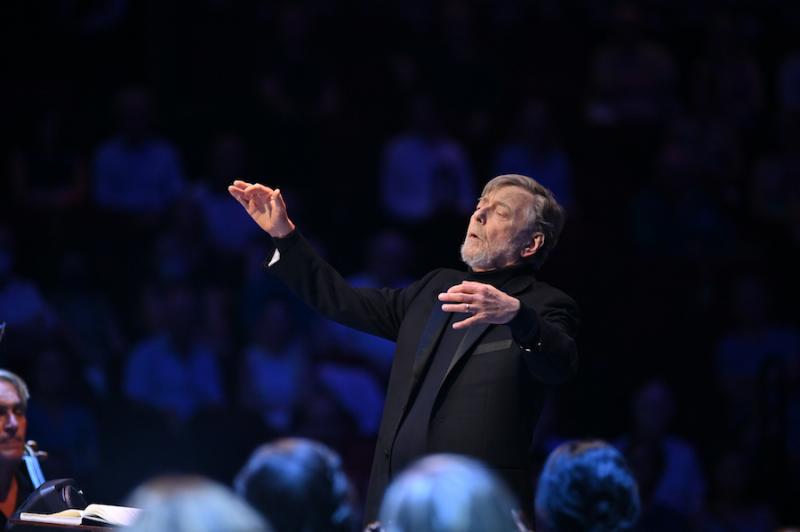
Reviewed by Richard Whitehouse Photo (c) Chris Christodoulou

Whether or not the Fourth Symphonies by Vaughan Williams and Tippett had previously been scheduled together, they made for a striking and provocative programme such as was its own justification. Omer Meir Wellber clearly thought so when this concert was planned and, even though indisposition had led to withdrawing from this year’s Proms, the presence of Sir Andrew Davis on the podium could hardly have been more conducive to the BBC Philharmonic Orchestra giving performances of the interpretive insight and technical conviction as were evident this evening.

Admittedly the Albert Hall’s opulent acoustic is never the best setting for VW4, the visceral impact of whose opening was inevitably diluted. Allowing for rather more expressive leeway than he might otherwise have done, Davis paced this explosive movement securely with just a slightly listless take on its coda detracting from the whole. The Andante was the highlight here – its fatalistic course exuding gravitas but never dragging, with the tritonal plangency of its main climaxes palpably in evidence and pathos of its final bars enhanced by an affecting contribution from flautist Alex Jakeman. This acoustic may have obscured something of the Scherzo’s contrapuntal ingenuity but not its sardonic humour or, in the trio, didactic coyness. The stealthy transition into the Finale could have had even greater cumulative focus, but what followed had all the requisite impetus – its central interlude raptly delineated, then the drama of its ‘epilogo fugato’ conveying increasing velocity through to the starkly inevitable return of the opening gesture and what is the most unequivocal four-letter ending of any symphony.

Interesting to recall the temporal distance between these pieces is now less than that between the Tippett and the present. Enthusiastically received at its Chicago premiere and one among a handful of his works still revived following his death, Tippett’s Fourth Symphony evinces  a ‘birth to death’ trajectory that differs – crucially so – from its assumed model of Sibelius’s Seventh in not being a cumulative design; its climax being rather the kinetic developmental paragraph at its centre and from where the piece fans out, in a sequence of evolving episodes, back to the launching of its introduction and onward to the passing of its coda. Although he may have directed performances of greater tautness, Davis here secured a persuasive balance between unity and diversity – bringing a metaphysical poise to its ‘slow movement’ then a deft whimsicality to its ‘scherzo’, whose respective qualities underlined the confrontational drama elsewhere. Lavish writing for brass and percussion helps makes this Tippett’s most virtuosic such statement, in which the BBC Philharmonic was rarely to be found wanting.

A less successful component of this reading was the latest attempt to represent the ‘breathing effect’ specified by the score, in which the real-time voice of CJ Neale seemed hardly more successful than those attempts of wind machine, sampler et al to realize Tippett’s speculative imagery. No matter – any such overreaching was part and parcel of this composer’s inherent ambition; an ambition, moreover, which his present-day successors would do well to emulate. Almost a century and half-century on, both these works pose challenges constantly to be met.

In concert – Zoë Beyers, English Symphony Orchestra / Kenneth Woods: Celebrating the Queen’s Platinum Jubilee

Beethoven Egmont, Op. 84 – Overture (1809-10)
Elcock Violin Concerto, Op. 13 (1996-2006) [UK premiere]
Vaughan Williams The Lark Ascending (1914/20); Symphony no.5 in D major (1938-43)

Zoë Beyers (violin), English Symphony Orchestra / Kenneth Woods

Routh Hall, Bromsgrove School
Friday 27 May 2022

There will be many concerts over the next fortnight celebrating Queen Elizabeth II’s Platinum Jubilee, but few (if any) of more substance than that given tonight by the English Symphony Orchestra with its principal conductor Kenneth Woods, taking place on the attractive campus of Bromsgrove School some miles from Birmingham.

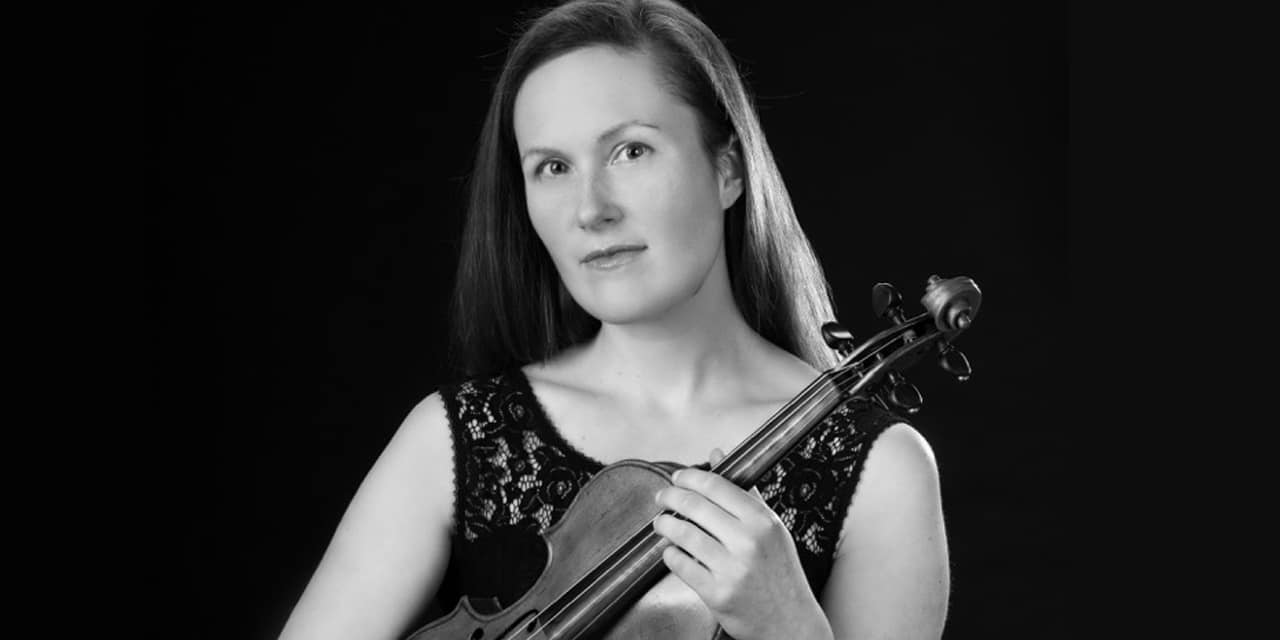
It might not have been written for this occasion, but the Violin Concerto by the ESO’s current composer-in-association Steve Elcock (above) was no less impressive for that. This marks something of a transition from those less ambitious pieces written for local musicians and the symphonic works now being recorded to great acclaim. It opens with an Allegro vivo whose rhythmic energy is maintained throughout, yet with enough expressive contrast for its second theme to assume greater expressive emphasis in the reprise. The highlight is a Molto tranquillo whose haunting main theme, initially unfolded by the soloist over undulating upper strings in a texture inspired by change-ringing techniques, is a memorable inspiration. A pavane-like idea later comes into focus and the closing stage, opening onto an eloquent plateau before evanescing into silence, lingers in the memory. The finale is a Passacaglia whose theme accelerates in five variations from Andante to Presto, culminating in a ‘cadenza’ for violin and timpani then a decisive pay-off.

A tough challenge, indeed, for any soloist and one which Zoë Beyers met with assurance over its 30-minute course. Aside from its sheer velocity the first movement is notable for a close-knit interplay between soloist and orchestra that was brought off with admirable precision, while the modal subtleties of the slow movement were rendered as enhancements to its overall tonal trajectory. Aside from a slight falling away of tension toward its centre, the finale saw the piece to a forceful close. Good to hear these performers recorded it prior to this performance, as a coupling to the Eighth Symphony that the ESO premiered last year, and which should be released over the coming months.

Beyers returned after the interval to launch a Vaughan Williams second-half (this year being the 150th anniversary of his birth) with The Lark Ascending. Easy to take for granted now that it is so frequently performed, the piece can still work its magic in an attentive rendering such as this. The underlying tempo might have been on the slow side, but the elegance and poise invested into the solo line were not to be gainsaid, nor was the translucency of orchestral textures which Kenneth Woods shaped with due restraint through the folk-like central section then into the easeful closing pages. Suffice to add that the unaccompanied final bars held those present spellbound with their artlessness.

There was at least as much to admire in the reading of VW’s Fifth Symphony which here followed on inevitably. A steady overall tempo for the Preludio did not exclude a palpable accumulation of energy in its development, nor a build-up of real fervency with the thrilling re-entry of its second theme. Understated it may be, but the Scherzo is replete with rhythmic quirks and while these were not always ideally negotiated, the music’s sardonic humour and ultimate evaporation were tellingly rendered. Doubtless this work’s emotional heart, the Romanza was admirably realized in its gradual coalescing of hymnal and folk-inflected elements towards a nobly wrought apex, but Woods kept enough in reserve so the final Passacaglia never risked becoming an anti-climax. It earlier stages conveyed  an emotional release as is countered by the ensuing anxiety then fateful reappearance of the work’s opening theme, subsiding into a coda which feels as much a benediction now as when it was first heard almost eight decades ago.

Beethoven‘s overture to Goethe’s Egmont might have seemed anomalous in this context but, as Woods pointed out in his opening remarks, the heroes and villains of 16th-century ‘Spanish Netherlands’ were not so far removed from those of today and, as the heady closing pages reminded us, triumph over adversity can never be taken for granted.

For further information on Steve Elcock, click here to visit his dedicated site, and for more on Vaughan Williams click here. To find out more about the artists, click on the names for more on Zoë Beyers, Kenneth Woods and the English Symphony Orchestra.