In concert – Jonathan Martindale, CBSO / Michael Seal: Summer Classics

michael-seal

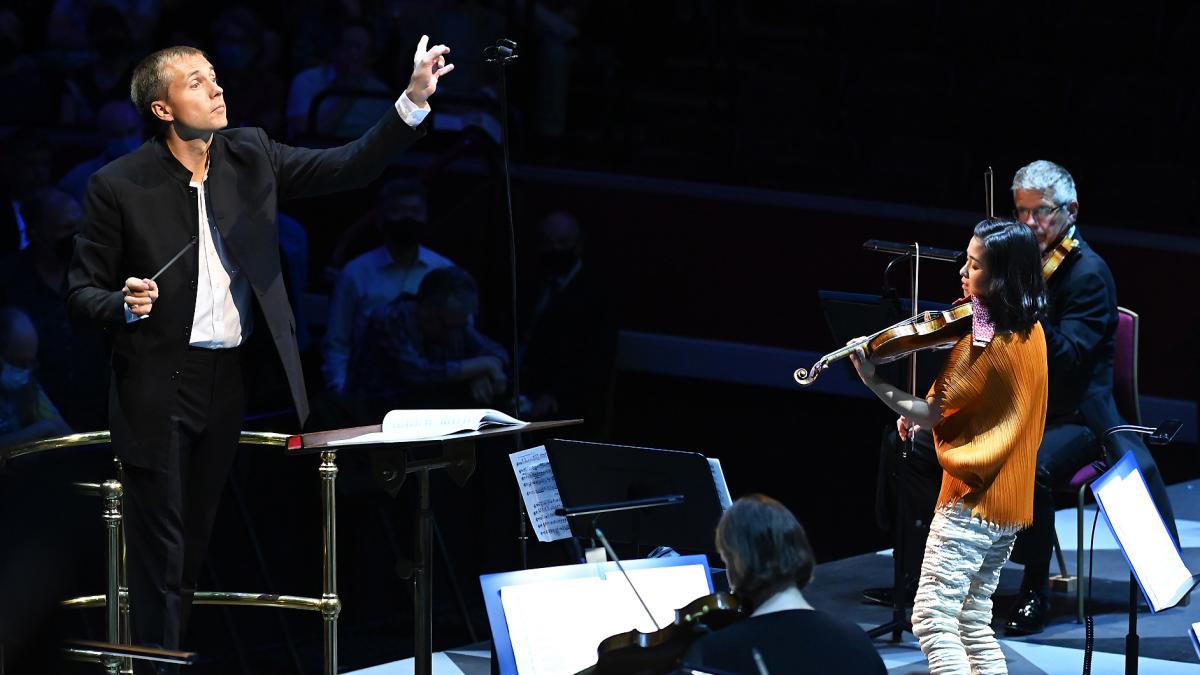
Jonathan Martindale (violin, below), City of Birmingham Symphony Orchestra / Michael Seal (above)

Dvořák Carnival Op.92 (1891)
Vaughan Williams
The Lark Ascending (1914/20)
Elgar
Chanson de matin Op.15/2 (1889)
Grieg
Peer Gynt Suite no.1 Op.46 (1875/88) – no.1, Morning; no.4, In the Hall of the Mountain King
Mendelssohn
A Midsummer Night’s Dream Op.21 (1826)
Vivaldi
The Four Seasons Op.8 (1718/20) – no.2 in G minor RV315 ‘Summer’
Price
Symphony no.1 in E minor (1931-2) – Juba Dance
Tchaikovsky
The Nutcracker Op.71 (1892) – Waltz of the Flowers

Symphony Hall, Birmingham
Friday 2 July 2021 (2pm)

Written by Richard Whitehouse Photo of Jonathan Martindale courtesy of Upstream Photography

The penultimate event in the City of Birmingham Symphony Orchestra’s current season, this afternoon’s Summer Classics featured a wide-ranging selection of pieces that between them spanned over two centuries, and whose ‘feel good’ factor at no time precluded stylish or committed playing.

With longstanding associate director Michael Seal at the helm, the orchestra made the most of Dvořák’s effervescent Carnival overture; the alluring pathos of its central interlude accorded due emphasis, and with some eloquent woodwind solos. Its popularity during recent years has made Vaughan Williams’s The Lark Ascending a regular inclusion in such programmes, and Jonathan Martindale (below, who also led the concert) gave a thoughtful while never flaccid reading – most perceptive in the middle section with its folk-like whimsy and fanciful evocations of birdsong. The CBSO responded with limpid dexterity, the whole performance a reminder that this work is best tackled as a concertante piece and by a player (recalling such as Hugh Bean, Iona Brown and, more recently, Richard Tognetti) who knows the orchestra from the inside.

Next came an ingratiating take on Elgar evergreen Chanson de matin, then excerpts from the First Suite of Grieg’s incidental music to Peer Gynt – a rapturous Morning and stealthy In the Hall of the Mountain King skirting headlong terror at the close. Mendelssohn’s overture to A Midsummer Night’s Dream made for an unlikely but effective centrepiece – the highlight being those fugitive imaginings towards its centre, along with the disarming eloquence of its final bars where the teenage composer conjures a fulfilment he was only rarely to recapture.

The Summer concerto from Vivaldi’s The Four Seasons again saw Martindale as soloist in an account that lacked little of that rhythmic vitality his contemporaries (notably Bach) seized on with alacrity; nor was there any absence of poise in its atmospheric second movement. One who has come in from the cold partly through the recovery of her manuscripts, Chicago-based Florence Price broke with convention by introducing the Juba Dance into her symphonies in lieu of a scherzo; the CBSO responding in full measure to its rhythmic verve. A winning harp solo from Katherine Thomas launched Waltz of the Flowers from Tchaikovsky’s ballet The Nutcracker and ended the main programme in fine style – Seal and the CBSO acknowledging the applause with the final ‘galop’ from Rossini’s William Tell overture as a dashing encore.

Throughout the concert, film expert Andrew Collins interspersed proceedings with his remarks and recollections (not least on that seminal 1970s supergroup The Wombles). The music itself was accompanied by varying shades and colours of lighting, but these rarely seemed intrusive – not least compared to the garish ‘Moulin Rouge’ effects routinely encountered nowadays at the Proms. Certainly, anyone in the process of getting the know just what classical music was all about, and those merely in search of a pleasurable afternoon’s listening, were well served.

Next Wednesday brings the last in this current series of concerts, the CBSO being conducted by Joshua Weilerstein (who is replacing an ‘unable to travel’ Edward Gardner) in an enticing programme of Judith Weir, Prokofiev (with the violinist Alina Ibragimova) and Beethoven.

You can find information on the final concert in the CBSO’s season at their website. For more information on composer Florence Price, click here

In concert – Members of the English Sinfonia @ St John’s Smith Square: English Miniatures

Members of the English Sinfonia: Janice Graham (violin), Nick Bootiman (viola), Julia Graham (cello) Chris Hopkins (piano)

Vaughan Williams The Lark Ascending (1914)
Bridge Miniatures – Book 2, H88 (1910)
Coleridge-Taylor Piano Trio in E minor (1893)
Holst String Trio in G minor (1894)
Bax Piano Quartet in One Movement (1922)

St. John’s, Smith Square, London, 15 December 2020 (lunchtime)

Reviewed by Richard Whitehouse

Celebrating its 60th anniversary next year, the English Sinfonia will be remembered by older listeners for those valuable recordings of British music with Neville Dilkes (not least the first modern account of Moeran’s Symphony). Its current incarnation as ensemble-cum-chamber orchestra enables it to tackle a wide repertoire, and even though only the core personnel was featured in this afternoon’s concert, the works that were chosen offered a more than plausible overview of British chamber music composed across the late 19th and early 20th centuries.

Easy to forget that, long before his music assumed a more radical mindset, Frank Bridge was a composer of lighter fare. Hence those three sets of Miniatures for piano trio – classy salon music of which the second set moves from a soulful while never cloying Romance, via an infectious and decidedly scherzo-like Intermezzo, to a Saltarello with more than a hint of menace in its hectic dash. By comparison, the Piano Trio of Samuel Coleridge-Taylor tries a little too hard to impress. If this early piece is hardly the equal of such as the later Clarinet Quintet, its three compact movements are never less than eventful – whether in the vehement Allegro with its portentous opening, a Scherzo whose unremitting energy brings little respite, or Finale whose distinctive furiant rhythm sees the whole work through to a forthright close.

Unlike the above, Holst composed relatively few chamber pieces in his maturity. While his String Trio evinces little sense of what he went on to achieve, this does not lack for incident. Idiosyncratic, too, in that its compact and forthright opening movement is followed by one which, over twice as long, integrates a slow movement, scherzo and finale that add up to an unlikely if cohesive whole; the fugal intricacies of that final section a stern test of ensemble such as the present players despatched with evident resolve. Appreciably more characteristic is the Piano Quartet by Bax – its tensile single movement packing a wide range of ideas and moods into little more than 10 minutes; and following an essentially conflicted to triumphal trajectory recalling that of the combative First Symphony which immediately preceded it.

Opening this afternoon’s programme, Janice Graham gave an affecting account of The Lark Ascending in the version for violin and piano first heard in public exactly 100 years ago. Now the orchestral version has become ubiquitous, this chamber guise can feel almost a reduction, yet the lucidity of its formal layout becomes even more explicit, and the understated poise of its piano part – as rendered by Chris Hopkins – belies any doubts as to Vaughan Williams’s limitations when writing for the instrument. An eloquent start to an enterprising programme.

Further information at https://www.englishsinfonia.org.uk/

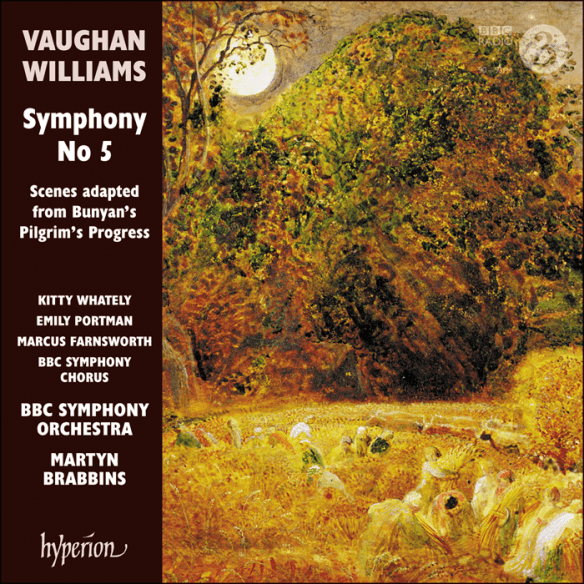
On record: BBC Symphony Orchestra / Martyn Brabbins – Vaughan Williams: Symphony no.5 & Scenes adapted from Bunyan’s Pilgrim’s Progress

*Emily Portman (singer); *Kitty Whatley (mezzo-soprano); *Marcus Farnsworth (baritone), *BBC Singers; *BBC Symphony Chorus, BBC Symphony Orchestra / Martyn Brabbins

Vaughan Williams
Symphony no.5 in D major (1938-43)
Scenes adapted from Bunyan’s Pilgrim’s Progress (1906)*

Hyperion CDA68325 [66’59”]
English text included
Producer Andrew Keener
Engineer Simon Eadon

Recorded 2 December 2018* & 4-5 November 2019 (Symphony 5), Watford Colosseum, UK

Reviewed by Richard Whitehouse

What’s the story?

Martyn Brabbins’s traversal of Vaughan Williams symphonies continues with the Fifth, long the most widely regarded of this cycle, alongside music written for a dramatized production which effectively launched the composer’s lifelong obsession with John Bunyan’s ‘allegory’.

What’s the music like?

Premiered in June 1943, the Fifth Symphony poses a challenge or even provocation through that inwardness all too easily regarded as escapism. A ‘less is more’ concept which Brabbins clearly appreciates – not least in a Preludio as builds incrementally, with little overt rapture going into the radiant second theme or a development understatedly accruing energy, toward a reprise whose climactic restatement of the second theme is (purposely?) less arresting than a coda in which any tonal ambiguity feels the more real for happening almost out of earshot. Easy to skate over, the Scherzo emerges with not a little malevolence in the deftness of its cross-rhythms – the chorale-like aspect of its trio questioning rather than affirming, then the return of the opening music exuding a sardonic quality left unresolved by the spectral close.

That the Romanza is the emotional heart of this work only increases a need for its contrast of moods to be (subtly) underlined. Brabbins achieves exactly so through an adroit interplay of the melodic and harmonic components whose cumulative yet unforced evolution accords the central phase of the movement an encroaching anxiety barely pacified at its culmination, before being more wholly transcended by a coda that is luminous in its simplicity and poise. Often thought unsatisfactory as a formal design, the final Passacaglia seems of a piece with what went before; its theme stated simply while purposefully before the variations build to a resolute central climax – after which, those conflicting elements of negation and affirmation are sublimated into a postlude which reaches out as though at once entreaty and benediction.

As a coupling, Scenes adapted from Bunyan’s Pilgrim’s Progress could not be more apposite. Written for a staging at Reigate Priory, the 13 short items unfold well as a continual sequence at the outset of an involvement with Bunyan’s novel that resulted in an evening-length drama 45 years on. Highlights are Emily Portman’s disarming take on the ‘Flower-girl’s song’, ‘The angel’s song’ eloquently rendered by Kitty Whately (her contribution an undoubted highpoint of ENO’s uneven 2012 production), Marcus Farnsworth’s fervour in a setting of Psalm 23 as constitutes the Shepherd’s Song, and lusty response from the BBC Symphony Chorus in The arming of Christian (best known as the hymn To be a Pilgrim) then a rapturous Final scene music which also serves as reminder that VW’s Tallis Fantasia was merely four years hence.

Does it all work?

It does. Brabbins’s Fifth may not be the most fervent or powerful but has the work’s measure as a cohesive and integrated entity. The Pilgrim’s Progress ‘Scenes’ makes for a fascinating comparison with subsequent versions in VW’s decades-long quest for a satisfying realization.

Is it recommended?

Indeed. The sound is on a par with previous instalments in its clarity and realism, and Robert Matthew-Walker’s booklet note expertly clears up any uncertainty over the genesis of VW’s Bunyan-related projects. Those remaining symphonies will hopefully not be long in coming.

For further information on this release, visit the Hyperion website, or the BBC Symphony Orchestra. You can also read Arcana’s interview with the conductor here

Playlist – Sound of Mind 3: Orchestral

Today’s playlist of music for the mind has an orchestral theme, which will hopefully bring you some colour if you’re stuck indoors.

This one features Aaron Copland‘s brightly-scored ballet music Appalachian Spring, the first movement of Rachmaninov‘s Second Piano Concerto, Elgar‘s Sospiri, shorter works by Grieg and Debussy, and Vaughan Williams‘ timeless Fantasia on a theme of Thomas Tallis:

I hope you enjoy it – and stay tuned for some uplifting Friday vibes tomorrow!

Ben Hogwood

On record: Elizabeth Watts, BBC Symphony Orchestra / Martyn Brabbins – Vaughan Williams: A Pastoral Symphony & Symphony no.4

Elizabeth Watts (soprano)*, David Butt Philip (tenor)**, BBC Symphony Chorus & Orchestra / Martyn Brabbins

Vaughan Williams
A Pastoral Symphony (Symphony no.3)* (1921)
Symphony no.4 in F minor** (1931-4)
Saraband, ‘Helen’ (1913-4)

Hyperion CDA68280 [80’57”]
English text included
Producer Andrew Keener
Engineer Simon Eadon

Recorded 26 & 27 November (Symphonies), 2 December 2018 (Helen), Watford Colosseum, UK

Reviewed by Richard Whitehouse

What’s the story?

Martyn Brabbins and the BBC Symphony Orchestra continue their cycle of the symphonies by Vaughan Williams with the Third and Fourth, two ostensibly very different pieces whose equally equivocal reception at their premieres now seems testament to their expressive reach.

What’s the music like?

No longer the relative rarity it once was, A Pastoral Symphony remains the most elusive of this cycle – its arcadian rapture shot-through with imagery of war and transience.

Brabbins sets a well-nigh ideal tempo for the opening movement, its deceptively passive interplay of landscape and evocation informed by eddying agitation made more explicit in its successor – whose distanced solos for horn and (offstage) trumpet afford concrete recollections of VW’s wartime experience, made the more poignant by being sensed on the edge of consciousness. For all its greater physicality, the third movement is no conventional scherzo in its eliding between moods with an agility finely conveyed here through Brabbins’s judicious pacing – not least that eerily flitting coda which forms an unerring transition to the finale. Its remote outer sections enhanced by Elizabeth Watts‘s yearning vocalise, this unfolds as a necessary culmination; the composer bringing to the fore emotions earlier half-glimpsed on the way to a powerfully wrought climax, leaving in its wake a catharsis more potent for its intangibility.

From here to the seismic eruption of the Fourth Symphony is to set forth on a very different journey, one of absolute expression in combat with force of circumstance. Brabbins keeps a firm yet flexible grip on the initial Allegro, its violent opening balanced by the fugitive calm into which it withdraws. He then finds the right ‘walking’ tempo for the Andante, this sombre if never featureless landscape underpinned by angular harmonic progressions that twice break out in ominous outbursts prior to the flute’s lamenting soliloquy towards its close. Perhaps the Scherzo’s outer sections could have evinced greater sardonic humour, though the overbearing pomposity of its trio is as finely judged as is the pulsating transition into the finale. Brabbins duly brings out its martial swagger and if tension during the earlier stages could be even more acute, the ghostly throwback at its centre yields a wan rapture and how persuasively he draws the thematic elements together in the epilogo fugato for a stretto of mounting tension whose denouement is a return to the work’s fateful opening gesture and a four-letter clinching chord.

As makeweight, Saraband ‘Helen’ proves an enticing discovery. Left unfinished towards the outbreak of the First World War, this setting of lines from Marlowe’s Doctor Faustus may be off-balance in its utilizing tenor and chorus for what surely needed to become a larger entity, though both David Butt Philip and the BBC Symphony Chorus acquit themselves ably, while Brabbins secures playing of real elegance and finesse in orchestral writing that inadvertently yields what emerged as the main theme of Serenade to Music almost a quarter-century later.

Does it all work?

Almost entirely. Those who have acquired the earlier releases in this series (A Sea Symphony and A London Symphony) will be aware of the qualities which Brabbins brings to VW, and so it proves here with what is among the finest recent accounts of the Pastoral. Others have evinced a more visceral response in the Fourth, but there is no lack of impact – allied to a methodical sense of purpose that pays dividends in those densely contrapuntal passages over which the composer laboured before ultimately getting them right.

Is it recommended?

Indeed. Sound has the sense of perspective but also immediacy necessary in this music, with Robert Matthew-Walker once again contributing a detailed and informative note. Hopefully the next instalment, featuring the Fifth (and Sixth?) Symphony, will not be long in coming.

For further information on this release, visit the Hyperion website, or the BBC Symphony Orchestra. You can also read Arcana’s interview with the conductor here