Christoph Prégardien – The Darker Side of Love

The Darker Side of Love – Christoph Prégardien and Daniel Heide at the Wigmore Hall

christoph-pregardien

Christoph Prégardien (tenor), Daniel Heide (piano) – Wigmore Hall, London, live on BBC Radio 3, 18 May 2015

Listening link (opens in a new window):

http://www.bbc.co.uk/programmes/b05tpryp

on the iPlayer until 17 June

Spotify

In case you cannot hear the broadcast, I have put together a Spotify playlist of most of the music in this concert, including recordings the artists have made where possible. The playlist can be found here

What’s the music?

Schubert: An den Mond, D259; Schäfers Klagelied, D121

Schubert: Erster Verlust, D226

Schubert: Rastlose Liebe, D138

Schubert: Wandrers Nachtlied II, D768

Schubert: Willkommen und Abschied, D767 (17 minutes)

Schumann: Dichterliebe, Op.48 (30 minutes)

What about the music?

The relationship between Schubert and the poetry of Goethe was long-standing, beginning in October 1814 and yielding tens of songs. Many of them are darker utterances, and the collection here enjoys the composer’s ability to cast a nocturnal scene for voice and piano seemingly at will. It also celebrates his faster, galloping songs, the singer in the saddle for an action-packed horse ride, while the sheer simplicity of shorter songs such as Erster Verlust is pure and touching.

Schumann’s famous year of song reached its creative peak in May 1840, when he wrote the Liederkreis, published as Op.39, and Dichterliebe, where he sought inspiration once again from the poetry of Heinrich Heine. The quote in the Wigmore Hall program sums it up perfectly, Schumann describing the verses as ‘short, maliciously sentimental, and written in the folk style’. They evoke outdoor scenes but also inward and often crippling emotions, the singer – and possibly the listener! – an emotional liability by the end. Schumann rescues Dichterliebe, however, through the piano postludes he provides to Am leuchtenden Sommermorgen (One bright summer morning) and the closing song Die altern, bösen Lieder (The bad old songs), attempting and largely succeeding to restore stability.

Performance verdict

Christoph Prégardien has been singing these songs (or ‘Lieder’, as we should really call them!) for a long time – he recorded most of them a while back – but he still brings keen emotion to the stage.

The silence of Wigmore Hall during a song as tense as Schumann’s Ich hab’ im Traum geweinet (I wept in my dream), the ninth of Dichterliebe’s dozen, said it all. Here was a performer creating vivid pictures from Heine’s barbed text and Schumann’s equally frosty responses to the dark side.

In Schubert, too, the steely edge of even the most youthful Goethe setting could be glimpsed, brought out in an early song like An den Mond (To the Moon) by pianist Daniel Heide, stressing the notes Schubert brings in to challenge the happier times of the song.

Schubert’s horse-riding songs, Rastlose Liebe and Wilkommen und Abschied, were adrenalin-fuelled dashes into the country, while Schäfers Klaglied brilliantly evoked both the tempest and its subsequent rainbow.

Prégardien is an unfussy singer who communicates with his audience through subtle but meaningful expression, both visually and with the use of his hands. This somehow carries over to the listener too, either in the hall or at home, part of a masterclass in how to sing these songs.

What should I listen out for?

Schubert

1:50 – An den Mond (To the Moon) A calm and seemingly contented song to begin the selection – though there are some warning signs, chiefly in the piano part, to suggest all is not well.

5:27 – Schäfers Klagelied (Shepherd’s lament) A downcast and solemn song, with a vivid depiction of a storm in its central section from the piano (from 6:55), which also somehow describes the resultant rainbow (7:13) before a return to sadness.

8:58 – Erster Verlust (First loss) A song of striking simplicity and sadness, with an aching melody where the purity of Prégardien’s tone really comes through

11:22 – Rastlose Liebe (Restless love) A song that gallops out of the blocks with its rapid movement on the piano, and the breathless voice almost struggles to keep up. Meine signs off beautifully at 12:30.

12:47 – Wandrers Nachtlied II (Wanderer’s Nightsong II) Here we can feel the stillness of a summer evening, the conditions in which Goethe scribbled the verses for this poem as he stood outside in a garden. Prégardien’s higher notes are beautifully tailored.

15:18 – Willkommen und Abschied (Greeting and farewell) Another of Schubert’s quick dashes through the text, though at the end of each verse we have a pregnant pause. Prégardien cries out ‘ihr Götter’ (‘O gods!’) at 17:17. The text at the end translates as ‘what a joy to be loved’

Schumann

The words for Dichterliebe can be found here

21:12 – Im wunderschönen Monat Mai (In the wondrous month of May) A graceful song to begin the cycle, with some beautiful top notes (the translated words ‘blossom’ and ‘desire’) that Prégardien very subtly stresses through a pause.

22:54 – Aus meinen Tränen sprießen (From my tears will spring) The spring-like openness continues, in the same key.

23:51 – Die Rose, die Lilie, die Taube, die Sonne (Rose, lily, dove) A playful song, over in a flash!

24:23 – Wenn ich in deine Augen seh (When I look into your eyes) A tender love song, that tellingly moves to the purity C major to tell of how ‘when I kiss your lips, then I am wholly healed’. There is a yearning postlude on the piano.

26:12 – Ich will meine Seele tauchen (Let me bathe my soul) Another short love song, this time with a flowing, watery piano accompaniment.

27:08 – Im Rhein, im heiligen Strome (In the Rhine, the holy river) The singer adopts a much more imposing tone to evoke the grandeur of the Rhine and the great cathedral of Cologne, where hangs an image of ‘Our beloved Lady’ – which the singer equates to that of his own love. The piano postlude is reminiscent of a Baroque aria.

29:16 – Ich grolle nicht (I bear no grudge) The text turns darker, though the musical language is still generally positive. The tenor has a heavier tone here, the voice more of a baritone in its richness.

30:49 – Und wüßten’s die Blumen, die kleinen (If the little flowers only knew) The piano matches the tenor in this flowing, limpid song – spring like in its subject matter but ultimately sad and regretful at a broken heart. This leads straight into…

32:05 – Das ist ein Flöten und Geigen (What a fluting and fiddling) A proud song but once again with a darker centre.

33:29 – Hör’ ich das Liedchen klingen (When I hear the little song) This is Heine’s poetry at its coldest, and in this brief song it gets a suitably bare response from Schumann, who then attempts some consolation in the extended piano postlude, which in reality says just as much as the song does.

35:47 – Ein Jüngling liebt ein Mädchen (A boy loves a girl) A more positive mood now – but soon the poetry turns dark as well. Schumann keeps his tongue firmly in his cheek, allowing the tenor a bit of sardonic humour and the piano a grand finish

36:47 – Am leuchtenden Sommermorgen (One bright summer morning) A beautifully simple song – though now the mood of sadness is taking hold with greater certainty. Again we have a longer piano postlude, the pianist reflecting the text through music and trying to console.

39:38 – Ich hab’ im Traum geweinet (I wept in my dream) Schumann’s use of silence here is striking and altogether ominous. Prégardien gathers the power of the final verse, the texture sparse as can be, until the music stops abruptly.

42:25 – Allnächtlich im Traume (Nightly in my dreams) An elusive song – another dream but one the poet cannot really remember – which possibly explains why Schumann leaves the music sounding half-finished at the end.

43:54 – Aus alten Märchen winkt es (A white hand beckons) There is greater optimism in this song, using the upper register of the piano for the first time in a while, but once again Heine insists on an ending that takes away the potential for happiness. Schumann’s music rescues this in the postlude however!

46:39 – Die alten, bösen Lieder (The bad old songs) A bit of nostalgia to finish – though this is a purge, the poet casting all his ‘bad and bitter dreams’ away in a heavy coffin. Schumann responds with gallows humour, a song that is bold and defiant in its execution but which fades away to reflection. Once again we have a piano postlude, this one even more meaningful as it tries to draw the cycle to a soft conclusion. In the right performance however, like this one, a level of bitterness remains.

Encore

53:05 – SchumannMit Myrthen und Rosen (With myrtle and roses) (the last song from Liederkreis, Op.24) This has an effortless, upward curve to the melody. Prégardien’s gestures to the audience here were beautifully observed.

Further listening

With Christoph Prégardien demonstrating his almost unparalleled abilities in Schubert, here is a Spotify link to a recent recording of him singing the great Schubert song cycle Winterreise. Again this is music on the dark side, but is greatly inspired at that. Texts can be found http://www.recmusic.org/lieder/assemble_texts.html?SongCycleId=47″>here and the playlist is here

For more concerts click here

Elias String Quartet and Simon Crawford Phillips – Messages Old and New

Messages old and new – the Elias Quartet give an Emily Howard world premiere, and are then joined by Simon Crawford Phillips for Schumann’s Piano Quintet

elias-quartet

Elias Quartet (Sara Bitlloch, Donald Grant (violins), Martin Saving (viola), Marie Bitlloch (cello), Simon Crawford-Phillips (piano) – Wigmore Hall, London, live on BBC Radio 3, 4 May 2015.

Listening link (opens in a new window):

http://www.bbc.co.uk/programmes/b05qypn8

on the iPlayer until 9 June

Spotify

In case you cannot hear the broadcast, here is a link to a recording of the Schumann (Howard’s pieces is a world premiere so not yet recorded). The Schumann is played here by Sviatoslav Richter and the Borodin String Quartet:

Spotify

What’s the music?

Emily Howard Afference (2015) (22 minutes)

Schumann – Piano Quintet (1842) (32 minutes)

What about the music?

Emily Howard’s new piece Afference, a substantial work for string quartet, is based on a physiological term to describe the way in which the brain processes our experiences of the world. Howard herself has a degree in maths and computer science, something that might lead an audience to expect a very calculated approach to composing music. This is not entirely the case though, as the biography on Howard’s own website suggests.

Afference appears to be her first work for string quartet, commissioned by the Elias Quartet themselves. It joins a canon of pieces that range from large-scale orchestral works (Axon and a symphony called Magnetite) to smaller scale compositions for clarinet and piano.

Schumann’s Piano Quintet was written in 1842, when he was still giddy with love for wife Clara. She was the dedicatee of this work, but as the BBC Radio 3 announcer Georgia Mann details it was first performed with none other than the composer Felix Mendelssohn at the piano.

Performance verdict

A fine concert, with concentrated playing from the Elias Quartet of what is on two listens an engaging new work for string quartet. Emily Howard writes in a distinctive style that the Elias Quartet understand, and the colours she achieves are consistently interesting and imaginative. It helps to know the program for the piece, as there do indeed seem to be a lot of messages transmitted in 22 minutes. Some of them are very nervy, though ultimately the piece feels of a positive nature.

The Schumann receives an excellent performance, the happiness of the first, third and final movements a joy to behold – while the second movement, if a tiny bit slow in its central section perhaps, is uneasy and in need of consolation this ultimately provides. Simon Crawford-Phillips plays brilliantly, with authority but also ensuring the strings are heard at all times. His nimble finger work in the third movement scherzo is especially impressive.

What should I listen out for?

Emily Howard

1:20 – a busy start with all four instruments playing frenetically then cuts to a section with a very small voice, doing battle with the quartet.

5:55 – the instruments all take a melodic line that uses portamento (sliding from one pitch to another) before a more intimate phrase starts to dominate. At this point the instruments are close together in pitch.

8:09 – a much slower section, with an intense violin pitch that grows into what sounds like a sorrowful lament, while the other three instruments give softly breathed harmonies. This leads on to some feverish activity, Howard’s nervous messages transmitted at great intensity.

13:17 – As the second movement starts there is a large gap between the instruments – violins on high and cello down below. The lack of a key centre brings to mind some of the quartet writing of Schoenberg, though Howard’s writing has more pitch-related implications in the cello’s continual return to its low ‘D’.

16:50 – a striking passage for violin with upwards phrases, in which Howard seems to be reaching for higher plains

18:51 – the instruments stick closer together again, but at 19:53 the violin shoots out a much higher phrase. The harmonies still make the music sound quite uneasy, as if in a state of dread.

22:20 – a piercing line on the violin returns to the pitch of D, before the rest of the quartet finish the piece with a short series of comments.

Schumann

26:23 – the first movement begins with a wonderfully positive outpouring of music from piano and strings together. The theme itself is a surprisingly catchy one

27:35 – a lovely tune makes itself known on the cello, Schumann at his most romantic with the music flowing beautifully onwards. This tune is then picked up with a counter melody from the violin.

32:03 – now in the centre of the development section, the music gets more turbulent, the piano lines swirling around those of the string quartet, but then we switch to a triumphant reprise of the opening music at 32:45.

35:33 – the subdued second movement begins. This is a form of funeral march and it has a halting tune, played by both strings and piano with short notes. This is complemented by a much sweeter episode of music that begins at 37:19, still in the spirit of remembrance but with a positive approach. The sombre first theme returns once again at 38:56.

40:10 – a faster episode begins, led by the piano, the strings with much heavier lines alongside – but still the tune persists from the viola at 41:00, picked up by the violin – and the sweeter theme also makes a reappearance (41:49).

44:16 – the third movement, a Scherzo, begins with fizzing interplay led by the piano. Schumann again finds music of great positivity and energy. At 45:34 a second section begins, in the far-removed key of F sharp major, before the main scherzo returns with just as much irrepressible energy at 46:16. At 46:58 a new section is introduced, again with plenty of energy! The main theme returns at 48:02, carrying through to an emphatic finish at 48:57.

49:04 – the last of the four movements begins, and again the energy levels are up – though here we begin in a minor key that briefly recalls the second movement march. Quickly the music moves to E flat major – the ‘home’ key of the piece. The music then becomes more reserved and secretive.

51:24 – the first theme comes back, though the music is still in a minor key and still feels a long way from ‘home’. Gradually though the music gets greater presence in the ‘home’ key, and by the time we get to 54:16 it is rooted here, and sweeps to a decisive finish by way of a fugue, instigated by the piano at 54:41 and rounding off at 56:28.

Want to hear more?

Following the contrasting nature of the two pieces in this concert, the suggested further listening looks to progress from the Howard with Schoenberg’s String Quartet no.2. This famously has a last movement that sets the text ‘I feel the air from another planet…’, sung by a soprano and said to consciously signal the composer’s move away from writing in a particular key (tonality). Here the words are sung by Susan Narucki, in conjunction with the Schoenberg Quartet.

After the Schumann a rewarding next port of call is the Piano Quintet by Dvořák, his second in the form – and once again played by Sviatoslav Richter and the Borodin Quartet. The playlist can be found on Spotify here:

For more concerts click here

Meta4 play Haydn and Schumann string quartets at Wigmore Hall

The Finnish quartet Meta4 play Haydn and Schumann string quartets at Wigmore Hall

meta-4

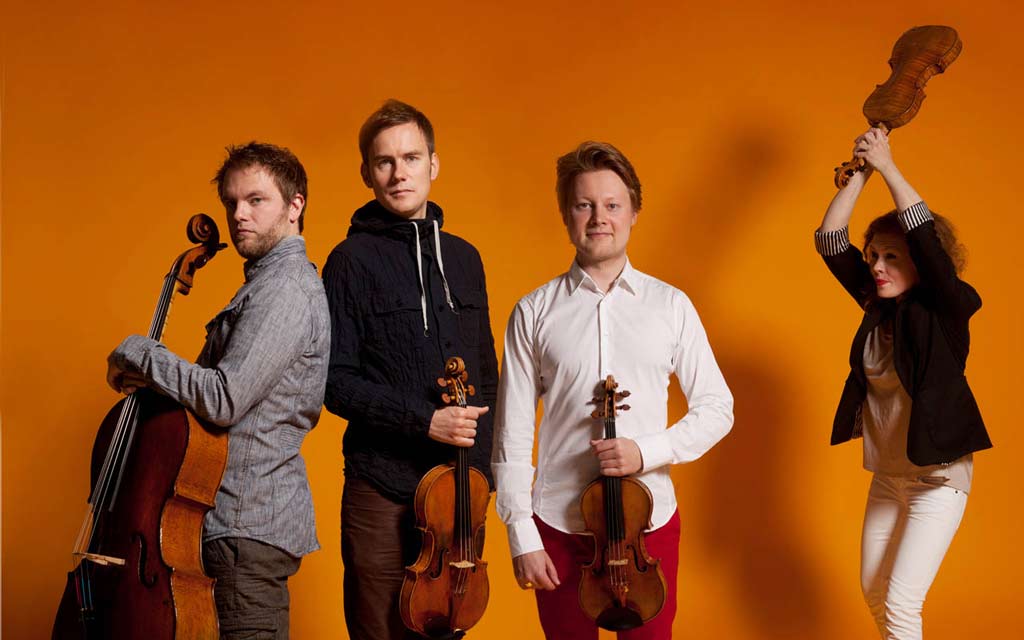
Meta4 (Antti Tikkanen & Minna Pensola (violins), Atte Kilpeläinen (viola) & Tomas Djupsjöbacka (cello)) – Wigmore Hall, live on BBC Radio 3, 6 April 2015.

Listening link (opens in a new window):

http://www.bbc.co.uk/programmes/b05pqzdk

on the iPlayer until 6 May

Spotify

This Spotify link is for those unable to gain access to the broadcast. As Meta4 have not recorded any of this music, two alternatives have been chosen in recordings by the Hagen Quartet:


What’s the music?

HaydnString Quartet in C major Op.20/2 (1772) (20 mins)

Schumann String Quartet no.1 (1842) (27 mins)

What about the music?

haydn

Haydn string quartets are so often a feature in an hour-long quartet recital that it is easy to forget just how revolutionary they were at the time of composition. The publication of his six ‘Sun’ quartets in 1772 (so-called because an early edition had the sun on its cover) represented a massive step forward in the history of the form towards what it has become today. One of the best quotes about the string quartet comes from Goethe – who referred to Haydn’s mastery of it as ‘’

Before the ‘Sun’ quartets the violins had almost total dominance in the melody – but the gradual development of viola and cello into melody instruments was well underway, and Haydn ensured that in the second of the six works he gave special attention to the cello from the outset – before bringing all four instruments together as equals. The musical language, too, is expressive, the composer moving to unusual keys and harmonies to present music that is far from simple – as C major often suggests it should be.

Schumann, on the other hand, is not really regarded as a string quartet composer – his primary instruments being the voice and the piano. Yet he contributed three very attractive works to the medium, all written in 1842, a year after his so-called ‘year of song’. This was after an intense period of study of the quartets of Haydn, Mozart and Beethoven.

Schumann dedicated the three quartets published as Op.41 to Mendelssohn – who loved them.

Performance verdict

These are spirited performances from Meta4. For the Haydn they bring out some of the revolutionary aspects of the writing by using less vibrato, giving a more austere sound when the harmonies get darker. Some of the tuning here is not perfect, but there is never lack of expression.

The Schumann quartet is extremely enjoyable, vigorous in its faster movements but finding the lyricism Schumann invests in his quartet writing especially in the slow movement.

What should I listen out for?

2:36 – the quartet begins with quite a sinewy sound. There is a sense of discovery here, a little similar in mood to the opening shades of Haydn’s ‘Le Matin’ symphony. A rather more austere section begins at 6:49, darker in mood, before the cello takes up the theme once again at 8:22.

10:01 – a louder attack from Meta4, and a more dramatic section of music from Haydn that seems to hark back towards the Baroque in its stormy implications. It is no coincidence that the music has shifted from C major to C minor, and the emotions are troubled. The movement ends, almost with a whimper.

13:05 – now the music is rather sweet, with an attractive line given to the first violin – but again the ‘sturm and drang’

A relatively genial last movement begins, but still doesn’t sound fully sure of itself until the pace picks up finishes at 22:42

Schumann

25:57 – a subdued beginning to the quartet, with careful interplay between the instruments. After this slow introduction the music speeds up and gets to the heart of its argument.

35:30 – a restless second movement with what is nonetheless quite a catchy tune when heard several times! A contrasting ‘trio’ section begins at 37:03, which has more graceful contours but still sounds a bit on edge with its chromatic nature.

39:53 – a rising line from the cello signals the beginning of the slow movement, with this material used as the basis

46:59 – a brisk last movement begun with three ‘snap’ chords before the music becomes more rustic and outdoors. Rushes to what looks like a false ending at 51:32, but then an extraordinary passage of play starts where the four instruments sound like bagpipes.

Encore

55:06 – the encore chosen by Meta4 is a ‘local’ one – Jusslin by the contemporary Finnish composer Timo Alakotila (5 mins)

Want to hear more?

After hearing one of the Haydn ‘Sun’ quartets, the other five are also strongly recommended. You can hear the Hagen Quartet playing them on Spotify here.

Similarly the other two Schumann quartets of the Op.41 set are recommended, together with the Piano Quintet (for piano and string quartet) written soon after. The Hagen Quartet are once again in action, playing the First String Quartet and Piano Quintet here (pianist Paul Gulda), and quartets nos. 2 & 3 here

For more concerts click here

Zhang Zuo – Schumann and Schubert at Wigmore Hall

Zhang Zuo plays contrasting piano works by Schumann and Schubert at the Wigmore Hall

zhang-zuo
Zhang Zuo (piano) – Wigmore Hall, live on BBC Radio 3, 30 March 2015.

Listening link (opens in a new window):

http://www.bbc.co.uk/programmes/b05nsbm7

on the iPlayer until 29 April

Spotify

Zhang Zuo has not recorded either of these works, so this Spotify playlist – for those unable to hear the radio broadcast – includes the Schumann played by Daniel Barenboim and the Schubert by Romanian pianist Radu Lupu.

What’s the music?

Schumann – Faschingsschwank aus Wien, Op.26 (Carnival pranks in Vienna) (1839) (19 minutes)

Schubert – Piano Sonata in C minor D958 (1828) (28 minutes)

What about the music?

Both Schumann and Schubert could proclaim the piano to be their first discipline, and both wrote masterfully for the instrument. These two pieces form a nice contrast in concert, for we hear Schumann at his most exuberant, in the throes of a love affair that was soon to culminate in marriage and the so-called ‘Year of Song’. Written in a brief stay in Vienna, the mischievous ‘carnival pranks’ include a quotation of the ‘Marseillaise’ in the first of the five pieces. This was especially daring as the French national anthem was banned in the Austrian capital at that time.

Schubert, on the other hand, was in the last year of his life and in the knowledge that death was increasingly to hand. His late trio of piano sonatas are remarkable works, reaching an intensity of emotion and accomplishment you can barely comprehend for a composer only just in his thirties. The C minor, the first sonata of the three, is perhaps the most tortured, and is complemented by two even bigger works in the form of the A major and B flat major sonatas, each weighing in around the 40 minute mark.

Yet all three are compelling works in the right performances, for Schubert finds ways of making the music reflect the depths of his thoughts, vividly so in the sudden lightning bolts of anxiety that strike at unexpected points. Time stands still in the slow music, while in faster passages there are almost not enough notes for Schubert to describe his thinking.

Performance verdict

Zhang Zuo – Zee Zee – is a brilliant pianist, of that there is no doubt. Technically assured and very clear in her communication of the notes, she made the music fairly rush out of the Steinway like an endless stream. Yet there were times in this recital where I longed for the music to have a bit more breathing space, because she showed in the slower moments that she has a tender side to her playing.

In some of the Schubert the sonata came across as rather brash. It must be difficult for a pianist in her early twenties to fully probe music written by a composer who knew he was dying. And although at times Zuo communicated some of the anguish Schubert must have been experiencing, the fast music was brittle and at times simply too fast. The finale was certainly thrilling but it raced away, pausing only occasionally for breath.

The Schumann was fun – especially the first of the six pieces – and there were some nice, intimate asides such as the second piece, which felt like a confidential letter between loved ones. But here too the music cut to the bone a little too quickly, especially in the closing piece. It isn’t entirely fair to compare Zuo, a pianist at the start of her career, with the old masters Lupu and Barenboim, who you can hear on the Spotify playlist above, but it is instructive to learn that Lupu spends nearly two minutes longer on the Schubert than Zuo.

I don’t want to be unduly critical – there was an awful lot to admire here after all – but I longed for a bit more light and shade from a pianist who clearly has the technical ability.

What should I listen out for?

Schumann

1:04 – We hear Schumann at his most exuberant as the carnival pranks get underway. This piece takes up half the duration of the collection, returning to its catchy main theme with great gusto each time, but also wandering off into distracted thoughts. The most enjoyable and extravert of these is the march beginning at 5:17 – which ushers in the ‘Marsellaise’ quotation. See if you can spot it!

10:07 – a short and tender romance, in complete contrast to the bluster of the opening piece. A confidential aside in the minor key.

12:36 – the third piece is quicker and flighty, and Schumann surprises his listener by moving to a distant key briefly, before coming back ‘home’.

14:36 – Zee Zee moves straight into the turbulent fourth piece, a torrent of notes that subsides at the end, before almost crashing straight into the fifth…

16:37 – the fifth piece starts with similar vigour and leads to an emphatic conclusion.

Schubert

22:16 – although the first movement is not one of unremitting darkness, the torture of Schubert’s final years is immediately clear to the untrained ear. There is edginess and anxiety here, and you can hear it in Zuo’s right hand right from the off.

There is respite, however, in the form of a second theme that melts under the fingers, especially when Zuo plays it for the second time at 27:10. The music seems set to move into calmer waters but Schubert muddies the textures by introducing a coda with low rumblings in the left hand, bringing the movement to an uncertain close.

30:09 – a soft, thoughtful slow movement with similar contours to the slow movement of Beethoven’s Pathétique sonata. Like Beethoven’s late period, Schubert’s last sonatas are known for their ability to hang suspended in time, but Zuo’s performance is just a bit too quick to capture that consistently – apart from 37:03, where the music reaches new levels of intimacy. A darker strand of music makes itself known at 31:34, and this comes to dominate the louder parts of the movement.

38:21 – an awkward attempt from Schubert to pick up the mood that ultimately ends in darkness. Although a minuet, the main theme does not feel like a piece for dancing – and especially when the stop-start episodes take over. The ‘trio’ section (from 39:31) has a more obvious lilt to its triple time, but is incredibly brief – and the opening returns at 40:40.

41:13 – the last movement, a Tarantelle, begins quickly and urgently, but disruption sets in when Schubert insists on moving to new and distant keys, trying hard it seems to assert some positive music but generally ending up with darker, stormy episodes. An exception to this can be found in a brief excursion to B major for more poetic thoughts at 44:10, while the final two chords – wrapping up at 50:16 – tell of resolution and grit but not release from the darkness.

Encore – J.S. Bach – the Minuet from his Partita for keyboard no.1 in B flat major

51:31 – an attractive, light touch to this encore, nicely detailed. There are two Minuets, the second appearing at 52:17 before the first is repeated at 53:00.

Want to hear more?

The second Schubert sonata has perhaps even more drama, and can be heard on Spotify played by Maurizio Pollini from track 5 of this album

To complement the Schumann, try his set of character pieces Carnaval, which can be heard here, played by Jorge Bolet.

For more concerts click here

Maurizio Pollini plays Schumann and Chopin

maurizio-pollini
© Cosimo Filippini / DG

Maurizio Pollini at Royal Festival Hall, 18 March 2015.

A solo piano recital at the Royal Festival Hall is always a special event, and if you haven’t tried it yet I thoroughly recommend the experience.

The sense of occasion such an event brings is enhanced as the soloist is hemmed in on all sides by the audience, with some on the stage and in the choir stalls behind – which is where I found myself for my first ever encounter with Maurizio Pollini.

The Italian, now in his seventies, has an illustrious recording and concert-playing career behind him. Two of the composers central to his repertoire are Schumann and Chopin, who formed one half each of this recital.

We heard Schumann first, with the brief but poetic Arabesque. This is a wonderfully romantic piece with a wistful main theme. Pollini was a bit stern with it, leaning more on the two short contrasting sections rather than indulging the main tune.

We moved on to the substantial Kreisleriana, a group of eight fantasy pieces dedicated to Chopin and inspired by the character Kreisler, in the creations of E.T.A. Hoffmann. Here Schumann alternates turbulent minor-key creations with softer, poetic major key ones. In Pollini’s hands the faster numbers threatened to disappear in a whirl of notes, the rhythms occasionally blurred, but there were moments of pure insight in the slower second and fourth pieces especially. The final piece, which to me sounds like a bird flying around in an increasingly irregular circle, was perfectly poised, leaving the audience with a sense of mystery.

For the second half Pollini brought out one of his concert staples, Chopin’s 24 Preludes – written around the same time as Kreisleriana. In just under forty minutes Chopin navigates a piece in each key, cleverly structured so that he effectively follows a ‘circle of fifths’. (In technical terms this means he moves from C major, and its relative key A minor, through G major (and its relative E minor) and so on, until travelling full circle.

This performance felt like one whole piece of 24 sections, brilliantly delivered and suitably dramatic. The centrepiece of the collection, the Raindrop prelude (no.15), epitomised Pollini’s approach by being relatively quick – while the faster preludes became thunderbolts from the blue.

Ending to a hero’s reception, Pollini generously fed us three encores, beginning with the waterfall of notes that is the Etude in C minor, Op.10/12, then moving to the relative calm of the D flat major Nocturne, Op.27/2. Then, as a handsome bonus, we had the Scherzo no.3 in C# minor, with its triumphant, Brahmsian chorale theme. After some nasty words were written about Pollini in the Spectator lately, this was the perfect riposte!

You can hear the music Maurizio Pollini played on a Spotify podcast, available here