Is there a less fashionable British composer than Delius?
Not where the BBC Proms are concerned, it would seem – as right from the start the composer’s music has not done particularly well at the festival in the last 50 years. That poor form is exemplified by In a Summer Garden, written about Delius’ garden in Grez-Sur-Loing, France. The piece, receiving its first performance at the Proms since Sir Charles Groves brought it to the festival in 1977, was revived here under Delian specialist Sir Andrew Davis.
Delius’ mastery lies in his orchestration and harmony, with sultry added notes and hazy, impressionistic textures that evoke the laziness of a summer day. Woodwind add bird calls, and lazy melodies flit around the orchestra, before rising to an apex. This performance is as good as any you could wish for, and Davis conducted it with great affection.
NielsenClarinet Concerto (1928) with soloist Mark Simpson
Not surprisingly, Nielsen’s Clarinet Concerto is a very different animal to the Delius. One of the composer’s last published works, it was the second in a sequence he was planning to write for members of the Copenhagen Wind Quintet – but sadly due to ill health he did not get as far as oboe, horn or bassoon.
Cast in three movements, the piece takes on a very private demeanour at times, the clarinet asked to play very quietly. This was where Mark Simpson came into his own, with exemplary control and poise that he held right up to the end, despite the necessities of breathing!
In the faster music Nielsen often brings to mind the music of Shostakovich, and the snare drum assumes a prominent role, frequently interrupting the soloist with its own thoughts. David Hockings, the resident BBC Symphony Orchestra percussionist, was on superb form here, and his rat-a-tat traded blows with the clarinet as the outer movements zipped along. On occasion, especially at the start, Simpson could have been louder still – but in his defence the Royal Albert Hall is not the easiest acoustic to work with for such a piece!
There will be more Under the Surface features as the Proms progress, exploring lesser known pieces and composers at the festival
Sibelius’ suite begins at 57:45; Walton’s interpretation at 1:18:36.
The Biblical tale of Belshazzar’s Feast, where the downfall of Babylon is predicted by a human hand writing on the wall during a lavish party, inspired three very different responses. The first, from Handel in 1744, took the form of a large scale sacred piece, but the second half of this Prom threw together two very different responses by twentieth century composers.
Sibelius wrote a score of ten scenes, condensing it into a suite of four for concert performance. It finds the composer in typically economic form, though it is a surprise to note the exotic Oriental Procession, colourfully rendered by Sakari Oramo and the BBC Symphony Orchestra. The Finnish conductor is an expert in this music, and found the emotional depths of the stark Solitude and the emotive Nocturne, where flautist Michael Cox spun a delectable web of notes. The finale, Khadra’s Dance, signed off in typical style.
The massive forces assembled for Walton’s Belshazzar’s Feast. Photo (c) Ben Hogwood
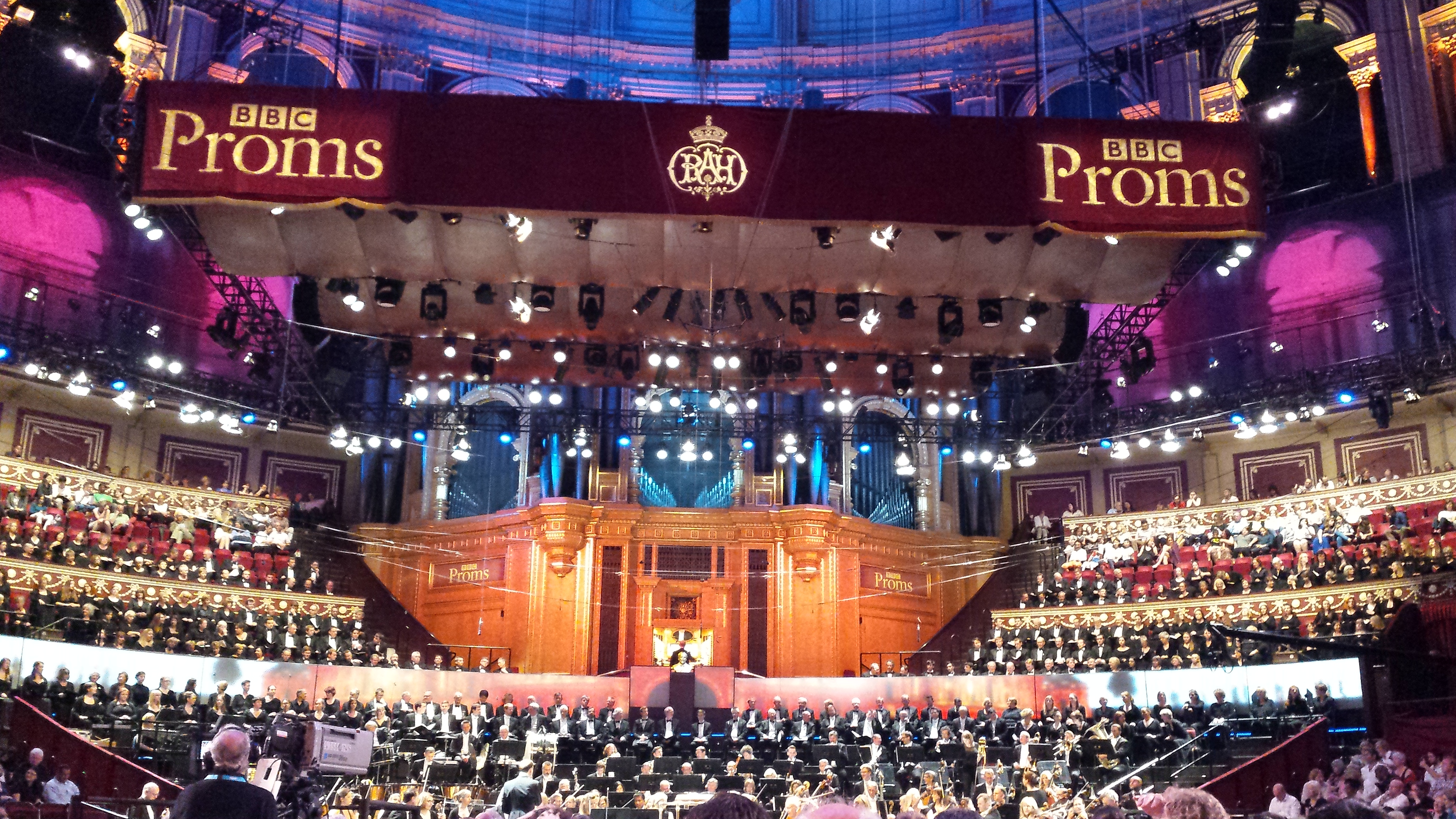
Walton, on the other hand, throws everything at his 35-minute tale, including the whole story in a choral dramatisation that at times threatened to take the roof off the Royal Albert Hall. With 256 singers (give or take one or two on the naked eye count from the Arena!) this was a massive scale on which to play out the story, and Christopher Maltman did a sterling job in the baritone solo role.
The chorus were the stars, though, and the combined forces of the BBC Singers, the BBC Symphony Chorus and the BBC National Chorus of Wales were absolutely superb; hair-raising, even. Their shout of “SLAIN!” when Belshazzar finally perished was terrifying. No less chilling was the macabre percussion used when the hand appears.
Yet the epic climax of the piece, with Babylon’s redemption trumping the empty jubilation of the feast, was the crowning glory. Brilliantly marshalled by Oramo and superbly sung by the assembled BBC National Chorus of Wales, BBC Singers and BBC Symphony Chorus, this was a piece to fire the starting gun on the 2015 Proms with maximum power. Here’s to the next 75!
Further listening
If this is your first encounter with the music of Walton, a strong recommendation goes to the composer’s Symphony no.1, his finest orchestral composition:
Sibelius‘ incidental music is curiously elusive – so here is some more in the form of his score for the play Pelléas et Mélisande. You will doubtless recognise the first movement, At the Castle Gate, as the music used for the BBC’s The Sky at Night:
If your curiousity is aroused for the third of the Belshazzar interpretations, this Spotify link gives you Handel‘s oratorio in its entirety:
This BBC Prom also included Nielsen’s ebullient overture to Maskarade and Mozart’s masterly Piano Concerto no.20, with soloist Lars Vogt. They are also on the iPlayer link above
It’s nearly time for the BBC Proms. The world’s biggest classical music festival – which seems to get bigger every year – starts this coming Friday at the Royal Albert Hall.
With so much to choose from Arcana has taken on the task of choosing ten Proms to attend, watch or listen to – which you can read about and preview below. The idea is to mix up a few obvious recommendations and a wildcard or two.
The Arcana coverage of the Proms is going to be a little bit different from your average review site. For a start any Prom reviewed in person will be experienced from the Arena rather than from a seat. This is for two reasons – the Arena has arguably the best acoustic in the notoriously tricky hall, and it’s also the place where the biggest cross section of musical public brush shoulders.
This year in its Proms coverage Arcana will also be focusing on new music, offering an appraisal of each premiere at the festival. This is a surprisingly demanding task, because there are 32 new pieces from the likes of Eric Whitacre, Hugh Wood and even a newly discovered work by Olivier Messiaen. An early interview on Arcana will feature percussionist Colin Currie talking about the new concerto into the open…, written for him by HK Gruber. So here we are then – ten Proms and tasters for you, however you intend to experience them. Happy Promming!
18 July: Ten Pieces Prom (Prom 2 – repeated on 19/7 at 11:00am) (TV)
Ten Pieces is the BBC’s initiative to get classical music into schools – but of course the learning need not stop there! This prom, presented by Dick and Dom, Molly Rainford and Dan Starkey, is comprised of all ten pieces, from John Adams’Short Ride in a Fast Machine through to the end of Stravinsky’s ballet The Firebird. Here’s a link to a preview of all ten pieces:
20 July: Thomas Tallis’ Spem in alium (Proms Chamber Music 1)
Once again Proms Chamber Music will visit the Cadogan Hall every Monday lunchtime – but to begin with The Cardinall’s Musick will perform sacred music by Cheryl Frances-Hoad – a world premiere – and the jawdropping Spem in alium of Thomas Tallis, a 40-part choral piece that simply has to be heard. Here is the Tallis Scholars’ conductor Peter Phillips discussing the work:
28 July: Prokofiev – Piano concertos 1-5 (Daniil Trifonov, Sergei Babayan and Alexei Volodin, London Symphony Orchestra / Valery Gergiev (Prom 14)
Not one for the faint hearted, this! Prokofiev wrote for the piano both as a percussion instrument and a lyrical one, so some of his works feature stabbing but often jaunty tunes. The Piano Concerto no.2 is particularly epic:
The world premiere of Sir James MacMillan’s Symphony no.4. Donald Runnicles will also conduct the underrated BBC Scottish Symphony Orchestra in Mahler’s Symphony no.5, which promises to bring new life to the old warhorse:
4 August: Monteverdi – Orfeo (Prom 25)
Described as ‘the first great opera’, Orfeo will be sung in Italian and conducted by Sir John Eliot Gardiner, who will, to quote the BBC Proms website, ‘transform the Royal Albert Hall into the 17th-century Mantuan court of the Gonzagas with some of Monteverdi’s loveliest melodies and most colourful instrumental writing’. Here’s what we have to look forward to:
5 August: Late Night with 6Music (Prom 27)
Following the successful 6Music night two years back, the station returns – this time with Mary Anne Hobbs at the helm to explore new music from two composers on the Erased Tapes label who write with classical music in mind. These are Nils Frahm…
An obvious recommendation perhaps, but if you wanted to see a Sibelius concert and had a choice of conductor, Osmö Vänska would surely be it. His interpretations of the composer are both incredibly detailed and deeply passionate, and the BBC Symphony Orchestra will no doubt fall under his spell for three of the composer’s symphonic masterpieces:
19 August: Elisabeth Leonskaja plays Mozart (Prom 45)
Elisabeth Leonskaja is quite simply one of the best pianists in the world today – and in Mozart’s Piano Concerto no.22 her performance should be sublime. Charles Dutoit and the RPO will no doubt prove sensitive accompanists – but in Debussy (the Petite Suite) and Shostakovich (Symphony no.15) they should also be rather special. Here is Leonskaja in solo Mozart:
9 September: Nielsen and Ives (Prom 72)
This intriguing night of music takes two wildly different forces from twentieth century music – anniversary composer Carl Nielsen, born 150 years ago, and the maverick Charles Ives, gradually revealed as one of the most influential composers of modern times. The former is represented by the impressive Violin Concerto, which will be played by the extravert violinist Henning Kraggerud. The latter by Symphony no.4, which really is best experienced in person. It contains a number of hymns, performed by a choir beforehand. Andrew Litton will be the guiding hand.
11 September: Elgar – Dream of Gerontius with Sir Simon Rattle (Prom 75)
Sir Simon Rattle returns for a second night at this year’s festival, leading the Vienna Philharmonic and a starry trio of soloists in Elgar’s magnificent choral work, with Toby Spence, Roderick Williams and wife Magdalena Kožená. Here’s an excerpt from the Berlin Philharmonic: