Arcana at the Proms – Prom 10: Laura van der Heijden, BBC Scottish Symphony Orchestra & Ryan Wigglesworth – Britten, Frances-Hoad & Elgar

Britten Gloriana – Symphonic Suite Op.53a (1953)
Frances-Hoad Cello Concerto ‘Earth, Sea, Air’ (2022) [Proms Premiere]
Elgar Symphony no.2 in E flat major Op.63 (1909-11)

Laura van der Heijden (cello), BBC Scottish Symphony Orchestra / Ryan Wigglesworth

Royal Albert Hall, London
Friday 26 July 2024

reviewed by Richard Whitehouse

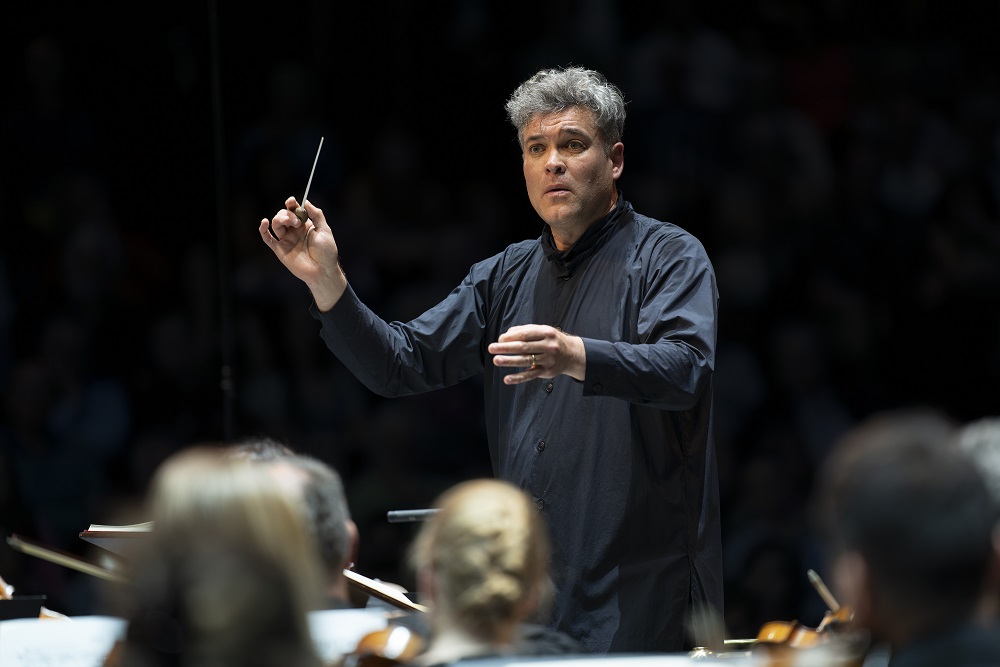
He might not be the only composer-conductor of his generation, but Ryan Wigglesworth has rapidly established himself among the best – as this concert with the BBC Scottish Symphony Orchestra, whose chief conductor he has been over these past two seasons, amply confirmed.

Other than Peter Grimes, the coolly received Gloriana was his only opera from which Britten extracted a concert suite. The vaunting syncopation of Tournament then wrenching fatalism of Gloriana moritura make for a telling framework, with this account at its most perceptive in the wistful poise of the Lute Song – the oboe being an eloquent replacement for the tenor thanks to Stella McCracken – then the evocative sequence of Courtly Dances where Britten effortlessly bridges the historical and the aesthetic divide between the eras of two Elizabeths.

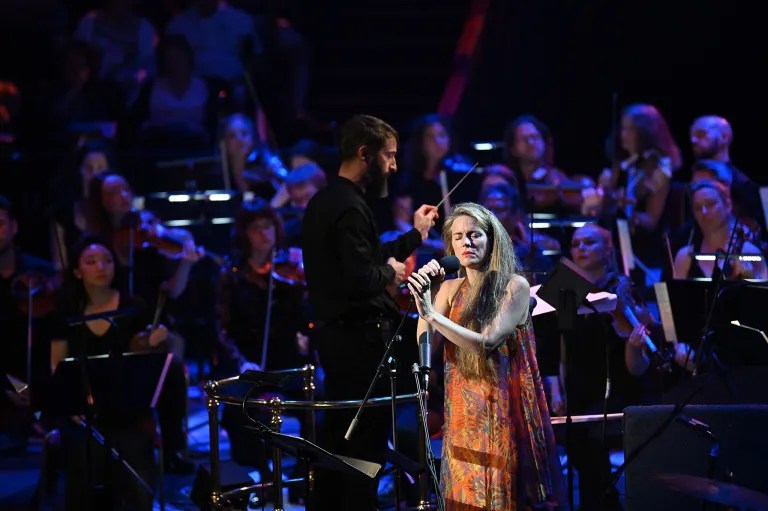
Next a first Proms hearing (just over a year after its Glasgow premiere) for the Cello Concerto by Cheryl Frances-Hoad. Drawing inspiration from recent research into diverse aspects of the natural world, the three continuous movements provide an arresting vantage on an outwardly traditional form. Hence the trajectory of swifts in flight, carbon-absorbing algae over oceanic expanses and gravitational force of volcanic activity each influencing the musical content of a rhythmically impulsive Allegro, harmonically diaphanous Larghetto and melodically soaring Presto giocoso; the whole afforded unity through its composer’s motivic resourcefulness and the engaging commitment of Laura van der Heijden (above) in her realizing of its solo part. She then responded to deserved applause with a limpid reading of Pablo Casals’ The Song of the Birds.
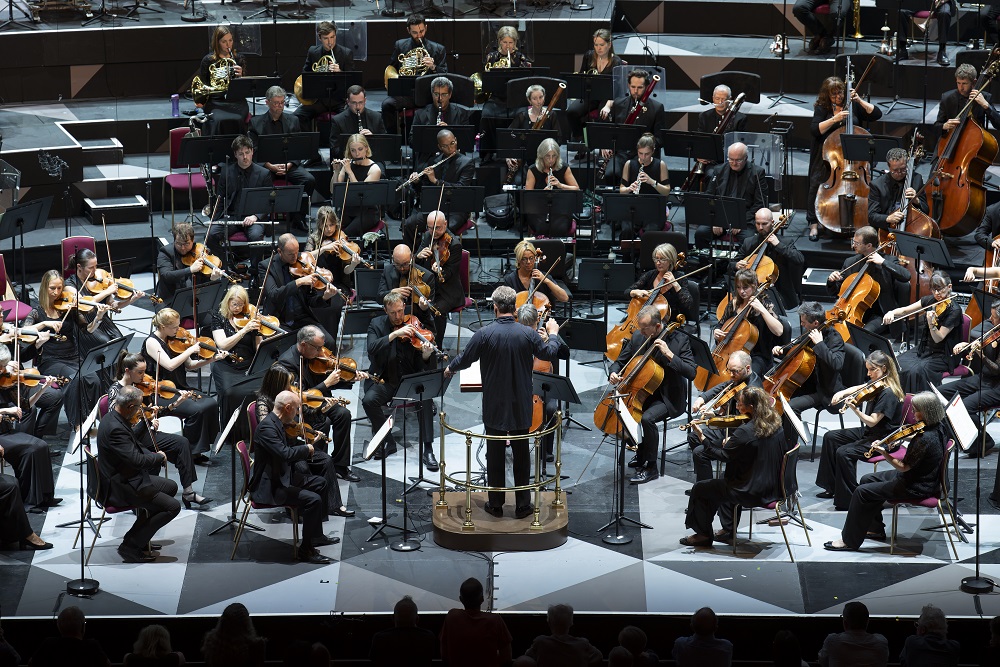
Elgar is a composer evidently close to Wigglesworth’s heart and this evening’s account of his Second Symphony did not disappoint. Launched a little too circumspectly, the initial Allegro duly found a persuasive balance between bounding energy and that musing uncertainty to the fore in the otherworldly processional near its centre. Its overall extroversion was countered by the Larghetto – circumstantial association with the death of Edward VII having tempted many into a funereal pacing but not Wigglesworth, whose handling of its cumulative halves brought sustained emotional intensity framed by the stark lamentation with which it begins and ends.

One of Elgar’s most formally subtle and expressively audacious movements, the scherzo had the requisite impetuousness and nonchalance, thrown into relief by the mechanistic violence towards its core and unnerving energy at its close. Moderate in tempo and not overly majestic in outlook the finale might have been thought anti-climactic, but Wigglesworth’s keen sense of its long-term unfolding emerged in the searching ambivalence of its development and the understated grandeur of a peroration which did not require reinforcing with an organ pedal. Those closing pages could have yielded even greater pathos, but their suffused fatalism was wholly in accord with the conductor’s conception of this movement, as of the work overall.

Just over a year before, Wigglesworth presided over an inspirational account in Birmingham of The Dream of Gerontius. Tonight’s performance of the Second Symphony might not have been quite its equal, but it more than confirmed him as an Elgar interpreter of genuine stature.

For more on this year’s festival, visit the BBC Proms website – and for more on the artists involved, click on the names to read more about Laura van der Heijden, the BBC Scottish Symphony Orchestra and conductor Ryan Wigglesworth, and composer Cheryl Frances-Hoad

Published post no.2,253 – Sunday 28 July 2024

Arcana at the Proms – Prom 8: Nick Drake – An Orchestral Celebration

Olivia Chaney, Marika Hackman, BC Camplight, Scott Matthews, The Unthanks, BBC Symphony Orchestra / Jules Buckley

Royal Albert Hall, London
Wednesday 24 July 2024

reviewed by John Earls Pictures below (c) John Earls and (bottom) Chris Christodoulou

This November sees the 50th anniversary of the tragic death of the English singer-songwriter Nick Drake at the age of 26, having released just three albums of beautiful, bittersweet songs. Little known at the time, his reputation and influence has grown significantly.

This 2024 BBC Prom – an ‘orchestral celebration’ of his music – was destined to be something quite special and credit should go to British journalist and broadcaster John Wilson for proposing it.

Jules Buckley, here conducting the BBC Symphony Orchestra, has been involved in a number of BBC Proms over the years giving orchestral twists to contemporary music. Many of Drake’s songs were released at the time with string arrangements by Robert Kirby (it was good to hear Buckley pay tribute to Kirby who he referred to as “Nick Drake’s foil”) and these were developed, as well as some new ones added, by a number of other arrangers for this concert.

Following a gripping opening of the instrumental Introduction from Drake’s Bryter Layter album, BC Camplight gave excellent performances of Fly and Pink Moon which was deftly accompanied by strings and horns. Alas, his closing of the concert with Drake’s classic Saturday Sun didn’t quite cut it, being a bit too schmaltzy for this reviewer. However, the final all orchestral piece, an arrangement by Sam Gale of Horn, a sparse solo guitar piece from Pink Moon, was luminous and intense, culminating in a poignant solo trumpet.

Marika Hackman gave enchanting versions of Fruit Tree and River Man and her take on Time Has Told Me was a wonderfully smoky blues accompanied by drums, organ and guitar (Neill MacColl did some sterling work throughout the evening).

Scott Matthews opened his account with a wonderful Way to Blue with dramatic strings and timpani which, from where I was sitting, at times slightly overpowered his delicate voice, something rectified in the second half for his lovely performances of Northern Sky and From the Morning.

Olivia Chaney (above) gave a strong vocal performance of Hazey Jane I and a terrific version of At the Chime of a City Clock where the strings and horns were again particularly effective. Her solo piano rendition of Time of No Reply was outstanding.

Two of the most moving moments did not feature Nick Drake songs at all but those of his mother Molly. The Unthanks performed touching versions of What Can a Song Do to You? and Set Me Free and were joined by Drake’s sister Gabrielle reciting some of Molly’s poems in both cases. It was extremely affecting.

One can only imagine what Gabrielle Drake must have thought hearing the songs of her brother (and mother) performed in this way after so many years to a packed Royal Albert Hall that listened respectfully and lovingly. It was fitting testimony to the enduring quality of the music of an extraordinary songwriter.

This concert (including interval discussion with John Wilson, Radio 3 presenter Elizabeth Alker and Gabrielle Drake) is available on BBC Sounds until early October. For more on the 2024 BBC Proms, visit the festival’s website at the BBC, and click on the link to read John Earls’ review of Richard Morton Jack’s biography on Nick Drake: The Life. 

John Earls is Director of Research at Unite the Union and tweets / updates his ‘X’ account at @john_earls

Published post no.2,250 – Thursday 25 July 2024

Arcana at the Proms – Prom 5: BBC National Orchestra of Wales & Ryan Bancroft – Schoenberg & Zemlinsky

Schoenberg Pelleas und Melisande Op.5 (1902-03)
Zemlinsky Die Seejungfrau (1902-03)

BBC National Orchestra of Wales / Ryan Bancroft

Royal Albert Hall, London
Monday 22 July 2024

reviewed by Richard Whitehouse

While the Proms has periodically resorted to re-creating concerts from its earlier years, there have been relatively few attempts to recreate groundbreaking events elsewhere – so making this replication of a programme played in Vienna on 25th January 1905 the more significant. Neither work enjoyed regular revival until the 1980s – the Schoenberg through logistics and the Zemlinsky through inaccessibility – but their expansive all-round scope, and their lavish forces, ensured that both were heard to advantage in the opulent Royal Albert Hall ambience.

It is not clear whether this running-order was that of the Vienna concert, where Schoenberg’s symphonic poem Pelleas und Melisande was lauded as the more original statement. Which is true as regards its late-Romantic idiom on the cusp of nascent Modernism, but the composer made things more difficult than they might be through his approach to form, whose outcome Busoni likened to ‘‘a number of sharp implements jostling in a sack’’. Maurice Maeterlinck’s drama may be covered in its essentials, but the challenge of channelling this into a systematic evolution make for an undeniably episodic trajectory. Ryan Bancroft succeeded admirably in holding together the sprawling whole, not least with his relatively swift (40-minute) traversal that kept the narrative aspect always in focus, while emphasizing the numerous harmonic and textural innovations. Nor was the BBC National Orchestra of Wales lacking in power, finesse or, indeed, that clarity needed to convey the density of Schoenberg’s motivic thinking, but the feeling of this work being ultimately being no more than the sum of its parts was inescapable.

Not something as could be levelled at Die Seejungfrau, Zemlinsky’s symphonic fantasy after Hans Christian Andersen that was well received if soon condemned as unduly derivative and disappeared after the score was withdrawn in 1907 – only to resurface 77 years later. It might lack the force and personality of Schoenberg, but Zemlinsky’s handling of an orchestra only slightly less extensive is comparatively effortless; the formal division into three movements of almost equal duration providing an overview of, without being beholden to the narrative, while enabling its composer’s hardly less resourceful handling of motifs to evolve with due artlessness. True, Zemlinsky’s melodic language leans more audibly on others (chief among them Tchaikovsky and Mahler), but its unforced spontaneity feels in striking contrast to the portentous, even over-wrought aspect of Schoenberg’s writing. BBCNOW responded with unfailing sensitivity, and Bancroft ensured a seamless unfolding over each movement as of the work overall. For all its stylistic derivation, Zemlinsky’s is intrinsically the better piece.

Such an outcome may not have been evident had the pieces been otherwise juxtaposed, such as only made the decision to present them thus the more worthwhile. Clearly attuned to their notably differing idioms, Bancroft brought out the best in both works (interestingly he opted to omit the ‘Sea Witch’ episode from the second movement, excised before the premiere but restored in the critical edition of 2013) – their respective qualities able to be assessed in more objective terms, now that consideration of ‘historical necessity’ has itself receded into history.

For more on this year’s festival, visit the BBC Proms website – and for more on the artists involved, click on the names to read more about the BBC National Orchestra of Wales and conductor Ryan Bancroft. Dedicated pages for the composers can be accessed by clicking on Schoenberg and Zemlinsky

Published post no.2,249 – Wednesday 24 July 2024

In concert – Music For Youth Proms 2022 @ Royal Albert Hall

Review and photos by Ben Hogwood

There is a justified amount of doom and gloom in the arts at present, with organisations striving for increases in attendance figures while clinging to the hope that their funding will not fall through the trapdoor, as it effectively has done in the recent Arts Council England announcements for English National Opera, Britten Sinfonia and London Sinfonietta, to name just a few.

Art forms are nothing if not resilient though, especially when powered by raw talent, enthusiasm and hard work – as this night of Music For Youth Proms clearly was. How inspiring it was to see hundreds of young performers create their own bookmark experiences at the Royal Albert Hall, delivering performances of power, confidence and poise, fuelled by a clear and sheer enjoyment of music.

There was no evidence of stage nerves as performers ranging from aged six to 25, from Gwent to Ukraine (via London) united together in music, each and every one of them doing themselves proud under the Music For Youth umbrella. The registered charity works, in its own words, ‘to provide young people aged 21 and under across the UK with free, life-changing performance and progression opportunities, regardless of background or musical style’.

The range of musical styles here was testament to this approach, creating an environment where genres can be celebrated rather than restrictive. The word ‘Proms’ may still conjure images of seated classical concerts, with a smattering of world music maybe, but here it stood for hip hop, soul, brass band, solo vocals, choir, classical for small and large orchestras and even jazz fusion bands.

To pick out a single performer would be unfair, as each one was fully deserving of their moment in the spotlight. For raw, upfront sass, the Sedgehill Academy Rap Collective from Lewisham excelled, especially when three soloists came forward to take the game to the audience, their sparky wordplay in original compositions making the Girls Rap Collective a thrilling live experience.

Illustrating the breadth of this country’s music, an affecting performance of Vaughan Williams’ Fantasia on a theme of Thomas Tallis followed from Musica Youth Strings, the Huddersfield-based ensemble giving true depth of feeling in their cleverly abridged account.

Cantilena from the Abbey Junior School in Reading were next, utterly charming as they sang The Puzzle and Silver Moon. They were complemented in the second half by the remarkably accomplished singing of the Northamptonshire County Youth Choir, whose accounts of music by Bob Chilcott (The Isle is Full of Noises) and Ola Gjeilo (Northern Lights) were breathtaking in both accuracy and emotion.

The brass players excelled, too – Gwent Youth Brass Ensemble in 3 Brass Dances by Ryan Linham, and the Mountbatten Big Band bringing exuberant lines to their Brooklyn medley. That the ensemble made such a big impression after No Trixx, a London fusion band of formidable musical capability, said much for their spirit.

The lasting image of the first half was provided by Ukrainian students from LPMAM (The London Performing Academy of Music, above), cleverly working Queen’s The Show Must Go On into the torch song Melody, from Ukrainian composer Skoryk. The students are on permanent placements at LPMAM, thanks to an initiative headed by conductor Stefania Passamonte, whose initiative and drive continues to bring more funding to enable more students to come over and base themselves in London. Judging by this performance they are revelling in the experience – typified by oboist Lola Marchenko, whose solos in both songs stayed long in the memory.

The second half of the Proms was similarly spectacular, with hundreds of singers and orchestral players forming the Lincolnshire Massed Ensemble (above). They delivered a Beyoncé medley of eye-opening power and positivity, headed by a group of girls whose vocals and dance moves showed just what a positive influence the former Destiny’s Child singer has exerted on them. As a celebration of 30 years of the Boston Music Centre, this took some beating.

From hundreds to just two, and the Emeli Sandé-influenced duo Chris and Baaba, whose intimate odes to friendship struck a very different but equally affecting chord, drawing the audience in closer to the round of the Albert Hall. We then heard remarkably assured solos from the York Music Forum Youth Jazz Ensemble, their Blue Matter a collection of cultured solos. A bracing account of the Overture to Hérold’s opera Zampa followed, given an excellent account by the City of Belfast Youth Orchestra. Finally, The Spy Game brought us full circle back to rap with Wag1Fam, a Stormzy-esque anthem to which the group bounced across the stage, never missing a note or a word.

The finale, a specially composed song Back Together, united all artists in a celebratory mood, a show of resolve and unexpected defiance.

Clearly this country – in the face of apparent efforts from on high to downplay the importance of music education – continues to nurture music making of astounding ability and refreshing confidence. Music For Youth is the ideal platform from which these artists can grow – but what needs to happen now is for them to get the ongoing support their talent craves and deserves. Politicians take note – music is a force for so much good and should be treated as such.

BBC Proms #7 – Soloists, La Nuova Musica / David Bates: Purcell Dido and Aeneas

Purcell Dido and Aeneas (c1689)

Dido – Alice Coote (mezzo-soprano)
Aeneas – James Newby (baritone)
Belinda – Gemma Summerfield (soprano)
Sorceress – Madeleine Shaw (mezzo-soprano)
Second Woman – Nardus Williams (soprano)
Sailor – Nicky Spence (tenor)
Spirit – Tim Mead (countertenor)
First Witch – Helen Charleston (mezzo-soprano)
Second Witch – Martha McLorinan (mezzo-soprano)

La Nuova Musica / David Bates (harpsichord)

Royal Albert Hall, London
Tuesday 19 July 2022 (late night)

Reviewed by Richard Whitehouse Photo (c) Chris Christodoulou

After the existential confrontations of Vaughan Williams and Tippett earlier this evening, the more restrained yet no less acute expression of Dido and Aeneas came as a necessary tonic – with Purcell’s only through-composed work for the stage leaving a memorable impression.

The nature of its conception might remain as conjectural as the circumstances of its premiere, but there can be no doubt that this opera’s blazed a trail over the centuries that followed. Not the least of its attributes is a formal economy and a tensile dramatic trajectory whose ‘less is more’ aspect could scarcely be more evident. Neither is there any lack of expressive diversity in a score where elements of levity, even slapstick are aligned with a dramatic acuity which draws the three short but judiciously balanced acts into a cohesive and inevitable continuity.

Tonight’s concert performance manifestly played to these strengths. For the title-roles, Alice Coote brought gravitas and nobility of spirit to that of Dido, with James Newby an impulsive while knowingly fickle Aeneas. It was, however, Gemma Summerfield who stole the show as Belinda in rendering this most dramatically fluid of the opera’s parts with an emotional force, latterly foreboding, that was never less than captivating. Madeleine Shaw was larger than life if never overly parodic as the Sorceress, with Tim Mead a plangent Spirit whose intervention (from the organ console) seals the fate of the main protagonists. Credit, too, to Nicky Spence for an uproarious yet winning cameo as the Sailor in a scene whose Village People campery seemed entirely apposite in context and hence made this opera’s outcome the more affecting.

Directing La Nova Musica from the harpsichord, David Bates never lost sight of the dramatic continuity while ensuring an exemplary balance between chorus and ensemble. The former responded with a judicious combination of eloquence and discipline, whereas the emphasis on a continuo section of theorbos, harps and even guitar opened out but never obliterated the bracing string sonorities. Tempos were almost invariably well chosen, and though the final chorus was undeniably drawn out, this reinforced its postludial function to the work overall.

The past 58 seasons have since Dido and Aeneas given complete on four previous occasions, each time reflecting on how the opera was perceived at the time. Tonight’s performance was such a statement, and one as reaffirmed its greatness some 333 years after the first staging.

For more information on the 2022 BBC Proms season, you can visit the festival website. For more on the artists, click on the names for La Nuova Musica and David Bates.