In concert – Peter Moore, London Symphony Orchestra / Ryan Bancroft @ BBC Proms: Folk Songs & Dances

Peter Moore (trombone), London Symphony Orchestra / Ryan Bancroft

Vaughan Williams English Folk Song Suite (1923)
Schuller Eine kleine Posaunenmusik (1980) [Proms premiere]
Tippett Triumph (1992) [Proms premiere]
Arnold arr. Johnstone English Dances Set 1 Op.27 (1950, arr. 1965)
Grainger The Lads of Wamphray (1904), Country Gardens (1918, arr. 1953), Lincolnshire Posy (1937)

Royal Albert Hall, London
Saturday 30 August 2025 11am

Reviewed by Richard Whitehouse Photos (c) BBC / Chris Christodoulou

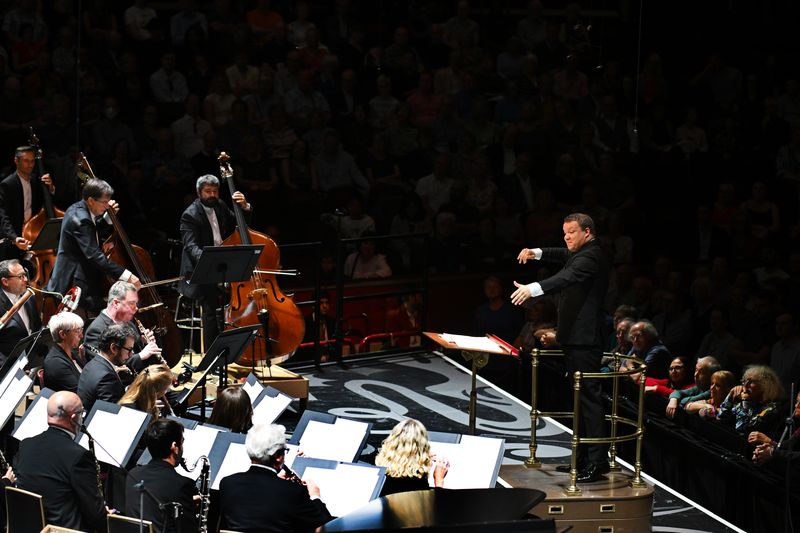
His pained countenance may have adorned its programme cover but Sir Simon Rattle’s ‘routine surgery’ meant this morning’s Prom was directed by Ryan Bancroft, though the works played by woodwind and brass (and basses) of the London Symphony Orchestra remained the same.

The concert duly breezed into life with Vaughan WilliamsEnglish Folksong Suite, heard in its original scoring for concert (i.e. – military) band such as imparts a forthright impetus to its outer marches – the former alternating brusqueness with insouciance, and the latter similarly balancing energy with geniality. In between these, the intermezzo provided welcome respite with its soulful medley. Expert as are the arrangements for orchestra by Gordon Jabob or for brass band by Frank Wright, this remains the ideal medium for an unassuming masterpiece.

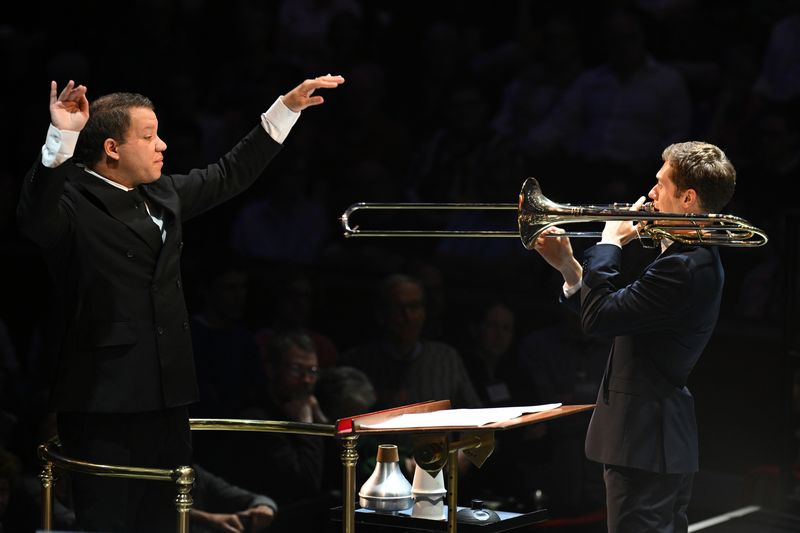
It would have been remiss of the Proms not to include a piece by Gunther Schuller in the year of his centenary, with Eine Kleine Posaunenmusik being a fine choice in context. Fastidiously scored for trombone and ensemble, whose wind and brass melded into tuned percussion with notable solos from piano and harpsichord, its five succinct movements outline a succession of vignettes in which Peter Moore sounded as attuned expressively as technically. With music as distinctive as this, Schuller’s fourth appearance at these concerts will hopefully not be his last.

Surprising that Michael Tippett’s Triumph should have remained so obscure within his output. Seemingly made during work on The Rose Lake, this ‘Paraphrase on Music from The Mask of Time’ is for the greater part his arrangement of the oratorio’s sixth movement, though it could be heard as encapsulating his music over the decade from the mid-’70s. The main portion pits fractured lyricism against dissonant outbursts as befits its genesis in a setting of Shelley’s The Triumph of Life and, if the closing affirmation sounds added-on, its finality is hardly in doubt.

There could hardly have been a more pointed contrast than with Malcolm Arnold’s initial set of English Dances – its sequence of winsome, bracing, elegiac then energetic numbers ideally conveyed in Maurice Johnstone’s arrangement. Their concision was thrown into relief by the relative garrulousness of The Lads of Wamphray, an early example of Percy Grainger’s love for folksong which, in this instance, rather outstays its welcome. Rattle presumably enjoys it and Bancroft gave it its head, but its inclusion here was not warranted by its musical quality.

From the other end of Grainger’s career, his concert-band arrangement of Country Gardens exudes all the wit and irony of his later creativity. It made a canny upbeat into Lincolnshire Posy, one of a select handful of concert band masterpieces and where the LSO gave its all. Thus, the incisive Lisbon (Dublin Bay) was followed by the pathos-drenched Horkstow Grange then intricately imaginative Rufford Park Poachers; the jaunty The Brisk Young Sailor by the darkly rhetorical Lord Melbourne (very different from Britten’s elegiac take).

The surging impetus of The Lost Lady Found brought to a suitably rousing close this suite and what was a fine showcase for the LSO woodwind and brass, an unexpected if welcome appearance by Bancroft and, above all, a demonstration of the potential of the concert band.

Click on the artist names to read more about Peter Moore, the London Symphony Orchestra and conductor Ryan Bancroft. Click also for more on composer Gunter Schuller and the BBC Proms

Published post no.2,644 – Monday 1 September 2025

Arcana at the Proms – Prom 5: BBC National Orchestra of Wales & Ryan Bancroft – Schoenberg & Zemlinsky

Schoenberg Pelleas und Melisande Op.5 (1902-03)
Zemlinsky Die Seejungfrau (1902-03)

BBC National Orchestra of Wales / Ryan Bancroft

Royal Albert Hall, London
Monday 22 July 2024

reviewed by Richard Whitehouse

While the Proms has periodically resorted to re-creating concerts from its earlier years, there have been relatively few attempts to recreate groundbreaking events elsewhere – so making this replication of a programme played in Vienna on 25th January 1905 the more significant. Neither work enjoyed regular revival until the 1980s – the Schoenberg through logistics and the Zemlinsky through inaccessibility – but their expansive all-round scope, and their lavish forces, ensured that both were heard to advantage in the opulent Royal Albert Hall ambience.

It is not clear whether this running-order was that of the Vienna concert, where Schoenberg’s symphonic poem Pelleas und Melisande was lauded as the more original statement. Which is true as regards its late-Romantic idiom on the cusp of nascent Modernism, but the composer made things more difficult than they might be through his approach to form, whose outcome Busoni likened to ‘‘a number of sharp implements jostling in a sack’’. Maurice Maeterlinck’s drama may be covered in its essentials, but the challenge of channelling this into a systematic evolution make for an undeniably episodic trajectory. Ryan Bancroft succeeded admirably in holding together the sprawling whole, not least with his relatively swift (40-minute) traversal that kept the narrative aspect always in focus, while emphasizing the numerous harmonic and textural innovations. Nor was the BBC National Orchestra of Wales lacking in power, finesse or, indeed, that clarity needed to convey the density of Schoenberg’s motivic thinking, but the feeling of this work being ultimately being no more than the sum of its parts was inescapable.

Not something as could be levelled at Die Seejungfrau, Zemlinsky’s symphonic fantasy after Hans Christian Andersen that was well received if soon condemned as unduly derivative and disappeared after the score was withdrawn in 1907 – only to resurface 77 years later. It might lack the force and personality of Schoenberg, but Zemlinsky’s handling of an orchestra only slightly less extensive is comparatively effortless; the formal division into three movements of almost equal duration providing an overview of, without being beholden to the narrative, while enabling its composer’s hardly less resourceful handling of motifs to evolve with due artlessness. True, Zemlinsky’s melodic language leans more audibly on others (chief among them Tchaikovsky and Mahler), but its unforced spontaneity feels in striking contrast to the portentous, even over-wrought aspect of Schoenberg’s writing. BBCNOW responded with unfailing sensitivity, and Bancroft ensured a seamless unfolding over each movement as of the work overall. For all its stylistic derivation, Zemlinsky’s is intrinsically the better piece.

Such an outcome may not have been evident had the pieces been otherwise juxtaposed, such as only made the decision to present them thus the more worthwhile. Clearly attuned to their notably differing idioms, Bancroft brought out the best in both works (interestingly he opted to omit the ‘Sea Witch’ episode from the second movement, excised before the premiere but restored in the critical edition of 2013) – their respective qualities able to be assessed in more objective terms, now that consideration of ‘historical necessity’ has itself receded into history.

For more on this year’s festival, visit the BBC Proms website – and for more on the artists involved, click on the names to read more about the BBC National Orchestra of Wales and conductor Ryan Bancroft. Dedicated pages for the composers can be accessed by clicking on Schoenberg and Zemlinsky

Published post no.2,249 – Wednesday 24 July 2024

In concert – Oliver Janes, CBSO / Ryan Bancroft: Adams, Mozart & Rachmaninoff

Adams The Chairman Dances (1985)
Mozart Clarinet Concerto in A major K622 (1791)
Rachmaninoff Symphonic Dances Op.45 (1940)

Oliver Janes (clarinet), City of Birmingham Symphony Orchestra / Ryan Bancroft

Symphony Hall, Birmingham
Wednesday 2 November 2022 [2.15pm]

Reviewed by Richard Whitehouse

Back from its successful US tour (the first such in almost a quarter of a century), the City of Birmingham Symphony Orchestra this afternoon returned to Symphony Hall for what was a programme of contrasts in which an element of dance seldom lurked far beneath the surface.

Although it is often considered emblematic of his opera Nixon in China, John Adams wrote The Chairman Dances well before completing the larger work – this ‘Foxtrot for Orchestra’ encapsulating much of its atmosphere without being intrinsic to its content. Capricious while shot through with a tellingly distanced nostalgia, this remains among Adams’s most effective concert pieces and Ryan Bancroft secured a fine account whose meticulous attention to detail was not without corresponding panache – down to its percussive ‘winding down’ at the close.

It is (nearly) always welcome when an orchestra’s section leader takes the platform as soloist, as was proven with Oliver Janes in Mozart’s Clarinet Concerto – easily the most popular such piece in its repertoire yet one that can easily seem bland or even characterless in performance. There was little chance of that here – not least with a swift and purposeful take on the opening Allegro that left relatively little room for lingering over incidental detail, even if something of its underlying elegance was sacrificed with Janes’s powers of articulation pressed to the limit.

This approach paid dividends in the remaining movements, not least an Adagio whose limpid eloquence was conveyed without trace of indulgence or wanton sentiment. The final Allegro, too, had a winning buoyancy – Janes evincing a deftness and spontaneity to which the CBSO responded in kind, and with a surge of energy towards the closing chords. It set the seal on an appealing rendition which, perhaps surprisingly, Janes will not repeat at tomorrow evening’s concert from Warwick Arts Centre – when that by Gerald Finzi will be the concerto on offer.

Soon to take the reins at the Royal Stockholm Philharmonic, Bancroft is evidently a conductor on a roll as was confirmed by his take on Rachmaninoff’s Symphonic Dances. A triptych that abounds in felicitous detail (as is often belied, if not actually concealed, by the score’s lack of expression markings), it needs flexible direction for each movement to cohere, and Bancroft had their measure. The first exuded a suspenseful energy that, in its central section, took on a winsome pathos embodied by its alto saxophone melody (affectingly played by Kyle Horch).

Even more persuasive was the sardonic central dance, its waltz motion underpinning some of the composer’s most astringent harmonies as were pointedly emphasized here. If the charged outer sections of the final dance lacked the ultimate in exhilaration, the quality of the CBSO’s response was never in doubt. In the slower middle episode, moreover, Bancroft’s deliberation ideally clarified those frequently dense textures whose expressive poise is achieved, uniquely for Rachmaninoff, without recourse to an actual melody. A sign of things to come, perhaps?

Bancroft will hopefully be returning next season, but the present one continues with events to mark the 150th anniversary of Vaughan Williams’s birth – including two of his symphonies and the film Scott of the Antarctic, for which the CBSO is contributing live accompaniment.

You can read all about the 2022/23 season and book tickets at the CBSO website. For more information on the artists, click on the names of Ryan Bancroft and Oliver Janes

In concert – Clara-Jumi Kang, CBSO / Ryan Bancroft – Coleridge-Taylor, Mendelssohn & Sibelius

clara-jumi-kang

Coleridge-Taylor Solemn Prelude in B minor, Op. 40 (1899)
Mendelssohn Violin Concerto in E minor, Op. 64 (1844)
Sibelius Symphony No. 2 in D, Op. 43 (1901-2)

Clara-Jumi Kang (violin), City of Birmingham Symphony Orchestra / Ryan Bancroft

Symphony Hall, Birmingham
Thursday 13 January 2022

Written by Richard Whitehouse Ryan Bancroft picture (c) Benjamin Ealovega

Having seen in the new year in customary Viennese-style, the City of Birmingham Symphony Orchestra continued its season with this programme of repertoire staples along with what was (probably) only the third performance of a relatively early orchestral work by Samuel Coleridge-Taylor.

The recent revival of interest in Coleridge-Taylor hopefully means such enticing pieces as his Violin Concerto and Clarinet Quintet will be heard more frequently at concert hall and recital rooms. If the Solemn Prelude is not quite on their level, it certainly deserved more than total neglect following its premiere at Worcester Cathedral in 1899; a further hearing last July only made possible after the manuscript was relocated at the British Library. Combining Elgarian nobility with Brucknerian grandeur, its outer sections exude a portentousness complemented by the expressive immediacy at its centre; abetted here by Ryan Bancroft’s flexible handling of tempo so a welcome melodic spontaneity came to the fore. No undiscovered masterpiece, but an appealing work that doubtless fulfilled its remit back then and could do so again today.

Mendelssohn’s Violin Concerto has never lacked for performances during the 177 years of its existence such that familiarity can breed, if not contempt, then at least a certain predictability. Credit to Clara-Jumi Kang for reminding one how (to quote David Kettle’s apt description in the programme) ‘‘quietly innovative’’ the piece is as to formal continuity and motivic fluidity. Not that this was a low-key or understated reading – Kang bringing out the combative side of the opening Allegro (‘appassionato’ it duly was), not least her impetuous take on the central cadenza whose developmental function was tellingly underlined. The Andante melded warm lyricism and plaintive regret to a bewitching effect then, after its teasing entrée, the animated repartee of the finale was deftly rendered through to a vivacious coda and decisive conclusion.

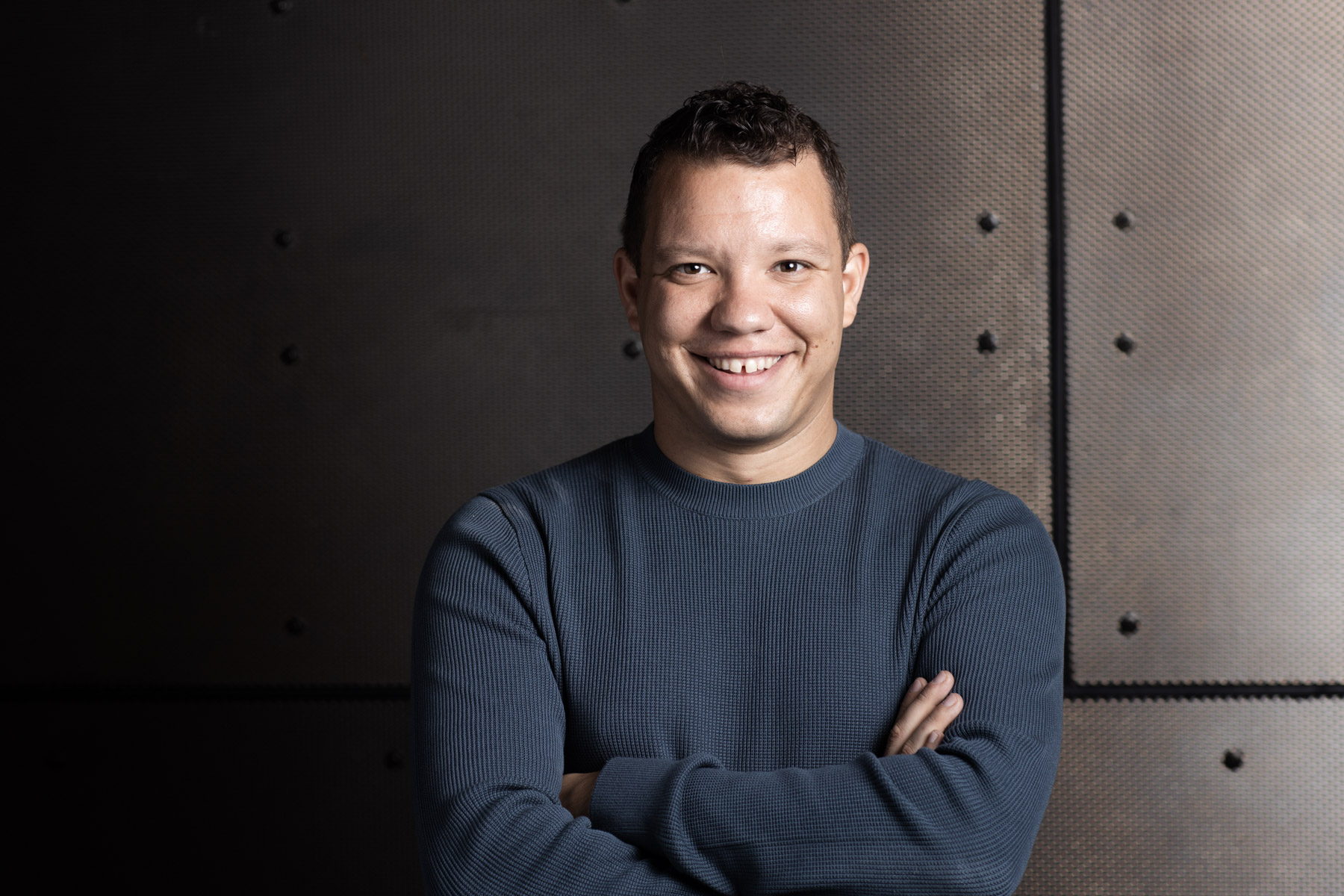
Now in his early thirties, Bancroft (above) is into his second season as principal conductor of the BBC National Orchestra of Wales and takes up a similar post with Royal Stockholm Philharmonic in 2023. This account of Sibelius’s Second Symphony left little doubt as to his interpretative credentials, not least with a finely proportioned yet impulsive reading of the initial Allegretto, then an Andante as lacked in little in that formal focus essential if its fervour is not to become histrionic. To which, an attacca from one movement to the other might have been beneficial.

The latter movements run continuously in any case – and, after a scherzo by turns tensile and tender, the transition was unerringly handled such that the finale hit the ground running. This can easily become discursive or even sprawl but, with its ‘big tune’ kept in check and starkly modal second theme keenly ominous, it built purposefully and with some inevitability to an apotheosis that, while it evinced more in the way of triumph than catharsis, none the less set the seal on an idiomatic performance with the CBSO woodwind and brass often at their best.

After an evening of Stephen Sondheim (now the more poignant following his death last November), then chief conductor designate Kazudi Yamada returns on Wednesday 19 and Thursday 20 January in a programme of Strauss, Mozart and Mahler.

For more information on the next concerts with Kazudi Yamada you can visit the orchestra’s website. Meanwhile click on the links for information on Clara Jumi-Kang and Ryan Bancroft.