As today is World Violin Day, here is a suitable piece to take us into the weekend! Hilary Hahn and the WDR Sinfonieorchester Köln under Semyon Bychkov oblige…
Published post no.2,392 – Friday 13 December 2024

As today is World Violin Day, here is a suitable piece to take us into the weekend! Hilary Hahn and the WDR Sinfonieorchester Köln under Semyon Bychkov oblige…
Published post no.2,392 – Friday 13 December 2024

by Ben Hogwood
This month we mark 200 years since the birth of Czech composer Bedřich Smetana in Litomyšl, east of Prague, on 2 March 1824.
Smetana is fondly regarded as the father of Czech music, his output spearheaded by the remarkable cycle of six symphonic poems Má vlast (My Country), containing vivid descriptions not just of the Czech countryside but also its architecture and history.
A new recording of the cycle has just been issued by the Czech Philharmonic Orchestra and their conductor Semyon Bychkov, on the Pentatone label, and it is included on the playlist below. However – as I hope you will find – there is a lot more to Smetana than this wonderful sequence alone.
The String Quartet no.1, subtitled From My Life, is a poignant tale of the composer’s life and subsequent deafness, unforgettably portrayed in the finale by the first violin. Also worth investigating in the composer’s chamber music output are the Second String Quartet and Piano Trio, while the inclusion of Richard III shows a depth of Smetana’s orchestral writing that is yet to be fully exploited in concert or on record. Make a note, too, of his contribution to Romantic piano music, in a series of attractive polkas.
Smetana’s contribution to opera is perhaps his principal legacy. Two works in particular stand out – The Bartered Bride, from 1866, and Dalibor, completed two years later. While very short excerpts from these are included in the playlist, I have included links to complete performances so that you can become acquainted with them.
Hopefully Smetana’s music will be celebrated in the concert hall as the year progresses, for it is generously melodic and passionate. The more you hear, the more rewarding it becomes!
Published post no.2,108 – Tuesday 5 March 2024

Prom 65 – BBC Symphony Orchestra / Semyon Bychkov
Bruckner Symphony no.8 in C minor WAB108 (1884-7, rev. 1889-90 [ed. Nowak])
Royal Albert Hall, London
Monday 4 September 2023
by Richard Whitehouse photos by Chris Christodoulou / BBC
It may have taken 70 years for its Proms premiere but the Eighth has since become the second most often played of Bruckner’s symphonies (this being its 21st hearing), and a near capacity house greeted tonight’s performance by the BBC Symphony Orchestra with Semyon Bychkov.
At home across a broad repertoire, Bychkov has of yet directed relatively little Bruckner, and the first movement took its time to settle. Fugitive rather than speculative in their emotional import, those distinct motivic elements lacked a final degree of definition and only began to take on greater cumulative focus during a development whose unfolding drama was matched but not exceeded by the climax of the coda – after which, that inexorable winding down into silence was precisely controlled while curiously unevocative in its sense of time running out.
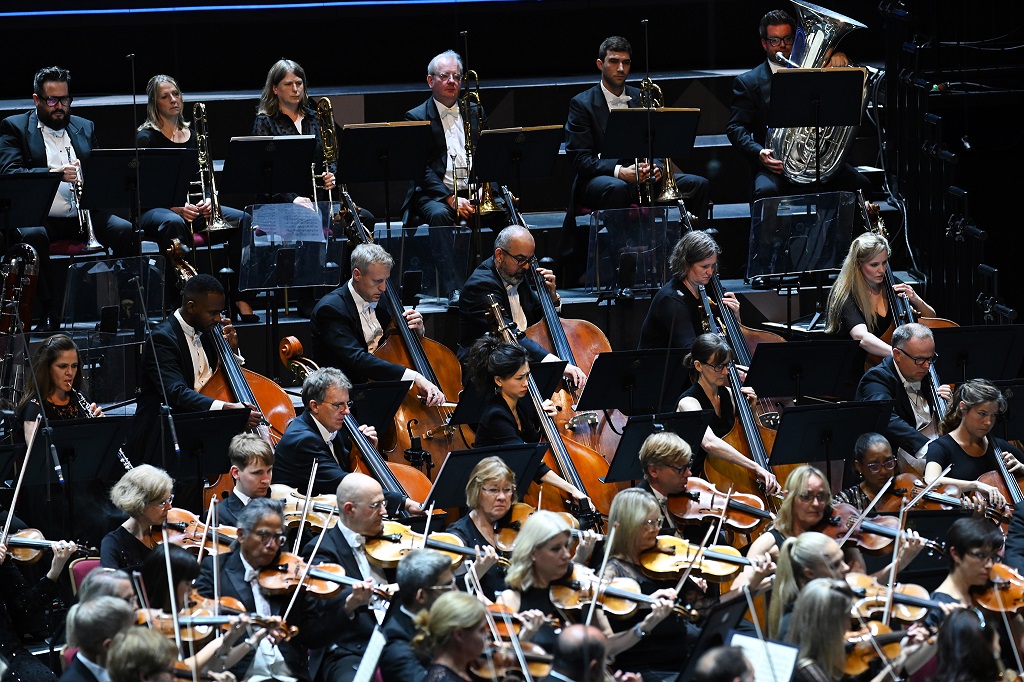
With the outer sections taken at a swift but never headlong tempo that enabled its underlying ostinato pattern to be perceived throughout, the Scherzo exuded energy while also mystery in what remains Bruckner’s most powerful instance of a genre he made his own. The brass was at its most assured, and Bychkov duly avoided any temptation to make the lengthy trio a self-contained episode. Its unforced progress brought winsome contributions from woodwind and harps, the reprise then having audibly greater impetus as it surged towards its decisive close.
As so often in this symphony, the Adagio found the interpretation and its realization in most potent accord. Mindful to draw its continual thematic restatements into a consistent process of developing variation, Bychkov conveyed the music’s expressive but also spatial grandeur with an assurance hardly less evident in its unfolding tonal trajectory. Nor did the excising of material in revision impede its course, even if the sudden appearance of cymbals and triangle at its climax sounded more than usually redundant. A pity, moreover, that momentary failings of intonation among Wagner tubas affected what was otherwise his near perfect rendering of the coda – Bruckner’s distilling of main motifs, underpinned by the halting accompaniment, finding closure only at that point where everything stops as the movement comes full circle.

From here the Finale set out with due purposefulness, even though the occasional rhythmic hesitancy gave notice of an approach in which the whole did not quite match the sum of its admittedly impressive parts. Strategically coinciding with those divisions of the movement overall, the chorale-like main theme brought a resplendent response as left its eloquent then ominous successors sounding incidental within the ongoing formal scheme, and though the extensive development did not lack for variety of content, its discursiveness made for a less than perfect unity. Any remaining tentativeness was none the less dispelled in a coda whose gradual emergence made for an apotheosis of unusual clarity – the superimposing of themes not just ingenious in its technical skill but cathartic in its conveying of a journey completed.
The illustrious rollcall of conductors who have tackled this work at the Proms speaks for itself, and while Bychkov might not yet have joined the ranks of Wand, Haitink and Mehta et al, his belief in and commitment to Bruckner’s Eighth was amply communicated to all those present.
For more on the 2023 BBC Proms, visit the festival’s website at the BBC. Meanwhile click on the names for more information on the BBC Symphony Orchestra and guest conductor Semyon Bychkov – and finally composer Anton Bruckner
by Ben Hogwood (photo (c) Marco Borggreve)
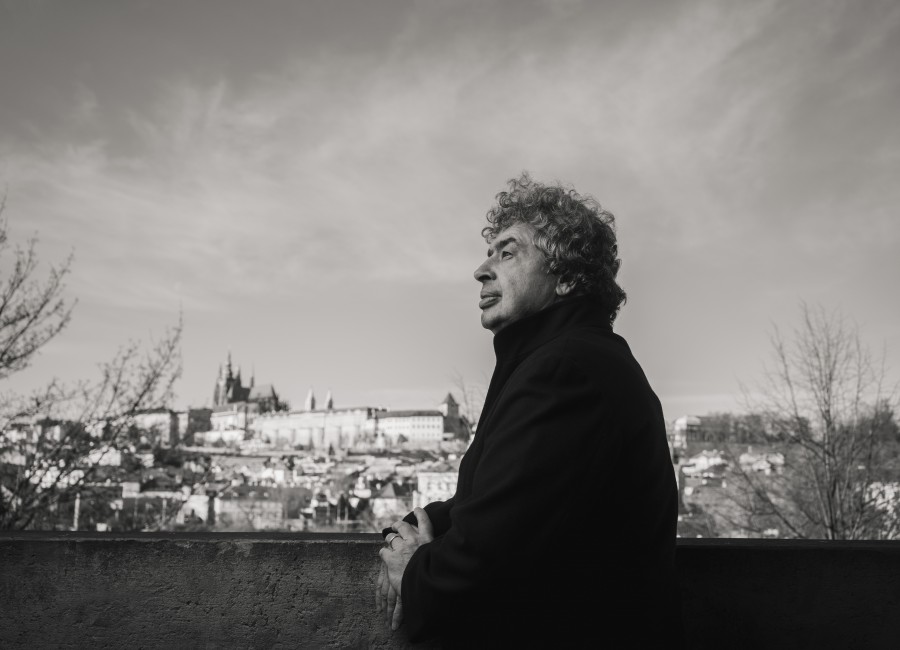
Semyon Bychkov turns 70 today…and in recognition of one of our finest living conductors, here is a link to watch this most erudite musician conducting the WDR-Sinfonieorchester Köln in William Walton’s First Symphony:
Here too is a playlist gathering together some of his finest recordings, from the early days with Philips to his most recent release, an account of Mahler’s Symphony no.5 with the Czech Philharmonic Orchestra for Pentatone. Along the way we hear excerpts or complete works by Tchaikovsky, Prokofiev, Mendelssohn, Dutilleux and Rachmaninoff. It is a wonderful listen, I’m sure you’ll agree!
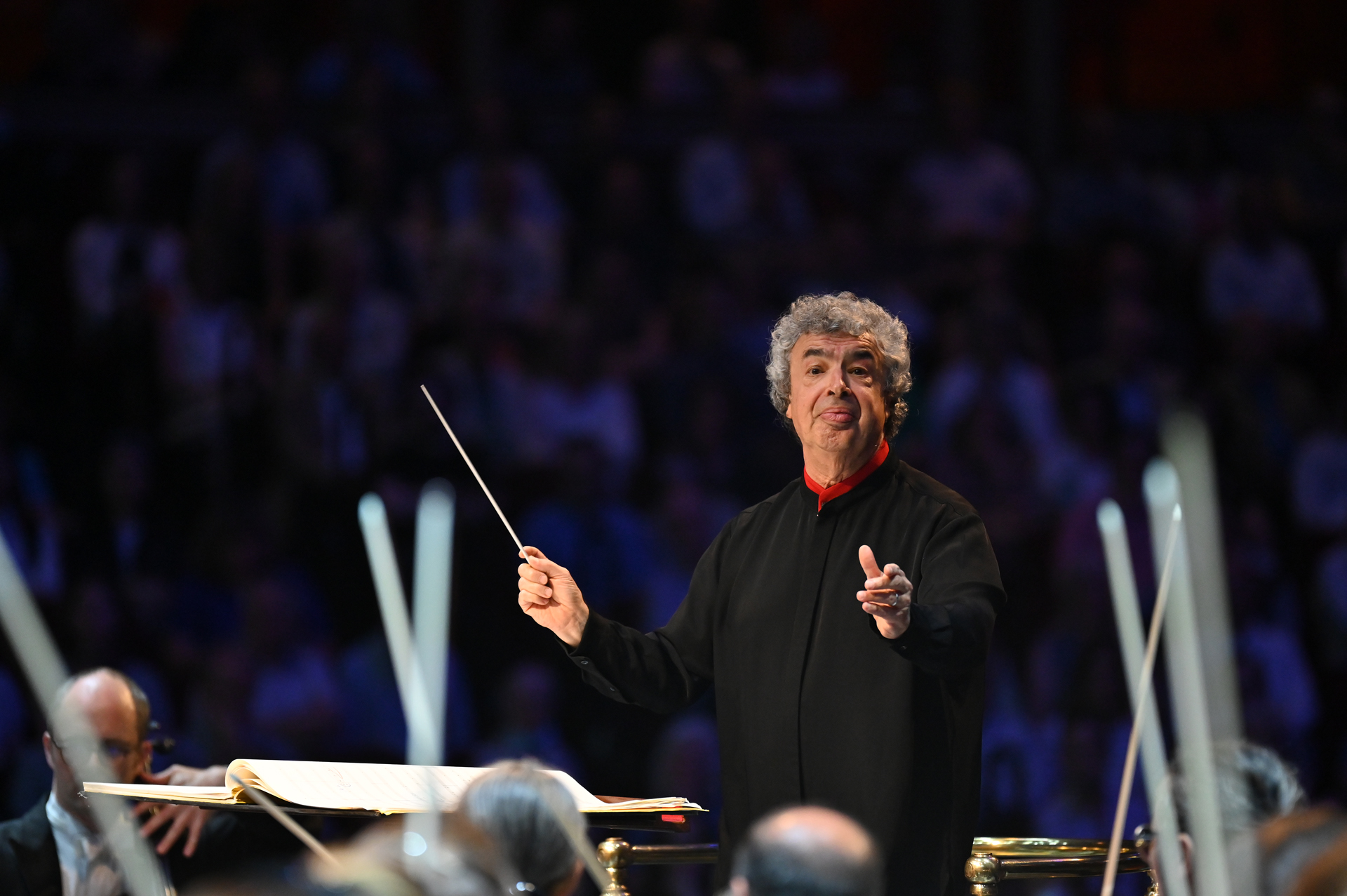
Prom 26 – Katia and Marielle Labèque (pianos), BBC Symphony Orchestra / Semyon Bychkov (above)
Anderson Symphony No. 2 ‘Prague Panoramas’ (2020-22) (BBC co-commission: World premiere of complete work)
Martinů Concerto for Two Pianos and Orchestra H292 (1943)
Rachmaninoff Symphonic Dances Op.45 (1940)
Royal Albert Hall, London
Friday 5 August 2022
Reviewed by Richard Whitehouse Photo (c) Chris Christodoulou
An unusually well-assembled concert this evening with what might be termed a programme of ‘three-by-threes’ – each of these three works having three movements which, in each case, results in a broadly symmetrical design, not least the Second Symphony by Julian Anderson (with the conductor, below).
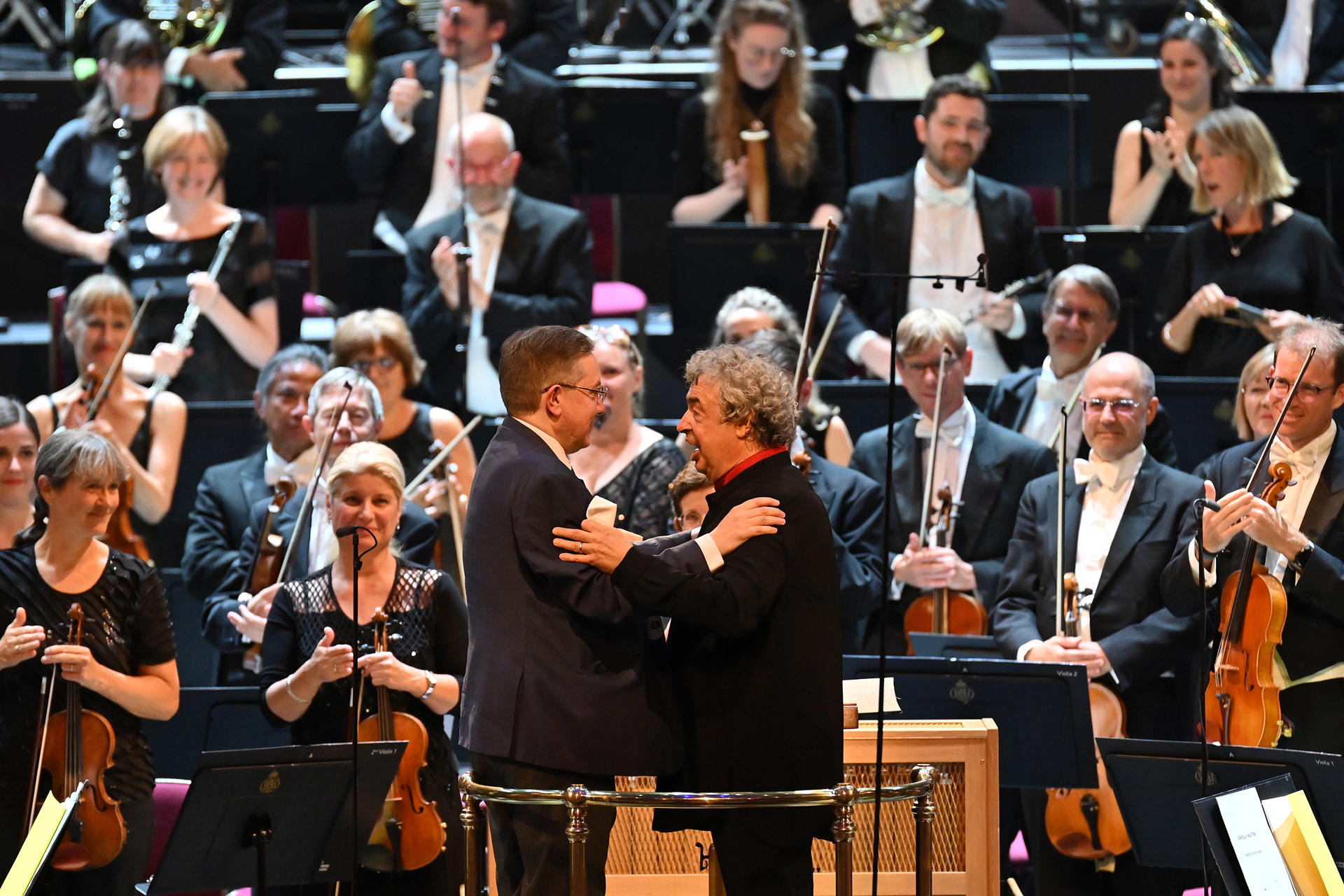
Inspired by Josef Sudek’s photographs of Prague while utilizing two medieval Czech hymns, Prague Panoramas (might Prague Pictures be even more apposite?) is typical in its fusing evocativeness with precision. Not least the preludial opening movement, its stark alternation of quick-fire chords and silence evolving into aspiring melodic lines as build to a tumultuous if quickly curtailed climax, though this linear aspect comes to dominate the nocturnal central movement with its expressive intensifications then fades against a backdrop of bell resonance and luminously modal polyphony. The finale is a deftly organized rondo – its energetic main material, inspired by Josef Lada’s almost Rabelaisian depictions of pub brawls, interspersed with more lyrical ideas through to the heady peroration later subsiding into a calm postlude.
Although its first two movements had been heard in Munich and Prague, this was the work’s first complete performance and found the BBC Symphony at its collective best – not least the lambently interweaving woodwind and strings, the visceral impact of brass and a substantial array of percussion whose contribution was pervasive. Semyon Bychkov (under-appreciated as an exponent of contemporary music) duly brought out that unity-within-diversity such as gave this work an underlying focus across the 32 minutes of its eventful yet cohesive course.
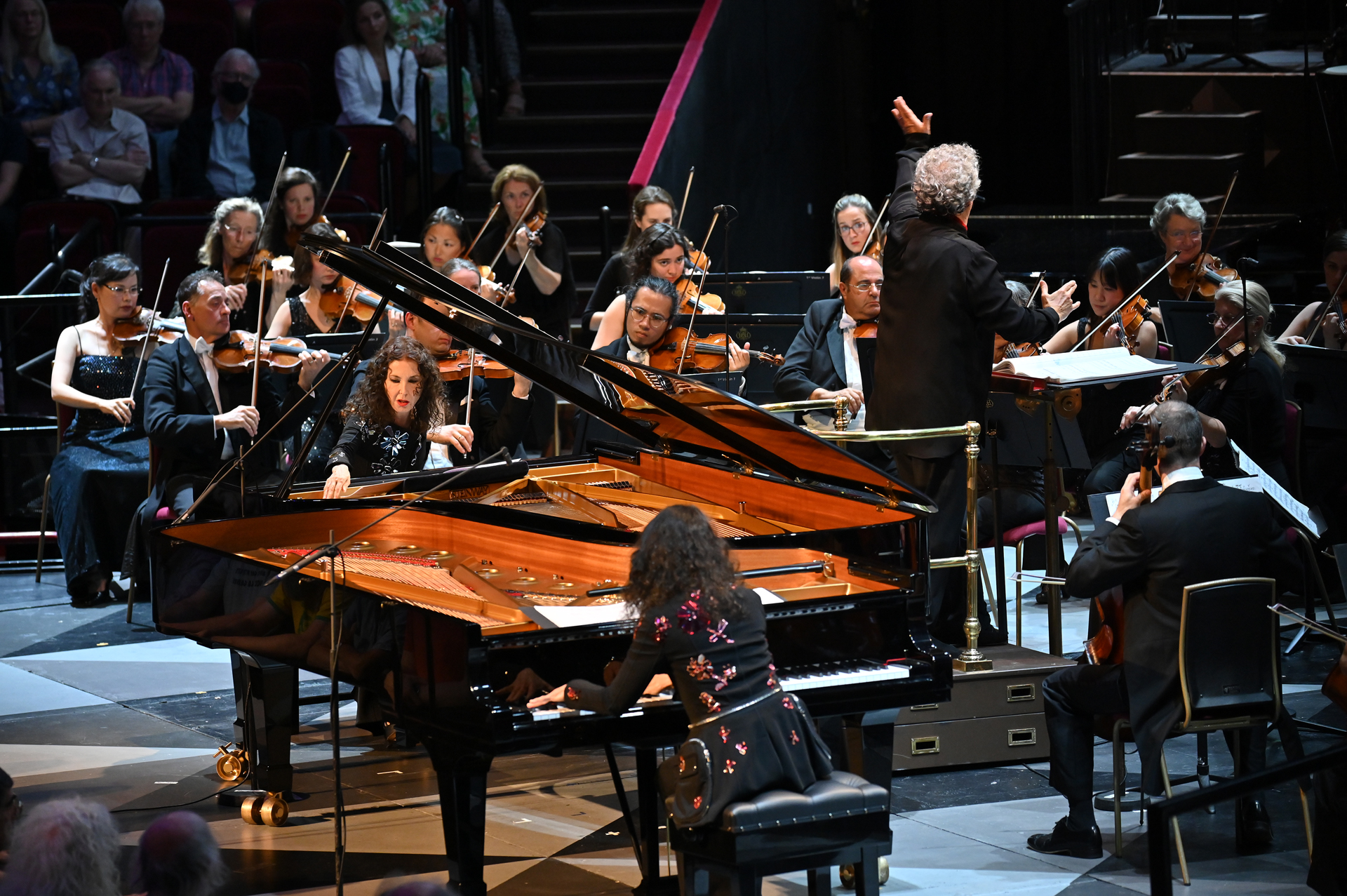
From Prague-inspired music by a British composer to that by a Czech composer in America – Martinů’s Concerto for Two Pianos may never have gained the plaudits of his earlier Double Concerto but it typifies this composer’s exile in a tried-and-tested interplay of folk-inflected melodicism with a harmonic acerbity recalling Prokofiev and rhythmic dexterity redolent of Stravinsky. Its undoubted highlight is a central Adagio whose almost ‘harmonie’ woodwind writing and circling piano figuration (had the composer come across the gamelan-influenced music of Colin McPhee?) feels mesmeric and affecting. Neither outer movement comes close in their audibly contrived amalgam of the rumbustious and lyrical, but this is music in which Katia and Marielle Labèque excel and tonight’s performance could rarely have been equalled.
Nor was there any doubting Bychkov’s authority in Rachmaninoff’s Symphonic Dances that followed the interval. Admittedly this now regularly played while technically exacting piece needed more rehearsal than the BBCSO was able to give it on this occasion, though the outer sections of the first dance had just the right ominous incisiveness and its middle part featured winsome alto saxophone from Martin Robertson. The second dance had irony and angularity aplenty, as was slightly offset by the strings’ less than unanimous response towards the close.
Its sombre ambivalence and intricate textures give the central span of the final dance a quality unique in this composer: if Bychkov might have endowed it with even greater intensity, there was no doubting his identity with this music here or on the way to its resplendent apotheosis.
For more information, click on the names of composer Julian Anderson – and for more on the artists, click on the names of Katia and Marielle Labèque, Semyon Bychkov and the BBC Symphony Orchestra. For more on this year’s BBC Proms as it continues, head to the Proms website
For more information, click on the names of composers Kalevi Aho and Kaija Saariaho – and for more on the artists, click on the names of Carolina Eyck, John Storgårds and the BBC Philharmonic Orchestra
 Arcana.fm