On this day 80 years ago – world premieres of Britten’s ‘Peter Grimes’ & Prokofiev’s ‘War & Peace’

by Ben Hogwood Picture from the current Welsh National Opera production of Peter Grimes

Eighty years ago today, two landmark operas of the 20th century received their world premieres.

Britten’s Peter Grimes, given its first performance at Sadler’s Wells under Reginald Goodall on 7 June 1945, is a breakthrough work in his output, one that would tie his music indelibly to the Suffolk coast. Telling the story of Grimes, the outcast fisherman, it captures the mysterious North Sea in rare clarity. You can read more about the opera’s history at my Good Morning Britten site, dedicated to the composer. The video links below are to a complete performance of the opera, with the Royal Opera conducted by Colin Davis:

Meanwhile the famous 4 Sea Interludes extracted from the work, Britten’s remarkably pictorial orchestral suite, are below – where you can follow the score:

Prokofiev‘s War and Peace is an altogether different beast – a mammoth project which first reached the public in the Great Hall of the Moscow Conservatory on 6 June 1945, where nine scenes from the opera were performed.

The finished opera is an epic dramatisation of Leo Tolstoy’s novel, which occupied Prokofiev from 1941 right up to the year of his death, 1953. Here is a famous recording conducted by Mstislav Rostropovich:

Published post no.2,557 – Saturday 7 June 2025

On this day – the world premiere of Prokofiev’s Second Symphony in 1925

by Ben Hogwood Picture from the Bain Collection, Library of Congress

This day marks the centenary of the premiere of one of Prokofiev‘s most remarkable works, the Second Symphony. It was first performed in Paris on 6 June 1925, under the baton of Serge Koussevitsky.

It is difficult to imagine a work of greater contrast to the first symphony in the composer’s output, the much-loved ‘Classical’. Where that was a masterly updating of the classical style, bursting with good tunes, the Second initially impacts as a cacophony of noise and seemingly devoid of melody.

Listen more closely, however, and you will hear some distinctive themes beyond the bluster, some innovative orchestration and a highly original approach to form drawing initially from Beethoven’s 32nd and final piano sonata. Perhaps inevitably these qualities were lost on the first audience, who recoiled from the piece. Their reaction gave Prokofiev serious doubts about his ability as a composer.

Yet time has treated this piece relatively well, with no less a composer than Christopher Rouse showering it with praise. Listen below and see what you think:

Published post no.2,556 – Friday 6 June 2025

In concert – Elizaveta Ivanova, BBC Symphony Orchestra / Vinay Parmeswaran @ Maida Vale: Carlos Simon, Ibert Flute Concerto & Prokofiev Seventh Symphony

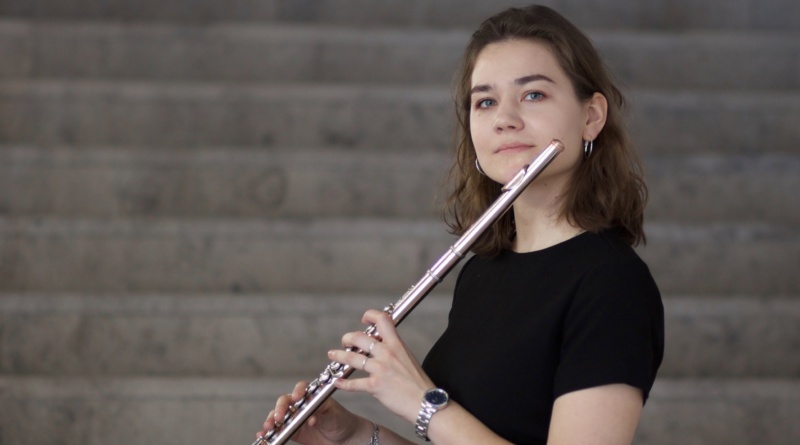
Elizaveta Ivanova (flute, below), BBC Symphony Orchestra / Vinay Parameswaran (above)

Carlos Simon Fate Now Conquers (2020)
Ibert Flute Concerto (1932-33)
Prokofiev Symphony no.7 in C# minor Op.131 (1952)

Studio 1, BBC Maida Vale Studios, London
Tuesday 4 February 2025 (2:30pm)

by Ben Hogwood Photo of Vinay Parameswaran (c) Roger Mastroianni, courtesy of The Cleveland Orchestra

For this concert linking seventh symphonies, the BBC Symphony Orchestra made their first public appearance with conductor Vinay Parmeswaran.

They began with music from Vienna via America, Carlos Simon effectively remixing the second movement of Beethoven’s Symphony no.7 and applying some fresh paint of his own. The piece was inspired by an entry Beethoven made into his journal in 1815, and takes its lead from “the beautifully fluid harmonic structure” of the symphony’s second movement, Simon composing “musical gestures that are representative of the unpredictable ways of fate”. Though Beethoven’s structure could still be glimpsed, it was viewed through music incorporating the language of Sibelius, Copland and John Adams to create a relatively familiar but ultimately thrilling orchestral vista. Simon’s development of the material was enjoyable to witness, though the sudden end felt underpowered in context. Nonetheless, here is a composer to investigate further.

Ibert’s Flute Concerto is one of the instrument’s calling cards from the 20th century, though is heard in concert rather less than it could be. Here it was performed by Elizaveta Ivanova, a flautist recently recruited to the BBC New Generation Artists programme and making her first appearance with the BBC Symphony Orchestra. She brought to the piece a welcome freshness, rising to the challenge of Ibert’s virtuoso solo part while including stylish phrasing and thoughtful dialogue with the orchestra. The graceful second movement Andante is the emotional centre of the concerto, and recalls the equivalent movement in Ravel’s Piano Concerto in G major in its beauty and softer-hearted sentiments. This was in vivid contrast to the outer movements, whose syncopations took the music closer to New York rather than Paris, Ibert’s cosmopolitan style enjoyed by the reduced BBC SO forces as much as by the athletic soloist. A fine performance, and a welcome revival for a composer whose colourful orchestral music and abundant melodies are a tonic.

Melodies, bittersweet or otherwise, are at the core of Prokofiev’s late Symphony no.7, written the year before his death. In a short interview section Parmeswaran implied the work was ‘softer’ than its predecessors, but there were no shrinking violets to be found as the second movement reached a juddering conclusion. Here Prokofiev’s attempts to write a competition winner, simultaneously pleasing Stalin, were affected by his own personal angst, for he was living in poverty at the time.

The weighty bass of the first movement and graceful cello theme of the third movement, marked Andante espressivo, were indicators of the emotional range of the symphony, but the biggest tune, heard from the full orchestra, was the second theme of the first movement, a soaring and winsome melody that returns to crown the final movement. Under Parmeswaran’s affectionate direction it was beautifully judged, though he was careful to ensure the final word in the symphony carried equal impact, the strange ticking of the percussion indicating the creeping passage of time. The symphony ended as it should, its smiling countenance compromised by a frown.

Listen

This concert was recorded for future broadcast on BBC Radio 3. A link will appear here when that becomes available.

Published post no.2,433 – Wednesday 5 February 2025

On this day in 1945 – the world premiere of Prokofiev’s Fifth Symphony

The 13th January 1945 saw the world premiere of one of the 20th century’s best-loved symphonies, conducted by its composer at the Great Hall of Moscow Conservatory. Sergei Prokofiev was the composer, with the USSR State Symphony Orchestra, giving the first performance of his Symphony no.5 in B flat major Op.100, intended to be “a hymn to free and happy Man, to his mighty powers, his pure and noble spirit”.

On the surface, the Fifth appears to be just that…with a healthy influence from the composer’s ballet scores, notably Romeo & Juliet. Yet scratch a little beneath the surface and there are compelling elements of darkness and acerbic wit, felt in the quickfire second movement Scherzo, with its macabre trio section, the deeply felt slow movement and – even more – the supposedly carefree finale.

The symphony is packed full of melody, delivered in Prokofiev’s typically chromatic but memorable style.

Published post no.2,410 – Monday 13 January 2025

In concert – Yeol Eum Son, CBSO / Jonathon Heyward: Still, Prokofiev & Sibelius

Yeol Eum Son (piano, below), City of Birmingham Symphony Orchestra / Jonathon Heyward (above)

Still Threnody: In Memory of Jean Sibelius (1965)
Prokofiev Piano Concerto no.2 in G minor Op.16 (1912-13, rev. 1923)
Sibelius Symphony no.5 in E flat major Op.82 (1914-19)

Symphony Hall, Birmingham
Thursday 24 October 2024

Reviewed by Richard Whitehouse Pictures (c) Laura Tiesbrummel (Jonathon Heyward), Marco Borggreve (Yeol Eum Son)

American by nationality, and currently music director of the Baltimore Symphony Orchestra, Jonathon Heyward is no stranger to orchestras in the UK and this afternoon’s appearance with the City of Birmingham Symphony Orchestra confirmed a rapport that will hopefully continue in future seasons.

His symphonic output may now be well covered by recordings, but performances of William Grant Still remain infrequent such that his Threnody came as a welcome novelty. Dedicated to Sibelius in the anniversary year of his birth, this finds its composer in understandably sombre mood (akin to that of his masterly concertante piece Dismal Swamp from two decades earlier) and, while there is little about its content that recalls the Finnish master, the interplay between elegy and processional is effectively handled through to its subdued yet highly affecting close.

It might not have enjoyed the popularity of its successor, but the CBSO has given memorable accounts of Prokofiev’s Second Piano Concerto over the decades and the present reading with Yeol Eum Son (above) was as good as it gets in a piece that does not make things easy technically or interpretatively. Starting reticently, the opening movement duly hit its stride in the capricious second theme before the orchestra made way for Son’s electrifying take on a cadenza which encompasses development and reprise; the orchestra’s climactic return being no less visceral.

Wresting coherence out of the unlikely formal design of this work is hardly an easier task but, here again, there was no doubting Son’s insight as she fairly tore through its Scherzo without loss of clarity; she and Heyward then drawing abrasive irony out of an intermezzo which can easily descend into caricature. Nor was there any lack of focus with a Finale whose headlong outer sections frame one of folk-tinged pathos – afforded a cumulative intensity only outdone by the propulsive closing stage where soloist, orchestra and conductor were thrillingly as one.

If the reading of Sibelius’s Fifth Symphony after the interval did not quite maintain this level of excellence, it was no also-ran as a performance. Heyward might have observed the Tempo molto moderato of its initial movement more literally, as his swift underlying pace made for too precipitate a climax into its scherzo-like second half. The accelerating transition between them was adeptly managed, but there was little room left for manoeuvre during the approach to a coda where not even the CBSO’s unfazed commitment could gain the necessary velocity.

Neither did the second movement lack forward motion, though here Heyward found a viable balance between the andante and allegretto elements – its (mostly) ingratiating poise abetted by felicitous playing from CBSO woodwind. Setting off impulsively, the finale rather lacked eloquence in its ‘swan theme’ but the resourceful evolution of its material was never in doubt. Other performances have conveyed greater emotional breadth thereafter yet, as those indelible six closing chords unfolded, there could be no doubting their decisiveness as parting gestures. Overall, then, this was impressive music-making with Heyward evidently a conductor on a mission. Next Wednesday brings a programme of Spanish evergreens conducted by Kazuki Yamada, with Miloš Karadaglić taking centre-stage in a certain guitar concerto by Rodrigo.

For details on the 2024-25 season A Season of Joy, head to the City of Birmingham Symphony Orchestra website. Click on the names to read more about pianist Yeol Eum Son and conductor Jonathon Heyward – and for a special website devoted to composer William Grant Still

Published post no.2,345 – Monday 28 October 2024