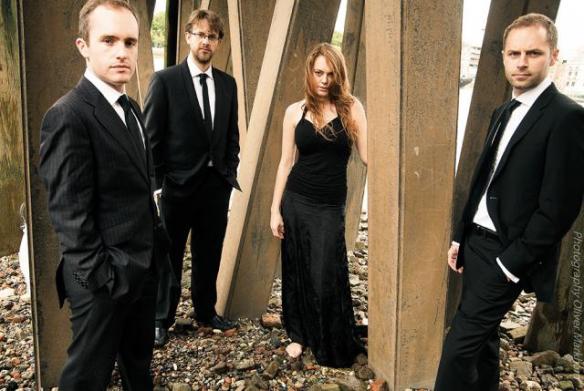
In concert – BBC Philharmonic Orchestra / Michael Seal: Discovering Bliss

BBC Philharmonic Orchestra / Michael Seal (above)

Sir Arthur Bliss
Miracle in the Gorbals (1944) – Overture
Things to Come (1934) – March
Metamorphic Variations (1972)

Royal Concert Hall, Nottingham
Wednesday 26 February 2025

Reviewed by Richard Whitehouse

2025 promises no mean retrospective of Arthur Bliss’s music in this 50th anniversary year of his death but no more significant revival than that of Metamorphic Variations, the composer’s late masterpiece that was heard live this evening for the first time in more than three decades.

Completed in December 1972 and premiered at Croydon’s Fairfield Halls the following April, Metamorphic Variations was the last while also the longest of Bliss’s purely orchestral works. Shorter than might have been, even so, as two of its sections were omitted at that first hearing (Leopold Stokowski having requested more rehearsal time for Tchaikovsky’s Pathétique after the interval) and given as an appendix in the published score; being excluded at later hearings as on the two commercial recordings. Tonight brought their reinstatement almost 52 years on.

First performed as ‘Variations for Orchestra’, this work only acquired its definitive title after considerable soul-searching on the composer’s part, though Metamorphic Variations is more accurate in terms of those ideas outlined in the initial Elements: an oboe cantilena, a phrase for horns then strings, and a cluster on woodwind – thereby setting up melodic, rhythmic and harmonic possibilities to be explored intensively over the ensuing 15 sections. The first five comprise a lively Ballet, a brusque Assertion and atmospheric Contrasts whose absence hitherto has been to the detriment of overall balance. Less crucial formally, Children’s March is of considerable fascination for its deft pivoting between innocence and experience, while Speculation marks a crucial expressive juncture through its renewed sense of anticipation.

Such anticipation is fulfilled by the starkness of Interjections then incisiveness of Scherzo I, before Contemplation yields further repose. Next come the two most elaborate sections – an increasingly energetic Polonaise being followed by Funeral Processions which builds to a wrenching, even anguished culmination. A lighter sequence moves from the dextrous Cool Interlude, via the angular Scherzo II, to the ingratiating Duet – an intermezzo prior to the final two sections. A brief yet potent Dedication makes explicit the work’s inscription to the artist George Dannatt and his wide Ann, then Affirmation draws each of the main elements into a sustained peroration thrown into relief through its ultimate subsiding into a return of the oboe cantilena from the opening and which, in its turn, brings a withdrawal into silence.

Scored with real virtuosity for sizable forces, Metamorphic Variations proves no less testing for the players as it is conceptually for the listener, though the BBC Philharmonic responded with assurance to Michael Seal who (given the unavailability of John Wilson) had not merely learnt the score in around 10 days but ensured an interpretation that was distinctively his own. Hopefully a recording from this source (how about it, Chandos?) will follow before too long: meanwhile, however, this performance is being broadcast by BBC Radio 3 in the near future.

Having provided the musical illustrations in Stephen Johnson’s introductory talk, Seal and the BBCPO had framed the first half with the fateful ‘Overture’ to Bliss’s wartime ballet Miracle in the Gorbals then the rousing ‘March’ from his inter-war score to the film Things to Come.

For more information on the orchestra’s 2024-25 season, head to the BBC Philharmonic Orchestra website Click on the names to read more about conductor Michael Seal, and about Sir Arthur Bliss himself. You can also find out more about The Bliss Trust

Published post no.2,463 – Tuesday 4 March 2025

On record: Sinfonia of London / John Wilson – English Music for Strings (Chandos)

Sinfonia of London / John Wilson

Britten Variations on a Theme of Frank Bridge Op.10 (1937)
Bridge Lament (1915)
Berkeley Serenade for Strings Op.12 (1938-9)
Bliss Music for Strings (1935)

Chandos CHAN 5264 [64’46”]
Producer Brian Pidgeon
Engineers Ralph Couzens, Alex James

Recorded 9-11 January 2020, Church of St. Augustine, Kilburn, London, UK

Reviewed by Ben Hogwood

What’s the story?

After three wonderful albums extolling the virtues of French orchestral music, Korngold and Respighi, John Wilson and his Sinfonia of London charges turn much closer to home with a set of British music for strings drawn from the 1930s. They begin with an established classic, Britten’s Variations on a Theme of Frank Bridge, complemented by two neglected works from Sir Lennox Berkeley (his Serenade for Strings) and Sir Arthur Bliss (the Music for Strings), neither of which appears to have been recorded in the last 20 years. There is also room for the brief Lament from 1915 by Bridge himself.

What’s the music like?

Britten’s Variations on a Theme of Frank Bridge will be familiar to many, but rarely in a performance as good as this. The theme, lovingly drawn from the Second Idyll for string quartet of Britten’s teacher, receives a virtuoso treatment, taken through a number of wildly differing dance forms before a powerful fugue and finale. The variations are sharply contrasted, with a crisp March at odds with the loving Romance that follows; the fulsome Wiener Walzer countered by the rush of a Moto perpetuo.

Berkeley’s Serenade for Strings works really well in this company. It is a work beginning with outward optimism but which ultimately falling under the shadow of the imminent Second World War. A busy first movement, its Baroque influences brought out by Wilson, is complemented by an inward looking but tender Andantino. Berkeley finds renewed energy in a quickfire Scherzo, but that is trumped by the closing Lento, which leaves a lasting impression, reflecting the anxiety felt as the 1930s drew to a close.

There is a good deal of positive energy in Bliss’ Music for Strings. Taking a lead from Elgar’s Introduction and Allegro of 1905, the composer writes for a full string orchestra but often picks out a smaller group of soloists. The substantial three movements show a masterly command of the string orchestra, from the wide span of the vigorous first movement to the meaningful Romance that follows, with lovely rich contributions from violas and cellos. The third movement starts hesitantly, in the depths, but soon the light breaks through to an effervescent finale.

Does it all work?

Everything works here, thanks to the thoroughly assertive performances secured by Wilson. He is quite quick on the draw with the theme for Britten’s variations, maybe quicker than some would like, but the thrills and spills that follow make this one of the finest versions available. The Aria Italiana has all guns blazing in a wonderful display of precision and power, while the Funeral March has a searing and chilling clarity.

Successful though the Britten is, it is the Berkeley and Bliss that ultimately give the disc its importance. The Berkeley is keenly felt, positive in its fast music but anxious in its two slower movements and raising emotional questions in the fourth. Wilson catches its air of uncertainty at the world in which we live, as relevant now as it was then.

The Bliss has terrific drive in its faster music, which builds up a thoroughly convincing momentum while succeeding in bringing forward the writing for the chamber ensemble at the front. The textures are beautifully clear thanks to the Chandos recording, the quicker melodies’ punchy phrasing cutting through easily.

The Bridge Lament, though short, proves a mellow complement to the Britten, a chance for the listener to collect their thoughts while the Sinfonia play with a beautiful, muted sound.

Is it recommended?

In every way. John Wilson and the Sinfonia of London breathe new life into this music, and their programme is superbly judged to bring two neglected and very fine works back into contention. The cover, a painting of Bliss’s Pen Pits house by Edward Wadsworth, is the icing on the cake with its classic 1930s style.

For further information on this release, visit the Chandos website.

In concert – Werther Ensemble: British Piano Quartets at St John’s, Smith Square

werther-ensemble

Werther Ensemble (Jamie Campbell (violin), Nicholas Bootiman (viola), James Barralet (cello), Simon Callaghan (piano); St John’s Smith Square, London, 21 February 2016

Bliss Piano Quartet in A minor, Op. 5 (1915)

Howells Piano Quartet in A minor, Op. 21 (1916)

Alwyn Rhapsody (1938)

Walton Piano Quartet in D minor (1919)

Written by Richard Whitehouse

The Werther Ensemble has proved itself adept across the broad spectrum of nineteenth- and twentieth-century chamber music, and this enterprising programme demonstrated the range of response by British composers to that most often overlooked of media – the piano quartet.

Admittedly it got off to a lukewarm start with the Piano Quartet by Sir Arthur Bliss. True the first movement began impressively, but its ensuing contrast of romantic ardour with a gauche folksiness the composer was soon to jettison never quite worked, then the central Intermezzo was simply too short and lightweight to hold a balance between its predecessor and the lively finale with its dutiful recall of the work’s opening theme towards the close. Understandable if Bliss should have left this piece to its fate as he headed off in a radically different direction.

A year younger, Howells completed his own Piano Quartet at much the same time, yet here there could be no doubt as to its consistency of musical idiom with those other chamber works from this composer’s early maturity. The opening movement unfolded with no mean deliberation, its main ideas emerging gradually and only rarely asserting themselves against a constantly shifting harmonic context.

For all that it conveyed a purposeful momentum as the Werther was mindful to contrast with the lingering eloquence of the central Lento – building in stages towards a soulful climax tinged with regret. After this, the finale may have surprised with its rhythmic incisiveness and often headlong progress, yet the affirmative outcome was audibly in keeping with the underlying trajectory of this ‘dark horse’ among works of its kind.

After the interval, a welcome revival for the Rhapsody as was the first of Alwyn’s two contributions to the medium. This packed a wealth of incident into its modest timespan of a little more than nine minutes. The tensile initial idea proved dominant while being flexible enough to accommodate understated material in a loosely palindromic structure that brought a satisfying completion. The Werther was more than equal to the technical challenges of a piece as reminded one some of Alwyn’s most distinctive music is to be found in his chamber output.

The programme concluded with the Piano Quartet by which the teenage Walton gave notice of his protean talent. Although revised in the 1920s and again in the 1950s, this is very much a young composer’s music – one steeped in recent scores by Ravel and Stravinsky that are put to productive use over its thematically interrelated four movements.

The Werther duly sustained its half-hour span with conviction to spare – whether in its trenchant response to the bracing scherzo, the ambivalent shadows that inform the Andante’s fitful progress, or the ingenuity by which the opening movement links hands with the finale in an impressive show of technical resource and cumulative energy – especially during the latter’s heady central passage, a sure pointer towards the composer’s musical preoccupations a decade and more hence.

An impressive conclusion, then, to a well-conceived and finely executed recital, in spite of the occasional intonational flaw. Apparently this had to be postponed from last year because of illness among the ensemble – in which case, its rescheduling was justified in every respect.