Smyth The Wreckers – Overture (1906) Elgar Variations on an Original Theme, Op. 36 ‘Enigma’ (1898-9)
English Symphony Orchestra / Kenneth Woods
Live performances at Worcester Cathedral, Saturday 30 October 2021
One of 2021’s welcome returns to the musical calendar, following its cessation in ‘lockdown year’, was the Elgar Festival – highlights from the final concert held at Worcester Cathedral last October comprising this latest in the English Symphony Orchestra’s digital online series.
The new production at this year’s Glyndebourne Festival should provide Ethel Smyth’s opera The Wreckers with a suitable reassessment. Never having entirely fallen out of the repertoire, the overture affords a decent overview of the emotional impulses found therein and makes for a forceful curtain-raiser. If its headlong opening pages and plangent ensuing melody – shared between cor anglais and oboe – set up a promise not entirely fulfilled, the hymnic fervour of its climax and the impetuous final surge were keenly projected in this forthright performance.
Elgar’s Enigma Variations has been a staple of British music since its premiere 123 years ago and, by definition, a regular feature of this festival. Neither time nor familiarity has (or should have) detracted from the originality of both its underlying conception and its musical content – attributes to the fore with this engrossing account. Kenneth Woods pointed up those formal divisions into which the 14 variations fall, prefaced by the hushed rendering of a theme whose mingled wistfulness and pathos set the tone not just of this work but also for Elgar’s maturity.
On to the first stage with the searching emotion of ‘C.A.E’ – followed by the quick succession of capriciousness in ‘H.D.S-P.’, insouciance in ‘R.B.T.’, then impetus in ‘W.M.B.’. The next three variations opened-out the expressive range accordingly – hence the alternation between the earnest and playful in ‘R.P.A.’, gentle whimsy of ‘Ysobel’ with its teasing viola part, and headlong energy of ‘Troyte’. The next two variations contrast genial elegance in ‘W.N.’ with rapt eloquence in ‘Nimrod’, here rightly conveying ardent passion instead of nostalgic regret.
The following two variations yield studies of a more complementary nature – thus the halting piquancy of ‘Dorabella’ during what becomes a relatively extended intermezzo, to which the swift animation of ‘G.R.S.’ (more probably his bull-dog Dan) functions as a decidedly terse scherzo. Especially persuasive was the next brace of variations – the thoughtful undulations of ‘B.G.N.’ as framed by its haunting cello solos, then the imaginative ‘***’ which romanza takes in easy affability and aching rumination over its unpredictable and speculative course.
Its considerable expanse (though how right Elgar was to extend those concluding stages from the perfunctory end he first envisaged) makes equating the final ‘E.D.U.’ variation with what went before a test of interpretive skill. Suffice to add this performance met its challenge head on – Woods gauging that initial crescendo as a basis from which the ensuing festivities could take off, allowing necessary breathing-space for the inward central interlude to leave its mark prior to resuming the earlier extroversion, then upping momentum for the opulent peroration.
Needless to add, the organ of Worcester Cathedral made its presence felt with those weighty pedals in the work’s closing bars – setting the seal on a memorable reading which benefitted from as spacious and well-balanced sound as has been achieved with this venerable acoustic.
You can watch this concert on the English Symphony Orchestra website, with free public viewing from 8-12 April 2022. The concert is available thereafter only to ESO Digital supporters.
For further information on the 2022 Elgar Festival click here, and for more on composer Dame Ethel Smyth click here Meanwhile for more on Kenneth Woods, click here
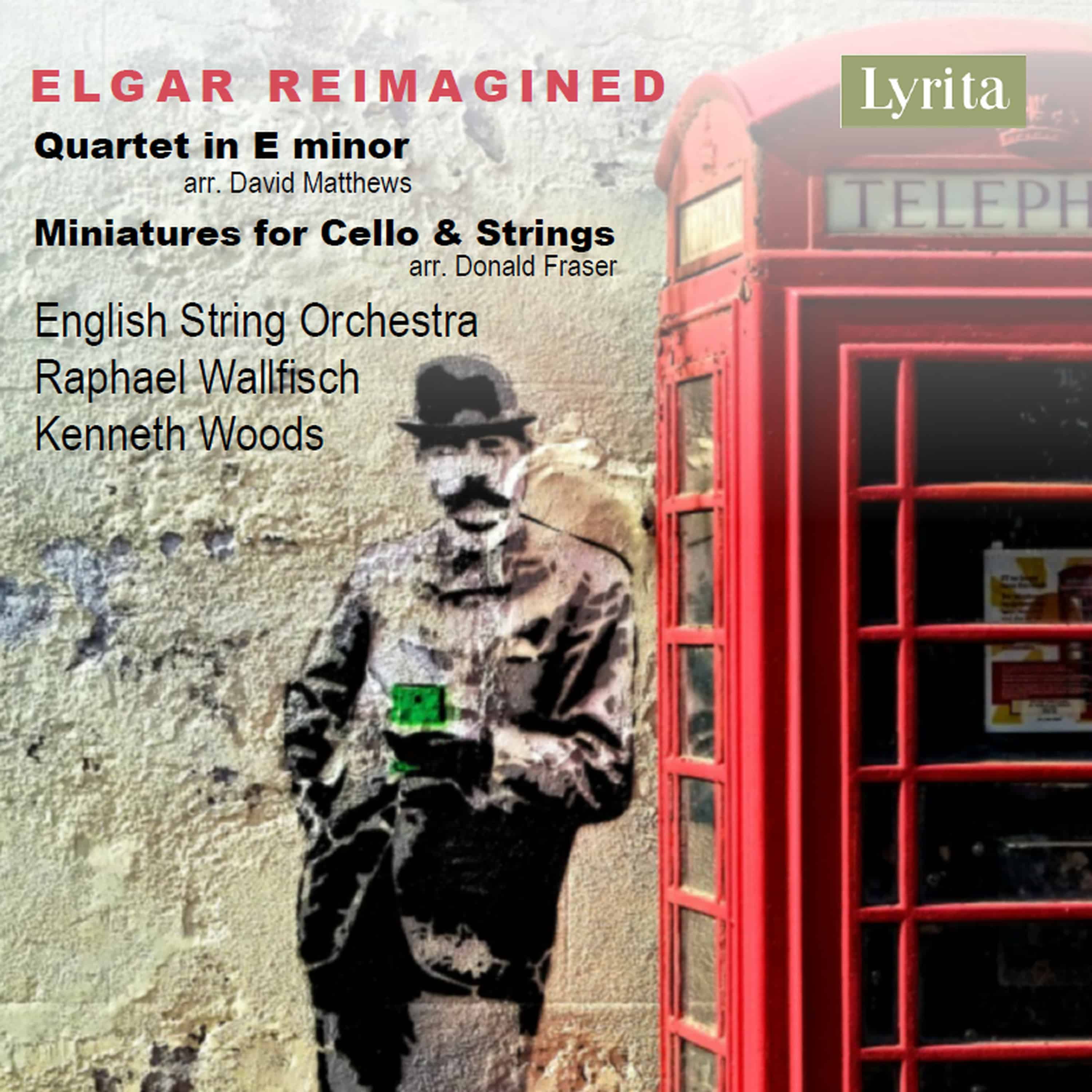
Elgar arr. Matthews String Quartet in E minor Op. 83 (1918) Elgar arr. Fraser Miniatures for Cello and Strings: Chanson de Matin, Op.15 No. 2 (1899). Chanson de Nuit, Op.15 No. 1 (1899). The Wild Bears, Op. 1b No. 6 (1908). Nimrod, Op.36 No. 9 (1899). Romance in D minor, Op.62 (1910). Sospiri, Op.70 (1914). Mazurka, Op.10 No.1 (1899). Pleading, Op.48 (1908). In Moonlight (1904). Salut d’Amour, Op.12 (1888). Adieu (1933)
Raphael Wallfisch (cello), English Symphony Orchestra / Kenneth Woods
Producer Phil Rowlands Engineer Tim Burton
Lyrita SRCD 394 [69’27”]
Recorded 22 September and 9 October 2020 at Wyastone Concert Hall, Monmouth
Written by Richard Whitehouse
What’s the story?
This new release by the English String Orchestra focuses on Elgar, a composer championed by this ensemble throughout its 44 years of existence, whose music is given an appealing and (for the most part) instructive appraisal across the programme of arrangements featured here.
What’s the music like?
The principal work is the String Quartet in E minor, arranged by David Matthews. Second in a wartime triptych of chamber pieces, it is less introspective than the Violin Sonata preceding it but less emotionally charged than the Piano Quintet which came after, while arguably the most finely proportioned – not least in terms of the subtle transformation of thematic elements across and between its movements. In this guise, it follows on from the Serenade then Introduction and Allegro as the hitherto missing large-scale work for string orchestra of Elgar’s high maturity.
Matthews has been mindful to equate the soloistic with the ensemble potential of this music, so the result is neither straightforward transcription nor radical re-conception. The opening Allegro discreetly evokes an autumnal rumination as sets the tone for much of what follows; even finer is the central Piacevole, its main theme suffused with an intensity whose extent is only revealed at the close. If the emotional acuity of the final Allegro is marginally diffused, there is no absence of purposeful intent as the music proceeds to a coda of terse decisiveness.
The remainder of this programme comprises a sequence of Miniatures, arranged for cello and strings by Donald Fraser and played by Raphael Wallfisch. Ostensibly an 11-movement suite, its efficacy in terms of smaller groupings and even individual encores should be self-evident.
Chanson de Matin launches proceedings in mellifluous fashion, and if the cello’s assumption of the melodic line is slightly to the detriment of the original scoring, that could hardly be said of Chanson de Nuit whose sombre contours and inward character are unerringly realized. Nor does The Wild Bears lose out on vivacity, and if the arrangement conjures up Saint-Saëns, this only serves to underline the importance of ‘Second Empire’ French music on Elgar’s thinking. The cello’s dominance in Nimrod rather detracts from the subtlety of this Enigma Variation’s instrumentation – conversely, the Romance brings soloist and strings into even closer accord than the composer’s version with orchestra. The highlight here is Sospiri, which presents one of Elgar’s finest inspirations in a striking new light. Lighter fare comes in the robust tread of the Mazurka, followed by an eloquent take on the song Pleading. In Moonlight (adapted from In the South) responds well to such limpid treatment, as does Salut d’Amour in conveying its essence without cloying. A wistful take on the piano piece Adieu provides an affecting close.
Does it all work?
Very largely. The idiomatic nature of the String Quartet is enhanced by the ESO’s committed playing under Kenneth Woods, a follow-up to their recording of the Piano Quintet in Fraser’s orchestration (Avie), while Raphael Wallfisch’s conviction in the Miniatures is undoubted.
Is it recommended?
Indeed, not least as the quality of the playing is abetted by the naturalness of the sound and informativeness of annotations by Matthews and Woods. Heard together, these two parts of Elgar Reimagined make for desirable listening in this 165th year since the composer’s birth.
written by Ben Hogwood Photo of Julia Fischer (c) Felix Broede
Arcana has an audience with Julia Fischer, the multi-skilled violinist and pianist who is Artist-in-Residence with the London Philharmonic Orchestra. Her most recent concerts have contained a complete cycle of Mozart’s five Violin Concertos, along with the Sinfonia Concertante and a chamber concert with LPO soloists. The Mozart will shortly be available to view online, after which Fischer will be busy rehearsing the Elgar Violin Concerto for performance with the orchestra in April.
Our online call finds her bringing a little sunshine to an otherwise grey morning, full of enthusiasm as she greets us from her home city of Munich. To begin, she recalls her first encounters with the Mzart concertos. “The G major Concerto, no.3, was taught by my first violin teacher when I was really very little. I must have been eight, and I remember hearing Arabella Steinbacher play it. I think that was my first encounter with that concerto.”
Perhaps not surprisingly, Fischer does not have a vivid memory of the impact it had on her – but was soon reacquainted with the piece. “A few months after that I actually performed the first movement of the concerto for my then teacher Ana Chumachenco so when I auditioned with her, it was with that first movement of the G major Concerto.”
Fischer recorded the concertos for Pentatone with Yakov Kreizberg and the Netherlands Chamber Orchestra, recordings that have aged will in the 15 years or so since she made them. Having spent a relatively long time with them, has her view changed at all? “I suppose, yes, but not in a conscious way. I learned them between the age of eight and fourteen, when I played the Fifth Concerto, then the Fourth Concerto when I was 16. The First and Second concertos I learned for the recording in 2006. After that I performed the cycle two or three times, and of course there are always things changing from one performance to the next, but my emotional approach didn’t change much.”
There are smaller considerations to be made, however. “Maybe the technical approach, the bowings, the note relations have changed a little, as there is always something you can discuss. You can do it with a large or small orchestra, with a conductor or without a conductor, with a harpsichord or without. There are many options, and I don’t think that any of those options are wrong. For the moment you have to find a good approach, and it depends on the people who are involved and who you play with.”
February seems a good time of year to be discussing and playing these essentially sunny, optimistic works. She smiles. “Let’s hope that we can be optimistic, you know?!” The concerts have interesting and exciting programmes around the Mozart works. Many of them will be given under Thomas Dausgaard, a conductor Fischer has worked with before. “Yes, he is a wonderful conductor. He is a very kind man, a wonderful musician. I specifically asked for him for these concerts.”
Dausgaard it was who chose the Richard Strauss pieces accompanying the Mozart – Don Juan and Tod und Verklärung with the Third and Fourth Concertos, and Till Eulenspiegels lustige Streiche with the Sinfonia Concertante. Meanwhile Fischer herself took charge of one concert. “I will always play and direct the first and second concertos, because I really don’t need a conductor there. I put together the first two concertos with the TchaikovskySerenade for Strings, and he did the rest of the programming.”
With the Mozart works, is there an assumption that the works are too easy to perform? “Yes. You can always find difficulties in any piece, but I think when you do the cycle it is important that each concerto has its own character, so that they don’t all sound the same. The First and Second Concertos are very different from Three, Four and Five, they are still very much from a perspective coming out of the Baroque-ish way of playing. I think Mozart probably had Vivaldi and Tartini in his mind, as they are much more difficult than Three, Four and Five.”
She expands on these three pieces. “The Third is probably the most lyrical one, and has the beautiful aria as its second movement, With the Fourth, it is a beautiful work, and as well as the portmanteau the second movement has this singing part. The Fifth is very different because it has the famous Turkish March finale, but with Three and Four you have to be careful that they don’t get too similar.”
Throughout the concertos, Fischer finds elements of Mozart’s operatic style. “I think it is everywhere”, she says emphatically. “In any Mozart, one has to see him first as an opera composer, and then it’s far easier to perform his instrumental pieces.”
From her answers above you will have gathered that Fischer learned the violin at an extremely young age. Indeed, she met Yehudi Menuhin well before her teens. Did she speak to him about the Mozart concertos at all? “Actually I played the Fifth Concerto with him, when I was 13, maybe 14. I remember playing that with him, but I don’t really remember the musicality of it. I also played the Beethoven Violin Concerto with him and that had a huge impact on me. We had a conductor for the rehearsals so he spent more time with me personally, and we worked on it together. The Mozart was a one-off concert in France, so we just met very briefly for that.”
As part her Mozart season with the London Philharmonic Fischer programmed a chamber concert, placing herself as soloist in the DvořákPiano Quintet no.2 – for she is indeed a fully-fledged concert pianist. It is an extra challenge, but one that she warms to. “I have played the first and second violin parts in that piece, and the piano part!” Does she find chamber music an essential complement to playing concertos? “There’s no difference”, she says. “It’s not as if I use a different technique or different perspective. For me it’s very natural that music is about communication, and communication is crucial to chamber music as well as orchestral pieces. For me it is not a different way of playing.”
As part of the chamber programme, Fischer included the little-heard Octet for Strings by Max Bruch – a composer who is all too often solely represented by his First Violin Concerto. “I love many pieces of his, I think they are really fantastic. The Octet is such a great piece of chamber music, and of course it’s fun to play. My first violin part is like the Mendelssohn Octet, it’s very challenging, and I like the double bass added to it which makes it almost like an orchestral piece. Whenever I am in residence with an orchestra, I try to programme the Bruch because usually I don’t get the opportunity to perform it.”
Fischer is relishing being back on the road and performing to audiences overseas. “In November I did my first tour in one and a half years, so that was very interesting!” she says with characteristic understatement. “Then I lost the LPO tour to Germany in December, and in January I was supposed to have a tour with my quartet. We were supposed to have nine concerts but in the end we had three. It’s a little bit frustrating but I’m very happy to have had this residency to perform.”
Playing the violin was not a challenge during the initial lockdown of 2020, but there were more immediate challenges. “It was very easy for me to keep playing”, she says. “I have no problem with making myself practice every day. I’ve never had a problem with that, but I am a mother to two school-age kids, and German schools were closed altogether for something like two months in the first lockdown. In the second lockdown my son was not in school for around six months. I had problems other than if I practiced or not!”
While she was grateful for the freedom to keep playing, Fischer was aware of the hardship caused. “There were certain professions that had to suffer the most, and we belong to those. Some people kept working through the entire pandemic, and I was basically without work for one and a half years. Of course I am lucky because I didn’t have any financial issues, and have a house and great family and everything, but from a professional point of view, artists were suffering a lot.”
Turning back to the more immediate future, Fischer will be performing the ElgarViolin Concerto with the London Philharmonic Orchestra and Vladimir Jurowski in early April. “It was my debut piece with the LPO in 2004”, she remembers, “it was my first performance with them. It was the first season that I played it in concert, but I learned it two years before that when I actually graduated from school. For my graduation I took five months off from concerts, so I didn’t perform for five months. My teacher said, “OK, let’s learn a few concertos in that time”, so I learned the Elgar and the Khachaturian. That was when I first learned it. I had it on my London Philharmonic tour with Vladimir Jurowski to Asia three years ago. And yeah, we actually wanted to play it on the December tour to be prepared for the April concert, which didn’t happen, so now we have to start over again, but I’m very much looking forward to it.
She is fulsome in her praise for the conductor. “Jurowski is absolutely phenomenal in these huge pieces, because it’s so big. You have such a big orchestra, the piece is very long, and you really need a conductor capable of finding the architecture of such a huge piece, and also one who is capable of accompanying because it is a very free concerto. You need somebody who can really follow you well, so I’m very much looking forward to that.”
She did not get a chance to converse with Yehudi Menuhin about the Elgar. “I remember when I met him, I started to collect his recordings. I have the recording of him when he was 16, with Elgar conducting, and that’s when I first heard the piece. My first encounter was with his recording, but I never talked to him about it.”
The Elgar concerto will be coupled with the Second Symphony of George Enescu, a typical example of Jurowski’s imaginative approach to his concerts. “I know Jurowski is pretty amazing with programming”, Fischer says. “When I need to find new programmes I text him and ask for his opinion, because I know that it’s not my strength, programming – so I always try to get inspiration from somewhere else!”
Fischer has not yet recorded the Elgar – is that something she would like to address? “I was supposed to record it a few times, and then something always just didn’t happen. We are recording the concert in April, so I’m looking forward to seeing that. I don’t think the Elgar is a piece I would want to record in a studio, because it’s so long. It’s hard to find the excitement through the piece, but in a concert recording I think it is entirely possible.”
In the longer term, are there other pieces Julia would like to learn and record? “I have always been very curious, and I used the pandemic to read through a lot of music and learn a few pieces. I don’t have a master plan though. When a conductor asks me to learn something I think about it. For example I’m playing in a year from now in Warsaw with Andrey Boreyko, and he asked me to learn the Violin Concerto by Karłowicz, which dates from around 100 years ago. I’m very happy to do that. I think it’s tough to judge a piece, because usually with many pieces you only know if they are going to work or not when you are on the stage. It’s worth learning and performing them once to decide if that is a piece you are going to keep in your repertory or not.”
Julia has a busy performing schedule for the rest of the year – pandemic permitting, of course. “Well, let’s see what’s going to happen! I’m very much looking forward to touring Europe with the Academy of St. Martin-in-the-Fields in May. The past two tours fell apart and this is a big tour. The problem with touring is that if you lose one country then the entire tour can fall apart. Unfortunately it is usually Germany that is the country with the most strict rules, and with the least support for arts, I have to say. I don’t think as many concerts have been cancelled anywhere as they have been in Germany. Or, even worse, when they don’t cancel but have these 25% or 50% rules. Until last week in Bavaria we had 25% and rules of being vaccinated two or three times. Some people wanted to come but it was too much of an effort, and in Austria it was the same. With those restrictions it is impossible to programme anything, so we will see – but for May the prognosis is good. That sounds hopeful but what we’ve learned in the last two years is not to be certain of that!”
She remains busy as a teacher, “a bit busier than I should be! I have too many students, which was a great thing during the pandemic of course. I was teaching every week, and that gave me a lot of joy, with a wonderful class and wonderful students, some very interesting musicians. We even did little concerts for each other just so that we could keep on performing, even if it was four or five of us we continued to do that. I am a very happy teacher!”
Julia Fischer performs and directs Mozart with the London Philharmonic Orchestra in two concerts set for broadcast on Marquee TV on 5 March and 12 March. For more details click here.
In the first concert she is soloist and director in the first two concertos, while Thomas Dausgaard conducts in the third. The second concert pairs the Fourth and Fifth concertos, while viola player Nils Mönkemeyer joins for the famous Sinfonia Concertante.
Fischer will perform the Elgar Violin Concerto with the LPO and Vladimir Jurowski in the Royal Festival Hall on Wednesday 13 April, with Enescu’s Second Symphony. Tickets for that concert can be found here.
Finally, for more information on Julia Fischer’s European tour with the Academy of St. Martin-in-the-Fields, click below:
Jonathan Martindale (violin, below), City of Birmingham Symphony Orchestra / Michael Seal (above)
Dvořák Carnival Op.92 (1891) Vaughan Williams The Lark Ascending (1914/20) Elgar Chanson de matin Op.15/2 (1889) Grieg Peer Gynt Suite no.1 Op.46 (1875/88) – no.1, Morning; no.4, In the Hall of the Mountain King Mendelssohn A Midsummer Night’s Dream Op.21 (1826) Vivaldi The Four Seasons Op.8 (1718/20) – no.2 in G minor RV315 ‘Summer’ Price Symphony no.1 in E minor (1931-2) – Juba Dance Tchaikovsky The Nutcracker Op.71 (1892) – Waltz of the Flowers
Symphony Hall, Birmingham Friday 2 July 2021 (2pm)
Written by Richard Whitehouse Photo of Jonathan Martindale courtesy of Upstream Photography
The penultimate event in the City of Birmingham Symphony Orchestra’s current season, this afternoon’s Summer Classics featured a wide-ranging selection of pieces that between them spanned over two centuries, and whose ‘feel good’ factor at no time precluded stylish or committed playing.
With longstanding associate director Michael Seal at the helm, the orchestra made the most of Dvořák’s effervescent Carnival overture; the alluring pathos of its central interlude accorded due emphasis, and with some eloquent woodwind solos. Its popularity during recent years has made Vaughan Williams’s The Lark Ascending a regular inclusion in such programmes, and Jonathan Martindale (below, who also led the concert) gave a thoughtful while never flaccid reading – most perceptive in the middle section with its folk-like whimsy and fanciful evocations of birdsong. The CBSO responded with limpid dexterity, the whole performance a reminder that this work is best tackled as a concertante piece and by a player (recalling such as Hugh Bean, Iona Brown and, more recently, Richard Tognetti) who knows the orchestra from the inside.
Next came an ingratiating take on Elgar evergreen Chanson de matin, then excerpts from the First Suite of Grieg’s incidental music to Peer Gynt – a rapturous Morning and stealthy In the Hall of the Mountain King skirting headlong terror at the close. Mendelssohn’s overture to A Midsummer Night’s Dream made for an unlikely but effective centrepiece – the highlight being those fugitive imaginings towards its centre, along with the disarming eloquence of its final bars where the teenage composer conjures a fulfilment he was only rarely to recapture.
The Summer concerto from Vivaldi’s The Four Seasons again saw Martindale as soloist in an account that lacked little of that rhythmic vitality his contemporaries (notably Bach) seized on with alacrity; nor was there any absence of poise in its atmospheric second movement. One who has come in from the cold partly through the recovery of her manuscripts, Chicago-based Florence Price broke with convention by introducing the Juba Dance into her symphonies in lieu of a scherzo; the CBSO responding in full measure to its rhythmic verve. A winning harp solo from Katherine Thomas launched Waltz of the Flowers from Tchaikovsky’s ballet The Nutcracker and ended the main programme in fine style – Seal and the CBSO acknowledging the applause with the final ‘galop’ from Rossini’s William Tell overture as a dashing encore.
Throughout the concert, film expert Andrew Collins interspersed proceedings with his remarks and recollections (not least on that seminal 1970s supergroup The Wombles). The music itself was accompanied by varying shades and colours of lighting, but these rarely seemed intrusive – not least compared to the garish ‘Moulin Rouge’ effects routinely encountered nowadays at the Proms. Certainly, anyone in the process of getting the know just what classical music was all about, and those merely in search of a pleasurable afternoon’s listening, were well served.
Next Wednesday brings the last in this current series of concerts, the CBSO being conducted by Joshua Weilerstein (who is replacing an ‘unable to travel’ Edward Gardner) in an enticing programme of Judith Weir, Prokofiev (with the violinist Alina Ibragimova) and Beethoven.
You can find information on the final concert in the CBSO’s season at their website. For more information on composer Florence Price, click here
Elgar, arr. David Matthews String Quartet in E minor Op.83 (1918)
Wyastone Concert Hall, Monmouth
Recorded September 22 2020 for online broadcast from Friday 14 May 2021
Written by Richard Whitehouse
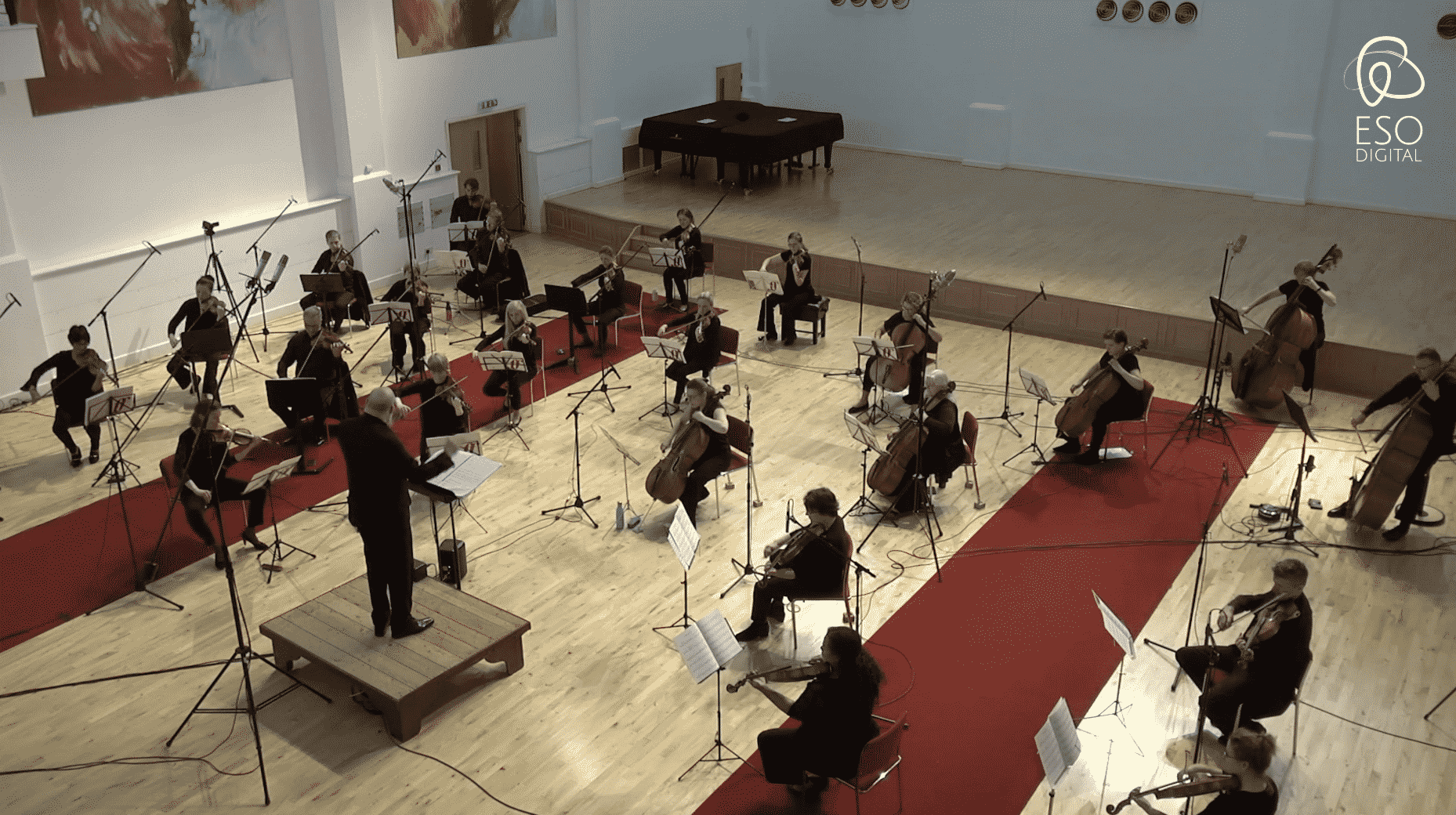
Following its programme of miniatures – original and arrangements – for cello and strings in March, this latest online concert by the English Symphony Orchestra returned to Elgar for a reading of his String Quartet arranged by David Matthews for a full complement of strings.
This was the second in a triptych of chamber works composed in rural seclusion at Brinkwells in Sussex, Elgar having escaped the wartime disillusion of London for what was to be his last sustained period of creativity. Less introspective than the Violin Sonata that preceded it while less emotionally charged than the Piano Quintet that came after, the String Quartet is the most finely proportioned of the three – unfolding as a sustained sweep whose subtle transformation of thematic elements across and between its three movements make it among the finest of his later compositions. Heard in this guise, it follows on from the Serenade then Introduction and Allegro as the hitherto missing large-scale work for string orchestra of Elgar’s high maturity – which should hopefully commend it to an audience beyond that of the composer’s devotees.
Matthews has numerous arrangements to his credit (not least Schumann’s Piano Concerto as recast for marimba), and he has been mindful to balance the soloistic and ensemble potential of this music, so the result is neither straightforward transcription nor radical re-conception. The opening Allegro moderato discreetly emphasises an autumnal musing that sets the tone for much of what follows; even finer is the second movement – marked Piacevole – whose equability yields a main theme suffused with intensity, the extent of which is only revealed towards the close. If the emotional acuity of the final Allegro is marginally diffused when rendered for larger forces, there is no lack of rhythmic definition as the music proceeds to a coda whose terse decisiveness is far removed from the opulence of just a few years before.
Its idiomatic nature was enhanced by the ESO’s attentive playing under Kenneth Woods, a natural follow-on to their take on the Piano Quintet in Donald Fraser’s arrangement (Avie). Heard together, these two parts of Elgar Reimagined should make for a desirable recording.
You can watch the concert on the English Symphony Orchestra website here
For more information on the English Symphony Orchestra you can visit their website here





 Arcana.fm