
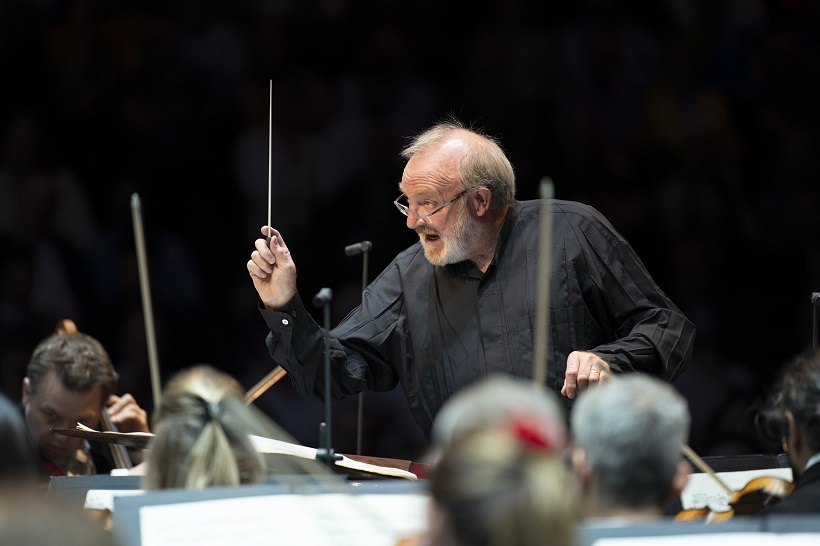
Arcana at the Proms – Prom 53: Remembering Sir Andrew Davis

Stravinsky Symphony in Three Movements (1942-5)
Reich Jacob’s Ladder (2023) [BBC co-commission: UK premiere]
Tippett The Midsummer Marriage – Ritual Dances (1946-52)
Elgar Variations on an Original Theme ‘Enigma’ Op.36 (1898-9)

Synergy Vocals [Tara Bungard (soprano), Micaela Haslam (soprano/director), Will Wright, Ben Alden (tenors)], BBC Symphony Orchestra / Martyn Brabbins

Royal Albert Hall, London
Friday 30 August 2024

reviewed by Richard Whitehouse Photos (c) Andy Paradise

What should have been the 133rd concert that Sir Andrew Davis conducted at the Proms became a commemorative event after his untimely death in April but, with Martyn Brabbins presiding over a thoughtfully amended programme, the outcome could not have been more appropriate.

Proceeding unaltered, the first half began with Stravinsky’s Symphony in Three Movements in a performance redolent of Otto Klemperer in its deliberation if without that conductor’s heft – not least an opening movement whose rhythmic trenchancy felt a little dogged as it unfolded. Best was the Andante – its deadpan humour complemented by the beatific poise at its centre, then a transition of hushed expectancy to launch the finale. Here the closing build-up might have been more visceral, but the conclusiveness of that final chord could hardly be doubted.

Davis (above) was hardly known as proponent of Minimalism in general or Steve Reich in particular, thus his scheduling this first UK performance of the latter’s Jacob’s Ladder could be taken as significant. Playing just under 20 minutes, this is artfully structured as four short ‘expository’ sections followed by four longer ‘developmental’ ones. The former pitted its four vocalists – a telling number in this context of eight strings, six woodwind, two vibraphones and one piano – against an instrumental ensemble that took precedence in those latter sections; the final one brings them together in new-found accord. Dealing with scalic patterns in all their conceptual and metaphorical implications, the musical content typifies late Reich in ruminative elegance or subdued intensity which, if it offers no revelations, is yet satisfying in its stylistic deftness.

Schumann’s Second Symphony had been planned for a second half as now commenced with the Ritual Dances from Tippett’s The Midsummer Marriage – an opera, and composer, close to Davis’ heart. Unfailingly cohesive to the degree its series of elemental and seasonal dances interwove with their respective ‘transformations’ and ‘preparations’, this account was equally notable for its textural clarity even in those most contrapuntally intricate passages, along with a colouristic sense sustained up to the climactic return of its initial music for a magical envoi.

When Brabbins last conducted Elgar’s ‘Enigma’ Variations at the Proms, it was the final item in a 60th-birthday tribute that began with Pictured Within – a latter-day equivalent involving 14 different composers. Tonight’s account gave eloquent insight into what has become almost too familiar a work, evident from the outset in a ‘Theme’ of melting pathos. Highlights from those that followed included the soulfulness of ‘C.A.E.’, pensiveness of ‘R.P.A.’ or elegance of ‘Ysobel’ with its lilting viola from Sebastian Krunnies. ‘Nimrod’ started imperceptibly but built towards a nobly wrought apex, with the affectionate portrayed ‘Dorabella’ or searching evocation of ‘***(Romanza)’ no less affecting. The ‘E.D.U.’ finale moved confidently to an organ-clad peroration exuding what Elgar elsewhere termed a ‘‘massive hope for the future’’.

Just before this performance, Brabbins spoke for a capacity house in paying tribute to Davis with his dedication to music-making in the UK and beyond; something Sir Andrew brought to every one of his 132 appearances at the Proms, across 54 years of dedication to his cause.

You can get details about this year’s season at the BBC Proms website – and you can click on the names to read more about the BBC Symphony Orchestra, their conductor Martyn Brabbins, and an obituary of Sir Andrew Davis himself

Published post no.2,287 – Sunday 1 September 2024

Steve Reich at 80 – Barbican review

reich-80

Steve Reich at 80

Pendulum Music (1968)

Nagoya Guitars (1996)

Electric Counterpoint (1987)

Different Trains (1988)

Pulse (2015) [Barbican co-commission: European premiere]

Three Tales (2002)

Dither (electric guitars), Thomas Gould and Miranda Dale (violins), Clare Finnimore (viola), Caroline Dearnley (cello), Beryl Korot (video); Electronic Music Studios of the GSMD; Synergy Vocals; Britten Sinfonia / Clark Rundell

Barbican Hall, London

Saturday 5th November [6.30pm]

The Barbican venues were dominated this weekend by Steve Reich, whose 80th birthday fell on October 3rd and whose music is the most vital manifestation of the minimalist aesthetic, as well as a pervasive influence on later generations of essentially non-minimalist composers.

The Saturday evening concert itself offered a fair overview of Reich’s evolution across three decades. Pendulum Music may be more an art installation than musical composition, but the presence of 16 people each setting a microphone in motion, such that the resulting feedback is projected by accompanying speakers, makes for a music-theatrical experience of no mean efficacy. A thought persists whether Reich might have been encouraged to do for pendulums what Ligeti had done for metronomes with his Poème symphonique just six years previously?

Utterly consistent in his compositional techniques, Reich has never written intrinsically bad pieces though he has written a few boring ones. There could be no doubting the effectiveness with which David Tanenbaum adapted 1994’s Nagoya Marimbas into Nagoya Guitars, even though the resulting canonic interplay barely sustained interest over its six minutes. Nor did the presence of live guitarists make Electric Counterpoint a riveting experience – not helped by amplification that blurred the interplay of the 11 leads and muddied that of the two basses.

This programme was to have featured Reich’s WTC 9/11 (by some way the most meaningful response to those atrocities in New York), but few would have begrudged revival of Different Trains. Here a live string quartet and three pre-recorded equivalents are overlaid with speech patterns as evoke their literal and metaphorical ‘journeys’ to spellbinding effect, above all in the climactic central Europe – during the war section where observations of three Holocaust survivors become integrated into a soundscape as affecting as any Reich has (and could ever have) achieved. Framed by engaging recollections of the composer’s peripatetic childhood in America – before the war, and a more reflective sequence focussing on observations After the war, it is likely to remain Reich’s masterpiece and Minimalism’s defining raîson d’être.

After which, Pulse was a gentle come-down. This latest Reich work deploys its ensemble of woodwind, strings and pianos via interweaving canons in music that pivots between repose and torpor – with more than a hint of American ‘ruralism’ as regard its harmony and texture.

Back to more immediate concerns with Three Tales – the second of Reich’s collaborations with the video artist Beryl Korot, and his closest engagement (to date) with the premises of contemporary music-theatre. There are three parts, and these are strongly differentiated as to era, concept and underlying form. Thus Hindenburg unfolds as a suite where reportage of the 1937 zeppelin disaster frames imagery of its construction and (over-reaching) ambition, while Bikini is akin to an oblique sonata-design in which footage from the air, on the atoll and on the ships is imbued with expressive intensification and ominous Biblical undertones.

These latter are to the fore in Dolly, where images of the first cloned mammal become the catalyst for six sections akin – in musical terms – to developing variation in the way over a dozen talking heads, with their ‘outlooks’ on the future, are juxtaposed in a sequence whose implosive final dialogue of Kismet (a socially intelligent humanoid robot) with its creator parallels changes from external to internal technological developments over the last century.

Hugely ambitious (despite its barely hour-long duration) and far more compellingly presented than on its previous Barbican outing over a decade ago, Three Tales might still promise more than it delivers, but its attempt to grapple with contemporary issues remains absorbing and it is to be hoped that Reich and Korot will take on one more collaborative challenge. Tonight’s realization overcame technical hitches to convey its emotional charge in full measure, Clark Rundell drawing a precisely coordinated response from Synergy Vocals and Britten Sinfonia.

Reich and Korot were on hand for a post-performance discussion where the former was asked as to future-plans. His immediate task is for a piece on the principals of the ‘concerto grosso’, which will doubtless emerge revivified at the hands of this perennially resourceful composer.

Richard Whitehouse