Wigmore Mondays – Nelson Goerner plays Debussy & Chopin

nelson-goerner

Nelson Goerner (piano) © Jean-Baptiste Millot

Chopin Polonaise in F# minor Op.44 (1841) (11 minutes)

2 Nocturnes Op.62 (1846) (12 minutes)

Polonaise in A flat major Op.53 (1842-3) (7 minutes)

Listen to the BBC Radio 3 broadcast here, until 23 November

Arcana’s commentary

For both Chopin and Debussy the piano became arguably their primary means of musical expression. Both used relatively traditional forms – studies, preludes for instance – but stretched them from conventional structures to suit their own means.

Here we heard seven of the twelve Préludes Debussy wrote as a book, the first of two, published in 1909 and 1910. These are character pieces where he was painting a picture or an impression, without always specifying his exact stimulus. Some were more obvious; others were left to the player for interpretation.

Nelson Goerner made each of these his own. The languid, humid atmosphere of Danseuses de Delphes (1:32 on the broadcast), with control and shading, set the scene and led to an enjoyable and mysterious La serenade interrompue (4:35). This was playful but wary too – dancing but not wanting to fully let itself go.

The ‘underwater rolling of pebbles’ from Verlaine’s poem could be sensed in Le vent dans la plaine (7:00), while the simplicity of La fille aux cheveux de lin (9:09) was rather moving. La danse de Puck (11:24) could have found the Midsummer Night’s Dream character in a more playful mood perhaps, while the thick atmospherics of Les sons et les parfums tournent dans l’air du soir (14:02) hung heavy on the air. Finally Les collines d’Anacapri (17:58) danced and shimmered, controlled but letting itself run wild too. The last four high notes were hammered out convincingly (20:37)

Goerner’s Chopin was rather different. The first of the Polonaises (22:14) was Chopin’s most ambitious work to use the dance form, using a Polonaise in its outer sections but a Mazurka in the middle (from 26:56). This central section had more charm but the outer sections were stern, almost obsessive – and brilliantly played. Their return after the Mazurka (30:05) was like two bolts of lightning, the mood almost that of a Tango from Goerner’s native Argentina.

The Nocturnes (33:40) and (40:12) could have done with a bit more air and relaxation; Goerner seemed rather anxious to push on with them. That said the trills of the first (from 37:55) were expertly managed, while the second was really nicely pointed.

The Polonaise (45:53) was heroic indeed, strutting its stuff but frequently dazzling, especially in Goerner’s white hot ostinato (49:02)

There was an encore to finish, an Impromptu of poise and grace (53:48), more of a Nocturne than the other two arguably.

Further listening

There is something rather special about Polish piano music – and to continue from the Chopin the Spotify playlist below offers up some lesser-heard treats in the form of piano concertos by Paderewski and Moszkowski, prefaced by a sprinkling of exotic Mazurkas from Szymanowski.

by Ben Hogwood
Wigmore Mondays – Vilde Frang & Aleksandar Madžar play Bartók and Schubert

vilde-frang-aleksandar-madzar

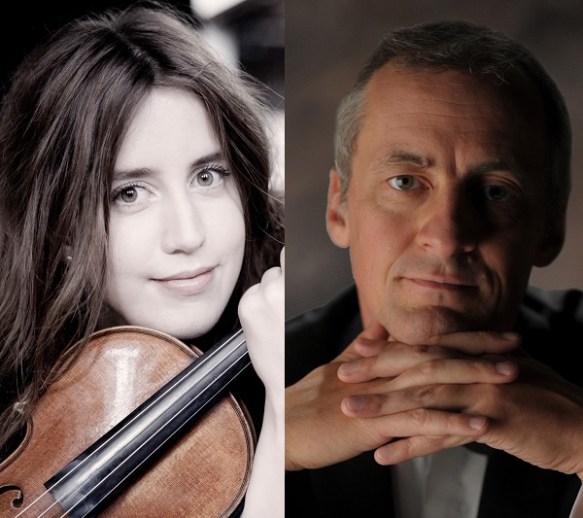
Vilde Frang (left, violin), Aleksandar Madžar (right, piano)

Bartók Violin Sonata no.1 (1921) (33 minutes)

Schubert Fantasy in C major D934 (1827) (21 minutes)

Listen to the BBC Radio 3 broadcast here, until 16 November

Arcana’s commentary

It is easy to see why Vilde Frang is held in such high regard. This contrasting program of Bartók and Schubert showed a steely side to her playing in the former, but also a purity of tone that could be easily appreciated throughout.

These qualities served her well in a powerful rendition of Bartók’s massive Violin Sonata no.1, but she could not have made this impact without Aleksandar Madžar’s superb piano playing, notable for its clarity and rhythmic precision.

Bartók and rhythm are inseparable, and the hold that folk music has on his compositions was all too clear in the syncopations and cross rhythms that Frang and Madžar exploited here. The angular tunes of the first movement (first heard at 2:07) had an assertive mood, brilliantly played.

Richard Bratby’s excellent program note reminded us how modern the music must have sounded in 1922, when Bartók himself played piano with violinist Jelly d’Aranyi, who became an important creative muse. Frang and Madžar powered through the first movement, making light of its technical difficulties, but in the second movement time stood still. Frang’s sweet but thoughtful tune, initially heard alone (from 14:26), was complemented by a solemn and mysterious chorale from Madžar (16:00), the two forces gradually aligning but still lost in a distant world.

The finale arrived with a flourish (25:15), both performers tackling it with some relish and achieving a remarkable unity of ensemble at the end (from 32:30), finishing with a terrifically spicy, bluesy chord.

Schubert’s Fantasy in C major can seem like a long piece in the wrong hands, but here it came alive. Completed in the last year of his life, it is conceived in a single span of four distinct sections, and is a very original piece of writing. Balance between the violin and piano is key, and this was spot on for the moving opening statement, where Madžar had a lot of work to do but was always responsive to Frang’s soft intonation (from 37:09)

A bracing Allegretto section (from 40:23) led to the centrepiece, a Theme & Variations (45:44) The origin of the theme, a Schubert song, was abundantly clear in this lyrical performance, while there was some sparkling playing from Madžar as the variations took hold (try 48:57) This flair and musicality continued to the return of the soft first movement theme, now shaping up in the finale (52:36), an emotional reunion in these hands before a convincing finish (from 57:40).

This was a superb concert, affirming Vilde Frang as one of the best violinists of her generation on the concert circuit, but also illustrating just what a fine pianist Aleksandar Madžar is too. Hear this if you can!

Further listening

You can hear more of Vilde Frang in an early album recorded for Warner Classics with Michail Lifits. Here she brings a sunny tone to violin sonatas by Grieg (no.1) and Richard Strauss, full of youthful exuberance, while there is more Bartók in the form of his Sonata for solo violin, a tour de force:

by Ben Hogwood

Wigmore Mondays – Nicholas Angelich plays Chopin & Liszt

nicholas-angelich

Nicholas Angelich

Chopin 2 Nocturnes, Op.55 (1842-4) (12 minutes)

Chopin 3 Mazurkas, Op.59 (1845)

Liszt Piano Sonata (1854)

Listen to the BBC Radio 3 broadcast here, until 9 November

Arcana’s commentary

A very satisfying blend of poetic 19th century piano music from Nicholas Angelich. By beginning with a well-chosen selection of Chopin he set the scene perfectly for the drama that is Liszt’s Piano Sonata, one of the great works for the instrument and a real test of any pianist’s clout.

First, though, the Chopin – and two contrasting works that bear the title Nocturne. This was a form of music that was more or less invented by the composer John Field and taken up by Chopin, who found it an expressive means with a relatively free form. The first of the two (from 1:46 on the broadcast) was distracted in mood and more than a little downcast. Thoughtfully played, it gradually became more animated before calm was restored with the theme at 5:58. The second nocturne (7:43) had a more open sound, with an almost constant ripple of watery accompaniment.

Angelich’s performances of the Mazurkas showed just how different Chopin’s interpretation of this dance could be.

The last of the three (22:10) was the most dramatic, shifting tellingly from major to minor key at 23:08, and ending there from 25:31.

You could say that Liszt’s Piano Sonata is a one-act play in four scenes – or you could equally say that it is a four-act play. Such is its formal design that both approaches work across the course of half an hour, and it really is one of those pieces the listener can be totally absorbed in.

For that you need the right performance of course, and this one from Nicholas Angelich fitted the bill in every way. The drama should begin even before the first soft, low notes are sounded, and here the period of silence beforehand built the anticipation nicely.

Then once we were under way at 27:30 Angelich set out the musical arguments, allowing the first movement to build its tension through to the start of the faster music at 28:20. After this the music really got going, though it was around the 36:27 where the tempo was really flying, leading up to a grand statement of the slow theme from Angelich at 38:05, a great demonstration of both power and grace at the piano.

This performance really came into its own in the slow movement however (from 41:00), setting a restful and uncommonly sublime mood, until a warning at 48:05 where the music from the start revealed itself again. Other points of note to look out for in the recording are at 48:43 where the fugue begins.

Angelich made a real and clear sense of this tricky passage, beginning with the theme and continuing at 48:55 with the ‘answer’ – as fugues are wont to do. Then the pyrotechnics ensued, a showy movement but one that Angelich kept under control, especially at 52:13 and a triumphant return of the big, slow theme. The coda, from 57:38, was exquisitely paced, and the end, when it came, was soft and petered out to the silence with which the Sonata began.

A performance as impressive for its quiet moments as its loud ones – and a Liszt sonata packed full of incident, drama and romance the whole way through.

Further listening

Angelich has very helpfully recorded something of a ‘concept’ album that begins with the Liszt Sonata. This work was dedicated to Schumann, so we also get that composer’s set of eight fantasy pieces Kreisleriana, one of his very best piano works. Completing the album are two Etudes by Chopin, the subject of Schumann’s dedication.

by Ben Hogwood

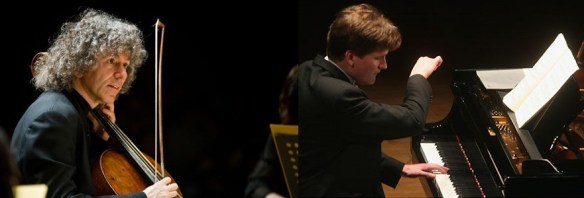
Wigmore Mondays – Steven Isserlis & Olli Mustonen in Prokofiev, Schumann and Mustonen

steven-isserlis-olli-mustonen

Steven Isserlis (cello), Olli Mustonen (piano) (both above)

Schumann 3 Romances, Op 94 (1849) (11 minutes); 3 pieces from Album für die Jugend, Op 68: Sheherazade; Winterszeit I & II (1848) (9 minutes)

Olli Mustonen Frei, aber einsam (UK premiere) (2014) (4 minutes)

Schumann arr. Isserlis Intermezzo from F.A.E sonata (1853) (3 minutes)

Prokofiev Cello Sonata in C, Op 119 (1949) (23 minutes)

Listen to the BBC Radio 3 broadcast here, until 2 November

Arcana’s commentary

Schumann is arguably Steven Isserlis‘ favourite composer. The clues are there in the enthusiasm with which the cellist talks about his music, the affection he gives to each of the melodic lines, and in this concert the construction of an imaginative suite of works for cello and piano, where his natural and extremely intimate lyrical side was to the fore.

Schumann did not write a fully-fledged sonata for cello and piano, but he did complete a number of pieces either directly for the combination or in a form that could be naturally arranged. Such is the case with the 3 Romances, published for oboe and piano as Schumann’s Op.94 but making a seamless transition to the cello.

In this performance the first Romance (from 1:47 on the BBC iPlayer) is a little doleful, the second (from 5:22) is notable for a relatively stormy central section, while the third (9:13) brings the instruments together in thoughtful unison.

After this Isserlis sat head bowed, listening intently as Olli Mustonen performed pieces from Album for the Young as though he and the listener were the only two people in the room. The first piece is Sheherazade (from 13:19), finding the level of intimacy that Schumann’s pieces for the young so consistently achieve, then from 17:10 we hear Winterszeit I and then the changing moods of Winterszeit II (19:01)

Mustonen himself then turns composer, with Frei, aber einsam (from 22:06), a piece for Isserlis alone written with the grace and intimacy of Schumann. It also has a bit of his childlike mischief when it gathers confidence – rather like a bird emerging from the nest – and starts flying along.

Mustonen uses the notes F-A-E as his starting point – which offers a strong like to the next work, heard from 26:46 we hear a tender performance of an arrangement of Schumann’s Romance for the collaborative FAE Sonata, a work written in tandem with Brahms (who contributed the famous Scherzo) and Albert Dietrich. It uses the notes ‘F-A-E’ in the simplest possible way – but also the most personal.

Following this attractive suite is the Cello Sonata of Prokofiev. Typically for the Russian composer this is full of good tunes, and in this performance (from 32:26) Isserlis and Mustonen bring them all to life in a vivacious performance. Isserlis had his way with the audience in the hall, too, with a few glances that sent up the more humourous moments of the second movement perfectly (from 42:46). There is music of romantic power, too, whether in the powerful climax of the first movement (at 41:11) or in the big finale (from 47:27) which sweeps impressively through its return to the main tune at 51:47.

A wonderfully affirming concert ends on a sad note with a tribute to the late conductor and violinist Sir Neville Marriner, the face of the Academy of St Martin-in-the-Fields, who passed away the day before at the age of 92. Isserlis chose the second of Schumann’s Five Pieces in Folk Style (from 56:42), and with Mustonen proceeded to give a touching and affectionate encore.

Further listening

For more music related to this concert, try the Schumann and the FAE playlist on Spotify below. This includes the whole of the collaborative FAE Sonata, the oboe and piano version of the 3 Fantasy Pieces in a wonderful recording from Heinz Holliger and Alfred Brendel and, to finish with, a rare recording of the Cello Sonata no.1 by Myaskovsky. He was the composer who raved about Prokofiev‘s Cello Sonata after its early performances – so here is his own moment in the sun:

by Ben Hogwood

Wigmore Mondays – Doric String Quartet play Debussy and Bartók

doric-string-quartet

Doric String Quartet [Alex Redington & Jonathan Stone (violins), Hélène Clément (viola), John Myerscough (cello)]

Bartók String Quartet no.4 (1928) (26 minutes)

Debussy String Quartet in G minor (1893) (27 minutes)

Wigmore Hall, London; Monday 26 September

Listen to the BBC Radio 3 broadcast here, until 26 October

Arcana’s commentary

An intriguing clash of two of the twentieth century’s biggest composers, glimpsed at very different stages in their development. It was perhaps a surprise that the Doric Quartet chose to begin with the Bartók, with its more abrasive tones, rhythms and harmonic language, but it received an extremely fine performance here.

Bartók wrote the piece at a point where his use of ‘cyclical’ and ‘arch’ forms was prevalent in his work. The String Quartet no.4 works as an arch, its first and fifth movements big-boned compositions, while the second and fourth are flighty and elusive. The third is a typical example of the composer’s night music, supremely evocative and more than a little wary of the shadows.

If not perhaps as ‘rustic’ as some of the Hungarian quartets in performance, it was played with precision accuracy, the rhythms making themselves clear with plenty of cut and thrust. The rocking motion of the second idea in the first movement (from 3:50 on the broadcast) offered a nice contrast.

It was perhaps in the middle movements however where the Doric were strongest. The second movement, played with mutes (from 8:11) offered shadowy contours and elusive, silvery sounds – not forgetting the odd outburst – while the third, a slow movement (from 12:02), has lovely shady contours at the end (from 17:28). Best of all was the fourth movement (17:58), played pizzicato (plucked) and with some especially good snappy effects.

Bartók’s moments of simplicity were surprisingly moving, while the gritty determination on show elsewhere was very convincing – nowhere more so than the start of the last movement, a big ensemble section of terrific drive (21:08).

Debussy’s only String Quartet comes towards the start of his composing career, just as he was shaking off the overbearing influence of Wagner. It signals a conscious move towards the more ‘impressionist’ language he started using with orchestral works such as Prélude à l’apres-midi d’un faune, but remains packed with extremely catchy tunes, enjoyable humour and rich textures.

The Doric performance was a very good one but did on occasion lapse towards a bit of fussiness with tempo variations. It certainly started rather smoothly (30:31), blunting the edges of Debussy’s humour a bit, but lovingly played. The less witty approach could also be felt in the second movement (from 37:10) – which, incidentally, is receiving a lot of exposure at the moment thanks to the Apple advertisement below:

The slow movement (from 41:21) was a beauty, notable for some lovely, elegiac sounds from the viola of Hélène Clément (at 44:22) and a beautifully judged climax. The finale felt a bit episodic, and it was difficult to always hear Alex Redington’s line at the very top of the texture where I was sat at the end of the hall. That said, its exuberance (from 49:47) could hardly be faulted.

Further listening

If you like the music in this concert, Ravel’s only String Quartet is a logical piece to hear next. It bears many similarities to the Debussy but is if anything even more exquisitely formed. For something a bit fuller for strings from Bartók, the Music for strings, percussion and celesta is a terrific orchestral piece, full of atmosphere and drama – so much so that Stanley Kubrick turned to it as part of his horror film The Shining. The playlist can be found here on Spotify, together with the music from this concert: