Patricia Petibon (soprano) and Susan Manoff (piano) – La Belle Excentrique, Wigmore Hall, Wednesday 16 December 2015
Review by Ben Hogwood
It isn’t often you see a rubber chicken as part of a song recital, and I would wager one has not been seen on the Wigmore Hall stage for quite some time. If ever! But this wasn’t just any song recital, this was a concert where soprano Patricia Petibon and pianist Susan Manoff asked questions of their audience, expanding the format but making them laugh and cry in the process.
The concert, a memorable Wigmore debut for Petibon, reminded us how regimented and serious some song recitals can be. Not a criticism you understand, for sometimes it is only right and proper to sit and listen to a singer and pianist making music of raw emotion. It can be one of the very best live experiences in classical music. But this was so very different, Petibon and Manoff marrying humourous music with songs of deep emotion, punctuated with well-chosen piano pieces.
La Belle Excentrique was the title given to the recital, which fell neatly into two parts. Part one began with understated beauty, the crystalline music of one of Reynaldo Hahn’s finest songs A Chloris a daring way to start, especially when sung so quietly. Yet gradually it became clear Petibon was here to have some fun, the actions at the end of the third Hahn song Quand je fus pris au pavillon a notice of intent. Soon the soprano was barking (Manuel Rosenthal’s Fido, Fido) and then Manoff donned a trunk for the same composer’s story of L’éléphant du Jardin des Plantes, both brilliantly done. Hats were donned for songs by Satie and Poulenc, while charm and heart-rending emotion took hold in two wonderful songs by Fauré.
The second half also moved between extremes. France, Spain and the Swiss Alps dovetailed beautifully for songs of powerful impact from lesser-known composers such as Henri Collet and Fernando Obradors, as well as underrated song composers Joaquín Turina and Joseph Canteloube, whose Chants d’Auvergne have fallen out of fashion in the last few decades. Petibon’s performance of La delaïssádo (The forsaken girl) proved this to be an oversight, matched by exceptional playing from Manoff who effortlessly deconstructed the orchestral parts. Then we moved back to farce, and an exaggerated performance of Leonard Bernstein’s song cycle La Bonne Cuisine. For this, Petibon and Manoff went the whole hog by dressing up as chefs and using props relating to the food they were describing. It was hilarious! The recital ended with a no holds barred performance of Lara’s popular song Granada, before two encores – the popular French song Parlez-moi d’amour and a short excerpt, The Cat, from Ravel’s opera L’enfant et les sortileges.
These two performers were a breath of fresh air on the Wigmore Hall stage, heightening our appreciation for 20th century song while questioning the conventional format of the song recital. The strongest possible recommendation I can give lies in the fact I have since purchased two of Petibon’s albums on Deutsche Grammophon, La Belle Excentrique and Melancolia (see Spotify below!) – and would wholeheartedly recommend and Susan Banoff as a concert experience to completely blow away the cobwebs.
In case you cannot hear the broadcast, here is a Spotify playlist of some of the music in this concert. Rachel Podger has in fact recorded this music but it is not currently available for streaming – so here is a version led by violinist Andrew Manze:
If you particularly want to hear Rachel in action – along with excerpts from some of her other recordings for Channel Classics – this page on her website provides more audio
What’s the music?
Biber: Mystery Sonatas (c1674):
Sonata No. 1 in D minor ‘The Annunciation’ (6 minutes)
Sonata No. 3 in B minor ‘The Nativity’ (7 minutes)
Sonata No. 9 in A minor ‘Jesus Carries the Cross’ (8 minutes)
Sonata No. 10 in G minor ‘The Crucifixion’ (9 minutes)
Sonata No. 11 in G major ‘The Resurrection’ (9 minutes)
Passacaglia in G minor (8 minutes)
What about the music?
If you don’t know much about the music of Biber yet like what you have heard from the 17th century then you really are in for a treat.
Performance verdict
The programming of the Wigmore Hall’s Monday lunchtime series often gets deserved plaudits, but to have this set of sonatas on the last of the concerts before the Christmas break was an inspired choice. In Rachel Podger the sonatas have their ideal vehicle, for she is a charismatic performer who clearly just loves playing the violin. In Marcin Świątkiewicz and David Miller she had the ideal support, the two very sensitive with the levels of their accompaniment, supplying light and shade but also subtle virtuosity. Świątkiewicz moved effortlessly between a small organ and the harpsichord, mindful of the colour he was making with each, and when he held the long notes on the organ as a descriptive aid (for instance giving an idea of the echo in Jesus’ tomb) the purity of tone was striking. Miller was a very tasteful presence on theorbo, this fascinating instrument always great to watch live but making a lovely mellow sound too.
Yet most eyes were on Podger, who played this music on four different violins with really impressive command not just of the notes and their intonation, but also of the characterisation. We lived the story in a very profound way, the abject despair of the crucifixion and burial only too obvious – but in the same way the portrayal of the resurrection, where minor key darkness gives way to major key light – was a radiant moment, the wide open sound a joy to behold.
From there it was on to the solo Passacaglia, and here it was as though Podger was on her own in the room, completely lost in the four note sequence that obsessively repeats – but finding all the variations in tone colour, attack, vibrato and rhythm that make this music consistently interesting. In this way she capped a very fine concert.
What should I listen out for?
First of all make sure you listen to the Radio 3 announcement from the beginning, and Rachel’s own introduction at 9:57 – they make the ideal preface to the music you hear, and the four instruments she uses to play it. As for Biber’s music:
No.1 The Annunciation (violin normally tuned)
The first of the suites is based on the following bible verse: Luke 1: 26-33 In Nazareth, the angel Gabriel riding on a cloud tells the Virgin Mary she is to have a child.
2:02 – a long low note from the chamber organ starts the Praeludium of this suite, where the violin becomes increasingly animated. Soon this leads into an aria allegro (4:13), where after a quick introduction from the organ the violin takes the lead in a gentle dance. But soon the dance becomes more energetic as the violin spins out variations on the melody. Then the organ holds a long note (6:49) over which the violin ducks and dives – and where the theorbo is more audible. Here it is as though the prophecy is being made.
No.3 The Nativity
Luke 2: 6-20 Surrounded by farm animals, Mary shows Jesus to two shepherds. The angel presides.
14:05 – a solemn though reverent beginning to this sonata, where the harpsichord can be heard elaborating in the background. Then from 15:43 the chamber organ and theorbo can be heard in a mellow accompaniment to the relatively shrill violin. At 17:31 the triple time Courante begins, thought to be set in this way to convey the rocking movements of Jesus’ cradle. At 19:09 the music slows considerably, the organ now an extremely slow accompanist – and another thoughtful, reverent passage brings the Nativity vision to a close.
No 9 Jesus Carries the Cross
Luke 23: 26-32 Jesus falls and Simon the Cyrenian is forced to help by a Roman with a stick while a daughter of Jerusalem ululates.
22:59 – this is a much more obviously grief-stricken piece, a sonata of mourning depicting a woman wailing with grief. The slow introduction depicts this from the outset, and from 24:28 the music becomes twisted. Then the mood softens, the soft strumming of the theorbo again evident against the cool sound of the organ – before Podger again speeds up, dominating the exchanges. Finally an organ improvisation brings in something of a coda 29:30.
No 10 The Crucifixion
Luke 23: 33-46 Jesus dies before three female onlookers.
32:21 – a real tour de force of word painting here, as Biber conjures up visions of Christ’s crucifixion. He does this through the hammering of nails into the coffin (e.g.33:07 in the Praeludium from violin and harpsichord), and then, after a dance based aria and some lively variations, through a violent earthquake, with all three instruments generating stunning power (40:14). The theorbo offers pointed support too, and is especially audible at 36:56.
No 11 The Resurrection
Luke 24: 1-12 Jesus bursts from the sepulchre, the cross now on his flag, surprising the guard and his cowering accomplice.
43:24 – the violin has a very unusual tuning for this sonata, creating a ‘cross’ – wholly appropriate given the subject matter! It is here that the music becomes free of the shackles of the minor key. First there is a slow introduction, where the sonorous octaves on the organ represent the echoes of the tomb. Then there is a quotation of the plainsong hymn Surrexit Christus hodie (46:05) from the organ, and a series of variations on this theme. The closing Adagio (from 50:46) is soft and rather beautiful, with the violin double stopping (playing more than one note at once). The theorbo is also more prominent here.
Passacaglia (violin normally tuned)
A guardian angel guides a child by the hand.
54:13 – the Passacaglia is an extraordinary bit of writing for solo violin, based on a sequence of just four notes the violin plays at the beginning. A sequence of 64 variations on this unfolds, becoming ever more intense as it progresses (from 58:15 for instance) until a rapt finish at 1:02:30.
Further listening
Biber could be regarded as being a slightly earlier example of the Baroque period. Fast forward just a couple of decades and you have quite a lot of music that has either become associated with Christmas or is Christmas-themed – so this disc of seasonal concertos by The English Concert and Trevor Pinnock is a wholly appropriate next port of call:
In case you cannot hear the broadcast, here is a Spotify playlist of some of the music in this concert. The Birtwistle is not on Spotify, and Adrian Brendel has not yet recorded either of the Debussy or Chopin Cello Sonatas, so alternative versions have been chosen:
What’s the music?
Debussy: Cello Sonata in D minor (1915) (11 minutes)
Birtwistle: Variations for cello and piano (2007) (6 minutes)
Chopin: Cello Sonata in G minor (1846) (31 minutes)
Every piece of music that Chopin published features the piano in some way. Most of his output is for piano solo but there are a couple of exceptions – two piano concertos and some works for piano and orchestra, the Polish Songs, the Piano Trio and this, Chopin’s only Cello Sonata.
It is a substantial piece, written late on in its composer’s career, and has a curious structure of four movements where the first is as long as the other three put together. It is a substantial piece of work, deeply felt in the slower music especially, but is also restless, the cello and piano playing closely together in melodies of unusual rhythm and contour. Chopin achieves the difficult task of honing his instincts for the piano to play as a solo instrument, balancing the two forces extremely well.
Debussy’s Cello Sonata is much shorter, a third of the length of the Chopin, but is equally concentrated in feeling. The work was to be the first in a series of six sonatas for different instrumental combinations from the composer, but sadly ill health determined he would not be able to get any further than three (the others are for violin and piano, and flute, viola and harp). The Cello Sonata is a sultry piece, particularly in the second movement Sérénade, which features plucking on the cello.
Bisecting these is one of Sir Harrison Birtwistle’s several pieces for cello and piano. The Variations are very closely linked to the Brendel family, and although they were commissioned by Adrian they take as their theme a piece written by Birtwistle for father Alfred. The theme is taken from another piece for the same combination, the Lied, and Birtwistle complemented that with this piece and several more to make a continuous sequence for cello, baritone and piano lasting just over half an hour.
Performance verdict
Adrian Brendel and Aleksandar Madzar gave highly accomplished performances of these three works, the result an extremely satisfying concert of contrasting musical language. The Debussy is a perennial favourite but sounded very fresh here, Brendel enjoying the almost complete freedom of the improvised second movement.
The Birtwistle, a gritty, concentrated piece, was very well done also, with characterisation of each of the short variations and some really vivid shades of colour from Brendel in particular.
The Chopin exploited the cellist’s singing tone beautifully, especially in the soaring second theme of the second movement. The duo stressed the uncertainty of much of this piece, and in particular the sizeable first movement, which here seemed to have just as many intriguing questions as it had answers. Brendel took everything in his stride technically, and the rapport and ensemble between the two performers – Madzar employing plenty of light and shade with the piano – was a real asset throughout.
What should I listen out for?
Debussy
2:04 – the first movement, a Prologue, begins with an opening statement from the piano, before the cello comes in expansively. The mood evokes to me a late summer evening. Debussy impresses with his economical use of form here, packing a lot of musical incident into a short movement before it finishing thoughtfully.
6:29 – the Sérénade is a nocturnal movement, and sounds like an improvisation, the plucked cello leading the piano in a stuttering series of musical gestures, showing off a more obvious Spanish influence. Gradually Debussy brings both instruments into line, and the cello uses the bow a lot more, building the tension and moving straight into…
9:50… the Finale, which starts with urgent piano and soaring cello before a vivacious theme makes itself known from the cello (10:08). This becomes the main focus of the movement, though the sultry mood of the Sérénade is not entirely forgotten.
Birtwistle
15:27 – the piece begins with a mysterious sound world on show, the cello playing two notes at once and the piano sounding very uncertain. The variations unfold in wildly differing moods, and without following the score it is relatively difficult to say where one ends and the next begins. After a tense beginning the piano stabs out two penetrating notes and then the music becomes faster – though the performers seem much more at odds. The end, when it comes, is slight.
Chopin
23:28 – the very substantial first movement (16 minutes) starts on the piano, with a solemn introduction. It doesn’t take long for Chopin to show off the pianist’s technique, but he is careful not to write a part that impinges on the cello once it appears with the theme. After a slow start the pace picks up a little, the mood intensifying – until Chopin works around to a repeat of the whole first section (from 28:42)
39:54 – a short scherzo that flits about without seeming to settle. The instruments are very closely linked in their musical discussion, both sharing the distinctive rhythm that Chopin gives to the main theme. The second theme () has a soaring quality very unusual to Chopin (in that he wrote so many melodies for the piano) and it has a penetrating beauty in this concert.
45:10 – a soft but warm-hearted slow movement, with a songful melody first aired on the cello but then repeated on piano. This is a surprisingly short movement, profound but giving the sonata a slightly lopsided form.
48:40 – the finale takes us back to the sonata’s ‘home’ key of G minor and finds an impressive urgency, with cello and piano working very closely together. Chopin employs a number of extremely catchy hooks but the form is relatively compressed…and soon the music moves into the major key and a thoroughly affirmative finish at 54:30.
Further listening
The Spotify playlist containing the music for this concert has been enhanced to include Chopin’s other large-scale chamber work, the Piano Trio. After this you can enjoy some music for cello and piano by a composer best known for his piano music, Franz Liszt – and played by the great Hungarian cellist Miklós Perényi:
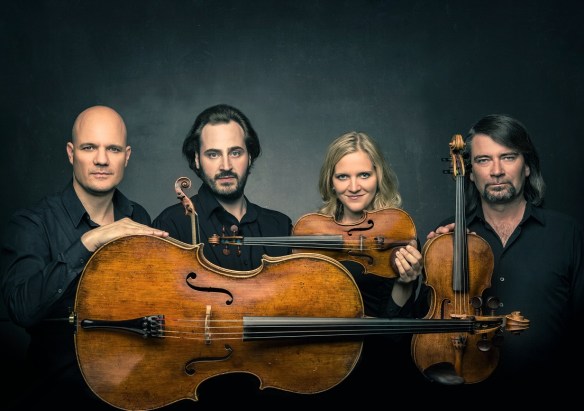
Artemis Quartet – with Friedemann Weigle (viola) on the far right.
Markus Groh (piano), Members of the Artemis Quartet – Vineta Sareika (violin), Gregor Sigl (viola), Eckart Runge (cello) – Wigmore Hall, London, live on BBC Radio 3, 30 November 2015
In case you cannot hear the broadcast, here is a Spotify playlist of the Brahms played in this concert, from available versions on Spotify:
What’s the music?
Bach/Piazzolla, arr. Eckart Runge: Partita for StringTrio – In Memoriam Friedemann Weigle (18 minutes)
Brahms: Piano Quartet No. 3 in C minor, Op. 60 (1875) (35 minutes)
What about the music?
This concert was a tribute to the violist Friedemann Weigle, a member of the Artemis Quartet who sadly died at the age of 53 earlier this year. The quartet write this about the Bach / Piazzolla suite with which they begin, arranged by their cellist Eckart Runge:
“Featuring excerpts from Bach‘s Goldberg Variations, the English Suite BWV808 and the Sinfonia BWV795, as well as two fragments from Piazzolla‘s Oblivion and Fuga 9, the Partita for Trio spans the lifetime of Friedemann, from his beginnings as a church musician’s son to his time as a member of the Artemis Quartett. In 2012, when we were conceptualising our Bach-Piazzolla suite, Friedemann was devoted to arranging the works of Johann Sebastian Bach. He had a special affinity for the music of Bach, music that had accompanied him since his childhood. At the same time, he had been fascinated by pop music – from rock to jazz – since his youth. Indeed, he often proudly said that his first public musical performance was as a drummer in a rock band. Friedemann’s curiosity for new musical forms once again became apparent when he learned – and learned to love – Piazzolla’s Tango Nuevo through the Artemis Quartett.
We performed the Aria from the Goldberg Variations at Friedemann’s funeral. The idea then came about for us to honour Friedemann through the arrangement of a Partita, which would bring together these two aspects of his musical interests and, as a trio, to show the absence of a beloved friend.”
Performance verdict
Sometimes in a concert it almost does not matter what the standard of performing is like, and this was one such occasion. Unfortunately Arcana was unable to attend but I am sure you will be able to gauge the depth of feeling immediately from the sensitive Bach arrangements, which are arranged into a very effective suite.
The BBC Radio 3 announcer Sara Mohr-Pietsch tells us that the last recording at which Friedemann was present was of Brahms String Quartets – and so the group have been performing Brahms with guest pianists on their tour. There is an extra poignancy and potency to their performance of the C minor Piano Quartet No.3, with a depth of feeling that even over the radio is very intense. The resilience and power of the outer movements is most impressive, the rhythms are sharply defined and the slow movement is the soft, beautifully played centre of the performance.
What should I listen out for?
Bach / Piazzolla
1:40 – a solemn opening passage of music, where the held notes on the string trio could be mistaken for the sonorities of the bandoneon – an instrument Piazzolla often used.
5:54 – a fugue – presumably from Bach’s English Suite BWV808 – begins, the players using next to no vibrato and keeping their bows near the bridge of their instruments by the sound of things, to secure quite a coarse sound – but then there is much more of Piazzolla appearing as the music moves into a characterful dance at 7:30. Then at 8:06 the mood changes abruptly again, returning to sorrowful memories.
17:18 – the Aria from the Goldberg Variations signals a switch from the sorrowful minor key to a much more optimistic major. With it the instruments bring more vibrato. The versatility of Bach’s music is very clear in this arrangement, the parts beautifully even in their distribution.
Brahms
Markus Groh (piano)
23:23 – the piece begins with a slow introduction, where a single unison from the piano brings in the strings with their theme. This call and response is repeated. At 24:22 the first movement proper begins, and is notable for its full texture and big musical statement. The music then subsides a little to softer, undulating thoughts and a second theme at 25:30 from the piano. Brahms continues with some powerful statements from both forces. At 31:42 the music is more graceful, led by the piano, but soon the fraught atmosphere returns, and at 32:57 the mood of the slow introduction returns, and the first movement finishes.
33:52 – the Scherzo, which as so often with Brahms features nervy crossrhythms and the feeling of piano versus strings. At 35:12 there is a flowing passage but still the nervousness is present – and at 36:34 the main theme returns, with razor sharp accuracy from the players, before an emphatic finish moves the music from C minor to C major.
38:21 – the slow movement begins with the cello softly playing, an elegiac line that is beautifully rendered here by Eckart Runge over a quiet piano accompaniment. Soon he is joined by the violin and the pattern for this deeply felt piece of music is set, the instruments sticking closely together but playing music of great tenderness and feeling. The movement ends quietly and thoughtfully at 47:45.
47:58 – the finale begins with a sense of nervousness again, the piano figuration dancing around the violin theme, before the music really cuts loose with all four instruments, Brahms unleashing the power at his disposal. In this performance the group take the repeat at 50:00. Then the music moves farther afield, in terms of its distance from the harmonies Brahms uses for the main key – before returning around the 53:35 mark – where we hear another account of the main melody on a lower part of the violin. The work as a whole leaves a strong impression, with a thoroughly convincing finish.
Further listening
Brahms enjoyed writing for the piano with stringed instruments, and his other two Piano Quartets are massive works but ones that repay repeated listening. The more popular of the two is the Piano Quartet No.1 in G minor, a really impressive structure that is one of the composer’s earliest large scale chamber works. The Piano Quartet No.2 in A major followed soon after…and both are given excellent performances on this album from pianist Nicholas Angelich, string playing brothers Renaud and Gautier Capuçon (violin and cello respectively) and Gérald Caussé (viola):
In case you cannot hear the broadcast, here is a Spotify playlist of some the music in this concert. Narek Hakhnazaryan has not yet committed any of these works to disc, though the Khudoyan solo sonata is available to watch on YouTube below:
Alternative versions of the Schumann and Mendelssohn can be heard below:
What’s the music?
Schumann: Five Pieces in folk style, Op.102 (1849) (16 minutes)
Adam Khudoyan: Solo Cello Sonata no.1 (1961) (8 minutes)
Schumann found in the cello an instrument with which he could express his music naturally, and his music for the instrument ranges from a late Cello Concerto to various ‘fantasy pieces’ for cello and piano. Five of these, the Funf Stücke im Volkston (Five Pieces in Folk Style) are vignettes for the combination where Schumann is clearly enjoying himself, music that ranges from the playful first and fourth pieces to the warm of the lyrical lullaby.
I have to confess this was my first encounter with the music of Adam Khudoyan (1921-2000), though, as the Wigmore Hall booklet writer Brian David discussed, he was one of Armenia’s most highly-regarded twentieth-century composers. He completed his Solo Cello Sonata no.1 in 1961, the first of a number of works for the instrument. It is a relatively short but intense work, David writing that ‘it has at its heart a deep, extended lament that moves between extremes of sorrow and anguish’.
Mendelssohn’s middle period of composition saw him writing with incredible spontaneity, and it is into this part of his career that both his major works for cello fall. Both of his cello sonatas are rich in expressive melodies and positive feeling, and the outpouring of good spirits at the start of the Second is difficult to shake off through the work. It does have a profound side too though, found in the slow movement where Mendelssohn works a prayerful chorale in a manner often interpreted as a contemplation of his dual Jewish/Christian heritage.
Performance verdict
From this evidence the partnership of Armenian cellist Narek Hakhnazaryan and Russian pianist Pavel Kolesnikov is most definitely one to keep an eye on. The duo clearly enjoy the music they make together, and while the perception is that Narek is the one to wear his heart on his sleeve more obviously, Pavel provides some wry humour as a counterpart.
That was most evident in the second movement of the Mendelssohn, where the piano phrases were beautifully shaped and strung out just a bit longer to enhance the witty theme. This performance was excellent, maybe a bit over-wrought in the first and last movements but reaching a degree of stillness in the slow movement that was very moving.
Their Schumann was also very enjoyable, played with a very fresh approach and again with a nice dash of humour. This music is rich in melody and the two clearly enjoyed each new tune and turn of phrase.
It was also very satisfying to hear the Khudoyan sonata for the first time, extending this Armenian’s credentials as an extremely proficient writer for cello. The use of folk melodies gets us close to the heart of Armenia quickly, and it was clear from his expression that Hakhnazaryan felt the same way. A technically superb and emotionally charged performance of music that has real concentrated expression.
What should I listen out for?
Schumann
1:32 – a bright and slightly mischievous first piece, marked ‘Vanitas vanitatum’, where the spiky cello and detached piano embark on a breezy march. The middle section from 2:50 is by contrast heavier and assertive.
4:49 – a rather gorgeous lullaby, led by the cello with dreamy accompaniment from the piano.
8:46 – a graceful dance that is a little within itself, the cello elusive and the piano quiet as though in thought. Perhaps a sign of shadow that suggests this to be a later composition – though the warmer middle passage, where the cello plays chords, is a much more positive complement.
12:49 – the exuberant fourth piece, led by the cello in breezy fashion – with a nice, more lyrical theme to boot from 13:15.
14:47 – the last piece is quite a frenetic affair that sounds almost as though it could have been written by Brahms. Here the cello and piano are in much more obvious dialogue with the syncopated rhythms.
Khudoyan
19:36 – the solo sonata starts with a bold statement, with chords on the cello. The forceful and heady mood. It brings to mind a little the rather bigger sonata by Kodály, especially at 20:45 when a slower tune is heard, one that seems to be inspired by folk music.
There are some quite jarring moments where Khudoyan puts two pitches very close together but overall the sonata is full of powerful and moving melodic lines, the composer using the cello chords as more of a rhythmic prompt.
25:45 – from here the cello has a brief but thoughtful section of ‘pizzicato’ (plucking) before the material from the beginning returns with even greater force. The piece ends with powerful chords.
Mendelssohn
29:33 – right from the beginning it is clear this is going to be a positive piece. Cello and piano open together with a sweeping melody, and the piano part is typically busy for Mendelssohn. The cello retains a song-like delivery to its melodies, and the music continues to surge forward strongly, suggesting the composer’s inspiration was very instinctive at this point in his life. The main theme returns at 34:00.
37:33 – this is a lovely example of Mendelssohn’s lightness of touch, a piece of music that has subtle humour and a memorable tune to go with it. This is introduced by the piano and repeated by the pizzicato (plucked) cello. A contrasting and flowing theme crops up at 39:22, before the main ‘scherzo’ material comes back at 40:49. A strong coda section begins at 41:58, with a more obviously romantic mood in the cello line.
44:04 – the slow movement begins with a set of chords from the piano that sound rather like a hymn (or ‘chorale’). The top note of each of these chords forms the melody which the cello eventually takes up, reaching an impressive intensity at 47:02. Then a meditative passage takes place over a long held note on the cello. The whole movement is almost certainly under the influence of Bach in the stepwise manner in which it moves and is beautifully simple.
49:44 – the finale returns us to the brisk manner of the first movement, cello and piano ducking and diving as they move towards the main theme at 50:09 on the cello. The music proceeds at a bustling pace, often with little opportunity for breath, as though Mendelssohn were writing music as fast as he possibly could!
Encore
57:54 – an encore in the form of an arrangement for piano of Rachmaninov’s Vocalise. A lovely, romantic, slow moving piece of music where time slows down a little – for nearly seven minutes, in this case!
Further listening
If you enjoyed the Mendelssohn and Schumann in this concert then there is more to explore in the cello and piano repertory from both composers. A very attractive account of Mendelssohn’s complete music for the combination can be found here, played by Antonio Meneses and Gérard Wyss:
The same combination released an album of Schubert and Schumann works for cello and piano in 2006, on which the Schumann pieces all make a lasting impression – as does Schubert’s substantial Arpeggione Sonata:



 Arcana.fm