Songs in the Key of Gambling – how music in Vegas helps you spend money!

nyny
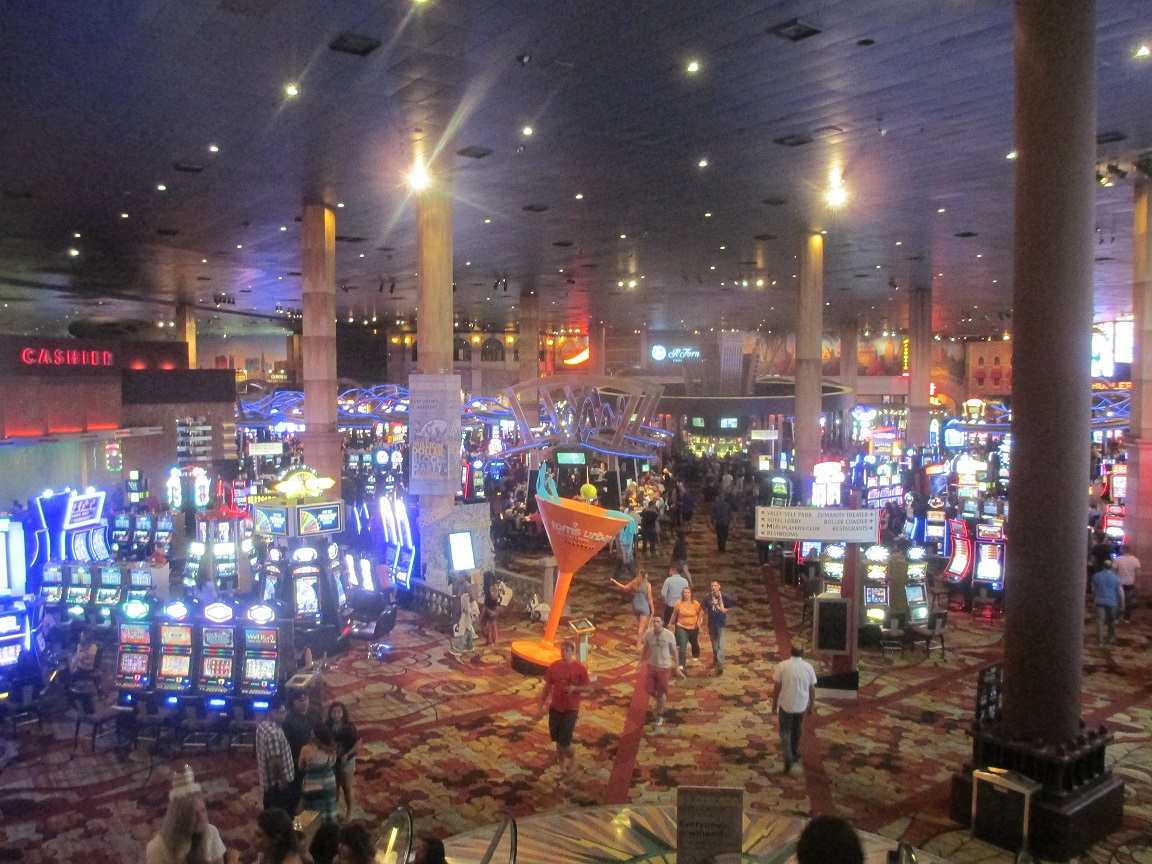
Ground floor panorama of New York New York hotel, Las Vegas

We all love a gamble. Don’t we?

Well a recent visit to Las Vegas revealed a few very cunning tricks that hotels, casinos and the makers of slot machines build into their venues. They have very subtle ways of making you part with your money.

This includes bright lighting, extra oxygen and free drinks and food if you’re sitting at a machine…but when it comes to the music their tactics are a little more devious.
moolah

The hotel in which we were staying, New York New York, has a massive wall of noise on its ground floor. And all of it is in a major key. Bright, treble rich colours are not just visual but they can be musical as well. Apart from the bass generated by the night DJ’s thumping trance tunes, there was almost nothing audible in the lower end of the scale.

Instead all the melodies and harmonies can be heard up top, with brightly voiced sounds that come across as electronically modified glockenspiels, clarinets, harps, flutes and organs.

I am fortunate enough to be blessed with perfect pitch, so it was almost an assault on the senses when walking out the lift to be blasted with a wall of pure C major. It seemed almost every machine was in this key, the notes all piling together to make a big, big sound of consonant and utterly positive harmony. The effect on the brain was striking, and this was even without reckoning on the songs played over the PA system or thumping out of the 9 bars and 12 restaurants in the hotel.

Again, these were almost all major key classics – Katy Perry’s Firework (in the key of A flat major), P!nk’s Try (E flat major), pretty much everything in the Avicii back catalogue (Wake Me Up is a classic in D major!) and, perhaps inevitably, a fair bit by Taylor Swift (Bad Blood being in G major).

When all these musical constituents were heard together this made a potent mix, the musical part of a carefully constructed environment for gambling. Thankfully we didn’t lose our shirts!

Wigmore Mondays – Anna Caterina Antonacci & Donald Sulzen

antonacci

Anna Caterina Antonacci (soprano), Donald Sulzen (piano) perform Poulenc melodramas

Wigmore Hall, London, live on BBC Radio 3, 14 September 2015

Listening link (open in a new window):

http://www.bbc.co.uk/programmes/b069x6kh

on the iPlayer until 13 October

Spotify

In case you cannot hear the broadcast, here is a Spotify playlist of the music in this concert – none of which Anna Caterina Antonacci or Donald Sulzen have yet recorded. Poulenc wrote these pieces either for voice and piano or voice and orchestra, and the playlist opts for the latter as Felicity Lott is the vocalist.

https://open.spotify.com/user/arcana.fm/playlist/2Xn85iACUoZurViTV2qiFs

A voice and piano version can be heard from Denia Mazzola Gavazzeni and Eric Hull here:

https://open.spotify.com/album/0CM2nBzQxiGys75arYMAki

What’s the music?

Poulenc: La dame de Monte Carlo (1961) (7 minutes)

Poulenc: La voix humaine (1958) (36 minutes)

What about the music?
poulenc-cocteau

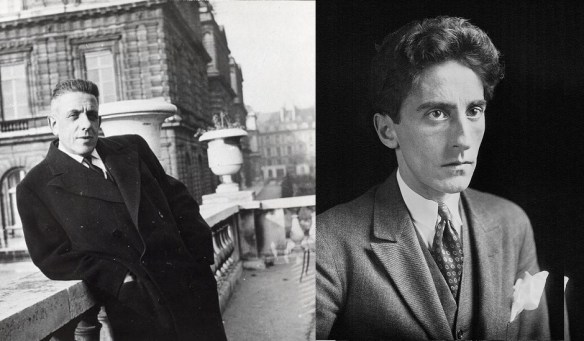
A brave program to start the Wigmore Hall’s new lunchtime season! Francis Poulenc (left picture above) is a composer loved for his humour and witty tunes, but these two melodramas bring out his darker side. The humour remains at a much-reduced level, as does the melodic interest which tends to be assigned more to the piano.

La dame de Monte Carlo, written to words by Jean Cocteau (right picture above), describes a suicidal woman who goes to the principality for a bout of gambling before ending her life in the Mediterranean.

La voix humaine is a much more substantial piece, written three years earlier. It was found by Poulenc and Cocteau to mimic their own lives, and Poulenc identified himself with the subject, a woman whose lover of five years is about to get married. We don’t meet the lover but the study of the woman, carried out in the form of a telephone call, builds a picture of both parties from her perspective. The woman is starting to come to terms with her lot, and has herself taken an overdose the previous night. Over the course of nearly 40 minutes Poulenc and Cocteau explore a wide range of feelings from earlier in the relationship, but above all they bring out the insecurities and terror of starting again alone without a loved one.

Their innovative script – telephones not being that widespread in 1958 – is well ahead of its time, still very relevant to the present day, and Poulenc portrays the phone ringing with uncanny accuracy through the piano. Not only that, he uses the piano to set the mood, describing not just the woman’s movements but also anticipating what is said on the other end of the line. It is an often uncomfortable but mesmerising experience.

Performance verdict

Anna Caterina Antonacci and Donald Sulzen were superb in this performance of both works, allowing a more light-hearted approach in La dame de Monte Carlo but getting right to the heart of the matter in La voix humaine, which turned into a harrowing experience as Antonacci walked restlessly up and down the stage.

Her text was especially clear, which proved to be a real asset when following the quick moving thoughts of the woman. Donald Sulzen was similarly profound in his communication of the piano part, even taking some elements from Poulenc’s orchestral arrangement to bolster his depiction of the unravelling emotions on stage. It all made for a powerful and unsettling concert – a bold season opener!

What should I listen out for?

La dame de Monte Carlo

Words are here, part of a massive Hyperion set of the complete Poulenc songs. The words can be found on Page 126

Described by the composer as ‘the lamentable story of an old, abandoned, miserable floozy who, instead of suicide, tries her luck at Monte Carlo and finally throws herself into the Mediterranean’.

2:16 – a gentle if quite sorrowful introduction from the piano, followed by the soprano with a downbeat assessment of life. Here Poulenc is describing sadness, and the different verses follow with descriptions of pride (from 4:24), lyricism (5:28), violence (6:37) and finally sarcasm (7:18). The sorrowful tale ends with the subject throwing herself into the sea – described impishly by the piano with a chord that sounds like a small ‘plop’!

La voix humaine

Words are here (no English translation available)

Antonacci played the role with a telephone either in her hand or on the table next to her, walking distractedly around the stage as the part demanded.

12:48 – the piano sets the rather fraught scene as the subject waits for the phone to ring – which it finally does (13:45). However it’s a wrong number, so the tension grows further until…

14:55 – the phone rings for a third time, and finally to her relief it is the woman’s lover. The conversation can begin. Initially she is strong but by 18:00 the façade is beginning to crack, as the husk in Antonacci’s voice shows. The speech is more faltering.

21:30 – the woman begins to panic, and then, as the two are momentarily disconnected at 22:15, her distress gets ever closer to the surface. Her lover does not sound the same – and then comes the confession, from 24:30, that ‘J’évite de me regarder’ (‘I no longer look at my face’)

26:06 – the quality of the line deteriorates, the piano becomes discordant and the operator has to intervene. The tension goes up another couple of notches!

29:37 – now the woman begins her confession, that she is close to ruin and took an overdose the previous night. She becomes agitated and starts to move around the stage, which you can hear as the perspective of the singer changes. The piano matches her mood.

32:22 – the music now reflects the sadness and emptiness of the subject, as the woman details the details of her overdose the previous night. Whenever the phone comes close to dying she becomes nearly hysterical.

35:43 – a tender moment as the woman recalls time with her lover, but the reverie is broken as the piano plays jazzy music, which she can hear over the phone.

38:39 – ‘I love to hear you speaking’, the woman confesses – and then she looks back on the five years they have spent together. Again this bout of nostalgia is rudely interrupted by an interloper on the line (39:31). Gradually the woman begins to imagine them making up – before around 42:00 declaring that ‘a telephone is cold, what we had is lost for ever’.

43:52 – the two become disconnected, and the woman feverishly wishes for her subject to call back. Her very life seems to depend on it.

44:51 – now the woman becomes gradually more resigned to the lovers’ fate, and the drama ends with a final declaration of love at 48:40. Here the waltz theme Poulenc has worked into the piano part returns in a poignant gesture, before a final piano chord.

Further listening

Normally Arcana would recommend a piece or two by the same composer, but in this case a strong recommendation is put forward for a live recording of Antonacci and Sulzen at the Wigmore Hall a few years back, performing a recital including French and Italian songs by Hahn, Tosti, Cilea and Respighi:

https://open.spotify.com/album/4MTzyat9ZtmmgHozyaUFwu

Under the Surface at the Proms – About Schmidt

Prom 73, 10 September 2015 – Vienna Philharmonic Orchestra / Semyon Bychkov at the Royal Albert Hall

schmidt
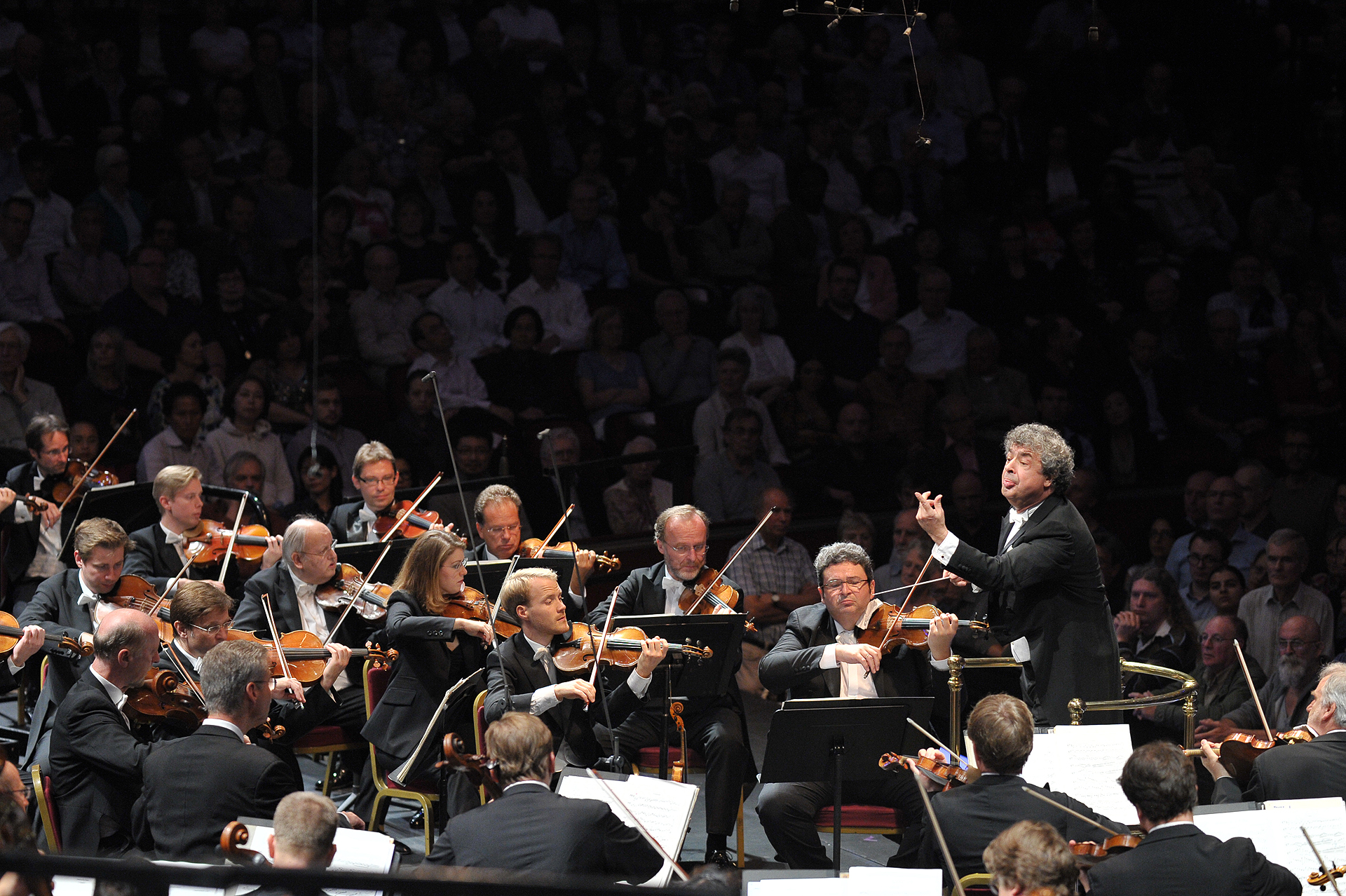
Semyon Bychkov conducts the Vienna Philharmonic Orchestra in Schmidt at the Royal Albert Hall. Photo (c) Chris Christodoulou

Symphony no.2 in E flat major
http://www.bbc.co.uk/events/ewbfxj#b068tnhg

‘Some music has to wait before it finds its place in the sun.’

This standout quote comes from an interview in the Proms program with conductor Semyon Bychkov, who conducted the Vienna Philharmonic Orchestra in this concert of two late Romantic symphonies. The work to which he referred was not BrahmsThird Symphony, which received an occasionally beautiful but ultimately rather lethargic performance in the first half, but the Second Symphony of Franz Schmidt, completed in 1913.

Schmidt’s music has only visited the Royal Albert Hall in full on two previous occasions. The Fourth Symphony, which experienced a revival when Frans Welser-Möst and the London Philharmonic Orchestra won a Gramophone Award for a recording of it in 1996, was heard at the festival in 1998. The relative success of this was followed by the massive sacred piece Das Buch mit Sieben Siegeln (The Book of the Seven Seals), which followed a similar path, recorded by Welser-Most in 1996 and performed by the same conductor in 2000.

Schmidt was a wholly suitable choice of composer for the Vienna Philharmonic, who have been revisiting important works in their history this year. Unlike the Brahms third they did not give the premiere of the Schmidt, but the connections with the composer are close. He became a member of the orchestra in 1896, where he played as a cellist – though he did not get on with Gustav Mahler, conductor at the time. Bychkov has championed the Second Symphony with other orchestras, so it made sense to finally bring it to the Vienna Philharmonic. From what I could tell this was their first season performing this or any of his symphonies. So what of the piece itself?

Written on a large scale, the Second clocks in at around 50 minutes. It is in three movements, the large second movement dominating at around half the length of the piece – and it was the centrepiece here. A colourful and richly layered set of variations on a theme, it delights in exploring a number of completely contrasting moods, drawing unusual textures from the orchestra that reveal Schmidt the organ composer. A few of the variations sound uncannily like right hand keyboard figures played at speed, with amazing clarity of colour.

There were clear influences from Bach, Beethoven, Mahler, Richard Strauss and Bruckner – yet the music was nothing like a copy of any of these composers. Instead Schmidt managed to stamp his own personality on the piece, shying away from obvious statements so that the mood was at times strangely elusive, on occasion reluctant to commit to emotion with obvious meaning.

It had operatic qualities, for sure, which could be felt in the ebb and flow of the drama and in the swell of the melodies – but the unusually luminous colours dominated, Schmidt using the orchestra in his own individual way. Here he wrote especially taxing parts for violins and violas, but the crowning glory was the massive brass chorale that appeared towards the end and was resolved without fuss.

Only the Proms could have presented this combination of orchestra and music, and should be congratulated for doing so. It was expertly performed and well received, and should go a long way to giving Schmidt’s music the chance of a revival it deserves. It will be interesting to come back in five years and see if anyone else has taken up the baton from Bychkov.

Want to hear more?

A playlist combining the Second and Fourth Symphonies can be heard here:

Meanwhile for the massive Das Buch mit Sieben Siegeln (The Book of the Seven Seals), in a recent recording made for Chandos under conductor Kristjan Jarvi, click on the link below:

This is the last Under the Surface feature of this year’s Proms. There will be more explorations of rare repertoire on Arcana in the coming months, both through recordings and concerts. Stay tuned!

Proms premieres – Birds with new plumage

tui-bird
The Tui Bird from New Zealand. Photo (c) Sid Mosdell

Messiaen, orch Christopher Dingle – Un oiseau des arbres de Vie (1987-1991, orch 2015)

Ravel, arr. Colin Matthews – Oiseaux tristes from Miroirs (1905, orch 2015)

BBC Philharmonic Orchestra / Nicholas Collon (Prom 29)

Duration: 4 minutes each

BBC iPlayer link

http://www.bbc.co.uk/events/ef3zc8#b0640p40

The Messiaen can be heard from 1:55; the Ravel from 35:02

What’s the story behind the pieces?

Messiaen’s Un oiseau des arbres de Vie (A bird from the tree of life) is music that is ‘incredibly technically difficult to conduct’, in the words of Nicholas Collon, given the job of overseeing its first performance in this guise, arranged by scholar Christopher Dingle.

The relatively short piece originally intended to be part of his massive, multi-movement orchestral piece Éclairs sur l’Au-Delà…, but was removed before the first performance. It is mostly scored for percussion but changes tempo and time signature more or less every bar. In the piece Messiaen profiles the New Zealand tui bird through a written-out melody of its song.

Meanwhile Ravel’s Oiseaux tristes (Sorrowful birds) is the latest French piano piece to be orchestrated by Colin Matthews. The composer has tried his hand at a number of Debussy Préludes, imagining how Ravel might have undertaken the task, but here he looks at one of the six parts of Miroirs, the suite written by the composer for piano. Ravel himself orchestrated two of the other movements, Une barque sur l’océan (A boat on the ocean) and Alborada del gracioso (Morning song of the jester).

The piece is intended to portray the sorrowful birds in the depths of a very hot summer forest. They are lost.

Did you know?

Ravel’s orchestration of Musorgsky’s Pictures at an Exhibition is one of many versions of the Russian composer’s suite for piano – but is the most performed.

Initial verdict

The Messiaen is bright and strongly rhythmic, but not in a conventional sense. It is very treble based, and is punctuated by crisp chords that have an unusual colour, with the wood block and tuned percussion heavily in evidence.

Colin Matthews’ orchestration is evocatively coloured, ideal for a humid evening at the Royal Albert Hall. The mood is oppressive, the brass lending weight to the lower end of the sound. It is clear from this that Matthews has listened closely to Ravel’s own methods of orchestration, because his way with the colours available is surely near to what the composer might have imagined.

Second hearing

tbc!

Where can I hear more?

Colin Matthews’ orchestrations of Debussy Préludes can be heard in a release made by the Hallé record label, found on Spotify here