Dave Howell – an anniversary interview for the 130701 label boss

130701

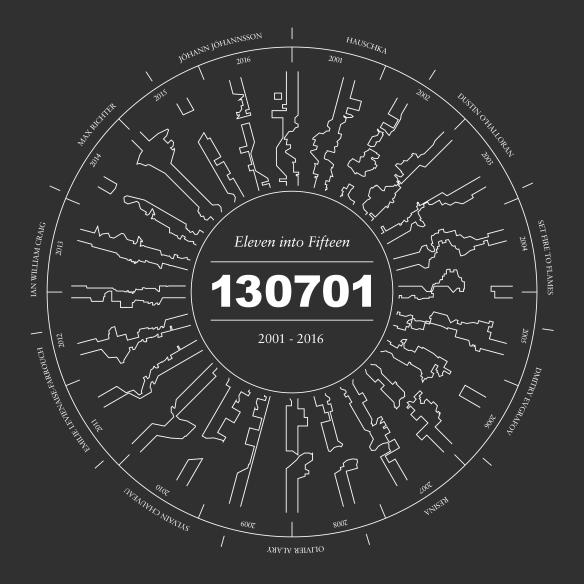
On this day, 15 years ago, a new record label was born. July 13th, 2001 – or, as we should call it for the purposes of this article, 130701 – for that was the new name given to the record company.

It was the brainchild of Dave Howell, and initially existed purely for the release of the new album by Set Fire To Flames, an offshoot of Godspeed! You Black Emperor. Soon the label built into releases from Max Richter and Sylvain Chauveau, adding composers influenced by but not bound to classical music tradition.

These included Hauschka, an adventurous and experimental pianist, Johann Johannsson – now an Oscar-winning soundtrack composer – and Dustin O’Halloran, now half of Mary Anne Hobbs darlings A Winged Victory For The Sullen.

Sadly this enviable pool of musical talent found itself uprooted by a legal dispute for the parent company of 130701, FatCat, and each artist had to subsequently leave the label. Somehow it returned from the ashes, with Howell once again at the helm – and now he can sit with understandable satisfaction, celebrating their fifteenth anniversary with a new compilation, and sharing with Arcana the formation and legacy of his label:

Can you remember your first encounters with classical music?

Ha. I don’t think any of us at FatCat had any background whatsoever in classical music at all prior to setting up 130701. The first encounters I can remember with classical were as a kid, with my father having a handful of classical LPs in the house. I remember one was Holst’s The Planets, and there was probably Vivaldi‘s The Four Seasons there too but he was just a dabbler really, he wasn’t really passionate about music and I never really dug much that he liked, so I don’t have any great memory of it.

I guess there was that thing of reacting against the values of your parents and their music and for me those records were the old order and didn’t speak to me. They came from an age and a class that felt remote and something that I just couldn’t relate to.

I think the first classical stuff I started finding myself getting interested by would probably have come through film – so things like Walter Carlos on ‘Clockwork Orange’ and Michael Nyman’s work for Peter Greenaway’s films.

That was probably the first time I heard contemporary classical stuff that to me sounded really interesting and a little later I read Nyman’s book of his on 20th century experimental music which became a big influence on my thinking and writing and a guide in exploring whole new areas of electronic music, Minimalism and the avant-garde. I think when I started getting more into electronic stuff, then I began to dig things like Satie, Morton Feldman, Arvo Pärt. I never had, and still don’t have, anything remotely approaching a decent understanding of the classical canon and what classical music actually is. But I do know, instinctively, what I like and why I like it, and I do trust my instincts 100%.

Can you remember your first encounters with electronic music?

That’s a little bit easier… growing up through the ’80s electronics was the common currency in pop music. I remember being hugely into Depeche Mode‘s first two or three albums when I was at secondary school. New Order. Kraftwerk. Human League. The Art Of Noise. Soft Cell‘s first couple of records I really loved. Odd bits of electro and hiphop. But if I’m honest, it was all very piecemeal and without any deep engagement or understanding of it in a cohesive sense. When I was at art school at the end of the ’80s I started getting heavily into industrial things – Throbbing Gristle, Cabaret Voltaire, SPK, Clock DVA, Coil.

I went to acid house parties in Portsmouth without really feeling the music, there were bits and pieces I liked but I never totally fell for it. I think I was probably a bit too insular, too much of a loner to really embrace that communal acid vibe. But then, after I moved to Bristol in ’91, I totally started falling into that UK electronica scene – LFO, Black Dog, Aphex Twin, Global Communication, that kind of thing.  Also a lot of early drum and bass stuff which seemed really fractured and exciting. I started to consume things much more voraciously, to really start digging deeper and deeper. The first Autechre album In Cuna Bula was a massive find, that opened so many doors for me, and was pretty much the reason I started writing the fanzine Obsessive Eye, which was ultimately what got me working at FatCat.

Do you remember when the two first combined in a meaningful way for you?

Electronics and classical? Well other than that Walter Carlos Clockwork Orange stuff, which was amazing but I heard it too early and kind of forgot about it, I would say probably on that first Sylvain Chauveau album, Un Autre Decembre, which was the second 130701 release and something I still really love. That was probably the key release that really helped start to orient 130701 towards the kind of ‘post-classical’ territory we have occupied. It fit really well alongside the Set Fire To Flames stuff (our first release) in that it had this kind of gritty, noisy, electro-acoustic layer locked alongside classical instrumentation – in this case, Sylvain’s really gorgeous, precise but emotive piano.

When Max Richter arrived a year later, that just kind of cemented things and everything seemed clear to me in terms of establishing this progressive, hybrid kind of aesthetic for the label, based on a meshing of traditional classical instrumentation used in on-traditional ways or used alongside newer technologies. There were other things around the same time that were doing similar – people like Kenneth Kirschner and Taylor Deupree; Ryuichi Sakamoto and Alva Noto, people who were taking the piano and re-contextualising it alongside computer processing and electronic noise.  I think the prepared piano material on Aphex Twin‘s Drukqs started a lot of balls rolling too.

What do you think is behind the current love for music that touches both classical and electronic aesthetics?

I think it’s a whole range of factors coming together.  in general, over the past 10 or 15 years especially, we’ve been on a curve where there’s just much more of an openness about dissolving boundaries as everything has become so much more accessible and maybe the older, more rigid subcultural signifiers and ties have broken down and the way people orient themselves, in terms of music at least, is much more fluid and fractured.

Maybe people don’t discriminate as much as they used to and maybe those kind of musics appeal to a younger generation or people of a certain age who’ve reached a point where they’re looking for things that are a bit calmer or something.. and a generation of musicians who’ve come through the academies or who are self-taught, or coming from non-academic angles, have just looked at ways of utilising those instruments into something that has a more connected modern context.

I also think it’s partly the result of a cumulative effect of things that have been percolating over the same period. this sort of area that we’ve been pushing for the past 15 years, alongside others like Type, Bedroom Community, Erased Tapes, etc – that’s been dripping away for a long time now and slowly drawing more and more people (both creators and consumers) into its orbit.

The music’s also been especially prevalent at sync level – on TV, radio, film, adverts. I can clearly remember back when we first started working with Max in 2004-2005, how fairly quickly his music just seemed to be taken up everywhere as sound-beds on radio, TV, to the level where almost every evening I’d be watching TV and would hear his music somewhere, so it starts to increasingly become part of the cultural soundscape. You can feel that now with Olafur Arnalds, Nils Frahm and others. And also I think when you have a handful of artists like that who are really forceful personalities and who play the game very cleverly and who are great live performers, then that creates a really strong momentum and it provokes further interest and opportunities in the media.

Do you think classical music has become more accessible as a result of that?

Possibly. I think also probably those big classical labels like Deutsche Grammophon have twigged what’s been going on at ground-level and have become a lot smarter about how to market classical music. They are starting to get a bit smarter with the way a release is packaged, and are looking at ways of appealing to a younger, hipper crowd.

Do you think it is important for a record label to innovate in the music it releases?

Not necessarily, no. There’s plenty of amazing music out there which is great without necessarily being innovative, and labels that function really well putting out such music. I think it’s important to have a vision and a strong sense of identity, integrity and quality control about what you do. That’s more important than being innovative.

Having said that, for me personally, that idea of pushing new angles and shaking things up, working with music that does feel innovative, has always been a really strong belief, almost a guiding principle for the past 20 years. I grew up reading melody Maker through the 1980s, with people like Simon Reynolds writing brilliantly about whole swathes of new music, and seeing stuff like Public Enemy, Young Gods, Buttonhole Surfers, My Bloody Valentine etc. on the cover of what were then huge publications, that was pretty amazing. That kind of modernist notion of renewal felt really important and utterly vibrant, and it marked my attitude indelibly and shaped how I thought about music and kind of helped confirm where my interests were.

I sort of luckily fell into A&R-ing and helping to run a label and when I started working here at FatCat I was full of idealism about what a label ought to be  – aiming at the kind of adventurous creativity and quality control of labels which for me were defining beacons of brilliance – Factory; Rough Trade between ‘77 – ‘81; 4AD and Blast First in the late eighties; Warp through the ‘nineties; Basic Channel; those kind of labels that were setting agendas, nurturing and working with artists who were chasing a very clear sense of their own vision, who had integrity and who were mostly pushing boundaries..  Whether we’ve got anywhere close to those standards with 130701 is for others to judge, but that was always my own hope / intent.

How would you say 130701 played a part in that?

In being innovative? I think we’ve just been really selective in what we’ve put out on 130701, and there’s been very little compromising.

Are you still in contact with the artists you nurtured on 130701?

Absolutely. I stay in touch with every one of them, meet up whenever they’re passing this way, and I’m really proud we’ve played some part, however small, in each of their careers, and I follow what each of them do pretty closely.

It must have needed a great strength of character to get the label going again. What were the driving forces behind that decision?

It was a massive blow to have lost the roster we had, and it took a while to recover from. I think starting to receive some great music from people like Dmitry and Emilie helped give a bit of impetus, and also the fact that we were coming up towards the fifteenth anniversary, which felt like it needed to be marked properly. Once you start to get things moving then it sort of started to take on a bit of its own momentum. There’s also been a bit of a will to prove to people that we know what we’re doing, that we could get back on our feet and re-establish ourselves as a vital label.

Are you actively looking for the ‘next thing’, rather than looking for the same kind of artist you had before the hiatus?

I guess we are also looking to search out people at the start of their careers a bit more. We’re not looking to repeat ourselves, but we are trying to retain that high sense of quality that we always had, and to be really selective in who we sign. In general I’ve always just tried to find artists in whom I can see some strong sense of purpose and integrity, people who are working their own angles and whose music is really stamped by a strong sense of their own identity, and who hopefully are strong and interesting live performers.

I think “same kind of artists you had before” is a bit of a difficult one also, as those artists weren’t really definable as being that similar. They each had their own thing going on and they were all at a really high level. And it’s not so easy to find people who come up to that level. I’m also very aware of how saturated this little scene is at the moment and I hear quite a lot of stuff that sounds just a bit derivative to my ears, or that lacks that extra something that sets it apart or that resonates strongly enough. It would be kind of easy to just shore things up and just sign a whole bunch of those artists making recognisable piano and string works, like some kind of spread-betting. So in part I feel we’re reacting a bit against that and trying to find things that can expand and reposition the label a bit so it doesn’t just sit in this comfortable little easily-defined space.

Who are you working with now, and what can we expect from the label over the rest of the year?

Well, the roster is basically being re-grown from scratch. Last year we signed pianist/ composers Dmitry Evgrafov and Emilie Levienaise-Farrouch, whose albums came out just before Christmas, and we’ll definitely keep working with them.

This year we reissued Hauschka‘s first album for us in an expanded form, and we signed Ian William Craig, Resina, and most recently Olivier Alary. There’s one or two others I’m keeping tabs on. Ian’s album is just dropping and he’ll be touring in August and I’m so happy to be working with him as I think he’s exactly that artist I mentioned above – someone who has completely his own thing going on and who is just the complete deal.

Resina‘s album will be out in September / October and again, she’s really exciting, doing her own thing, navigating us into slightly different territory. She’s an amazing live performer and someone who could have a really bright future.

I’m looking at trying to bring in a couple of others over the next year or so and just really focus on working with and helping enable those artists to realise their visions and grow their careers as much as possible.

Do you think there is a danger the majors will take some of the spirit of discovery and originality out of the artists you worked with?

You mean Max and Johann signing to Deutsche Gramophon changing their adventurousness away?  No, knowing them both really well, I really don’t think that will happen at all. I think DG / Universal are wise enough to understand the way both artists work and I’m sure they’ll just let them continue. They’re both culturally voracious artists and both similarly driven by finding really interesting narratives and concepts and in shaping and framing those within their own aesthetics. I think that spirit of discovery is hard-wired and I just think they’ll continue doing what they’ve been doing. They just have increasingly better resources to realise those ideas.

If you could recommend some new listening for Arcana readers, what would it be? (preferably a mix of 130701 and a few others if you’ve got time!)

Here’s some recent / new stuff  I’ve been enjoying that’s all more or less in the 130701 ballpark:

A.G.

Ben Lucas Boysen

Kara Lis Coverdale

For more on 130701 records, you can visit the label’s website

Wigmore Mondays – Florian Boesch & Malcolm Martineau in Schumann & Wolf

boesch-martineau

Florian Boesch (baritone), Malcolm Martineau (piano)

Wigmore Hall, London, 4 July 2016

written by Ben Hogwood

Audio (open in a new window)

http://www.bbc.co.uk/programmes/b07j3vm5

Available until 3 August

What’s the music?

Schumann Die beiden Grenadiere Op.49/1; Abends am Strand Op.45/3; Die feindlichen Brüder Op.49/2

Märzveilchen Op.40/1; Muttertraum Op.40/2; Der Soldat Op.40/3; Der Spielmann Op.40/4 (all 1840) (20 minutes)

Wolf Goethe Lieder: Der Schäfer; Phänomen; Wandrers Nachtlied; Anakreons Grab; Harfenspieler I – III (18 minutes)

Schumann Belsatzar Op.57 (1840) (5 minutes)

Spotify

Florian Boesch has recorded a disc of Schumann but only one of the songs in this concert (Belsatzar). Here is a playlist containing all of the songs, using recordings made by the great baritone Dietrich Fischer-Dieskau:

About the music

1840 was an extraordinary year for Robert Schumann’s musical productivity. His so-called ‘year of song’, it saw him write 138 songs in total – including the eight in this recital program. Among the choice are four settings of Heine, which certainly preyed on the composer’s dark side.

In a similar vein, the year 1888 was a hugely productive one for the song composer Hugo Wolf. The tenor Ian Bostridge wrote this very fine introduction to the songs of Wolf for the Guardian in 2006. He wrote a whole songbook setting some of Goethe’s poetry, collected in 22 songs through 1888 and 1889, in the composer’s late twenties. The seven we hear are illustrations of the composer’s ability to combine melodic originality and a piano part that helps set the words in context, including the three songs of the downtrodden harpist.

Performance verdict

Florian Boesch’s baritone is an extraordinary instrument, and it is perfectly suited to the darker recesses of these Schumann settings, especially the Heine songs. Here is some of the composer’s most descriptive vocal music, and it is incredibly effective in this performance, not just for Boesch’s insights but for Malcolm Martineau’s ever colourful piano pictures. Here the colours are predominantly grey and black, but the steely edge to his lower register tone is crucial to the impact of the text and makes the moments of lighter relief – for there are a few! – ever more telling.

Similar forces are at work in the music of Wolf, which Boesch brings to thoughtful life. He is particularly effective in the slower songs such as Wandrers Nachtlied, where he and Martineau exhibit wonderful control of the drawn out phrases.

What should I listen out for?

Schumann

1:48 Die beiden Grenadiere (The two grenadiers) text

The piano’s terse introduction is quickly picked up by the baritone, who sings of the battle in dark tones. At 4:18 the song breaks into the melody of La Marseillaise, as the French grenadier expresses his wish to be buried on home soil should he die.

5:13 Abends am Strand text

A chilling song.

8:47 Die feindlichen Brüder (The hostile brothers) text

The singer and piano are closely aligned here. Initially the mood is a brooding one in preparation for the brothers’ fight, but then hostilities break out and the tempo quickens considerably, the piano stooping ever lower, well below the range of the singer.

11:20 Märzveilchen Op.40/1 (March violets) text

The mood lightens a little for Schumann’s celebration of the flowers, described by the poet as ‘a pair of laughing blue eyes’.

12:54 Muttertraum Op.40/2 (A Mother’s Dream) (Adelbert von Chamisso) text

The piano part is characteristically intimate for this soft reverie – but the peace does not last long, for there is a dark side in the form of a raven outside the window (from 14:10) at which point the singer’s tone gets progressively darker, to the depths of the end.

15:26 Der Soldat Op.40/3 (The Soldier) (Adelbert von Chamisso) text

There is a military air from the start of the piano introduction, with fanfares and ceremony, but again the mood is steely dark, right through to the drama of the bullets fired in the last verse, where the poet ‘shot him through the heart’.

18:20 Der Spielmann Op.40/4 (The Fiddler) (Adelbert von Chamisso) text

There are bright festivities at the start of this song, but again it is not long until darker thoughts emerge, the baritone sinking lower in his range as he sings of the bride of the story, who ‘looks like whitewashed death’.

Wolf

23:29 Der Schäfer (The Shephard) text

A darkly humourous song about a lazy shepherd, set by Wolf with some far-reaching harmonies and lazily decorated piano lines.

24:57 Phänomen (Phenomenon) text

A slow song, offering consolation at its end.

26:52 Wandrers Nachtlied (Wanderer’s Night Song) text

A slow and deeply sorrowful song, with long, drawn-out phrases – completed by Martineau’s soft postlude, lost in thought.

30:06 Anakreons Grab (Anakreon’s Grave) text

The contemplation at Anacreon’s Grave is not as sorrowful as one might think, ‘beautifully graced with verdant life’ in Goethe’s words. The song speaks of rest rather than torment.

32:45 Harfenspieler I text

Not surprisingly the piano imitates the harp beautifully at the start, though the vocal line that follows is quite stern, the singer imploring ‘leave me to my torment’!

36:25 Harfenspieler II text

Another predominantly slow setting, portraying a wretched man with dark tone in the singer’s voice and a reserved piano part.

38:49 Harfenspieler III text

The most dramatic of the three Harfenspieler settings, a tormented singer, in ringing tones, lamenting how the heavenly powers ‘let the wretched man feel guilt’.

Schumann

43:26 Belsatzar (Belshazzar) text

This extraordinary song runs through a whole gamut of moods and emotions. It begins with the Babylonian king singing with great bravado, his boasting and the piano’s tumbling figures adding to the sense of giddiness. At 45:24 he proclaims, ‘I am the king of Babylon!’ After this the song turns, the king fearful, until the famous writing on the wall passage, which sends a chill through the spine from 46:17. There is no coming back from here for the king, murdered by the end.

Encore

49:45 Described as ‘Twitter of the nineteenth century’ by Florian Boesch, this is Schumann’s Verratene Liebe Op 40/5 – another von Chamisso text – and it’s over in 45 seconds!

Further listening

Florian Boesch is a remarkable talent – and has forged a formidable partnership with Malcolm Martineau. Here they are in a complete album of Schumann, including the first of the composer’s Liederkreis cycles:

Julia Fischer & Igor Levit – Beethoven at Wigmore Hall

fischer-levit

Richard Whitehouse on a complete cycle of Beethoven’s Sonatas for piano and violin given at the Wigmore Hall over three nights, from Monday 4 – Wednesday 6 July

Monday 4th – Sonatas Op.12 nos.1-3 (1797-8); A minor, Op.24 (1800)

Tuesday 5th – Sonatas in F, Op. 25, ‘Spring’ (1800-1); Op.30 nos.1-3 (1801-2)

Wednesday 6th – Sonatas in A, Op. 47, ‘Kreutzer’ (1802-3); in G, Op. 96 (1812)

Julia Fischer (violin), Igor Levit (piano)

Unlike his symphonies, string quartets or piano sonatas, Beethoven’s violin sonatas cannot be taken as representative of his output as a whole. The first nine were written in barely six years up to the threshold of the composer’s second period, whose ending is duly marked by his final such work. The cycle nevertheless makes for an ideal mini-series as is frequently encountered, with the present one – spread plausibly yet unequally over three recitals – from Julian Fischer and Igor Levit having already been heard in Munich, Berlin, Zurich and Paris.

A violinist who has few equals for consistency of line, with a pianist of abundant insight over a broad repertoire, promised much for this traversal and so it proved – whether in the robust expressive contrasts of the Op. 12 trilogy, the more pronounced differences between those of Opp. 24 and 25, the almost perfect balance that prevails between the widely varied threesome of Op. 30, then the virtuosity and high-flown rhetoric of Op. 47; with the formal subtlety and emotional restraint of Op. 96 at far more of a remove than its temporal distance might suggest.

One of the chief attractions of such a cycle is hearing pieces that rarely surface independently in recital. Hence the Sonata in A which forms an unobtrusive centrepiece to the Op. 12 set, its elegant intermezzo-like Andante preceded by an Allegro whose waltz-like insouciance amply complemented the drily humorous finale. Arguably a little too knowing here, Fischer sounded more at ease with the Sonata in D – not least its questing initial Allegro and tonally deceptive finale, though the central variations felt a little over-calculated for their poise fully to register.

The Sonata in E flat brought out the best in this partnership, Levit pointing up the emotional breadth of the opening Allegro as surely as Fischer maintained the unbroken melodic span of its Adagio, before the duo laid on the rhetoric of the combative finale. Hardly less impressive was the Sonata in A minor – its coursing initial Presto unfolded with propulsive energy, then its successor duly emerging as a quixotic amalgam of slow movement and scherzo such as is offset by a finale whose restless modulations anticipate Schumann, Brahms and even Reger.

Opening the second recital, the ‘Spring’ Sonata presented less of an expressive contrast than expected – not least as Fischer downplayed the Schubertian elegance of its initial Allegro as surely as the Mendelssohnian sentiment of its Adagio. The brief Scherzo was wittiness itself, even if the finale’s easefulness felt a little matter of fact. Not so the Sonata in A that launches the Op. 30 set, the airy lyricism of its Allegro a deft foil to the searching Adagio that may be Beethoven’s most elusive such movement, with the final variations having minx-like charm.

The Sonata in C minor inevitably dominated this sequence, its initial Allegro of an expressive vehemence comparable to its formal ingenuity then the Adagio with a simmering tension that burst forth in the stark coda. Levit made play with the Scherzo’s fractious piano part, while it was Fischer who took the lead in a final Allegro of an energy purposefully held in check until its coruscating coda. Not that the Sonata in G was unduly anti-climactic: the knowingness of its minuet manqué a telling foil to those respectively tensile and deadpan Allegro’s either side.

The final recital comprised the last two sonatas in a short measure yet ideally complementary programme. Too often an exercise in rhetorical overkill, the ‘Kreutzer’ Sonata was notable for an unusually close-knit integration of the first movement’s Presto with its Adagio introduction – opening-out without dissipating its driving impetus, then the Andante’s eloquent variations building to a searching coda. The final Presto capped the whole with fine style, its underlying tarantella replete with a teasing archness and sufficient pathos to make it a fitting conclusion.

Nine years on and the Sonata in G closes Beethoven’s ‘heroic’ second period with a poise at times verging on the ethereal. Fischer and Levit amply evoked such a quality in the unhurried opening Allegro, its trills and arpeggios as whimsical as they were profound, then the Adagio plumbed depths as were deftly offset on seguing into the Scherzo with its terse rhythmic gait and winsome trio. If the final Allegro felt at all uneventful, the inwardness and decisiveness of its closing two variations were tellingly conveyed as the work (and the cycle) neared its end.

And that was it – with, as in the previous two recitals, no room for encores or for Beethoven’s relatively minor sundry pieces for violin and piano. No matter, this was an impressive as well as an absorbing traversal – not least for its underlining those collaborative strengths as makes the Fischer/Levit duo a potent one. Hopefully it will be taking this music into the studio at the earliest opportunity, so leaving a permanent record of three evenings as amply reinforced the strengths of what remains the most significant contribution to its genre over two centuries on.

You can read Arcana’s interview with Tasmin Little about the Beethoven sonatas here

Wigmore Mondays – Daniel Ottensamer & Christoph Traxler

daniel-ottensamer

Daniel Ottensamer (clarinet, above), Christoph Traxler (piano)

Wigmore Hall, London, 27 June 2016

written by Ben Hogwood

Audio (open in a new window)

http://www.bbc.co.uk/programmes/b07h6cn8

Available until 27 July

What’s the music?

Luigi Bassi Concert Fantasia on themes from Verdi’s Rigoletto (1901) (13 minutes)

Zemlinsky arr. James Breed 2 Fantasies on Poems of Richard Dehmel Op. 9 (1990) (6 minutes)

Poulenc Clarinet Sonata (1962) (13 minutes)

Horovitz Clarinet Sonatina (1981) (13 minutes)

Spotify

Daniel Ottensamer and Cristoph Traxler have not recorded this music, but the Spotify playlist below gives a guide to other versions in the event you are unable to access the broadcast link:

About the music

A range of music for clarinet and piano, most of which lies slightly off the beaten track compared to repertoire staples.

We begin in Italy, with the clarinettist and composer Luigi Bassi (1833-1871), whose concert fantasia on themes from Rigoletto is arguably his most popular work. We then move to Vienna and Alexander Zemlinsky, a composer who for a long time was better known as teacher to Arnold Schoenberg. In more recent times his music has taken on greater prominence, for it sits between the romantic approach of Brahms and Mahler and the music of his pupil, which eventually left tonality behind altogether.

The Richard Dehmel fantasies were written for piano, but James Breed discerned suitable lines for clarinet and arranged them with the instrument in mind.

Poulenc’s Clarinet Sonata is his last piece of chamber music, written in the summer before his death in 1962. Dedicated to Arthur Honegger, it was written for the clarinettist Benny Goodman.

Joseph Horovitz has been a prolific English composer, particularly for woodwind, and at the age of 90 still cuts a sprightly figure – he was in the audience for this concert! Born in Vienna, Horovitz emigrated to England at the start of the Second World War, and studied music in London. His sonatina for clarinet and piano, a short work with jazzy inflections, was completed in 1981.

Performance verdict

A fine and varied program of music for clarinet and piano, given with some panache by Daniel Ottensamer and Christoph Traxler. The Poulenc was an especially fine performance, with the faster movements taken at a daring pace. This meant a little bit of phrasing on the melodies was compromised, but the overall effect was thrilling.

This was also the case with Bassi’s Concert Fantasia, a real crowd-pleaser of a performance, which was nicely complemented by the heady romanticism of the Zemlinsky, effectively transcribing for clarinet and piano in James Breed’s sensitive arrangement.

The Horovitz was great to watch, especially with the composer’s enthusiastic reaction at the end. There were some persuasive rhythms here, some of which seemed to have been directly imported from the West Indies, and Ottensamer moved around the stage as he played, fully immersed in the music.

Another special moment was to follow in Popov’s arrangement of a late Brahms Intermezzo, bringing pure contemplation to the hall and some incredibly sensitive, quiet playing from both clarinet and pianist Christoph Traxler, who expertly shaded his lines throughout.

What should I listen out for?

Bassi

1:20 – the piano begins with a fanfare to make the audience sit up, preparing the way for the clarinet in a manner that suggests a grand orchestral piece. The clarinet arrives at 2:07, almost imperceptibly but then showing off through music of great athleticism. Once arrived it settles into a graceful theme. Then after another grand passage the clarinet showcases one of Verdi’s main themes at 4:23. The music becomes light and agile.

There is some very enjoyable back and forward between the clarinet and piano as they play Verdi’s themes and their variants, as though they are dancing on the stage themselves. The theatrical performance tricked the audience (including me!) at 10:10, where we thought the two had finished – but instead there were more athletics to come, finishing with a flourish at 14:00.

Zemlinsky / Breed

15:38 – Voice of the evening – as you might expect for music of the evening the mood is languid, the clarinet murmuring above the hazy piano. The harmonic language is rich with added notes, adding to the enchanted atmosphere.

18:45 – Forest rapture – this piece is more outwardly expressive in the clarinet part, but still carries a humid atmosphere, the trees close at hand. The arrangement for clarinet is a natural one.

Poulenc

23:28 – a bright, staccato start soon leads to one of the main themes of the sonata’s first movement, given on the clarinet at 23:43. Poulenc utilises the instrument’s capacity for bittersweet emotions, with music that alternates between charm and mischief. At 25:40 the music takes on a slow, thoughtful mood which the clarinet tops with a melody of great beauty. Then the music of the opening reappears, in a more sombre form.

28:49 – the second movement is a deeply felt Romanza, led by the clarinet with a lyrical opening, before another gem of a quiet melody at 29:36. This is countered by a higher, more raucous thought.

33:33 – after some introspection both clarinet and piano burst out of the blocks with an exuberant finale. It’s hard to resist the bright and breezy clarinet theme!

Horovitz

37:43 – a settled and fluid start from both clarinet and piano, quite lyrical in its delivery, though the music becomes livelier and has an undercurrent of angst in the exchanges between the two instruments. Then we return to the more convivial mood of the opening.

42:56 – a shadow falls across the start of the slow movement, with both instruments quiet and reserved.

47:14 – this is the most distinctive movement of the three, with a swaying rhythm immediately given out from the piano. This is a license for the clarinet to roam free, and it does so with persuasive good spirits.

Encore

51:30 – an arrangement of a Brahms piano piece – the Intermezzo, Op.118 no.2, made by Nicolai Popov. It is a lovely, autumnal piece of music.

Further listening / viewing

The clarinet was a very important instrument for one of this year’s anniversary composers, Max Reger. Reger is an undervalued composer, and some of his most expressive music was written for clarinet and piano, as this album from Eduard Brunner and Gerhard Oppitz reveals:


Wigmore Mondays – Les Ambassadeurs

les-ambassadeurs

Les Ambassadeurs / Alexis Kossenko (above)

Les Ambassadeurs (Lina Tur Bonet, Stefano Rossi (violins), Tormod Dalen (cello), Allan Rasmussen (harpsichord) / Alexis Kossenko (flute, director)

Wigmore Hall, London, 20 June 2016

written by Ben Hogwood

Audio (open in a new window)

http://www.bbc.co.uk/programmes/b07gnc3g

Available until 20 July

What’s the music?

Blavet Flute Concerto in A minor (1745) (14 minutes)

Pisendel Sonata in D for violin and basso continuo (c1717) (11 minutes)

Leo Flute Concerto in G (unknown) (8 minutes)

Leclair Ouverture No 3 in A major, Op 13 No 5 (1746) (4 minutes)

Vivaldi Recorder Concerto in A minor, RV108 (1724) (7 minutes)

Spotify

Les Ambassadeurs have not recorded this music, but the Spotify playlist below gives a guide to other versions in the event you are unable to get the broadcast link to work:

About the music

It is more than possible that you will only have heard of one of the five composers in this concert, which also presented Les Ambassadeurs in their first visit to the Wigmore Hall. The ensemble is normally around fifteen strong, though to fit the confines of the venue here it was scaled down to five.

Les Ambassadeurs is modelled on the Dresden Hofkapelle, an orchestra in Bach’s time that was regarded as one of the best in Europe. The music they choose comes from the 18th century, naturally, but here presents contemporaries who are not often heard.
Michel Blavet (1700-1768) was a French flautist and composer, and a prominent part of Les Concerts Spirituel in Paris. His Flute Concerto of 1745 was rediscovered in 1954.

Meanwhile the Italian composer Leonardo Leo (1694-1744) was a prolific composer for the stage, but wrote in particular for cello and flute. This concerto appears to be a recent discovery.

Composer-violinist Leclair (1697-1764) appears with an overture intended for his only opera Scylla et Glaucus, while Johann Georg Pisendel (1687-1755), an employee of the Saxon court in Dresden, wrote his Violin Sonata in an Italian style, bringing to mind the compositions of Vivaldi.

Speaking of which, the concert concludes with one of Vivaldi’s many concerti for flute / recorder and strings. This one was composed at a time when the composer was often away from Venice, but sent scores by post for his pupils to play.

Performance verdict

A series of excellent performances gave a valuable insight into a corner of the eighteenth century not often visited in concert.

Alexis Kossenko led his charges with great enthusiasm, and the planning of the concert was ideal to give a contrast between the works for flute and recorder and those smaller scale pieces for violin – brilliantly played by Lina Tur Bonet.

The works of Blavet, Pisendel and Leo stood up well in comparison to their more illustrious contemporaries, with lively introductions from the strings in the flute concertos, setting the tone for some considerable virtuosity from Kossenko.

What should I listen out for?

Blavet

5:46 – the strings begin with a purposeful tune, the start of a lively Allegro. They are joined by the flute at 6:32. The flute is then the dominant character in proceedings, which includes quite a substantial development of the first tune. At 10:43 we hear the flute alone in a showy cadenza, over a single held note from the other players, before they wrap up the movement.

11:39 – Blavet stays in the key of A minor for his slow movement, a solemn piece of music – but then there is a switch to A major at 13:07, and a lighter outlook. Then at 14:16 the harmonies turn once more to the minor key, though there is now a more positive feel to the music.

15:07 – the strings begin with some brisk music, and you might hear the slap of bow on string as they strive for maximum thrust. The flute joins at 15:49 with a similar sense of purpose. At 16:35 there is a flashy cadenza, but then at 18:12 and 19:02 we hear it in some very difficult music, taking the solo role to extremes.

Pisendel

20:45 – the ‘basso continuo’ (cello and harpsichord) set out a bright opening to which the violin quickly responds, before taking the lead in light hearted dialogue. Then at 22:00 the harmonies open out into more complex areas and the solo violin is given a really testing workout. Eventually Pisendel works his way back to the original key.

24:19 – a slow second movement, still in the original key of D major, but making moves towards the minor key a lot, giving the harmonies more colour in music of greater strife.

27:40 – back to the major key for the third movement, where the violin has a free standing part over the continuo, which anchors the music. From 30:30 Pisendel makes greater demands on his soloist, with rapid string crossing. There is a false end at 31:42, then a proper finish a couple of seconds later.

Leo

33:16 – the strings start off with a perky theme, setting out the main melodies and figures before the flute joins them at 33:57. Before long Leo is asking a lot of the flute, with some breathless phrases before we hear the strings’ theme again at 35:28, now in the key of E minor – the closest ‘relative’ to the work’s home key of G.

37:21 – for the slow movement Leo moves back to the ‘relative’ minor for a slow dance, gracefully introduced by the violins before handing over to the flute at 38:01.

41:23 – after the relative anguish of the slow movement the breezy finale is a nice contrast, the violins flourishing with their tunes, complemented by the flute from 41:58.

Leclair

45:54 – a series of rapidly ascending scales on the cello and violin form the basis of the musical material for this characterful overture. It is a lively, bright piece of music.

Vivaldi

51:16 – Vivaldi gets straight down to business in this piece, with no way of introduction – the strings and recorder are straight in together with some quick exchanges. From 53:30 the recorder has a tricky, virtuosic passage.

54:17 – slow, chugging violins over spread chords from the harpsichord set the scene, after which the recorder comes in with longer phrases.

56:44 – a triple time dance, led by the recorder with enthusiastic support from the strings.

Further listening

As a complement to this concert, here is a link to Les Ambassadeurs in accompaniment to the soprano Sabine Devieilhe, in an enticing album of vocal works by Rameau: