Alban Gerhardt – a Proms interview with the cellist who sings

ag44_credit_sim_canetty-clarkehyperion_records

Alban Gerhardt has not played his cello for 12 days…but on the evening Arcana calls for a chat he is about to pick it up, finally.

“It’s fantastic not having played for that length of time!” he enthuses. How will he get back into the saddle? “I start off with very basic exercise, just playing open strings and long notes – nothing else really. It’s all about getting to know it again, and I play so slow that I won’t get any notes wrong or play anything false. Then tomorrow I will restart the Dvořák, which I haven’t played in a long time!”

He is referring to the Dvořák Cello Concerto, which he will perform at the Proms this year – Prom 25, to be precise, on Wednesday 3rd August at the Royal Albert Hall, where his accomplices will be the Royal Philharmonic Orchestra and their conductor Charles Dutoit. “I definitely haven’t played the piece this year”, he confirms, “but I think I am starting next year with it a couple of times. I’m very glad to have been playing other things, otherwise you start doing crazy stuff with a piece. If you do perform something more than 50 times without a proper break the danger is you start doing those things to entertain yourself.”

As is customary with all Arcana interviews, I move on to ask the cellist if he can recall his first encounters with classical music. “Mine were pre-natal! My mother was a singer, so I heard her singing and practising, and when I was born I was crawling between the music stands. I don’t actually have any memory without music, it has been the all-dominating thing for me. My mother would sing a lot, and then the cello was the next choice, as I found I could sing with that.”

His love of the cello developed as an extension of the voice. “In my second lesson I learned how to make the music vibrate, to use vibrato, and it made so much sense to me. My mother had a natural vibrato from between the ages of three and four and I picked it up. I had a minority complex about my voice, but when I got the cello it all happened and I ran screaming through the house, I was so happy!”

Gerhardt has performed the Dvořák concerto at the Proms before, stepping in for the indisposed Heinrich Schiff in 2001. “It was a huge thrill, to be playing such a big piece on the biggest stage of all.” How will this experience be different for him? “I think by now I am so old” (he’s only 47! – Ed) “but I am very much looking forward to working with Charles Dutoit again. The stage doesn’t matter so much anymore, I find, and I don’t get inhibited or frightened. I do respect the stage more though, wherever I am. Everybody deserves a good performance wherever I am, and it shouldn’t necessarily be better just because I am at the Proms. The last time I played it was exhausting because you have to produce more sound in the Royal Albert Hall. In the last six years I have been playing with earplugs, as I used to force my sound, and that has helped enormously.”

This year the BBC Proms is focusing intently on the cello, with ten concerto performances and four premieres. Does that reflect the instrument’s popularity? “I would love to say yes, but I don’t know”, he says candidly. “There are many seasons for each of the orchestras where the violin and the piano are far more in demand. It might reflect the number of wonderful cellists there are these days, though I do find I am missing a bit, a wonderful protagonist like Mstislav Rostropovich who created works and was such a natural force for the instrument. He was not created by any PR or fancy stories, but there was a huge hunger in this guy. Now we have specialists and PR people – they are wonderful players but none are of that stature so far. It could be a couple of people standing up for the instrument, but then maybe it’s Rostropovich’s fault, that nobody has stepped up like that since him! Maybe Casals did, but there has not been anyone quite of the same stature. It feels like we are still trying to catch up.

Gerhardt has yet to record the concerto, save for a disc given away with a past issue of the BBC Music Magazine, but from the sound of things is not in a hurry to do so. “I’d like to one day, but there is no rush. It should be in the perfect setting. I don’t want to do it for the sake of it. It is such an important piece, such a symphonic work. To make it special it would have to be recorded with genius people. I think ahead of the Dvořák I have pushed for the Bach suites, but that is maybe the next thing I would love to tackle.”

And what of the considerable honour of performing the piece at the Proms? “It will always be special, the excitement is so much bigger. I believe my father played at the Proms with the Berlin Philharmonic Orchestra in the 1960s. I think it was when Herbert von Karajan came to the Proms for the first time (this appears to have been in January 1973 according to the Proms website) and it was a very political occasion. He told me that when the oboist Lothar Koch gave the ‘A’ the whole audience hummed it! The orchestra thought it was sabotage, but then they realised the orchestra was so excited. When I was asked to the Proms around 20 years later I played Shostakovich in the late 1990s. I got frightened, but now I am excited to play for this unbelievable audience.”

He goes on to discuss the advantages of planning for the festival. “At the Proms you can schedule almost anything and people come! For instance this year Steven Isserlis is playing a new orchestral version of Thomas Adès’s Lieux retrouvés, and it is one of my standout Proms, as I love Isserlis. I am sure it will be full.” There is a note of regret, too. “I wish this could be translated into other seasons, because I think it proves you don’t always need the big names like Beethoven and Brahms to fill a hall. Music is for all seasons, not just the summer!”

Staying with the Proms theme of the cello, does he think it true to say the instrument is popular for new works? “Not so much in the last 40 years”, he says. “Not since the Rostropovich commissions. We live in times where there is a much shorter life, things expire quickly, and so to get a piece into the repertoire is impossible. This has happened with the Dutilleux concerto perhaps (Tout un monde lointain) but not since then, especially if you compare those pieces to Shostakovich and Prokofiev.”

He muses on the reasons for this. “It is difficult for a player to learn without having a pianist accompany them, and for that you need a piano reduction. People love modern music, and there is lots being written, but it’s been written, played once and then never again. Maybe that’s how it was 300 years ago, after all Bach had to write a cantata every week! It is nice to go back to a piece and rediscover it though. I have been able to do that with some contemporary pieces which is great as you can do so much more with them. With the Dvořák I can tell a story with it, and I can channel my energies so that I am not dead by the end of the first page, and can carry through the whole piece!”

What of recommending a piece of cello music to Arcana readers? “The Wigmore Hall Director John Gilhooly did tell me that Lieux retrouvés is a fantastic piece”, says Gerhardt, “and he thinks it is one of the greatest pieces written in the last few years. I think that is my favourite last cello recording, the one made with Isserlis and Adès themselves. I do love to go to concerts rather than stay at home and listen though, I am not a big consumer of recordings. Having said that this one is also special for the Janáček and Fauré pieces they include, it has a beautiful combination of works. They are such fantastic musicians, and at times they remind me of Rostropovich and Benjamin Britten in partnership.”

It is nearly time for Gerhardt to head home and pick up his cello. “I will summon the energy over the next six days to completely fall in love with the piece again”, he declares. “I have a complete score and will go back to basics, to look at the part without any marks on the page and look at what the composer really had in mind. Otherwise I find that I do things in the moment and repeat them. A clean score, with no markings, fingerings or bowing instructions, brings you back to the composer.”

BBC Proms – Of Land, Sea and Sky…

prom-15

Andrew Davis conducting the BBC Symphony Chorus and Orchestra

(c) Chris Christodolou

Prom 15; Royal Albert Hall, Tuesday 27 July 2016

Tchaikovsky The Tempest (1873)

Anthony Payne Of Land, Sea and Sky (2016) [BBC commission: World premiere]

Bruch: Violin Concerto No. 1 in G minor (1866) (Ray Chen, violin)

Vaughan Williams Toward the Unknown Region (1906)

The focal point of this evening’s Prom was a first hearing for Of Land, Sea and Sky, the latest work from Anthony Payne and a BBC commission to mark his 80th birthday in a week’s time.

Taking its departure from a description of white horses in the Rhône Valley as they seemed to merge into the surrounding water, this piece comprises eight continuous sections in which the relationship between image and illusion is considered from numerous perspectives.

Payne evidently looked at various texts before deciding to write his own: what resulted is functional in the best sense, each of the choral sections conveying its appropriate imagery without any superfluous literariness. Choral writing is less certain in that it often feels more of a textural gloss on, than integrated into orchestral writing whose clarity and resourcefulness continues from Payne’s previous large-scale works; indeed, the piece as a whole seems to unfold as a sequence of variations on the motifs set out in the opening pages, with an orchestral postlude effecting a final synthesis as the very notion of illusion is rendered in suitably elusive terms.

Of Land, Sea and Sky is typical of Payne in that its approachable (and recognizably English) while never derivative idiom is likely to yield any number of subtleties on repeated hearings. The present performance seemed an assured one, Andrew Davis securing a committed response from the BBC Symphony Orchestra and Chorus in music whose intricacy benefited from the cushioning resonance of the Albert Hall acoustic. This also marked the fourth Proms collaboration between conductor, orchestra and composer, and will hopefully not be the last.

The programme had opened with a hearing for The Tempest, Tchaikovsky’s still relatively unfamiliar symphonic fantasy inspired by, yet by no means indebted to Shakespeare’s play. The framing seascape music, with its sombre horn writing, resonates long after the music has ended, and if what comes in-between – notably the eloquent but unmemorable ‘love’ theme – finds the composer at less than his best, this was perhaps reinforced by a reading that lacked nothing in cohesion without sustaining a cumulative momentum across the piece as a whole.

After the interval, Ray Chen made his much-heralded Proms debut with Bruch’s First Violin Concerto. A little histrionic, the preludial first movement was vividly and at times ardently projected, with a heightened transition into an Adagio whose fervency was purposefully held in check. Nor, other than a slightly hectoring edge in passagework, was there much to fault in the final Allegro; despatched with a flamboyance continued in the encore – Paganini’s 21st Caprice in A, which provided ample means for Chen to display his meaningful virtuosity.

The concert ended with a welcome revival for Vaughan Williams’s Toward the Unknown Region, the composer’s first major success and a piece whose impression is greater than its modest length. If the rapt inwardness of the first half feels more successful than the fervency of what follows, Davis ensured a cumulative tension such as made the final pages – the BBC Symphony Chorus giving its all and the Albert Hall’s organ enhancing the resplendence – a fitting testimony to Walt Whitman’s conviction as to the soul’s tangibility in death as in life.

Richard Whitehouse

The 2016 BBC Proms are go! Here’s what happened in Prom 1…

proms-2016

The national flag of Argentina waves in response to Sol Gabetta‘s account of the Elgar Cello Concerto

(c) Ben Hogwood

The BBC Proms are go!

The 2016 season is underway, and in a packed Royal Albert Hall this evening we were treated to the first of 75 Proms. As is traditional Sakari Oramo and the BBC Symphony Orchestra gave us a flavour of the season, but also a substantial second half in the form of Prokofiev‘s cantata and film score, Alexander Nevsky.

To begin, a sad reflection of the world’s troubles could be keenly felt in La Marseillaise, the Proms showing solidarity with France after the horrors in Nice. After such an event music can feel inconsequential but it can also bring people together and provide some sort of comfort – and in the big, swooning tunes of Tchaikovsky‘s Romeo and Juliet Oramo provided just that. The woodwind chorale on the approach to the end was particularly moving.

Sol Gabetta then stamped her own personality on Elgar‘s Cello Concerto, taking a few liberties with the tempo – but none of these were for personal gain, rather reflecting her own interpretation of the music. The pauses at the end of some of Elgar’s phrases were unexpected but profound, while the silvery accompaniment of the BBC SO spoke of Autumn rather than our supposed high summer. Gabetta’s encore, Dolcissimo by the Latvian composer Peteris Vasks, found her singing as well as playing cello, reducing the Royal Albert Hall to reverent silence.

Things got even colder for Prokofiev‘s film score Alexander Nevsky, though there were thrilling moments when the massed choir of the BBC National Chorus of Wales – just over 200 in all – let rip. The basses reached their lowest notes with commendable accuracy, while the Battle On The Ice, where Nevsky faces his German and Estonian foes, was thrilling and immediate.

Yet the show was stolen by Olga Borodina, the Russian mezzo-soprano ghosting onto the stage for a keenly felt account of The Field of the Dead near the end. Her emotion was first hand, and Oramo’s sensitive hand on the tiller encouraged a similarly heartfelt response from the orchestra.

It was a concert that bodes well for the season – and this year Arcana is planning two different approaches to its coverage of the BBC Proms. There will be a few straight ‘reviewed’ concerts, but the focus of our coverage will be on taking people to the Proms who have not been before. To that end our reviews of Proms will not be by experts, rather by first-time punters chosen from a pool of friends and contacts. Further to that, all reviews will be from the Arena, which is the ultimate Proms experience – and which to my knowledge is the best place for sound quality, let alone atmosphere.

No other source reviews from here as far as I am aware…so stick with Arcana in the weeks ahead, particularly through August. I can assure you we will be bringing classical music to new audiences on a weekly basis!

Ben Hogwood

Wigmore Mondays – Ensemble Marsyas and Kristian Bezuidenhout

Ensemble Marsyas, Kristian Bezuidenhout (left)

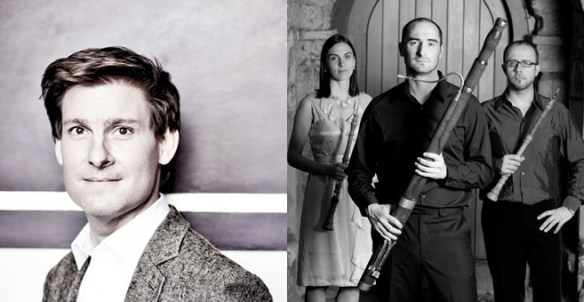
Ensemble Marsyas (Josep Domènech Lafont (oboe), Nicola Boud (clarinet), Alec Frank-Gemmill (horn), Peter Whelan (bassoon), Kristian Bezuidenhout (fortepiano)

Wigmore Hall, London, 11 July 2016

written by Ben Hogwood

Audio (open in a new window)

http://www.bbc.co.uk/programmes/b07jhwk7

Available until 10 August

What’s the music?

Mozart Quintet for piano and wind in E flat major, K451 (1784) (23 minutes)

Beethoven Quintet for piano and wind in E flat major, Op.16 (1796) (24 minutes)

Spotify

Kristian Bezuidenhout and the Ensemble Marsyas have not recorded this music, but in case the broadcast link does not work the Spotify playlist below gives alternative versions from pianist Stephen Hough and the Berlin Philharmonic Wind Quintet, available on BIS:

About the music

Mozart held his quintet in extremely high regard in comparison with the rest of his output. Its first performance was part of a marathon concert that also featured the Linz and Haffner symphonies, but all the composer could talk about was his satisfaction with the new quintet. It does mark something of a departure, being the first work for the combination of piano and wind quartet, and the writing for both is superb.

In some of his early works Beethoven was consciously using instrumental combinations already mastered by Mozart, and applying his own stamp to them. The early string trios, piano trios and this quintet for piano and wind are all examples. Typically he does things his way in all of them, and in the quintet the piano really does take the lead, perhaps betraying the fact that Beethoven was about to publish his first two piano concertos.

It is an ambitious work, with a particularly sizeable first movement, and in the second Beethoven allows each of the wind instruments a chance to shine in a solo capacity.

Performance verdict

There is something about the sonic combination of piano and wind that is enormously comforting, either as late night / early morning listening or in a concert experience. To say it was invented by Mozart may be stretching things a little far, but it is seemingly the earliest work to put the combined forces together, followed by Beethoven in his early ‘if you can’t beat them, join them’ mode.

The two make a good concert coupling, especially when the performances are as good as these. Kristian Bezuidenhout is a musician who easily dispels the fears among some concert goers that the fortepiano is a tinny instrument of little sound quality. He gets his phrases to really sing, especially in quiet moments, and throughout the more graceful parts of both pieces he played several melting passages of music.

The wind players were every bit as good, led more obviously in the Mozart by oboist dfgd or in the Beethoven by the bright timbre of clarinettist Nicola Loud. Alec Frank-Gemmill wrestled manfully with the difficulties of natural horn to produce a lovely sound, while on occasion the bassoon of Peter Whelan had a timbre resembling a baritone saxophone. When all four played together it was a beautiful sound, sometimes rough around the edges in a most appealing way, reminding us that there is such a thing as over-polished performance!

One of the most enjoyable Wigmore concerts of the 2015-16 season, closing the series with a flourish and well worth hearing. As a postscript, it is worth noting Ensemble Marsyas were formed as a result of relationships formed in the European Union Baroque Orchestra. Would such a thing be possible after the UK leaves the union? Very unlikely!

What should I listen out for?

Mozart

2:02 – a slow introduction, where the tonality of E flat is established – but where the sonorities of the wind instruments are also made clear, as though Mozart were introducing the new idea to his audience. Then at 4:08 we hear the start of the allegro, introduced by the piano then passed over to the winds. This is a genial piece of music, like listening to a conversation between musical friends, and Mozart develops his ideas comprehensively, a good example occurring at 8:44.

12:05 the slow movement, a beautifully restrained introduction followed by solos for clarinet, oboe and then horn, Mozart giving each of the treble instruments their chance to shine. The fortepiano – reclaiming melody at 13:28 – is very much part of the ensemble. The horn gets a bigger solo at 16:08, part of a central section deeper on feeling.

19:37 – the fortepiano begins the finale with a detached and relatively simple theme that gains more colour when the woodwind repeat it. This tune becomes more of an earworm as the piece progresses.

Beethoven

28:15 – a subdued fanfare signals the beginning of the quintet from the wind, answered by a profound statement on the piano. This is a slow introduction, and a grand one at that, before the fast movement proper gets underway at 30:51, with some lively exchanges between the instruments and a number of tricky runs on the piano.

41:02 – a gentle start to the first movement, the fortepiano playing a figure that sounds like a lullaby. The sonorous tones of the wind instruments are soon in play with the same material, before solos from all four. The piano returns to the lullaby material at 45:12.

47:17 – the finale starts with a tune on the piano that you know is going to be whistled by the end of the concert! It is a perky and optimistic melody, often assigned to the bright clarinet timbre. When piecked up by the wind its dance character comes through, and for the rest of the movement it is developed and repeated.

Further listening

Not too long after the pieces in this concert were composed and performed, Rossini wrote six sonatas for string ensemble, published in 1804. Around twenty years later, Frédéric Berr thought these would be suitable when arranged for wind quartet – and so it proved. They make a very enjoyable hour’s music, making absolutely no demands on the listener!

On record: Oberon Symphony Orchestra – Beethoven, Dvořák, Grieg & Langgaard

oberon

Beethoven: Symphony No.6 ‘Pastoral’; Dvořák: Cello Concerto in B minor (Rohan de Saram (cello), Oberon Symphony Orchestra / Samuel Draper)
Recorded live at St James’s Church, Sussex Gardens, London on 19th October, 2013

Grieg: Peer Gynt – Suites Nos. 1 & 2; Langgaard: Symphony No. 4 ‘Løvfald’ (UK premiere); Sibelius: Symphony No.5 (Oberon Symphony Orchestra/Samuel Draper)
Recorded live at St James’s Church, Sussex Gardens, London on 27th September, 2014

Now nearing the end of its fourth season, the Oberon Symphony has already established itself as an orchestra equally at home in the standard repertoire and relatively unfamiliar music; its conductor, Samuel Draper, as attentive to the letter of the score in question as to the spirit that informs it. These discs, comprising two out of its 13 concerts to date, typify the questing spirit of its performances: these are presented unedited, with no attempt to disguise passing flaws in ensemble or intonation – not that this lessens appreciation of some committed music-making.

What’s the music like?

The first disc juxtaposes two seminal pieces from either end of the 19th century. Beethoven’s ‘Pastoral’ Symphony has been described as the last of his works where beauty of sound and richness of texture predominate, and Draper acknowledges this in his unforced approach to the opening Allegro then his leisurely though never sluggish handling of its Andante. Some felicitous woodwind playing here (not least with the interplay of bird-calls towards its close) is further evident in the scherzo, even if the earnest characterization arguably pre-empts the ‘Storm’ movement which emerges as sombre rather than elemental. The highlight is a finale that rightly carries the expressive weight of the whole, its progress underpinned by an elusive if tangible onward motion which holds good through to a radiant climax and searching close.

The performance of Dvořák’s Cello Concerto features Rohan de Saram, for many years the cellist of the Arditti Quartet and a soloist whose perspective on arguably the finest work in its genre is distinctive and refreshing. Thus the initial Allegro is rendered with the necessary emotional breadth, its expansive though never unduly protracted formal design confidently unfolded despite passing technical fallibilities, while the central Adagio is even finer in its mingling of wistfulness with those passionate outbursts as open-out the music’s expression accordingly. De Saram’s inward eloquence comes into its own both here and in the extended coda to the finale, an inspired afterthought (prompted by the death of the composer’s sister-in-law) whose intense retrospection makes the concluding bars more affirmative in context.

The second disc has the Oberon SO venturing into more esoteric realms with the UK premiere of the Fourth Symphony by the Danish composer Rued Langgaard. Langgaard (1893-1952) is among the more prominent instances of a creative figure who snatched defeat from the jaws of victory, yet between his heady early success and the neglect prevalent from the mid-1920s onwards is a series of works that ought to have established him among the leading European composers of his generation. Not least the Fourth Symphony (1916): its subtitle, ‘Fall of the Leaf’, is often rendered as ‘Autumn’ though the seasonal process of change and decay surely has a metaphysical and even apocalyptic resonance. Its single movement, in eight continuous sections, is best heard as an expanded sonata-form design overlaid by continuous variation.

Certainly the plunging gesture with which it opens sets the tone for what follows and Draper amply brings out this fatalistic defiance, then ensures a seamless transition into the plaintive second main theme whose opulent expansion on strings at the end of the exposition is among the work’s highpoints. Nor does the central span risk diffusiveness, Draper as attentive to the geyser-like eruptions on strings and woodwind at its apex as to the mesmeric transition when oboe unfolds a plangent melodic line over a string cluster of inward intensity. Exposed string writing is for the most part securely managed, and while Draper cannot quite prevent the final stages from hanging fire, he secures the necessary momentum heading into the coda with its startling bell-like ostinatos, then a final build-up in which dread and decisiveness are as one.

This concert commences with three pieces from Grieg’s music for Peer Gynt. ‘Morning’ is rapturously expressive, while ‘The Death of Åse’ avoids undue vehemence, its inward final bars preparing for a ‘Solveig’s Song’ whose indelible main melody never becomes cloying.
Sibelius’ Fifth Symphony is given a sympathetic if not always ideally focussed reading. The first movement is finely launched, Draper ensuring the altered exposition repeat has the right cumulative intensity, with the majestic central climax moving convincingly into its ‘scherzo’ continuation where progress can be fitful, yet the coda lacks little in velocity. More debatable is a second movement which emerges as a slow intermezzo, its progress having insufficient lightness of touch as the music takes on a greater ambivalence prior to its winsome close. In the finale, Draper elides ideally between the surging impetus and airborne rapture of its main themes; if Sibelius’ ingenious design feels at times uncertain, neither the glowing affirmation of its coda nor the decisiveness of those six closing chords (taken ‘in tempo’) can be gainsaid.

Does it all work?

On both discs, the warm while occasionally diffuse sound is in keeping with the acoustic of St. James’s Sussex Gardens, with the booklets including full personnel for each concert and some excellent booklet notes (notably from Hannah Nepil on Dvořák and Andrew Mellor on Langgaard) – though Draper’s name might reasonably have featured on both the front covers.

Is it recommended?

Yes. The discs are obtainable either at the Oberon SO’s concerts (the next of these is on September 17th), or directly via the orchestra’s website