
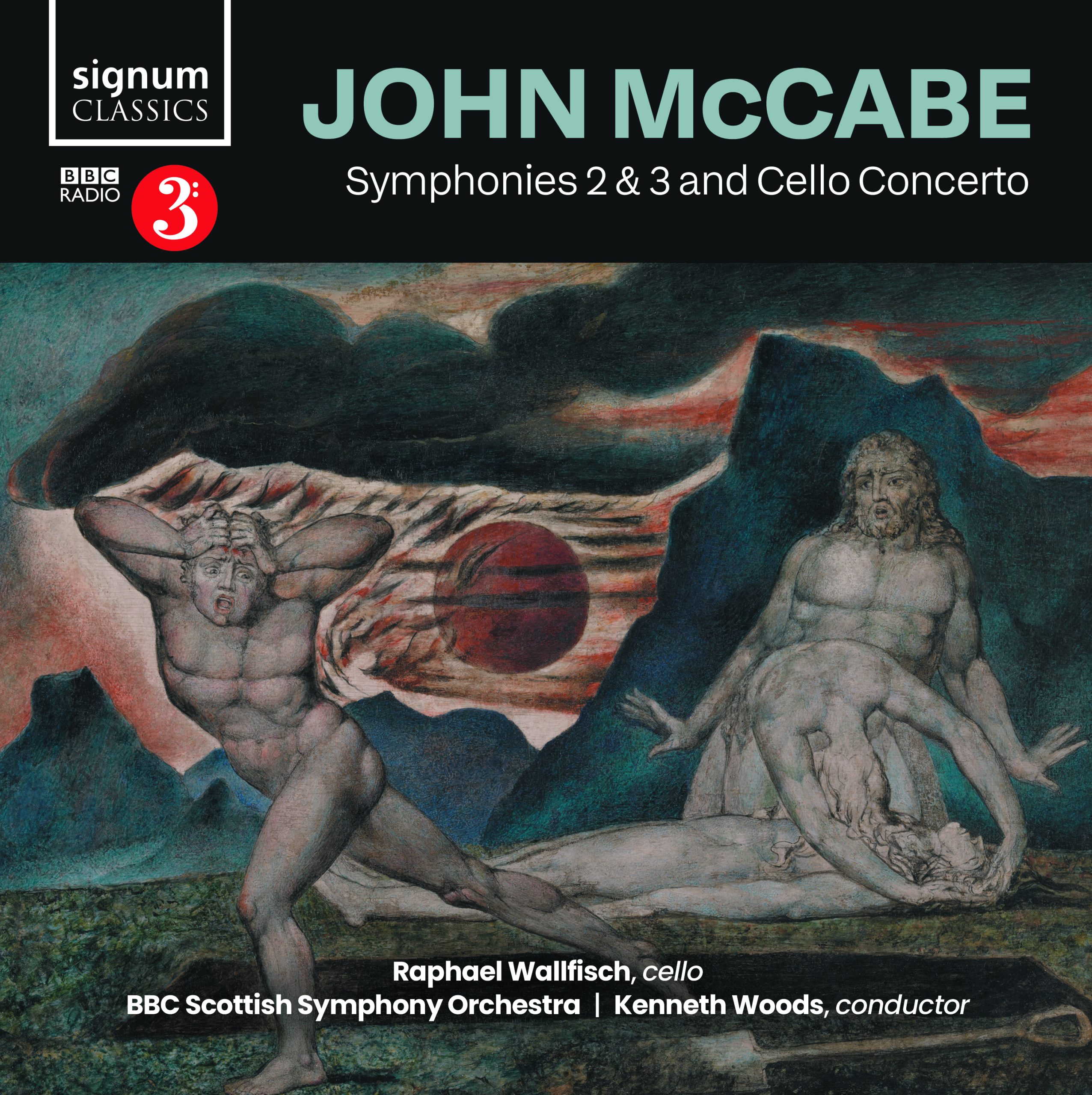
Raphael Wallfisch (cello), BBC Scottish Symphony Orchestra / Kenneth Woods
John McCabe
Symphony no.2 (1970-71)
Symphony no.3 ‘Hommages’ (1978)
Cello Concerto ‘Songline’ (2007)
Signum Classics SIGCD1007 [67’32”]
Producer Andrew Keener Engineer Oscar Torres, Matthew Swan
Recorded 9-11 June 2025 at City Halls, Glasgow
Reviewed by Richard Whitehouse
What’s the story?
Signum Classics makes a notable addition to the discography of John McCabe (1939-2015) with his Second and Third Symphonies, alongside his Cello Concerto, given committed and perceptive performances from the BBC Scottish Symphony Orchestra with Kenneth Woods.
What’s the music like?
Ranging over four decades, McCabe’s seven symphonies are a defining factor of his output and his achievement overall. An ability to reassess the genre afresh each time is hardly less true of those 20 or so concertos which, between them, encompass the entirety of his career.
Certain listeners may have encountered the Second Symphony via Louis Frémaux’s recording (EMI/Warner) made soon after the premiere. The catalyst was Sam Peckinpah’s Western The Wild Bunch (1969) and though McCabe does not follow this hard-hitting scenario literally, he does chart its emotional and maybe its experiential trajectory. A speculative woodwind phrase pervades the single movement whose five sections purposefully alternate fast and slow tempi, incisive and reflective moods, on its course to a visceral while cathartic denouement. That the work emerges full circle, the same yet different, comes as no surprise given its inspiration in a film which was unyielding in its fatalism but highly enlightening through its innate realism.
The stylistic consistency of McCabe’s idiom across several decades is borne out by his Cello Concerto, the ‘Songline’ of whose subtitle references that route taken through its content by the listener akin to aboriginals tracing a physical path through the Australian terrain; even a psychological path through their culture. Tersely though cogently argued, its outer Allegros frame a lengthy Adagio that takes in elements of slow movement and scherzo – separated by an accompanied cadenza where the soloist interacts with luminous tuned percussion in what ranks among its composer’s most eloquent inspirations. Neither are those closing bars, their abruptness dispelling any equivocation, seem other than inevitable in terms of a conclusion.
Stemming from what was a productive period for the genre in the UK, the Third Symphony is a highlight of McCabe’s output. The ‘Hommages’ of its subtitle makes reference to Haydn and Nielsen – but any such allusions are merged into a cumulative structure whose three (more or less) continuous movements unfold from an oblique if stealthy sonata design, via a ‘Fantasia’ more intermezzo than slow movement, to a ‘Fugue-Variations’ which gradually propels the whole orchestra towards an inexorable culmination with resplendent brass then ricocheting percussion. One of the most visceral endings in the modern symphonic repertoire that made an audible impression at its premiere, 48 years ago, and would doubtless do so again today.
Does it all work?
Yes, not least with Woods so attuned to McCabe’s idiom: the Second Symphony less taut if more flexible than Frémaux’s pioneering account and the Third a reminder of why Charles Dutoit’s premiere left such an impact. Nor is Raphael Wallfisch at all wanting in Songlines.
Is it recommended?
Indeed, enhanced by spacious yet detailed sound with informative notes from Guy Rickards. Hopefully Woods and the BBCSSO will take McCabe’s final two symphonies into the studio, while such major works as the Third Piano and Second Violin Concertos also await recording.
Listen / Buy
You can explore purchase options at the Signum Records website, and listen to excerpts from the album at Presto Music. Click on the names to read more about composer John McCabe, cellist Raphael Wallfisch, the BBC Scottish Symphony Orchestra and conductor Kenneth Woods
Published post no.2,986 – Tuesday 17 August 2026

