
Unknown's avatar

About Arcana

My name is Ben Hogwood, editor of the Arcana music site (arcana.fm)

Arcana at the Proms – Prom 23: Benjamin Grosvenor, Rodolfus Choir, London Philharmonic Chorus & Orchestra / Edward Gardner – Busoni & Rachmaninoff

Rachmaninoff Symphonic Dances Op.45 (1940)
Busoni Piano Concerto in C major Op. XXXIX (1902-4)

Benjamin Grosvenor (piano), The Rodolfus Choir (men’s voices), London Philharmonic Choir (men’s voices), London Philharmonic Orchestra / Edward Gardner

Royal Albert Hall, London
Monday 5 August 2024

reviewed by Richard Whitehouse Photos (c) Andy Paradise

This centenary of Busoni’s death has not thus far seen a great deal of activity in the UK, so it was gratifying to find the Proms scheduling his most (in)famous work – the Piano Concerto tonight receiving its second performance at these concerts, 36 years to the day after its previous outing.

Back then, the first half featured Beethoven’s Fourth Symphony and a more apposite coupling than Rachmaninoff’s Symphonic Dances. Now firmly ensconced in the orchestral repertoire, it remains a stern test the London Philharmonic Orchestra did not quite meet on this occasion – despite such felicities as Martin Robertson’s eloquent alto sax in the first movement and Edward Gardner’s conjuring of a tangible malevolence in its successor. Impulsive but erratic in its outer sections, the finale’s evocative central span had a superficial quality typical of this performance overall.
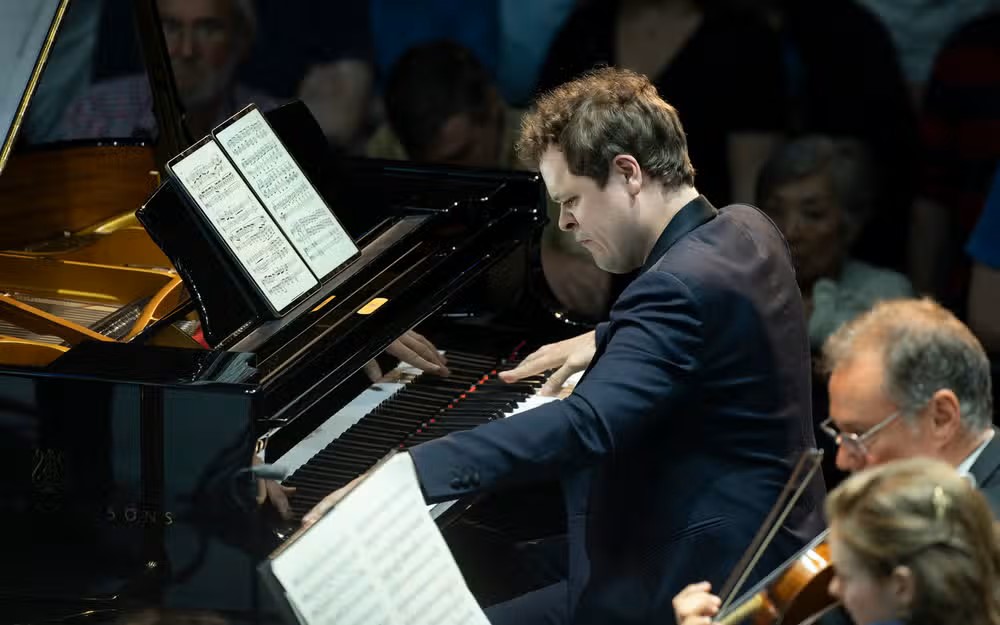
This was not the case in the Busoni. Benjamin Grosvenor (above) might not the first name who comes to mind for this concerto but, having already given performances in Reykjavik and Berlin, he was audibly attuned to an idiom not as elusive as often supposed in its canny amalgam of the Germanic and Italianate, while his playing was fully equal to its technical demands. That he is not a pianist looking to confront the orchestra head on ensured a more than usually close-knit coordination with players and conductor, which was almost always to the benefit of this piece.

Not least in Prologo e Introito, its orchestral introduction enticingly shaded by Gardner with Grosvenor integrating his unequivocal entry into what are essentially variations on the theme at the outset. Few pianists have weighted Busoni’s complex chords or his intricate harmonies with such translucency, not least the end of this movement where piano and orchestra melded to spellbinding effect. Straight into Pezzo giocoso, its capricious outer sections framing one of stealthy ambivalence as perceptively rendered as was that spectral angularity near its close.

Grosvenor managed the rare trick of making Pezzo serioso simultaneously cumulative and cohesive. He duly channelled the slow-burning momentum of its introduction into the rolled chords of its barcarolle-like first part – Gardner sustaining impetus across its successor to an imperious climax, during which the soloist never risked being obliterated. The lead-in to its third part had a poise equal to that at the end, where subtle rhythmic contrasts between piano and timpani against undulating strings had an enfolding calm to diffuse any lingering tension.

A general pause for retuning, then All’italiana burst forth – the underlying tarantella rhythm a springboard for its motley succession of vernacular elements initially humorous and latterly uproarious, held in check by the scintillating give-and-take of soloist and orchestra. Grosvenor almost topped these shenanigans with his electrifying cadenza – after which, Gardner prepared admirably for Cantico in which male voices (above) hymned Allah’s praises with mounting fervour; Grosvenor a largely passive observer until he belatedly returned for the headlong signing-off.

Quite a performance, then, that will hopefully be released commercially. Did Busoni offer an encore at that Berlin premiere? It could not have been more suitable than J.S. Bach’s Prelude in E minor BWV855, transposed and arranged by Alexander Siloti – three minutes of balm bringing us gently down to earth.

For more on this year’s festival, visit the BBC Proms website – and to read more on the artists involved, click on the names: Benjamin Grosvenor, Edward Gardner, The Rodolfus Choir, London Philharmonic Choir and the London Philharmonic Orchestra

Published post no.2,264 – Thursday 5 August 2024
Arcana at the Proms – Prom 23: Thoughts on Busoni’s Piano Concerto

Benjamin Grosvenor (piano), The Rodolfus Choir, London Philharmonic Choir, London Philharmonic Orchestra / Edward Gardner

Royal Albert Hall, London
Monday 5 August 2024

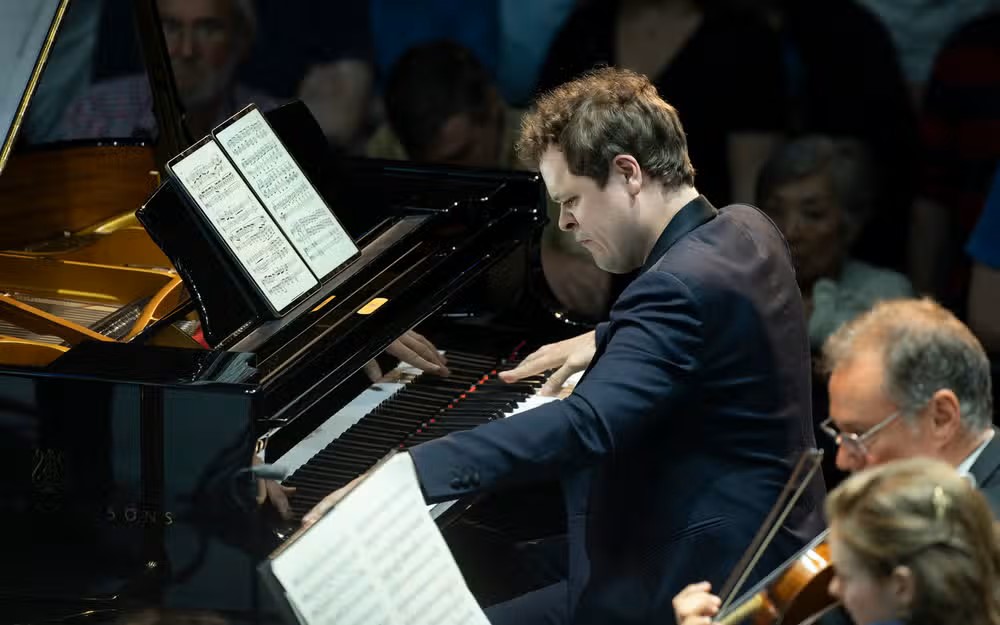
by Ben Hogwood Photo (c) Andy Paradise

A full review of Prom 23 will follow from Richard Whitehouse, but I wanted to register some thoughts on my first live encounter with one of the most extraordinary piano concertos you could ever hope to hear.

In the last few months pianist Benjamin Grosvenor has taken Ferruccio Busoni’s Piano Concerto on something of a concert tour, and has written of his love and admiration for the piece in a Guardian article, which proves a helpful guide for anyone not fully attuned to the piece.

The centenary of Busoni’s death falls this year, hence the first appearance of this piece at the Proms in 36 years, since a memorable occasion when Peter Donohoe squared up to the solo part in the company of the BBC Symphony Orchestra and Mark Elder. Oh, and the BBC Singers – for this work, unbelievably, has a male chorus in the finale, singing “Lift up your hearts to the Power Eternal”, a hymn to Allah from Adam Oehlenschläger’s Aladdin. Busoni’s quote in the score at this point is that “The Pillars of Rock begin to make soft and gentle music.”

Yet even before we got to that fifth movement the extraordinary power and individuality of Busoni’s music was shining through. The London Philharmonic Orchestra under Edward Gardner had a big part to play here, setting the scene in the Prologo e introito as though we were standing in a cathedral, awestruck at the architecture but still taking in a new sight with each about turn.

Grosvenor’s interpretation of his part was balletic, and the music really danced – swooping down from the heights or bubbling up from the depths, the pianist finding remarkable clarity in even the most complex passagework. Busoni, a formidable concert pianist himself, really tests his soloist, but retains a well-judged balance between piano and orchestra. Grosvenor and Gardner somehow found this equilibrium in the notoriously tricky acoustics of the Royal Albert Hall, where from the arena you could hear the clear communication of Busoni’s ideas. The orchestra were superb here – percussion ideally balanced, strings and wind interacting with the piano cleanly and the brass sensitively placing their chorale interventions. The clarinet and viola solos in the second movement had all the room they needed, while the orchestral colour that appears so unexpectedly and vividly in this work was richly shaded.

And what of the piece itself? In many ways it was like listening to a progressive rock album from the 1970s, which in itself is extraordinary when you think the Piano Concerto was completed in 1904. The sheer scope of Busoni’s imagination knew no bounds, then – taking on board more obvious influences from Bach, Beethoven, Chopin and Liszt, while using harmonic techniques to remind us that we were now in the age of Sibelius, Elgar and even Schoenberg.

The fourth movement was perhaps the most remarkable in this performance. With the gargantuan third completed, a kind of meditation in four parts, Busoni summons even greater invention for a Tarantella of remarkable energy, the solo part whirling round in a circle and brilliantly played here by Grosvenor. Just as it seemed all possibilities had been exhausted, the appearance of the male chorus was a masterstroke, their sonorous tones floating above much of the audience in the Royal Albert Hall. They leant a whole new dimension to the work, meaning that even those who might have been struggling 55 minutes into a piece found the new impetus and energy in Busoni’s exultation.

If you have not yet encountered this extraordinary piece I encourage you to without delay – but don’t stop there, for Busoni’s solo piano output, while very different, has many riches to impart in a fraction of the time. First, though, you have to try the Piano Concerto. It will knock your socks off!

You can listen to this concert on BBC Sounds – with the Busoni Piano Concerto beginning at 1:03:55. For more on this year’s festival, visit the BBC Proms website

Published post no.2,263 – Wednesday 7 August 2024

In appreciation – Antonio Meneses

by Ben Hogwood

In the last few days we have heard of the sad news of the death of cellist Antonio Meneses at the age of 66. There is a fitting tribute to Meneses in an obituary by The Strad magazine, but we wanted to pay tribute in the form of a playlist of some of his finest recordings.

The sequence, which you can listen to below, includes solo Bach – the Solo Cello Suite no.1 – followed by Brahms‘s Cello Sonata no.1 and the Mendelssohn Song without Words Op.109, with pianist Gérard Wyss. Meneses made some very fine recordings for the AVIE label, of which Gaspar Cassadó‘s Solo Cello Suite was one – and this is followed by a short illustration of his time as cellist in the Beaux Arts Trio, a lovely movement from Dvořák‘s Dumky Trio.

Finally we get to hear Meneses in the orchestral arena, with a recent recording made for Naxos of the Villa-Lobos Fantasia for cello and orchestra, and one of his most famous recordings, the Brahms Double Concerto with Anne-Sophie Mutter and the Berliner Philharmoniker under Herbert von Karajan:

Published post no.2,262 – Tuesday 6 August 2024

Arcana at the Proms – Prom 19: Jess Dandy, Senja Rummukainen, BBC SO & Sakari Oramo – Holst ‘Cloud Messenger’, Harvey & Elgar

Harvey Tranquil Abiding (1998) [Proms Premiere]
Elgar Cello Concerto in E minor, Op. 85 (1918-19)
Holst The Cloud Messenger, H111 (1909-10, rev. 1912) [Proms Premiere]

Jess Dandy (contralto), Senja Rummukainen (cello), BBC Symphony Chorus, BBC Symphony Orchestra / Sakari Oramo

Royal Albert Hall, London
Saturday 3 August 2024

reviewed by Richard Whitehouse Photos (c) Chris Christoudoulou

Now approaching his 12th season as chief conductor of the BBC Symphony Orchestra, Sakari Oramo tonight gave his first Prom of the season with this typically well-balanced programme of British music framing unfamiliar pieces past or (relative) present with a classic of its genre.

First came a welcome revival for Tranquil Abiding – doubtless one of Jonathan Harvey’s most immediately appealing works and one where the rhythm of ‘breathing’ central to so much of his later output is afforded lucid expression. The degree to which its melodic content emerges out of then returns into the surrounding texture was duly conveyed by Oramo, who ensured a real sense of expectation as this music took on an almost tangible impetus towards its climax. A pity that some restless and inattentive listeners robbed the final stage of its ‘ultimate calm’.

Long before it had the eminence it now enjoys, Elgar’s Cello Concerto was a regular Proms item through advocacy from Beatrice Harrison, Anthony Pini and, latterly, Jacqueline du Pré. Senja Rummukainen (above) thus joined a distinguished roster of soloists and, in the first movement at least, seemed a little inhibited in this context. Her arresting lead-in to the scherzo brought playing of greater involvement, both here and in an Adagio whose autumnal eloquence never risked sentimentality. The relatively lengthy finale was securely rendered, its themes incisive then genial, and if the development culminated a little portentously, the reprise was tellingly subdued before a moving apotheosis and curtly inevitable coda. Rummukainen can be heard again in London in the Dvořák concerto, with the BBC Concert Orchestra, this October 4th.

In the 150th anniversary of his birth, and the 90th anniversary of his death, a major revival by Gustav Holst was almost mandatory. Setting his translation from the Sanskrit of a poem by Kālidāsa, The Cloud Messenger never quite recovered from its evidently disastrous premiere such that revivals have been occasional. At almost 45 minutes, it is a demonstrable statement of intent whose expansive choral gestures are assured but almost anachronistic given Holst’s chamber opera Sāvitri redefined his conceptual approach and musical idiom barely a year before. Yet the present work amply foreshadows much of what was achieved over the next two decades, notably a freely evolving melisma mostly unimpeded by rhythmic precedent and a harmonic subtlety such as only needed greater refinement in its handling to realize its fullest potential.

That much of this latter aspect was already in place is clear from those intimate passages for semi-chorus to the fore during its later stages, while the third of its five continuous section brought a confiding soliloquy that Jess Dandy (above) – contralto in the truest sense – realized with distinction. A pity she was not heard again, but the BBC Symphony Chorus was not found wanting beforehand or in that ethereal leave-taking with which the work evanesces, ‘Venus’-like, to its close. Whatever the stylistic inconsistencies, the best of it is Holstian to its core.

Now it is available in an expert reduction for chamber orchestra by Joseph Fort, The Cloud Messenger should attract more frequent hearings, but the Royal Albert Hall proved a fitting venue for this expansive original while Oramo’s perceptive performance did not disappoint.

For more on this year’s festival, visit the BBC Proms website – and for more on the artists involved, click on the names to read more about Jess Dandy, Senja Rummukainen, the BBC Symphony Chorus, BBC Symphony Orchestra and chief conductor Sakari Oramo

Published post no.2,261 – Monday 5 August 2024

Summer serenades: Stenhammar

This Sunday Arcana returns to the serenade, looking at an example from Sweden that has acquired something of a cult following. The music of Wilhelm Stenhammar is not as well known as it might be, but his attractive orchestral canon is headed by this tuneful and airy Serenade. Cast in five movements, the piece was inspired by a trip to Italy in 1909, and completed by the Swede in 1913. Here it is performed by the Gävle Symphony Orchestra conducted by Hannu Koivula:

Published post no.2,270 – Sunday 4 August 2024