…in the form of an early work by Sir Edward Elgar. Here is his Serenade for Strings in E minor Op.20, performed by the Royal Philharmonic Orchestra, conducted by Sir Charles Groves:
Published post no.2,204 – Sunday 9 June 2024


…in the form of an early work by Sir Edward Elgar. Here is his Serenade for Strings in E minor Op.20, performed by the Royal Philharmonic Orchestra, conducted by Sir Charles Groves:
Published post no.2,204 – Sunday 9 June 2024
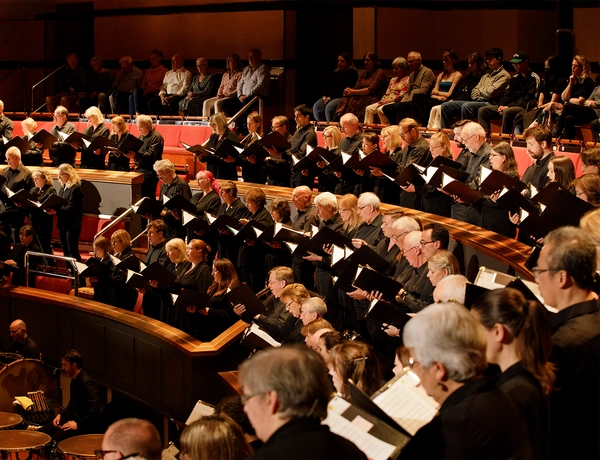
Katie Tretheway (soprano), CBSO Chorus, University of Birmingham Voices, City of Birmingham Symphony Orchestra / Ludovic Morlot
John Luther Adams Vespers of the Blessed Earth (2021) [CBSO co-commission: UK premiere]
Sibelius Symphony no.2 in D major Op.43 (1901-02)
Symphony Hall, Birmingham
Thursday 9 May 2024
Reviewed by Richard Whitehouse
Almost eight years ago, the City of Birmingham Symphony Orchestra and Ludovic Morlot gave the UK premiere of John Luther Adams’ Become Ocean. Tonight they, with the CBSO Chorus and University of Birmingham Voices, gave that of his most recent large-scale work.
It may have been obliquely inspired by Monteverdi, but Vespers of the Blessed Earth is very much a humanist response to those ecological challenges of the present and, to this end, its texts have a concreteness and functionality which is wholly at the service of the music. Thus A Brief Descent into Deep Time sets words as depict the (reverse) geological evolution of the Grand Canyon, its emotional matter-of-factness in contrast to A Weeping of Doves with its unaccompanied setting of the call of the Papuan fruit dove in what is one of Adams’ most ravishing inspirations. Hardly less affecting is Night-Shining Clouds – an interlude, in the form of a chaconne, for strings that follows what the composer calls a ‘sub-harmonic’ series with its slowly spiralling descent to the depths for a graphic evocation of cloudly pollutants.
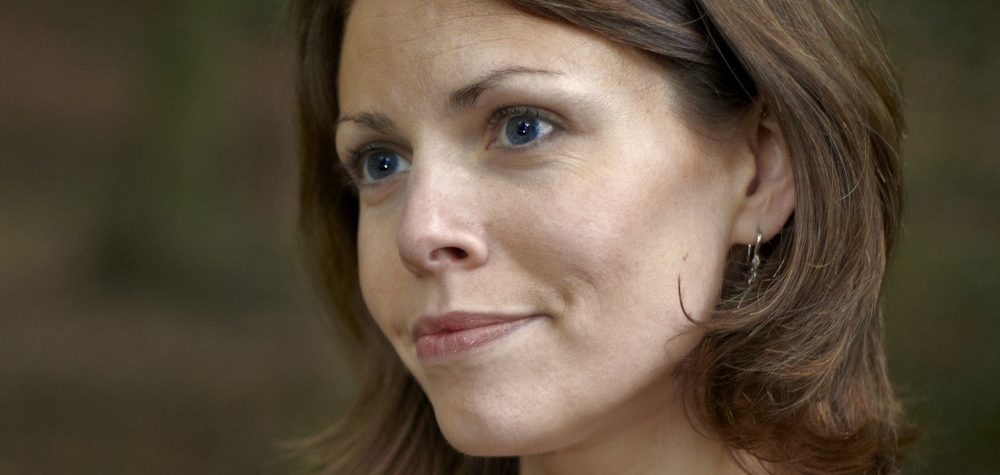
The fourth and climactic section, Litanies of the Sixth Extinction divides the choruses into four parts which between them chant the names of species in the process of or likely to face extinction – closing ominously with Homo Sapiens. It was here that an antiphonal placing of strings and percussion, along with choirs of woodwind and brass placed along either side of the upper circle, came into its own but, typically for Adams, the effect was one of cumulative if not intensifying emotion. Aria of the Ghost Bird followed with its transcribed rendering of the call from the now-extinct Kaua’i O’ō, tonight taken by Katie Tretheway (above) in what was a finale of the gentlest eloquence. It duly remained for offstage flute and chimes, here placed up in the grand tier, to see this inconsistent while always absorbing work to its wistful close.
In his thoughtful introductory remarks, Morlot spoke of the appositeness when juxtaposing Adams with Sibelius and the latter’s Second Symphony, which followed the interval, made his point admirably. Once the most popular such piece by Sibelius (and, indeed, of the last century), latter-day performances too often fight shy of its innate rhetoric or overt emotion. Without being disengaged, this account succeeded because of its methodical trajectory, not least a first movement whose restraint was never at the expense of its overall incisiveness.
With its stark contrast between conflict and consolation, the slow movement can easily fall into overkill but not here – Morlot evincing a keen sense of cohesion through to its baleful ending. The scherzo likewise secured keen cohesion from its alternate energy and raptness, then its surging transition into the finale brought an emotional frisson maintained through to an apotheosis whose grandeur never felt self-conscious or overbearing. Whether the triumph expressed is cultural or personal, the underlying essence of its affirmation was not in doubt.
It certainly set the seal on a memorable evening – one that confirmed the undoubted rapport between orchestra and conductor, while bridging the conceptual divide and almost 120 years between these pieces. Hopefully the CBSO and Morlot will be working together again soon.
Click on the link to read more on the current CBSO concert season, and on the names for more on soprano Katie Trethewey, conductor Ludovic Morlot, the University of Birmingham Voices and the CBSO Chorus. Meanwhile you can click on the name for more on composer John Luther Adams
Published post no.2,203 – Saturday 8 June 2024

by Ben Hogwood
This is a tenth album for Actress – and something of a new departure for Darren Cunningham, the man behind the moniker. For Cunningham has produced a purely ambient album.
Smalltown Supersound describe the new album as being “imbued with a sense of freedom. And of stillness. The kind of stillness within artistic motion that arises via the deepest states of flow. Once ‘inside’ the Statik experience, listeners may well find themselves newly calm and meditative.”
Listen below, and see if that happens to you!
Published post no.2,202 – Friday 7 June 2024

Composer Unsuk Chin and cellist Alban Gerhardt are featured musicians at the 75th Aldeburgh Festival this year. They have been linked in music since 2009, when Alban was the soloist in the premiere of Unsuk’s Cello Concerto at the BBC Proms in 2009. They talk to Arcana about how the piece has evolved and their hopes for this year’s festival.
by Ben Hogwood
The 75th Aldeburgh Festival of Music and the Arts is upon us – and Arcana is in the very fortunate position of talking simultaneously with two of its Featured Musicians, Korean composer Unsuk Chin and German cellist Alban Gerhardt. Unsuk is checking in from her Berlin residence, where she is deeply ensconced in composition work – of which more later. Gerhardt, as is often the case, is touring – and is about to join us from his hotel lobby in Spain, where he played the Lalo concerto the previous night.
The two have a strong musical bond, cemented by the Cello Concerto Unsuk composed for Gerhardt, first performed at the Proms in 2009 with the BBC Scottish Symphony Orchestra. Gerhardt will bring it to Aldeburgh in 2024 with the same orchestra, under Ryan Wigglesworth, on 20 June.
Firstly, however, we welcome Unsuk to the chat. Her youthful countenance is complemented by an intense focus on her music – which comes to the fore as soon as we begin to discuss Alaraph, a quarter-hour piece for orchestra receiving its first UK performance at Aldeburgh this season. Subtitled Ritus des Herzschlags (Rite of Heartbeat), it is a powerful and dramatic piece, in which Unsuk is drawn to the concept of so called ‘heartbeat stars’, that have a regular pulsation.
“I’m very interested in science”, she says, “and I was very interested in the different types of stars. These heartbeat stars have a certain rhythm of changing the brightness, and immediately I imagined a certain type of rhythm where I could compose a piece with this idea. The second idea in Alaraph came from Korean traditional music. We have very vivid, dynamic folk music, and I was always very impressed by its rhythms and melodies, and I wanted to bring them all into one piece. Lots of percussion instruments will be needed there!”
In spite of the large percussion section, the piece ends quietly, which if anything heightens the drama. “The piece is a kind of ritual,” she explains, “and the six percussionists play a very big role. The sound is moving from left to right and right to left, and at the end of the piece they repeat the cymbal sound. Then they should stand and show the cymbals, as a kind of ritual.”
On a much smaller scale, we will hear a group of Chin’s Piano Etudes, in concerts from Joseph Havlat and Rolf Hind. Talking about the Etudes almost inevitably draws parallels with Unsuk’s teacher György Ligeti, whose own Etudes for piano have proved revelatory in the course of the instrument’s recent development. Were they intimidating when she started to write in the form? “When I studied with Ligeti he had just finished the first cycle of six etudes, and I was at the premiere of those pieces”, she says. “On the other hand, I have played the piano since I was four, so it was for me the main instrument. I certainly got some influence from him in writing piano pieces, but even if he had not written piano etudes, I would have written my etudes for sure!”
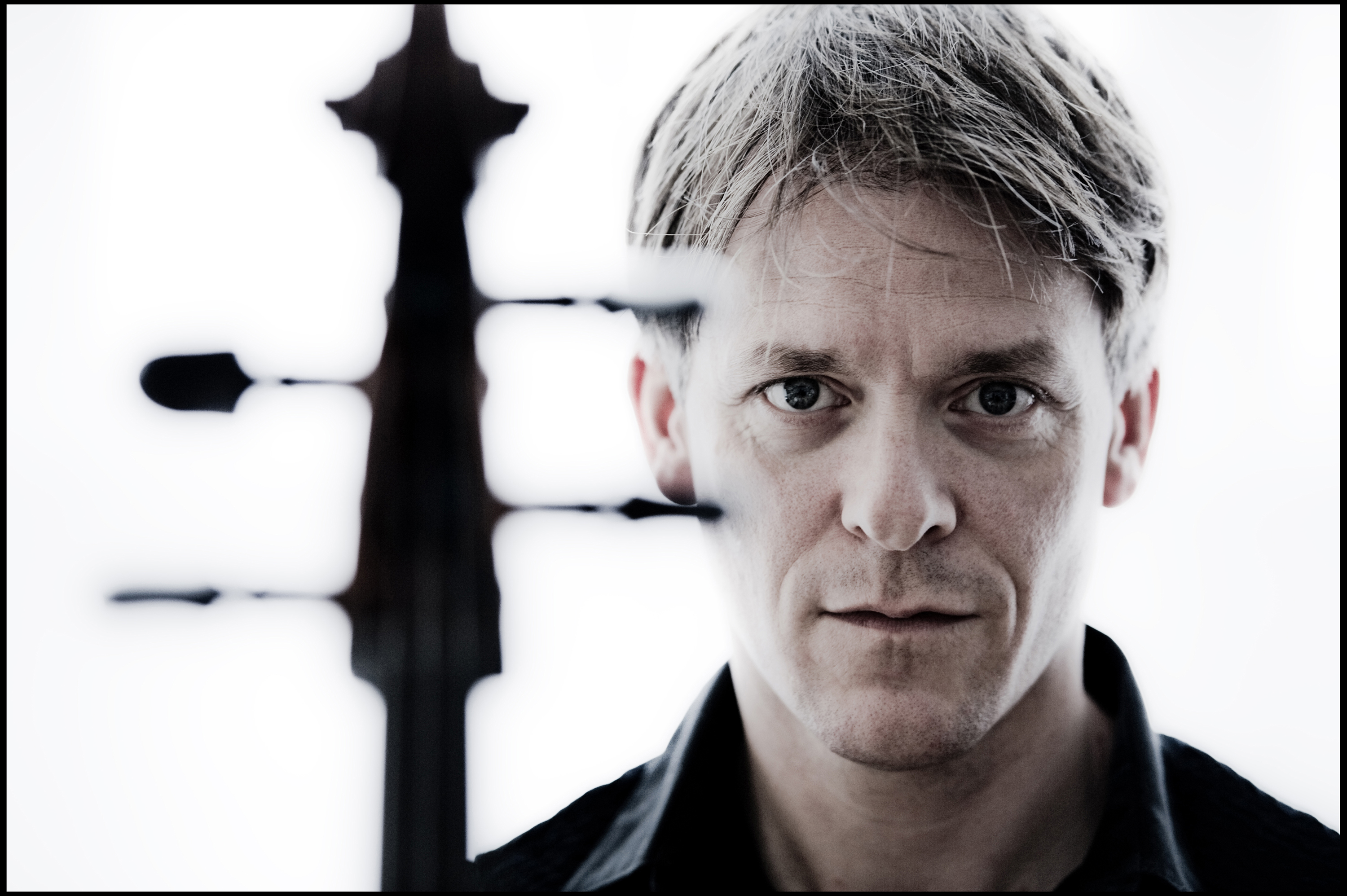
At this point Alban joins the call, and Unsuk greets him enthusiastically. “Your hairstyle is new!”, she exclaims, but he shakes his head. “No, just less hair!”, he says, smiling. Gerhardt is being modest, for he too looks bright-eyed and in good spirits. Talk inevitably turns to the Cello Concerto Unsuk wrote for him, and they recall their first meeting. “We met first in 1999 in Helsinki”, she says. “It took a couple of years, but then I had some idea of how it would be very nice to write a cello concerto for him. That was the beginning, but then he had to wait almost seven years while I got the piece ready!”
Gerhardt was not impatient for the piece, however. “I am glad you mentioned that, because it proved to me that you are not slow or lazy, but very respectful for the genre of the cello concerto. I remember at first that you were very hesitant, and that’s a wonderful quality, because these days it’s like everybody should be writing a cello concerto. One of the most difficult tasks nowadays, with a big orchestra, is that you want to use it as a composer. But if you use it, then you lose the cello. You were aware of that huge challenge, and you took your time. It got postponed a few times, and at the Proms too, but I’m so happy – because this piece works! The truth is that it was performed in Berlin by another cellist, Alisa Weilerstein, which is fantastic. Which other modern cello concerto can you say that about, that it was performed in the same city at 10 years difference by a top-class cellist? I’m very happy about that!”
Chin smiles in gratitude. “You are always supporting me!” she laughs. “The first time we met was through Lisa Batiashvili”, recalls Gerhardt, “and she is a close friend but also grew up together with Unsuk’s husband, Maris Gothóni. I knew about Maris first, and then I met Unsuk and was shocked by her charisma and aura, and then when I heard the Violin Concerto I thought, “she needs to write a cello concerto!”
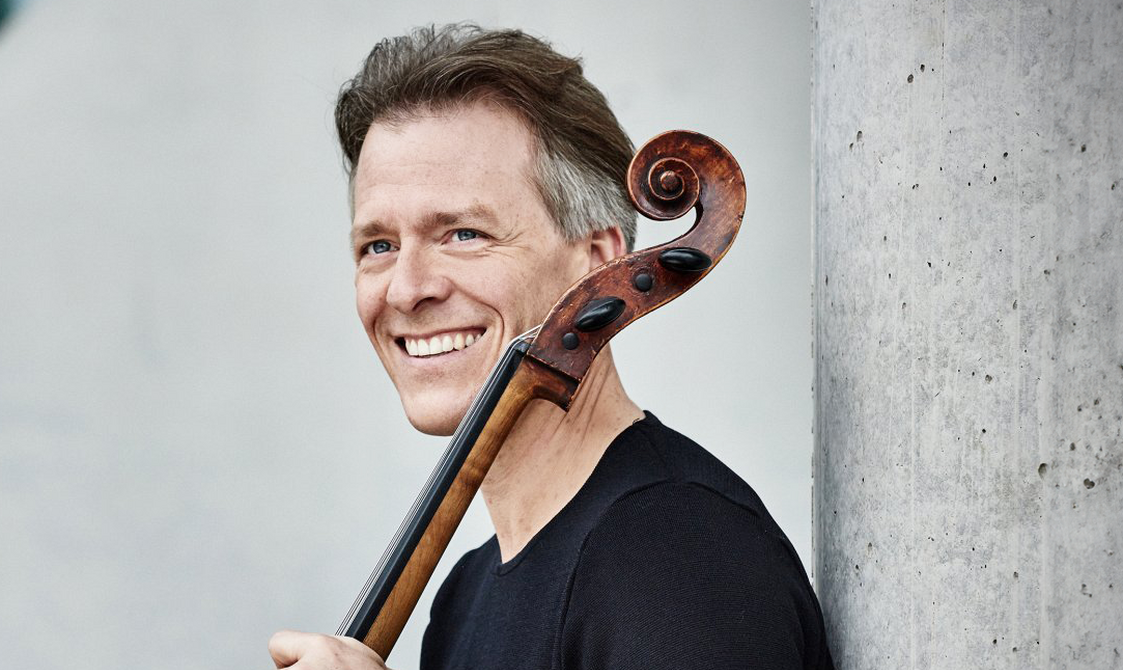
The concerto makes some fearsome technical demands, wasting no time in pitching the soloist right to the core of the action – an aspect that Gerhardt applauds. “Actually, the beginning is among the easiest bits of the whole piece! It’s not easy at all, but compared to what comes later, I’m not afraid of the beginning. I’m happy to start right away because if you sit there forever, you start thinking and getting nervous, which is not a good thing.”
“For me the working process was very interesting”, Chin interjects, “because often the artist and composer will have conversations and contacts, but with us it was not like that. I just wrote the piece to the end, and I delivered, and he delivered his playing. It was extremely professional, and there was not a need to change anything because of his technique. I wrote what I wanted, and he played it at the premiere by memory. I couldn’t believe that a human being could do that!”
At this point, Gerhardt has a confession to make. “This is the biggest shame of my life, because I was big headed, and I got lost three times – I was not happy. The most beautiful and difficult part in the last movement, which is like 80 seconds, is very wittily written and difficult to play. It is probably the 80 seconds I have practised most in my life, and I completely missed them in the world premiere. I’m so grateful that I have had 30, 40 more times now to play it. For me that is the biggest thing. I have not played so many world premieres, but each one is the worst performance – it always gets better. You need to give it a chance to grow – not with the memory slips, but the piece settles. With this piece the more I play it the more beauty and intensity I discover, and the more I understand it. There is so much to understand that you cannot grasp it all at first sight.”
He is relishing bringing the piece to the Aldeburgh Festival. “I am very happy to play it there, after 15 years and having premiered it with the same orchestra. It will be a completely different performance, and I would bet my life it will be a much better one!”
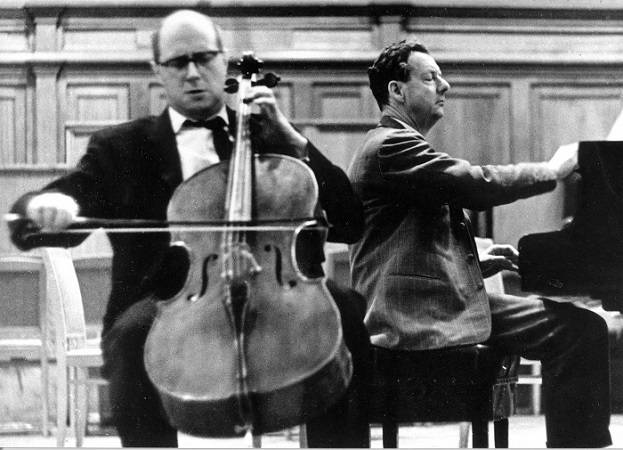
As well as the concerto Alban will be teaming up with regular recital partner, pianist Steven Osborne, in a recreation of a legendary recital given by Mstislav Rostropovich and festival founder Benjamin Britten (both above) in July 1961, where the world premiere of Britten’s Cello Sonata took place. Gerhardt considers the rapport both performers have in that recital. “Britten was a fantastic pianist and a wonderful musician, besides being a great composer. I wouldn’t say Steven and I have the same rapport because none of us is as creative as these two guys. Rostropovich was a composer himself, not a great composer, but he wrote some quite witty pieces, and conducted and played the piano. He was really a complete musician, although I don’t agree with everything he did interpretation-wise – which is perhaps bad taste on my part – but they were two giants of music! I think Steven and I understand each other well because we are closer in age and Western, whereas the Russian and the Brit – that’s quite a mix!”
He considers the concert further. “You have no idea how brave I actually am because two nights before I am playing Dvořák in Chicago, and I arrive in the middle of the night at 1am the day of the recital. I’m already very scared of that day!” We agree that Rostropovich would probably be in favour. “Yes, he would approve of doing something stupid like that!”
Both Unsuk and Alban are intensely honoured by their roles this year. “I heard lots of things about Aldeburgh and Benjamin Britten, who I really admire as a composer”, says Chin, “and it’s a really great honour to be played at the festival”. Sadly she won’t be attending in person, due to the composition of her opera Die dunkle Seite des Mondes (The Dark Side of the Moon) getting to the stage where it can’t be left. “It should be finished by the end of this year!” she confirms. “I’m not coming to Aldeburgh, then!” jokes Alban on hearing the news. “For me it’s an honour, but it is also an honour for the festival to have Unsuk, because she is one of the two or three best living composers. Anybody should be honoured to play her music.”
He recalls his first visit to the Suffolk town. “I think I was first there 20 years ago. A few months ago I went to the Red House for the first time, and saw the manuscript of Britten’s Cello Suite no.1, and it was beautiful to see the handwriting. It had a lot of the fingerings and bowings of Rostropovich on it, and I didn’t like that because I wanted to know what Britten actually said.”
He applies the same argument to the newer commission. “That’s why when we made an edition of Unsuk’s concerto I was very hesitant of putting too much of me in there, because I want the next performer to come up with their own ideas. For example, some of the metronome markings of Unsuk I cannot play, but I like that! The question is – should we change them to what I could do? I said no, because it’s good to know that she had that in mind, and the next player should try to get to it. Metronome markings are not the rule of law, but it gives us an idea of what the composer had at some point in their mind. I would hate if people came and took my interpretation as the one to do. The one to do is in the score, and what was in Unsuk’s head. I don’t think it helps much to ask her how to play it!”
Unsuk nods in agreement. “I think you said once it’s like a child you give birth to”, says Gerhardt, “but then it grows, maybe in a direction you’re not happy with!” The only few things you told me”, he recalls, “were about some slides in the first movement, which happened by accident. The great thing is that we have these scores, which are like a protocol, which give us an idea of what to do and then we do it. Every interpretation should by definition be different, if each one is the same then something went wrong. We become in a way an assistant to the composer ourselves, and if the interpretation is always presented the same then that is a job badly done. We have to be different!”
Playing solo Britten at Aldeburgh, as Gerhardt will do with the Cello Suite no.1, presents a special challenge. “It was scary when I did it the first time”, he admits. “but now the scary part is out I’m just going to enjoy it. András Schiff told me once that the older he gets the more nervous he gets. I find the older I get, the less I care about other people and what they think. I want to transmit what I feel about the music, and the older I get the more I dare to really do what I want, and not follow rules or guidelines. I take Gustav Mahler as an example, and where he reduced the Adagietto of his Fifth Symphony from nine minutes to seven minutes when conducting. Less is more!” As a listener, it is good to hear of artistic development in this way. “As a listener, I don’t want to be bored”, says Gerhardt. I hate it when people celebrate something where there is nothing to celebrate, like a dog stopping at every tree!”
Unsuk, meanwhile, will be totally immersed in competing her new opera. “I am writing the libretto myself as well”, she says, “because I created the story. It is based on the relationship between an Austrian physician Wolfgang Pauli and Karl Gustav Jung. It is a very complex story, and I can’t digest it in pure texts. It is about a man who is a genius but who has a very complicated private life and very interesting, wonderful dream every night. He is suffering, and therefore wants to be helped – so goes to Karl Gustav Jung and they start analysing Pauli’s dream. I took this biography as the base and put some fiction in there to write a story like a new version of Faust. I’m writing the music and the libretto myself, in German.”
The opera is due to be premiered in May 2025, at Hamburg State Opera, conducted by Kent Nagano, and staged by the English / Irish team Dead Centre. In the meantime a much smaller piece, Nulla est finis, will act as a companion to Thomas Tallis’ great 40-part motet Spem in alium, in a festival performance from Tenebrae at Ely Cathedral. “It is very small”, she says modestly. “It is not a piece, more a small prelude to the Tallis piece.” Has she listened to much of his music previously? “Not much, but I knew this piece. The commission came from Sweden, and they wanted a small prelude to Spem in alium, so I thought it would be nice to compose a kind of entrance where the choir are whispering, and slowly the tones come in and it goes to Spem in alium.”
Beyond the festival, Gerhardt has a typically busy year – but first a holiday. “I only think up to June”, he says, “and then I think I have three weeks free!” There are recording plans afoot with Hyperion, which remain under wraps for now. The Dvořák concerto, which he is performing in Chicago, would be a wonderful contender. “My view of it has changed, because I had a look at the facsimile of the piece and a lot of new ideas popped out, so it will be quite different. I think it’s more like what Dvořák had in mind, and I have to tell conductors off sometimes now! I find the same with Brahms symphonies, where people do these same, silly rubatos, and they are lacking in inspiration, because they cannot come up with their own!”
Finally, the question has to be asked – might there be a Cello Concerto no.2 from Unsuk Chin? She laughs, a little nervously! “At the moment there is no plan, but you never say never!” she says. “I would never push for a second one,” says Alban, “because the first one is so great, and I’ve never played it that I’m 100% happy with myself. If any other cellist was to ask for a second one, I would urge them to play the first one five or ten times, and then we can talk! For me that is one of the reasons why there are so few concertos added to the repertoire since Dutilleux. There is so much one can do with this piece, so much fine tuning one can do. We as performers should strive for higher, not for perfection necessarily but for musical expression. I don’t think the world needs number two, we should be very happy and blessed that there is a number one!”
Published post no.2,201 – Thursday 6 June 2024

Quatuor Danel [Marc Danel & Gilles Millet (violins), Vlad Bogdanas (viola), Yovan Markovitch (cello)]
Shostakovich String Quartet no.7 in F# minor Op.108 (1959-60)
Weinberg String Quartet no.7 in C major Op.59 (1957)
Weinberg String Quartet no.8 in C minor Op.66 (1959)
Shostakovich String Quartet no.8 in C minor Op.110 (1960)
Wigmore Hall, London
Monday 3 June 2024
by Richard Whitehouse Photo (c) Marco Borggreve
Quatuor Danel’s interleaving of string quartets by Shostakovich and Weinberg arrived at its effective half-way point this evening with a programme featuring the seventh and eighth of their respective cycles: quartets that are as different from each other as are these composers.
His briefest and likely most ambivalent, Shostakovich’s Seventh Quartet is dedicated to the memory of his first wife from the vantage of the short-lived marriage to his second. Its three movements play without pause, their oblique formal and expressive circularity being potently realized here – whether those fugitive speculations of the opening Allegretto, wistful regret of the central Lento, or seething anger of a final Allegro whose fugal aggression pointedly heads back to the opening theme for a close of simmering unease. Music, then, which implies much more than could really be stated, as the Danel underlined throughout this perceptive reading.
Coming 11 years after its monumental predecessor, Weinberg’s Seventh Quartet might seem representative of a (necessary) lowered ambition in the late- and post-Stalin years. Subdued and even enervated, its opening Adagio never strays from a musing uncertainty the ensuing Allegretto (originally preceded by a vivid scherzo, subsequently withdrawn) offsets through its poise and charm. Neither predicts a finale as takes the precedent of that in Shostakovich’s Second Quartet to its logical extreme – these 23 variations on a sombre theme unfolding as a palindrome from sustained grandeur to seething energy, then back to the start for a glowering apotheosis. Undoubtedly one of the great such movements in the history of the string quartet.
Such music would usually mark the end of a programme but, following the trajectory of this double-cycle, it concluded the first half of a recital which continued with Weinberg’s Eighth Quartet. Once relatively familiar through its championing from the Borodin Quartet and, in the UK, the Lindsays, its single movement (reciprocally taken to a new level with the 13th Quartet of Shostakovich) builds from initial reticence to a dance-like section of pronounced Klezmer inflections. Affording a culmination of audible anguish, this duly subsides towards the mood of the opening for a conclusion of becalmed intimacy realized to perfection here.
It is worth recalling how much more frequently played, compared to the rest of his cycle, was Shostakovich’s Eighth Quartet even a quarter-century after its composer’s death. All credit to the Danel for investing it with a continual sense of (re-?) discovery – the pensive allusiveness of its initial movement yielding an anticipation brutalized by the violence of its scherzo then deflected by the quizzical repartee of its intermezzo. The fourth movement assuredly took no hostages to fortune in its graphic alternation between the confrontational and consoling, and it remained for the finale to restore emotional equilibrium with its resumption of the opening music – albeit now devoid of quotations as Shostakovich stands ‘naked’ before his listeners.
A gripping performance and one, moreover, that brought this first phase of the Danel’s cycle to a natural close. It resumes on October 16th with the Ninth and 10th Quartets by Weinberg alongside the Ninth Quartet by Shostakovich – a programme equally eventful and intriguing.
You can hear the music from the concert below, in recordings made by Quatuor Danel -including their most recent cycle of the Shostakovich quartets on Accentus:
For more information on the next concert in the series, visit the Wigmore Hall website. You can click on the names for more on composer Mieczysław Weinberg and Quatuor Danel themselves.
Published post no.2,200 – Wednesday 5 June 2024
 Arcana.fm